Species · Insects
North American Wheel Bug Arilus cristatus
The scientific name of the North American Wheel Bug is Arilus cristatus. It is a species of insect in the family Reduviidae (assassin bugs), order Hemiptera. The name dates from 1763.
- Scientific name
- Arilus cristatus (Linnaeus, 1763)
- Common name
- North American Wheel Bug
- Genus
- Arilus
- Family
- Reduviidae (Assassin Bugs)
- Order
- Hemiptera
- Class
- Insecta
- Recorded in
- 5 countries
- Name status
- accepted in the Catalogue of Life

Overview
The North American Wheel Bug (Arilus cristatus (Linnaeus, 1763)) is an insect in the family Reduviidae, order Hemiptera, and class Insecta. It occurs throughout Kentucky and ranges across eastern Canada and the United States into Mexico and Guatemala. Adults are distinguished by a prominent wheel-shaped ridge on the thorax, and the species preys on a variety of insects.
Written 24 November 2026 from the sources listed below. Each statement was checked against the passage it cites; statements that could not be supported were removed.
Appearance
Adults have gray to brownish-gray bodies and a prominent wheel-shaped or cog-shaped ridge on the thorax. The ridge has between eight and twelve teeth or tubercles.[1][2][3]
Newly molted adults are black. Nymphs have bright red or orange abdomens and lack the adult wheel-shaped structure.[4][5]
Adults have armored forewings and membranous hind wings. The insect has beak-like mouthparts projecting from the front of its head and two red-orange scent glands that can be ejected from its abdomen.[6][7][8]
Adults can reach a maximum body length of 38 mm, with males somewhat smaller than females. Newly hatched nymphs are approximately eight millimeters long.[9][10][11]
Habitat
The North American Wheel Bug occurs in leafy areas. Recorded habitats include sunflowers, goldenrod, and cotton, as well as locust tree trunks and fruit and tree groves.[12][13][14]
In Kentucky, the species occurs in meadows and on trees and shrubs. Individuals are occasionally found on buildings and are frequently observed in residential areas and parks during late summer and fall.[15][16][17]
Diet
The species commonly preys on caterpillars and beetles. Recorded prey include Japanese beetles, cabbage worms, orange dogs, tent caterpillars, and Mexican bean beetles.[18][19]
Its diet also includes moths, other soft-bodied insects, sawfly larvae, aphids, and stink bugs. It can prey on invasive brown marmorated stink bugs.[20][21][22]
The species sometimes consumes honey bees and wasps. It may also exhibit cannibalism, including nymphs preying on other nymphs and females consuming males after mating.[23][24]
Behaviour
The species is most active during daylight. Individuals move and fly slowly, producing a noisy buzzing sound during flight, while adults are commonly attracted to lights at night near wooded areas.[25][26][27]
The species captures prey by gripping and pinning it with its front legs before inserting its beak. It injects digestive enzymes that paralyze prey and dissolve its internal tissues.[28][29]
The species produces audible sounds by rubbing its proboscis against a groove beneath its thorax. The purpose of this sound is unknown.[30][31]
When disturbed, individuals can release an unpleasant chemical from their scent glands. The species generally avoids contact with humans and bites when handled or harassed.[32][33]
Reproduction and life cycle
Eggs generally hatch in early May. Nymphs undergo five molts and take approximately 94 days to reach maturity, with the final molt lasting longer than the earlier nymphal molts.[34][35][36][37]
In warm climates, some populations may overwinter in stages other than eggs.[38]
Conservation
The North American Wheel Bug is regarded as beneficial because it preys on insect pests.[39]
Uses
The species is considered beneficial for biological pest control in gardens and wooded areas.[40]
Classification of the North American Wheel Bug
| Kingdom | Animalia |
|---|---|
| Phylum | Arthropoda |
| Subphylum | Hexapoda |
| Class | Insecta (Insect) |
| Order | Hemiptera |
| Suborder | Heteroptera |
| Infraorder | Cimicomorpha |
| Superfamily | Reduvioidea |
| Family | Reduviidae (Assassin Bugs) |
| Subfamily | Harpactorinae |
| Tribe | Harpactorini |
| Genus | Arilus (Wheel Bugs) |
| Species | Arilus cristatus (Linnaeus, 1763) |
Where the North American Wheel Bug is found
Checklists and occurrence records place Arilus cristatus in 5 countries across North America. GBIF holds 44,453 georeferenced records of it.
Countries
Regions and cities with the most records
- Texas, United States 8,974
- Virginia, United States 3,932
- Florida, United States 3,121
- North Carolina, United States 3,005
- Maryland, United States 2,563
- Pennsylvania, United States 2,277
- Oklahoma, United States 2,086
- Illinois, United States 1,756
- Missouri, United States 1,731
- Ohio, United States 1,697
- Indiana, United States 1,553
- Kansas, United States 1,390
- Georgia, United States 1,174
- Tennessee, United States 1,034
- Arkansas, United States 987
- South Carolina, United States 886
- Kentucky, United States 869
- New Jersey, United States 726
- Gainesville, United States 658
- Alabama, United States 645
- Austin, United States 621
- Fort Worth, United States 606
- Louisiana, United States 549
- Grapevine, United States 536
- Missouri City, United States 526
- Frisco, United States 521
- North Richland Hills, United States 513
- Bedford, United States 508
- Allen, United States 499
- Lewisville, United States 499
- Plano, United States 485
- Champaign, United States 483
- Delaware, United States 472
- Reston, United States 458
- Flower Mound, United States 457
- Arlington, United States 454
3 more countries have a few records outside this range
These countries hold a few records of Arilus cristatus but lie outside the range the checklists give for it. Such records are often zoo or garden specimens, museum material or vagrants, so the species is not counted as occurring there.
Range as the checklists state it
Middle America
North America
A number beside a place is its count of GBIF occurrence records. A place without a number comes from a checklist alone. Records show where a species has been observed or collected, which can include escapes and vagrants.
Common names
English
- North American Wheel Bug
- Wheel Bug
Names in 2 other languages
- French
- Réduve roue-dentée
- Spanish
- Chinche Crestada Norteamericana
Synonyms
One other scientific name has been used for this species and is now treated as a synonym of Arilus cristatus.
- Cimex cristatus Linnaeus, 1763
Related species
- Arilus carinatus
- Arilus collaris
- Arilus depressicollis
- Arilus faujasi
- Arilus gallus
- Arilus nigriceps
- Arilus spiniceps
-
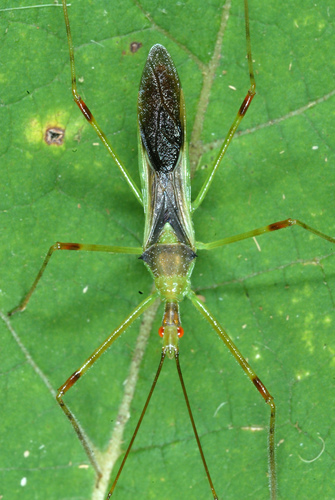 Pale Green Assassin BugZelus luridus
Compare
Questions and answers
What is the scientific name of the North American Wheel Bug?
The scientific name of the North American Wheel Bug is Arilus cristatus. Written with its author, the full name is Arilus cristatus (Linnaeus, 1763).
Which family does the North American Wheel Bug belong to?
Arilus cristatus belongs to the family Reduviidae, in the order Hemiptera and the class Insecta.
Where is the North American Wheel Bug found?
Checklists and occurrence records place Arilus cristatus in 5 countries: United States, Mexico, Canada, Costa Rica and Saint Vincent and the Grenadines.
What other names does the North American Wheel Bug have?
Arilus cristatus is also known in English as Wheel Bug.
What happens if a wheel bug bites you?
The species generally avoids contact with humans and bites when handled or harassed.[33]
How rare is a wheel bug?
The North American Wheel Bug is most common in eastern Canada and the United States. It occurs throughout Kentucky and its geographic range extends into Mexico and Guatemala.[41][42][43]
How did the wheel bug get its name?
The name refers to the prominent wheel-shaped or cog-shaped ridge on the adult's thorax, which has between eight and twelve teeth or tubercles.[2][3]
What is the largest assassin bug in North America?
The North American Wheel Bug is one of the largest terrestrial Hemiptera in North America.[44]
What does a North American wheel bug eat?
It commonly preys on caterpillars and beetles, including Japanese beetles, cabbage worms, orange dogs, tent caterpillars, and Mexican bean beetles. Its diet also includes moths, aphids, sawfly larvae, stink bugs, and other soft-bodied insects.[18][19][20][21]
Where do North American wheel bugs live?
The species occurs in leafy areas, including sunflowers, goldenrod, cotton, locust tree trunks, and fruit and tree groves. Its range includes eastern Canada and the United States, Mexico, and Guatemala.[12][13][14][41][42]
Do wheel bugs bite?
Yes. The species generally avoids contact with humans and bites when handled or harassed.[33]
Sources
Passages the profile rests on
- Adult individuals have a gray to brownish-gray body. Source passage: “The adult is gray to brownish gray in color” — English Wikipedia
- Adults possess a prominent wheel-shaped or cog-shaped ridge on the thorax. Source passage: “A characteristic structure is the wheel-shaped pronotal ridge along its thorax.” — English Wikipedia
- The adult wheel structure has between eight and twelve teeth or tubercles. Source passage: “there can be 8-12 teeth/tubercles on this wheel” — extension.illinois.edu
- Newly molted adults are black in color. Source passage: “and black shortly after molting” — English Wikipedia
- Nymphs have bright red or orange abdomens and lack the adult wheel-shaped structure. Source passage: “the nymphs (which do not yet have the wheel-shaped structure) have bright red or orange abdomens.” — English Wikipedia
- Adults have armored forewings and membranous hind wings. Source passage: “North American wheel bugs exhibit armored forewings and membranous hind wings” — English Wikipedia
- The species has two red-orange scent glands that can be ejected from its abdomen. Source passage: “A. cristatus possesses two scent glands (red-orange in color) that can be ejected from its abdomen” — English Wikipedia
- The insect has beak-like mouthparts projecting from the front of its head. Source passage: “They also have beak-like mouthparts that arise from the front of their head” — extension.illinois.edu
- Adults can reach a maximum body length of 38 mm. Source passage: “reaching up to 38 mm (1.5 in) in length in its adult stage.” — English Wikipedia
- Males are somewhat smaller than females. Source passage: “males are somewhat smaller than the females.” — English Wikipedia
- Newly hatched nymphs are approximately eight millimeters long. Source passage: “eight-millimeter-long red nymphs” — English Wikipedia
- The species occurs in leafy areas. Source passage: “residing in leafy areas and hiding whenever possible.” — English Wikipedia
- Recorded habitats include sunflowers, goldenrod, and cotton. Source passage: “Known habitats of the North American wheel bug include sunflowers, goldenrod, cotton” — English Wikipedia
- The species has been recorded on locust tree trunks and in fruit and tree groves. Source passage: “trunks of locust trees, and various fruit and tree groves.” — English Wikipedia
- In Kentucky, the species occurs in meadows and on trees and shrubs. Source passage: “found in meadows, on trees and shrubs” — entomology.mgcafe.uky.edu
- Individuals are occasionally found on buildings in Kentucky. Source passage: “occasionally on buildings throughout Kentucky.” — entomology.mgcafe.uky.edu
- The species is frequently observed in residential areas and parks in Kentucky during late summer and fall. Source passage: “frequently seen in late summer and fall in residential areas, parks, and other outdoor settings.” — entomology.mgcafe.uky.edu
- The species commonly preys on caterpillars and beetles. Source passage: “The North American wheel bug commonly preys on caterpillars and beetles” — English Wikipedia
- Recorded prey include Japanese beetles, cabbage worms, orange dogs, tent caterpillars, and Mexican bean beetles. Source passage: “such as Japanese beetles, the cabbage worm, orange dogs, tent caterpillars, and the Mexican bean beetle.” — English Wikipedia
- The species feeds on moths and other soft-bodied insects. Source passage: “This insect is a predator that feed on caterpillars, moths, and other soft bodied insects.” — entomology.mgcafe.uky.edu
- The species also consumes sawfly larvae, aphids, and stink bugs. Source passage: “They can commonly be found feeding on pests like caterpillars, beetles, sawfly larvae, aphids, and stink bugs, among others.” — extension.illinois.edu
- The species can prey on invasive brown marmorated stink bugs. Source passage: “wheel bugs are one of the few insects that will feed on the invasive brown marmorated stink bug.” — extension.illinois.edu
- The species sometimes consumes honey bees and wasps. Source passage: “they may also feed on insects we would consider beneficial, such as honey bees and wasps.” — extension.illinois.edu
- The species may exhibit cannibalism, including nymphs preying on other nymphs and females consuming males after mating. Source passage: “nymphs may prey on one another and the female may feed on the male after mating is concluded.” — English Wikipedia
- The species is most active during daylight. Source passage: “The North American wheel bug is most active in daylight” — English Wikipedia
- Individuals move and fly slowly and produce a noisy buzzing sound during flight. Source passage: “They move and fly slowly, and in flight produce a noisy buzzing sound.” — English Wikipedia
- Adults are commonly attracted to lights at night near wooded areas. Source passage: “Adult wheel bugs are commonly attracted to lights at night near wooded areas” — entomology.mgcafe.uky.edu
- The species captures prey by gripping and pinning it with its front legs before inserting its beak. Source passage: “gripping and pinning their prey with their front legs.” — English Wikipedia
- The species injects digestive enzymes that paralyze prey and dissolve its internal tissues. Source passage: “injecting it with enzymes, paralyzing it and dissolving its insides” — English Wikipedia
- The species produces audible sounds by rubbing its proboscis against a groove beneath its thorax. Source passage: “producing audible sound by rubbing the tip of its proboscis in a groove under its thorax.” — English Wikipedia
- The purpose of the sound produced by rubbing the proboscis is unknown. Source passage: “The purpose of this sound is unknown” — English Wikipedia
- When disturbed, individuals can release an unpleasant chemical from their scent glands. Source passage: “wheel bugs will release an unpleasant chemical when disturbed” — extension.illinois.edu
- The species generally avoids contact with humans and bites when handled or harassed. Source passage: “While wheel bugs are not aggressive and avoid contact with humans, they will defend themselves (bite or, perhaps more accurately, stab) if harassed or handled.” — extension.illinois.edu
- Eggs generally hatch in early May. Source passage: “Eggs generally hatch in the beginning of May” — English Wikipedia
- Nymphs undergo five molts before reaching adulthood. Source passage: “which will undergo five molts until they reach the adult stage the following summer.” — English Wikipedia
- Nymphs take approximately 94 days to reach maturity. Source passage: “Overall, it takes roughly 94 days for nymphs to reach maturity.” — English Wikipedia
- The final molt before adulthood lasts longer than the earlier nymphal molts. Source passage: “the interval of the 5th and final molt prior to the adult stage is the longest.” — English Wikipedia
- In warm climates, some populations may overwinter in stages other than eggs. Source passage: “communities in warm climates may not overwinter as eggs.” — English Wikipedia
- The species is regarded as beneficial because it preys on insect pests. Source passage: “a moderately common, widely distributed, beneficial assassin bug that preys on pest insects.” — ask.ifas.ufl.edu
- The species is considered beneficial for biological pest control in gardens and wooded areas. Source passage: “These insects are considered beneficial in the garden and wooded areas, as they reduce the numbers of some insect pests.” — entomology.mgcafe.uky.edu
- The species is most common in eastern Canada and the United States. Source passage: “North American wheel bugs are most common in eastern Canada and the United States” — English Wikipedia
- Its geographic range extends into Mexico and Guatemala. Source passage: “their range extends into Mexico and Guatemala.” — English Wikipedia
- The species occurs throughout Kentucky. Source passage: “found in meadows, on trees and shrubs, and occasionally on buildings throughout Kentucky.” — entomology.mgcafe.uky.edu
- The species is one of the largest terrestrial Hemiptera in North America. Source passage: “It is one of the largest terrestrial Hemiptera in North America” — English Wikipedia
Data
- Catalogue of Life, 2026-10-16 XR cc by
- Global Biodiversity Information Facility CC BY 4.0
- Wikidata CC0
- GeoNames CC BY 4.0
- Wikimedia Commons per image; credit shown with each image
- Within the Catalogue of Life, this name comes from The Integrated Taxonomic Information System cc0
References
- Henry, Thomas J., and Richard C. Froeschner, eds. (1988). Catalog of the Heteroptera, or True Bugs, of Canada and the Continental United States.
- Maldonado Capriles, & Jenaro. (1990). Systematic Catalogue of the Reduviidae of the World (Insecta: Heteroptera).
This species in other databases
Page built on 24 November 2026. See how the catalog is made and all sources and licences.
Cite this page
ScientificNames.org. (2026). Arilus cristatus (North American Wheel Bug). Retrieved November 24, 2026, from https://scientificnames.org/species/arilus-cristatus
“Arilus cristatus (North American Wheel Bug).” ScientificNames.org, 2026, scientificnames.org/species/arilus-cristatus. Accessed 24 Nov. 2026.
ScientificNames.org. “Arilus cristatus (North American Wheel Bug).” Accessed November 24, 2026. https://scientificnames.org/species/arilus-cristatus.
@misc{scientificnames_arilus_cristatus_north_american_wheel_bug,
  author = {{ScientificNames.org}},
  title = {Arilus cristatus (North American Wheel Bug)},
  year = {2026},
  url = {https://scientificnames.org/species/arilus-cristatus},
  note = {Accessed 2026-11-24}
}