Species · Flowering plants
Sea Thrift Armeria maritima
The scientific name of the Sea Thrift is Armeria maritima. It is a species of flowering plant in the family Plumbaginaceae (leadwort family), order Caryophyllales.
- Scientific name
- Armeria maritima (Mill.) Willd.
- Common name
- Sea Thrift
- Genus
- Armeria
- Family
- Plumbaginaceae (Leadwort Family)
- Order
- Caryophyllales
- Class
- Magnoliopsida
- Recorded in
- 46 countries
- Name status
- accepted in the Catalogue of Life
Overview
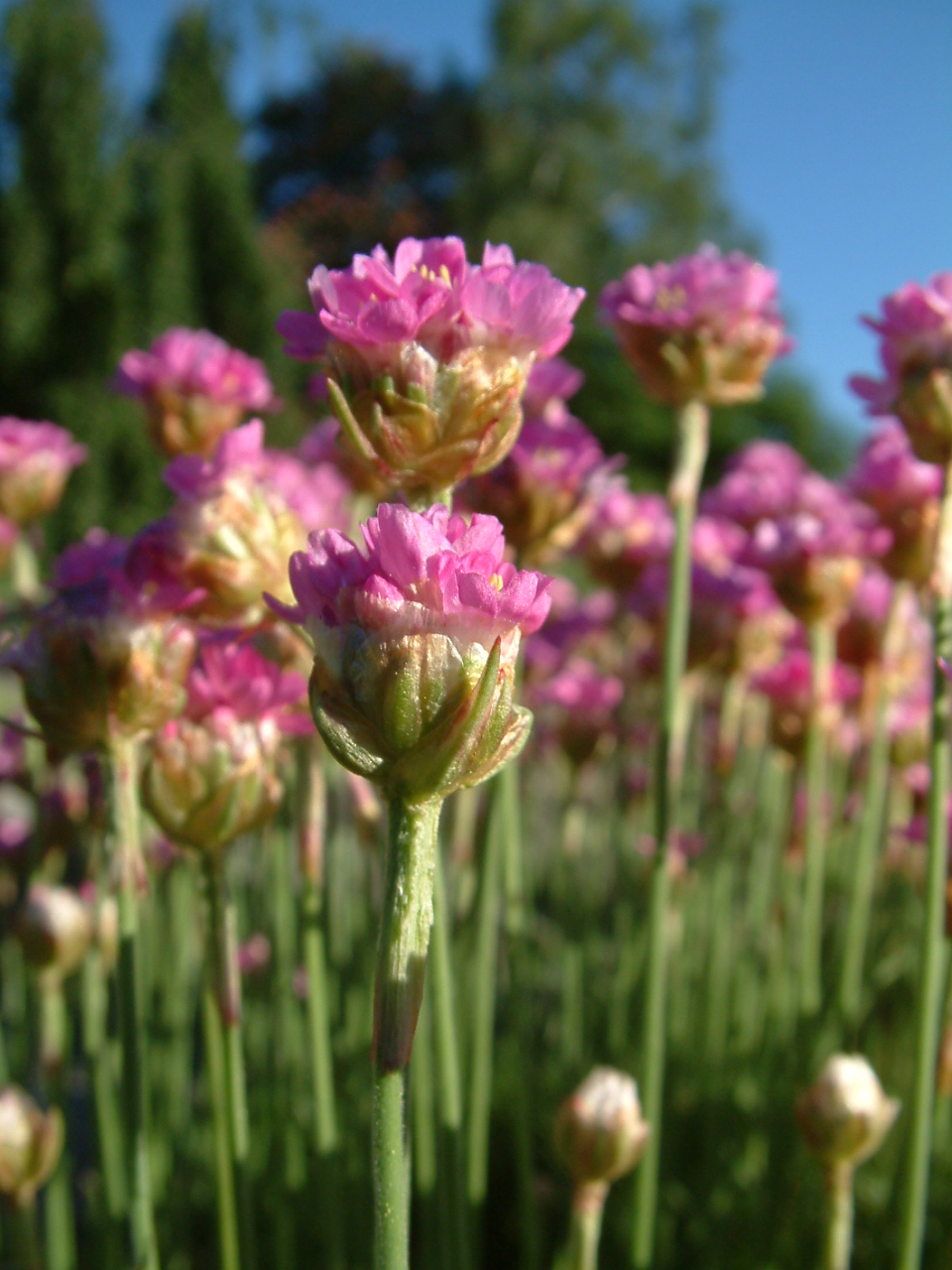
Sea thrift (Armeria maritima) is an evergreen perennial flowering plant in the family Plumbaginaceae, order Caryophyllales and class Magnoliopsida. It grows in dry, sandy and saline environments, including coastal cliffs, grasslands and salt marshes, as well as salted roadsides and inland mountain rocks. It forms compact, low-growing clumps and produces spherical clusters of flowers in pink, purple, white or red.
Written 26 November 2026 from the sources listed below. Each statement was checked against the passage it cites; statements that could not be supported were removed.
Appearance
Sea thrift is an evergreen perennial that forms compact, low-growing clumps. It produces long stems bearing spherical clusters of bright pink flowers, which can also be purple, white or red.[1][2][3]
Habitat
Sea thrift grows in dry, sandy and saline environments. Its coastal habitats include cliffs, grasslands and salt marshes.[4][5]
The species also occurs along salted roadsides and on inland mountain rocks.[6]
Armeria maritima sensu lato has a circumpolar distribution across the Northern Hemisphere, with wild populations in coastal areas throughout the Northern Hemisphere.[7][8]
Twelve subspecies of Armeria maritima are accepted. Armeria maritima subsp. azorica occurs in the Azores, while subsp. barcensis occurs in central Romania near Brasov and subsp. bottendorfensis occurs in central Germany at Bottendorfer Hügel.[9][10][11][12]
Armeria maritima subsp. californica occurs along the western coast of North America from Vancouver Island to California. Subsp. elongata occurs in northern, central and eastern Europe, and subsp. halleri occurs in coastal Europe from Spain to Poland.[13][14][15]
Armeria maritima subsp. hornburgensis occurs in central Germany near Hornburg, while subsp. interior occurs in Saskatchewan near southern Lake Athabasca. Subsp. intermedia occurs in Denmark and northern Germany.[16][17][18]
Armeria maritima subsp. maritima occurs in northern and western Europe and Greenland. Subsp. purpurea occurs in southern Germany, Switzerland and northern Italy.[19][20]
Armeria maritima subsp. sibirica occurs in subarctic Eurasia and North America and at Hoosier Ridge in Colorado.[21]
Behaviour
Sea thrift flowers in British salt marshes from April through October.[22]
Reproduction and life cycle
Pollination is carried out by insects, including bees and Lepidoptera.[23]
Conservation
Sea thrift is common in British salt marshes and is described as a common species in the United Kingdom.[24][25]
The tall thrift subspecies is described as critically endangered due to agricultural pressures.[26]
Uses
Sea thrift is cultivated as a garden flower and distributed internationally as a cut flower. It grows well in xeriscape and rock gardens.[27][28]
The cultivar Vindictive has received the Royal Horticultural Society's Award of Garden Merit.[29]
Classification of the Sea Thrift
| Kingdom | Plantae |
|---|---|
| Subkingdom | Pteridobiotina |
| Phylum | Tracheophyta |
| Class | Magnoliopsida |
| Order | Caryophyllales |
| Family | Plumbaginaceae (Leadwort Family) |
| Tribe | Limonieae |
| Genus | Armeria (Thift) |
| Species | Armeria maritima (Mill.) Willd. |
Where the Sea Thrift is found
Checklists and occurrence records place Armeria maritima in 46 countries across Asia, Europe, North America and South America. GBIF holds 192,878 georeferenced records of it.
Countries where it is native or its origin is not stated
- Andorra 6
- Austria 206
- Belarus 125
- Belgium 2,905
- Bulgaria 5
- Canada 2,882
- Croatia 2
- Czechia 688
- Denmark 25,602
- Estonia 463
- Faroe Islands 313
- Finland 1,026
- France 9,063
- Germany 17,674
- Greece 5
- Greenland 899
- Guernsey 126
- Hungary 14
- Iceland 6,140
- Ireland 3,101
- Isle of Man 844
- Italy 36
- Japan 10
- Jersey 75
- Latvia 74
- Lithuania 51
- Luxembourg 6
- Mongolia 7
- Montenegro 1
- North Macedonia 3
- Norway 11,020
- Poland 3,532
- Portugal 153
- Romania 32
- Russia 1,207
- Serbia 3
- Slovakia 122
- South Korea 4
- Spain 1,526
- Sweden 16,199
- Switzerland 17
- The Netherlands 17,897
- Ukraine 30
- United Kingdom 62,790
- United States 5,994
Countries where it has been introduced
Regions and cities with the most records
- Scotland, United Kingdom 20,715
- England, United Kingdom 17,136
- Central Jutland, Denmark 7,307
- South Denmark, Denmark 4,492
- Västra Götaland, Sweden 4,064
- Wales, United Kingdom 4,006
- Mecklenburg-Vorpommern, Germany 3,878
- Den Helder, The Netherlands 3,687
- Bavaria, Germany 3,639
- Zealand, Denmark 3,562
- California, United States 3,489
- Skåne, Sweden 3,410
- Camborne, United Kingdom 2,760
- Vlissingen, The Netherlands 2,595
- Redruth, United Kingdom 2,556
- Brandenburg, Germany 2,535
- Penzance, United Kingdom 2,482
- Falmouth, United Kingdom 2,297
- Knokke-Heist, Belgium 2,292
- Kalmar, Sweden 2,274
- Maldegem, Belgium 2,237
- Truro, United Kingdom 2,225
- Brugge, Belgium 2,206
- Friesland, The Netherlands 2,018
- Blankenberge, Belgium 1,891
- Sint-Kruis, Belgium 1,880
- Assebroek, Belgium 1,859
- Newquay, United Kingdom 1,812
- Capital Region, Denmark 1,691
- Hauts-de-France, France 1,547
- Lower Saxony, Germany 1,492
- South, Iceland 1,333
- Halland, Sweden 1,260
- Saxony-Anhalt, Germany 1,161
- Björlanda, Sweden 1,153
- Gelderland, The Netherlands 1,139
4 more countries have a few records outside this range
These countries hold a few records of Armeria maritima but lie outside the range the checklists give for it. Such records are often zoo or garden specimens, museum material or vagrants, so the species is not counted as occurring there.
A number beside a place is its count of GBIF occurrence records. A place without a number comes from a checklist alone. Records show where a species has been observed or collected, which can include escapes and vagrants.
Common names
English
- Sea Thrift
- Marsh Daisy
- Sea Cushion
- Sea Daisy
- Sea-pink
- Thift Seapink
- Thrift
Names in 12 other languages
- Danish
- Engelskgræs, Fåreleger
- Dutch
- Engels gras
- Finnish
- rusolaukkaneilikka
- French
- arméria maritime, armérie maritime
- German
- Gewöhnliche Grasnelke
- Northern Sami
- lávkeneillet, lávkenellet
- Norwegian Bokmål
- fjærekoll, strandnellik
- Norwegian Nynorsk
- fjørekoll
- Portuguese
- relva-do-Olimpo
- Russian
- armeriâ primorskaâ
- Spanish
- clavel de playas
- Swedish
- Gräsnejlika, trift
Synonyms
One other scientific name has been used for this species and is now treated as a synonym of Armeria maritima.
- Armeria vulgaris var. maritima Rosenv.
Subspecies and varieties
- Armeria maritima subsp. azorica subspecies
- Armeria maritima subsp. barcensis subspecies
- Armeria maritima subsp. bottendorfensis subspecies
- Armeria maritima subsp. californica (Western Thrift) subspecies
- Armeria maritima subsp. elongata (Tall Thrift) subspecies
- Armeria maritima subsp. fontqueri subspecies
- Armeria maritima subsp. halleri subspecies
- Armeria maritima subsp. hornburgensis subspecies
- Armeria maritima subsp. interior (Athabasca Thrift) subspecies
- Armeria maritima subsp. intermedia subspecies
- Armeria maritima subsp. maritima (Thrift) subspecies
- Armeria maritima subsp. planifolia subspecies
- Armeria maritima subsp. serpentini subspecies
- Armeria maritima subsp. sibirica (Foxflower) subspecies
Related species
-
 Sea RoseArmeria pungens
-
 Berlengas Sea PinkArmeria berlengensis
- Armeria arenaria
- Armeria alpina
- Armeria alliacea
- Armeria pubinervis
- Armeria soleirolii
- Armeria girardii
Compare
Questions and answers
What is the scientific name of the Sea Thrift?
The scientific name of the Sea Thrift is Armeria maritima. Written with its author, the full name is Armeria maritima (Mill.) Willd..
Which family does the Sea Thrift belong to?
Armeria maritima belongs to the family Plumbaginaceae, in the order Caryophyllales and the class Magnoliopsida.
Where is the Sea Thrift found?
Checklists and occurrence records place Armeria maritima in 46 countries, including United Kingdom, Denmark, The Netherlands, Germany, Sweden and Norway.
What other names does the Sea Thrift have?
Armeria maritima is also known in English as Marsh Daisy, Sea Cushion, Sea Daisy, Sea-pink, Thift Seapink and Thrift.
Does sea thrift spread?
Sea thrift forms compact, low-growing clumps. Its spread beyond these clumps is not established.[1]
Where is the best place to plant Armeria?
Sea thrift grows well in xeriscape and rock gardens and occurs naturally in dry, sandy and saline environments.[4][28]
Is Armeria a perennial?
Yes. Sea thrift is an evergreen perennial.[1]
Where to plant sea thrift?
Sea thrift grows in dry, sandy and saline environments, including cliffs, grasslands and salt marshes. It also grows well in xeriscape and rock gardens.[4][5][28]
Do Armeria plants come back every year?
Sea thrift is an evergreen perennial.[1]
Sources
Passages the profile rests on
- Armeria maritima is an evergreen perennial that forms compact, low-growing clumps. Source passage: “It is a compact evergreen perennial which grows in low clumps” — English Wikipedia
- The plant produces long stems bearing spherical clusters of bright pink flowers. Source passage: “sends up long stems that support globes of bright pink flowers.” — English Wikipedia
- Its flowers can also be purple, white or red. Source passage: “In some cases purple, white or red flowers also occur.” — English Wikipedia
- The species grows in dry, sandy and saline environments. Source passage: “It can grow in dry, sandy, saline conditions” — English Wikipedia
- Its coastal habitats include cliffs, grasslands and salt marshes. Source passage: “such as coastal cliffs, grassland and salt marshes” — English Wikipedia
- The species also occurs along salted roadsides and on inland mountain rocks. Source passage: “salted roadsides and inland on mountain rocks.” — English Wikipedia
- Armeria maritima sensu lato has a circumpolar distribution across the Northern Hemisphere. Source passage: “Armeria maritima sensu lato has a circumpolar distribution” — English Wikipedia
- Wild populations occur in coastal areas throughout the Northern Hemisphere. Source passage: “can be found in the wild in coastal areas across the Northern Hemisphere.” — English Wikipedia
- Twelve subspecies of Armeria maritima are accepted. Source passage: “12 subspecies are accepted.” — English Wikipedia
- Armeria maritima subsp. azorica occurs in the Azores. Source passage: “Armeria maritima subsp. azorica Franco – Azores” — English Wikipedia
- Armeria maritima subsp. barcensis occurs in central Romania near Brasov. Source passage: “central Romania (near Brasov)” — English Wikipedia
- Armeria maritima subsp. bottendorfensis occurs in central Germany at Bottendorfer Hügel. Source passage: “central Germany (Bottendorfer Hügel)” — English Wikipedia
- Armeria maritima subsp. californica occurs along the western coast of North America from Vancouver Island to California. Source passage: “west coast of North America from Vancouver Island to California” — English Wikipedia
- Armeria maritima subsp. elongata occurs in northern, central and eastern Europe. Source passage: “northern, central, and eastern Europe” — English Wikipedia
- Armeria maritima subsp. halleri occurs in coastal Europe from Spain to Poland. Source passage: “coastal Europe from Spain to Poland” — English Wikipedia
- Armeria maritima subsp. hornburgensis occurs in central Germany near Hornburg. Source passage: “central Germany (Hornburg)” — English Wikipedia
- Armeria maritima subsp. interior occurs in Saskatchewan near southern Lake Athabasca. Source passage: “Saskatchewan (southern Lake Athabasca)” — English Wikipedia
- Armeria maritima subsp. intermedia occurs in Denmark and northern Germany. Source passage: “Denmark and northern Germany” — English Wikipedia
- Armeria maritima subsp. maritima occurs in northern and western Europe and Greenland. Source passage: “northern and western Europe and Greenland” — English Wikipedia
- Armeria maritima subsp. purpurea occurs in southern Germany, Switzerland and northern Italy. Source passage: “southern Germany, Switzerland, and northern Italy” — English Wikipedia
- Armeria maritima subsp. sibirica occurs in subarctic Eurasia and North America and at Hoosier Ridge in Colorado. Source passage: “subarctic Eurasia and North America, Colorado (Hoosier Ridge)” — English Wikipedia
- The species flowers in British salt marshes from April through October. Source passage: “where it flowers April to October.” — English Wikipedia
- Pollination of Armeria maritima is carried out by insects including bees and Lepidoptera. Source passage: “Pollination is by various insects including bees and Lepidoptera.” — English Wikipedia
- The species is common in British salt marshes. Source passage: “It is common in British salt marshes” — English Wikipedia
- Armeria maritima is described as a common species in the United Kingdom. Source passage: “Armeria maritima is a common species in the UK” — English Wikipedia
- The tall thrift subspecies is described as critically endangered due to agricultural pressures. Source passage: “the subspecies, tall thrift (Armeria maritima subsp. elongata), is critically endangered due to agricultural” — kew.org
- Armeria maritima is cultivated as a garden flower and distributed internationally as a cut flower. Source passage: “It is a popular garden flower and has been distributed worldwide as a garden and cut flower.” — English Wikipedia
- The species grows well in xeriscape and rock gardens. Source passage: “It does well in gardens designed as xeriscapes or rock gardens.” — English Wikipedia
- The cultivar Vindictive has received the Royal Horticultural Society's Award of Garden Merit. Source passage: “The cultivar 'Vindictive' has gained the Royal Horticultural Society's Award of Garden Merit.” — English Wikipedia
Data
- Catalogue of Life, 2026-10-16 XR cc by
- Global Biodiversity Information Facility CC BY 4.0
- Wikidata CC0
- GeoNames CC BY 4.0
- Wikimedia Commons per image; credit shown with each image
- Within the Catalogue of Life, this name comes from Synonymic Checklists of the Vascular Plants of the World cc by
References
- (Mill.) Willd. where the name was published
This species in other databases
Page built on 26 November 2026. See how the catalog is made and all sources and licences.
Cite this page
ScientificNames.org. (2026). Armeria maritima (Sea Thrift). Retrieved November 26, 2026, from https://scientificnames.org/species/armeria-maritima
“Armeria maritima (Sea Thrift).” ScientificNames.org, 2026, scientificnames.org/species/armeria-maritima. Accessed 26 Nov. 2026.
ScientificNames.org. “Armeria maritima (Sea Thrift).” Accessed November 26, 2026. https://scientificnames.org/species/armeria-maritima.
@misc{scientificnames_armeria_maritima_sea_thrift,
  author = {{ScientificNames.org}},
  title = {Armeria maritima (Sea Thrift)},
  year = {2026},
  url = {https://scientificnames.org/species/armeria-maritima},
  note = {Accessed 2026-11-26}
}