Species · Mammals
Southwestern Water Vole Arvicola sapidus
The scientific name of the Southwestern Water Vole is Arvicola sapidus. It is a species of mammal in the family Cricetidae (new world mice and rats), order Rodentia. The name dates from 1908.
- Scientific name
- Arvicola sapidus Miller, 1908
- Common name
- Southwestern Water Vole
- Genus
- Arvicola
- Family
- Cricetidae (New World Mice and Rats)
- Order
- Rodentia
- Class
- Mammalia
- Red List category
- NT Near Threatened
- Recorded in
- 5 countries
- Name status
- accepted in the Catalogue of Life

Overview
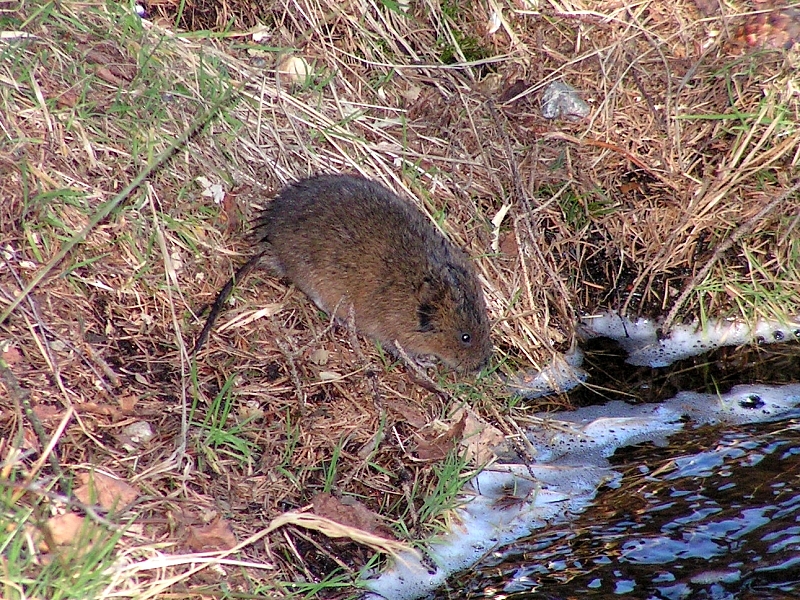
Arvicola sapidus Miller, 1908, known as the Southwestern Water Vole, is a large amphibious vole. The species occurs across most of France and extends southwestward through Spain and Portugal. It inhabits small patches of dense vegetation on muddy soil beside water bodies.
Written 26 November 2026 from the sources listed below. Each statement was checked against the passage it cites; statements that could not be supported were removed.
Appearance
The Southwestern Water Vole is a large amphibious vole. The proposed subspecies Arvicola sapidus tenebricus from northern Iberia is characterised by darker fur. Individuals in Doñana National Park show reduced body size and weight, attributed to environmental factors rather than genetic divergence.[1][2][3][4]
Habitat
The species inhabits small patches of vegetation on muddy soil beside water bodies. Dense vegetation provides protection against predators and drought.[5][6]
Suitable habitats occupied by the species account for less than two percent of the studied region in southern Spain. Its specialised habitats are naturally fragmented across the studied landscape.[7][8]
Behaviour
Southwestern Water Voles can disperse across apparently unsuitable terrain to colonise distant suitable habitat patches. Their average dispersal distance is approximately 700 metres, with no significant difference between males and females.[9][10][11]
Gene flow occurs between populations occupying non-adjacent habitat patches.[12]
Reproduction and life cycle
The species reproduces throughout the year, with the highest reproductive activity occurring between March and October. Reproductive activity peaks between April and June and decreases noticeably between November and February.[13][14][15]
Females reach sexual maturity at approximately 140 grams of body weight. They produce an average litter of approximately four offspring, with litter sizes ranging from one to seven.[16][17][18]
Heavier females tend to produce larger litters. Approximately five percent of embryos die before birth, and intrauterine mortality is more frequent among older females.[19][20][21]
Adult females can produce multiple litters annually, and some may produce as many as six litters over their lifetime. Females can become pregnant again shortly after giving birth, and pregnancy and lactation can occur simultaneously.[22][23][24][25]
Male reproductive capacity varies seasonally, with testes reaching their largest size during spring and summer.[26]
Conservation
The Southwestern Water Vole is classified as Near Threatened on the IUCN Red List. Its naturally fragmented populations are susceptible to local extinction.[27][28]
Classification of the Southwestern Water Vole
| Kingdom | Animalia |
|---|---|
| Phylum | Chordata |
| Subphylum | Vertebrata |
| Infraphylum | Gnathostomata |
| Parvphylum | Osteichthyes |
| Megaclass | Tetrapoda |
| Class | Mammalia (Mammal) |
| Subclass | Theria |
| Infraclass | Eutheria |
| Order | Rodentia (Rodent) |
| Suborder | Myomorpha (Mice) |
| Superfamily | Muroidea |
| Family | Cricetidae (New World Mice and Rats) |
| Subfamily | Arvicolinae (Arvicoline Rodents) |
| Genus | Arvicola (Water Voles) |
| Species | Arvicola sapidus Miller, 1908 |
Where the Southwestern Water Vole is found
Checklists and occurrence records place Arvicola sapidus in 5 countries. GBIF holds 18,124 georeferenced records of it.
Countries
Regions and cities with the most records
- Provence-Alpes-Côte d'Azur, France 2,222
- Occitanie, France 1,724
- Auvergne-Rhône-Alpes, France 876
- Bourgogne-Franche-Comté, France 766
- Catalonia, Spain 696
- Valencia, Spain 584
- Pays de la Loire, France 567
- Centre-Val de Loire, France 385
- Aragon, Spain 308
- Extremadura, Spain 297
- La Crau, France 293
- Hyères, France 291
- La Valette-du-Var, France 288
- La Garde, France 287
- Île-de-France, France 245
- Cavaillon, France 241
- Galicia, Spain 236
- L'Isle-sur-la-Sorgue, France 228
- Limoges, France 226
- Le Havre, France 223
- Toulon, France 213
- Gap, France 210
- Bayeux, France 208
- Montivilliers, France 184
- Manosque, France 161
- Mauguio, France 158
- Basque Country, Spain 156
- Lunel, France 155
- Rochefort, France 144
- Grasse, France 131
- Picassent, Spain 130
- Silla, Spain 130
- Fontenay-le-Comte, France 128
- Le Pontet, France 125
- Albal, Spain 122
- La Rochelle, France 122
Range as the checklists state it
Europe & Northern Asia (excluding China)
A number beside a place is its count of GBIF occurrence records. A place without a number comes from a checklist alone. Records show where a species has been observed or collected, which can include escapes and vagrants.
Common names
English
- Southwestern Water Vole
- Southern Water Vole
Names in 17 other languages
- Catalan
- Rata d'aigua
- Czech
- hryzec větší
- Dutch
- West-Europese Woelrat
- Finnish
- lännenvesimyyrä
- French
- Campagnol amphibie, Rat d'eau
- Galician
- Rata de auga
- German
- Iberische Schermaus, West-Schermaus, Westschermaus
- Greek
- Νότιος Νεροαρουραίος
- Hungarian
- Déli kószapocok
- Italian
- Arvicola acquatica meridionale
- Japanese
- イベリアミズハタネズミ
- Norwegian Bokmål
- Sørlig Vannrotte
- Polish
- karczownik zachodni
- Portuguese
- Campanhol-aquático-meridional, Rato-de-água
- Russian
- Иберийская полёвка
- Slovenian
- zahodni voluhar
- Spanish
- Rata de Agua
Synonyms
3 other scientific names have been used for this species and are now treated as synonyms of Arvicola sapidus.
- Arvicola sapidus tenebricus Miller, 1908
- Arvicola tenebricus Miller, 1908
- Microtus musiniani Lataste, 1884
Related species
-
 European Water VoleArvicola amphibius
-
 Montane Water VoleArvicola scherman
-
 MuskratOndatra zibethicus
-
 European HamsterCricetus cricetus
-
 Golden HamsterMesocricetus auratus
-
 Winter White Dwarf HamsterPhodopus sungorus
- Indefatigable Galapagos MouseNesoryzomys indefessus
-
 Roborovski Dwarf HamsterPhodopus roborovskii
Compare
Questions and answers
What is the scientific name of the Southwestern Water Vole?
The scientific name of the Southwestern Water Vole is Arvicola sapidus. Written with its author, the full name is Arvicola sapidus Miller, 1908.
Which family does the Southwestern Water Vole belong to?
Arvicola sapidus belongs to the family Cricetidae, in the order Rodentia and the class Mammalia.
Where is the Southwestern Water Vole found?
Checklists and occurrence records place Arvicola sapidus in 5 countries: France, Spain, Portugal, Andorra and Germany.
What is the conservation status of the Southwestern Water Vole?
The IUCN Red List category recorded for Arvicola sapidus is Near Threatened (NT).
What other names does the Southwestern Water Vole have?
Arvicola sapidus is also known in English as Southern Water Vole.
Are water voles as big as rats?
The Southwestern Water Vole is described as a large amphibious vole, but no comparison with rats is provided.[1]
Sources
Passages the profile rests on
- The southwestern water vole is a large amphibious vole. Source passage: “The southwestern water vole or southern water vole (Arvicola sapidus) is a large amphibious vole” — English Wikipedia
- The proposed subspecies Arvicola sapidus tenebricus from northern Iberia is characterised by darker fur. Source passage: “A. sapidus tenebricus in northern Iberia, characterised by darker fur” — English Wikipedia
- Individuals in Doñana National Park show reduced body size and weight. Source passage: “individuals in Doñana National Park show a consistent reduction in body size and weight” — English Wikipedia
- The reduced body size and weight observed in Doñana National Park are attributed to environmental factors rather than genetic divergence. Source passage: “attributed to environmental factors rather than genetic divergence” — English Wikipedia
- The species inhabits small patches of vegetation on muddy soil beside water bodies. Source passage: “small vegetation patches on muddy soil along water bodies” — English Wikipedia
- Dense vegetation provides protection against predators and drought. Source passage: “using dense vegetation cover as protection from predators and drought.” — English Wikipedia
- Suitable habitats occupied by the species account for less than two percent of the studied region in southern Spain. Source passage: “These habitats constitute less than 2% of their studied region in southern Spain” — English Wikipedia
- The species' specialised habitats are naturally fragmented across the studied landscape. Source passage: “These habitats constitute less than 2% of their studied region in southern Spain, making their populations naturally fragmented” — English Wikipedia
- Southwestern water voles can disperse across apparently unsuitable terrain to colonise distant suitable habitat patches. Source passage: “able to traverse seemingly inhospitable terrain to colonise distant patches of suitable habitat.” — English Wikipedia
- The average dispersal distance of the species is approximately 700 metres. Source passage: “Field studies show dispersal distances averaging approximately 700 metres (2,300 ft)” — English Wikipedia
- Dispersal distances do not differ significantly between males and females. Source passage: “without significant differences between sexes.” — English Wikipedia
- Gene flow occurs between populations occupying non-adjacent habitat patches. Source passage: “gene flow among populations remains relatively high, even between non-adjacent habitat patches” — English Wikipedia
- The species reproduces throughout the year, with the highest reproductive activity occurring between March and October. Source passage: “the most intense reproductive activity occurring from March through October” — English Wikipedia
- Reproductive activity peaks between April and June. Source passage: “peaking between April and June.” — English Wikipedia
- Reproductive activity decreases noticeably between November and February. Source passage: “a distinct reduction in reproductive activity occurs from November through February” — English Wikipedia
- Females reach sexual maturity at approximately 140 grams of body weight. Source passage: “Females become sexually mature when they reach a weight of around 140 grams” — English Wikipedia
- Female southwestern water voles produce an average litter of approximately four offspring. Source passage: “On average, females produce litters of about four offspring” — English Wikipedia
- Litter sizes range from one to seven offspring. Source passage: “litters of about four offspring (range 1–7).” — English Wikipedia
- Heavier females tend to produce larger litters. Source passage: “heavier females tending to have larger litters.” — English Wikipedia
- Approximately five percent of embryos die before birth. Source passage: “Intrauterine mortality affects about 5% of embryos” — English Wikipedia
- Intrauterine mortality is more frequent among older females. Source passage: “and is more common in older females.” — English Wikipedia
- Adult females can produce multiple litters annually. Source passage: “The reproductive life of adult females may include multiple litters annually” — English Wikipedia
- Some females may produce as many as six litters over their lifetime. Source passage: “some individuals potentially having up to six litters over their lifetime.” — English Wikipedia
- Females can become pregnant again shortly after giving birth. Source passage: “females may conceive again soon after giving birth” — English Wikipedia
- Pregnancy and lactation can occur simultaneously in female southwestern water voles. Source passage: “the simultaneous occurrence of pregnancy and lactation in some individuals.” — English Wikipedia
- Male reproductive capacity varies seasonally, with testes reaching their largest size during spring and summer. Source passage: “testes reaching their largest sizes during spring and summer” — English Wikipedia
- The southwestern water vole is classified as Near Threatened on the IUCN Red List. Source passage: “It is listed on the IUCN Red List as a Near Threatened species.” — English Wikipedia
- The species' naturally fragmented populations are susceptible to local extinction. Source passage: “making their populations naturally fragmented and susceptible to local extinctions.” — English Wikipedia
- The species occurs across most of France and extends southwestward through Spain and Portugal. Source passage: “native to most of France and southwestwards through Spain and Portugal.” — English Wikipedia
Data
- Catalogue of Life, 2026-10-16 XR cc by
- Global Biodiversity Information Facility CC BY 4.0
- Wikidata CC0
- GeoNames CC BY 4.0
- Wikimedia Commons per image; credit shown with each image
- Within the Catalogue of Life, this name comes from The Integrated Taxonomic Information System cc0
References
- Ann. Mag. Nat. Hist., ser. 8 vol.1 p.195 where the name was published
- Ellerman, J. R., and T. C. S. Morrison-Scott. (1966). Checklist of Palaearctic and Indian Mammals 1758 to 1946, 2nd Edition.
- Wilson, Don E., and DeeAnn M. Reeder, eds. (1993). Mammal Species of the World: A Taxonomic and Geographic Reference, 2nd Ed., 3rd Printing.
- Wilson, Don E., and F. Russell Cole. (2000). Common Names of Mammals of the World.
- Musser, Guy G., and Michael D. Carleton / Wilson, Don E., and DeeAnn M. Reeder, eds. (2005). Superfamily Muroidea. Mammal Species of the World: A Taxonomic and Geographic Reference, 3rd Ed., Vol. 2.
This species in other databases
Page built on 29 November 2026. See how the catalog is made and all sources and licences.
Cite this page
ScientificNames.org. (2026). Arvicola sapidus (Southwestern Water Vole). Retrieved November 29, 2026, from https://scientificnames.org/species/arvicola-sapidus
“Arvicola sapidus (Southwestern Water Vole).” ScientificNames.org, 2026, scientificnames.org/species/arvicola-sapidus. Accessed 29 Nov. 2026.
ScientificNames.org. “Arvicola sapidus (Southwestern Water Vole).” Accessed November 29, 2026. https://scientificnames.org/species/arvicola-sapidus.
@misc{scientificnames_arvicola_sapidus_southwestern_water_vole,
  author = {{ScientificNames.org}},
  title = {Arvicola sapidus (Southwestern Water Vole)},
  year = {2026},
  url = {https://scientificnames.org/species/arvicola-sapidus},
  note = {Accessed 2026-11-29}
}