Species · Flowering plants
Whorled Milkweed Asclepias subverticillata
The scientific name of the Whorled Milkweed is Asclepias subverticillata. It is a species of flowering plant in the family Apocynaceae (dogbane family), order Gentianales.
- Scientific name
- Asclepias subverticillata (A.Gray) Vail
- Common name
- Whorled Milkweed
- Genus
- Asclepias
- Family
- Apocynaceae (Dogbane Family)
- Order
- Gentianales
- Class
- Magnoliopsida
- Recorded in
- 2 countries
- Name status
- accepted in the Catalogue of Life
Overview
The species is native to New Mexico, Arizona, Colorado, Utah, parts of nearby states, and Mexico.
Written 26 November 2026 from the sources listed below. Each statement was checked against the passage it cites; statements that could not be supported were removed.
Appearance
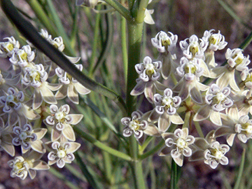
The plant can grow to 1.2 metres in height, and its leaves range from 2 to 12.5 centimetres in length. Its flower clusters are 2–3 centimetres wide, and individual flowers can reach 1.5 centimetres across.[1][2][3][4]
The species produces smooth fruit pods containing seeds with long hairs. The pods measure 5–10 centimetres in length.[5][6]
Habitat
The species occurs in the southwestern United States and Mexico. Its native distribution includes New Mexico, Arizona, Colorado, Utah, parts of nearby states, and Mexico.[7][8]
Behaviour
Whorled milkweed is unpalatable to livestock. It is considered toxic to animals when consumed in large quantities.[9][10]
Uses
Among the Zuni people, young boys eat the plant's buds. The Zuni people also gather the fruit pods when they are two-thirds ripe and use their fibers to weave clothing.[11][12]
The seed coma is made into cords used to fasten plumes to prayer sticks.[13]
Classification of the Whorled Milkweed
| Kingdom | Plantae |
|---|---|
| Subkingdom | Pteridobiotina |
| Phylum | Tracheophyta |
| Class | Magnoliopsida |
| Order | Gentianales |
| Family | Apocynaceae (Dogbane Family) |
| Subfamily | Asclepiadoideae |
| Tribe | Asclepiadeae |
| Subtribe | Asclepiadinae |
| Genus | Asclepias (Milkweed) |
| Species | Asclepias subverticillata (A.Gray) Vail |
Where the Whorled Milkweed is found
Checklists and occurrence records place Asclepias subverticillata in 2 countries across North America. GBIF holds 5,672 georeferenced records of it.
Countries
Regions and cities with the most records
- New Mexico, United States 1,645
- Arizona, United States 1,143
- Colorado, United States 574
- Texas, United States 268
- Utah, United States 257
- Albuquerque, United States 205
- Flagstaff, United States 193
- Rio Rancho, United States 174
- South Valley, United States 157
- Santa Fe, United States 154
- Prescott Valley, United States 71
- Prescott, United States 69
- Chihuahua, Mexico 60
- Enchanted Hills, United States 59
- Pueblo West, United States 56
- Pueblo, United States 54
- Las Cruces, United States 46
- Coahuila, Mexico 45
- Durango, Mexico 38
- Security-Widefield, United States 37
- Colorado Springs, United States 33
- Nuevo León, Mexico 33
- Cañon City, United States 32
- Kansas, United States 30
- Grand Junction, United States 25
- Sierra Vista, United States 24
- Sunland Park, United States 24
- Alamogordo, United States 23
- Gallup, United States 23
- Clifton, United States 22
- El Paso, United States 22
- Fountain, United States 21
- Hurricane, United States 19
- San Luis Potosí, Mexico 18
- Payson, United States 17
- Durango, United States 16
Range as the checklists state it
USA (Arizona, Colorado, Idaho, Kansas, Missouri, Nebraska, New Mexico, Nevada, Oklahoma, Texas, Utah, Wyoming); Mexico (Aguascalientes, Chihuahua, Coahuila, Durango, Nuevo León, Querétaro, San Luis Potosí, Sonora, Zacatecas)
A number beside a place is its count of GBIF occurrence records. A place without a number comes from a checklist alone. Records show where a species has been observed or collected, which can include escapes and vagrants.
Common names
English
- Whorled Milkweed
- Poison Milkweed
Names in 2 other languages
- French
- asclépiade de l'Ouest
- Spanish
- Algodoncillo cola de caballo
Synonyms
One other scientific name has been used for this species and is now treated as a synonym of Asclepias subverticillata.
- Asclepias verticillata var. subverticillata A.Gray
Related species
-
 Butterfly MilkweedAsclepias tuberosa
- SilkweedAsclepias syriaca
-
 Tropical MilkweedAsclepias curassavica
-
 Swamp MilkweedAsclepias incarnata
-
 Showy MilkweedAsclepias speciosa
-
 Narrow-leaf MilkweedAsclepias fascicularis
-
 Red-ring MilkweedAsclepias variegata
- Purple MilkweedAsclepias purpurascens
Compare
Questions and answers
What is the scientific name of the Whorled Milkweed?
The scientific name of the Whorled Milkweed is Asclepias subverticillata. Written with its author, the full name is Asclepias subverticillata (A.Gray) Vail.
Which family does the Whorled Milkweed belong to?
Asclepias subverticillata belongs to the family Apocynaceae, in the order Gentianales and the class Magnoliopsida.
Where is the Whorled Milkweed found?
Checklists and occurrence records place Asclepias subverticillata in 2 countries: United States and Mexico.
What other names does the Whorled Milkweed have?
Asclepias subverticillata is also known in English as Poison Milkweed.
Sources
Passages the profile rests on
- The plant can grow to 1.2 metres in height. Source passage: “Growing to 1.2 metres (4 feet) in height” — English Wikipedia
- Its leaves range from 2 to 12.5 centimetres in length. Source passage: “leaves ranging from 2–12.5 centimeters (1–5 inches) in length.” — English Wikipedia
- Its flower clusters are 2–3 centimetres wide. Source passage: “the umbel is 2–3 cm (3⁄4–1+1⁄4 in) wide” — English Wikipedia
- Individual flowers can reach 1.5 centimetres across. Source passage: “individual flowers up to 1.5 cm (1⁄2 in) across” — English Wikipedia
- The species produces smooth fruit pods containing seeds with long hairs. Source passage: “The fruit pod is smooth and 5–10 cm (2–4 in) long; the seeds inside have long hairs.” — English Wikipedia
- Its smooth fruit pods measure 5–10 centimetres in length. Source passage: “The fruit pod is smooth and 5–10 cm (2–4 in) long” — English Wikipedia
- The species is native to New Mexico, Arizona, Colorado, Utah, parts of nearby states, and Mexico. Source passage: “It is indigenous to New Mexico, Arizona, Colorado and Utah and parts of some nearby states, in addition to Mexico.” — English Wikipedia
- The species occurs in the southwestern United States and Mexico. Source passage: “Asclepias subverticillata is a plant found in the southwestern United States and Mexico.” — English Wikipedia
- The species is unpalatable to livestock. Source passage: “The species is unpalatable and very toxic to livestock.” — English Wikipedia
- The plant is considered toxic to animals when consumed in large quantities. Source passage: “Milkweed is considered toxic to animals if consumed in large quantities” — nps.gov
- Among the Zuni people, young boys eat the plant's buds. Source passage: “Among the Zuni people the buds are eaten by young boys.” — English Wikipedia
- The Zuni people gather the fruit pods when they are two-thirds ripe and use their fibers to weave clothing. Source passage: “The pods are also gathered when two-thirds ripe and the fibers are used for weaving clothing.” — English Wikipedia
- The seed coma is made into cords used to fasten plumes to prayer sticks. Source passage: “The coma is made into cords and used for fastening plumes to the prayer sticks.” — English Wikipedia
Data
- Catalogue of Life, 2026-10-16 XR cc by
- Global Biodiversity Information Facility CC BY 4.0
- Wikidata CC0
- GeoNames CC BY 4.0
- Wikimedia Commons per image; credit shown with each image
- Within the Catalogue of Life, this name comes from Synonymic Checklists of the Vascular Plants of the World cc by
References
- Vail. (1898). Bull. Torrey Bot. Club 25: 178 (1898). where the name was published
This species in other databases
- Catalogue of Life H6QK
- Wikidata Q2866403
- iNaturalist 127159
- World Flora Online wfo-0000551795
- GRIN 316575
Page built on 28 November 2026. See how the catalog is made and all sources and licences.
Cite this page
ScientificNames.org. (2026). Asclepias subverticillata (Whorled Milkweed). Retrieved November 28, 2026, from https://scientificnames.org/species/asclepias-subverticillata
“Asclepias subverticillata (Whorled Milkweed).” ScientificNames.org, 2026, scientificnames.org/species/asclepias-subverticillata. Accessed 28 Nov. 2026.
ScientificNames.org. “Asclepias subverticillata (Whorled Milkweed).” Accessed November 28, 2026. https://scientificnames.org/species/asclepias-subverticillata.
@misc{scientificnames_asclepias_subverticillata_whorled_milkweed,
  author = {{ScientificNames.org}},
  title = {Asclepias subverticillata (Whorled Milkweed)},
  year = {2026},
  url = {https://scientificnames.org/species/asclepias-subverticillata},
  note = {Accessed 2026-11-28}
}