Species · Spiders and other arachnids
Asemonea virgea
Asemonea virgea has no English name on record in the checklists used here. It is a species of arachnid in the family Salticidae (jumping spider), order Araneae. The name dates from 2003.
- Scientific name
- Asemonea virgea Wesołowska & Szűts, 2003
- Genus
- Asemonea
- Family
- Salticidae (Jumping Spider)
- Order
- Araneae
- Class
- Arachnida
- Recorded in
- 2 countries
- Name status
- accepted in the Catalogue of Life
Overview
Asemonea virgea is a jumping spider belonging to the family Salticidae. The species has been recorded in Guinea and the Republic of the Congo. The species is distinguished from Asemonea cristata by its shorter femoral apophysis and from Asemonea cuprea by the bumps on the side of its palpal tibia.
Written 27 November 2026 from the sources listed below. Each statement was checked against the passage it cites; statements that could not be supported were removed.
Appearance
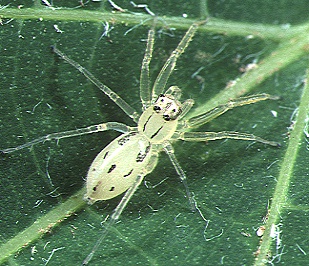
The female carapace is generally yellowish-brown and covered with very fine white hairs. A thin brown line runs along its edges, while the eye field is slightly hairier, lighter and more yellowish than the surrounding carapace.[1][2][3]
The female's eyes are relatively large and arranged in four rows. Her sternum is heart-shaped and her clypeus is whitish.[4][5][6]
The female abdomen is pale yellow with six brown spots arranged in pairs along its middle. Its underside is whitish.[7][8]
The female has long spinnerets and long, thin legs that are generally whitish-yellow. Her legs bear numerous long brownish spines and fine hairs.[9][10]
The female epigyne has an oval knob extending from its middle. Large round copulatory openings near the back of the epigyne are surrounded by large lips showing strong sclerotization.[11][12][13]
The male carapace is pear-shaped and moderately high. It is dark yellow with a thin brown marginal line.[14][15]
The male chelicerae are orange and have five small teeth on both their front and rear edges.[16]
The male abdomen is pale yellow with a brownish marginal band, small dark lateral dots and two arrow-shaped dark dorsal patches. Its underside is whitish.[17][18]
The male has long, thin, generally whitish-yellow legs. The front legs have dark lines and dots on some segments, while the legs have light hairs and very pale, long, slender spines.[19][20][21]
The male palpal femur has a long furrow lined with very fine hairs and bears a pointed femoral apophysis. The palpal tibia has three triangular bumps.[22][23][24]
Habitat
The species thrives in trees and shrubs.[25]
The species has been recorded in the Nimba Mountains in Guinea at an altitude of 500 m above sea level.[26]
Diet
The species is predominantly a diurnal hunter. It is likely to consume nectar when it is available.[27][28]
Behaviour
Spiders of the genus Asemonea generally walk and run rather than jump. When hunting, they generally lunge or leap towards prey, sometimes when it is 1–2 m away.[29][30][31]
The species spins sheet webs on the undersides of leaves.[32]
The spiders use visual displays during courtship. They also communicate with other spiders through vibratory signals transmitted along silk.[33][34]
Classification of Asemonea virgea
| Kingdom | Animalia |
|---|---|
| Phylum | Arthropoda |
| Subphylum | Chelicerata |
| Class | Arachnida (Arachnid) |
| Order | Araneae (Spider) |
| Family | Salticidae (Jumping Spider) |
| Genus | Asemonea (Tailed Jumping Spiders) |
| Species | Asemonea virgea Wesołowska & Szűts, 2003 |
Where Asemonea virgea is found
Checklists and occurrence records place Asemonea virgea in 2 countries across Africa. GBIF holds 1 georeferenced records of it.
Countries
Range as the checklists state it
Guinea, DR Congo
A number beside a place is its count of GBIF occurrence records. A place without a number comes from a checklist alone. Records show where a species has been observed or collected, which can include escapes and vagrants.
Related species
- Oribi Gorge Asemonea Jumping SpiderAsemonea clara
- Asemonea murphyae
- Asemonea stella
-
 Asemonea tanikawai
- Asemonea amatola
- Asemonea cristata
- Asemonea mirpurensis
- Asemonea cuprea
Compare
Sources
Passages the profile rests on
- The female carapace is generally yellowish-brown and covered with very fine white hairs. Source passage: “is generally yellowish-brown and covered in very fine white hairs.” — English Wikipedia
- The female carapace has a thin brown line along its edges. Source passage: “It has a thin brown line along its edges” — English Wikipedia
- The female eye field is slightly hairier, lighter and yellowish than the surrounding carapace. Source passage: “its eye field is slightly hairier, lighter and yellowish.” — English Wikipedia
- The female's eyes are relatively large and arranged in four rows. Source passage: “Its eyes are relatively large and arranged in four rows.” — English Wikipedia
- The female sternum is heart-shaped. Source passage: “The underside of its front section, its sternum, is shaped like a heart.” — English Wikipedia
- The female clypeus is whitish. Source passage: “The part of its face known as its clypeus is whiteish.” — English Wikipedia
- The female abdomen is pale yellow with six brown spots arranged in pairs along its middle. Source passage: “it is pale yellow with a pattern of six brown spots arranged in pairs running down the middle” — English Wikipedia
- The female abdomen has a whitish underside. Source passage: “Underneath, it is whitish.” — English Wikipedia
- The female has long spinnerets and long, thin legs that are generally whitish-yellow. Source passage: “It has long spinnerets that it uses to spin webs and long thin legs. They are generally whitish-yellow” — English Wikipedia
- The female's legs have numerous long brownish spines and fine hairs. Source passage: “They have many long brownish leg spines and fine hairs on the surface.” — English Wikipedia
- The female epigyne has an oval knob extending from its middle. Source passage: “has an oval knob extending from the middle” — English Wikipedia
- The female has large round copulatory openings near the back of the epigyne. Source passage: “large round copulatory openings near the back.” — English Wikipedia
- The female copulatory openings are surrounded by large lips showing strong sclerotization. Source passage: “the large lips around the openings that show strong signs of sclerotization.” — English Wikipedia
- The male carapace is pear-shaped and moderately high. Source passage: “The male has a moderately high pear-shaped carapace” — English Wikipedia
- The male carapace is dark yellow with a thin brown marginal line. Source passage: “It is similar to the female, dark yellow with a thin brown line around the edge” — English Wikipedia
- The male chelicerae are orange and have five small teeth on both their front and rear edges. Source passage: “The spider's chelicerae are orange, with five small teeth visible on both the front and rear edges.” — English Wikipedia
- The male abdomen is pale yellow with a brownish marginal band, small dark lateral dots and two arrow-shaped dark dorsal patches. Source passage: “It is pale yellow with a brownish band across the edge, small dark dots towards the sides and two arrow-shaped dark patches on the top.” — English Wikipedia
- The male abdomen has a whitish underside. Source passage: “As with the female, its underside is whiteish.” — English Wikipedia
- The male has long, thin, generally whitish-yellow legs. Source passage: “long thin generally whitish-yellow legs like the female” — English Wikipedia
- The male front legs have dark lines and dots on some segments. Source passage: “Its front legs have dark lines and dots on some of its sections.” — English Wikipedia
- The male has light leg hairs and very pale, long, slender leg spines. Source passage: “There are light leg hairs and very pale long slender leg spines visible on all of them.” — English Wikipedia
- The male palpal femur has a long furrow lined with very fine hairs. Source passage: “a long furrow on the palpal femur that is lined with very fine hairs” — English Wikipedia
- The male palpal femur bears a pointed femoral apophysis. Source passage: “a projection, or femoral apophysis, that has a pointed end.” — English Wikipedia
- The male palpal tibia has three triangular bumps. Source passage: “The tibia also has three triangular bumps” — English Wikipedia
- The species thrives in trees and shrubs. Source passage: “The spiders thrive in trees and shrubs.” — English Wikipedia
- The species has been recorded in the Nimba Mountains in Guinea at an altitude of 500 m above sea level. Source passage: “In Guinea, it has been found in the Nimba Mountains at an altitude of 500 m (1,600 ft) above sea level.” — English Wikipedia
- The species is predominantly a diurnal hunter. Source passage: “Although predominantly a diurnal hunter” — English Wikipedia
- The species is likely to consume nectar when it is available. Source passage: “the spider is also likely to eat nectar if it is available.” — English Wikipedia
- Spiders of the genus Asemonea generally walk and run rather than jump. Source passage: “Despite being termed jumping spiders, Asemonea spiders rarely jump. Instead, they generally walk and run.” — English Wikipedia
- When hunting, the spiders generally lunge or leap towards prey. Source passage: “When hunting, they mainly lunged or leapt at prey” — English Wikipedia
- A hunting leap can occur when prey is 1–2 m away. Source passage: “a leap often occurring when the prey is 1 to 2 m (3 ft 3 in to 6 ft 7 in) away” — English Wikipedia
- The species spins sheet webs on the undersides of leaves. Source passage: “They spin sheet webs on the underside of leaves.” — English Wikipedia
- The spiders use visual displays during courtship. Source passage: “They use visual displays during courtship” — English Wikipedia
- The spiders communicate with other spiders through vibratory signals transmitted along silk. Source passage: “transmit vibratory signals through silk to communicate to other spiders.” — English Wikipedia
Data
- Catalogue of Life, 2026-10-16 XR cc by
- Global Biodiversity Information Facility CC BY 4.0
- Wikidata CC0
- GeoNames CC BY 4.0
- Within the Catalogue of Life, this name comes from The World Spider Catalog cc by
References
- Wesołowska, W. & Szűts, T. (2003). A new species of Asemonea from equatorial Africa (Araneae: Salticidae: Lyssomininae). Folia Entomologica Hungarica 64: 59-62. where the name was published
This species in other databases
Page built on 29 November 2026. See how the catalog is made and all sources and licences.
Cite this page
ScientificNames.org. (2026). Asemonea virgea. Retrieved November 29, 2026, from https://scientificnames.org/species/asemonea-virgea
“Asemonea virgea.” ScientificNames.org, 2026, scientificnames.org/species/asemonea-virgea. Accessed 29 Nov. 2026.
ScientificNames.org. “Asemonea virgea.” Accessed November 29, 2026. https://scientificnames.org/species/asemonea-virgea.
@misc{scientificnames_asemonea_virgea,
  author = {{ScientificNames.org}},
  title = {Asemonea virgea},
  year = {2026},
  url = {https://scientificnames.org/species/asemonea-virgea},
  note = {Accessed 2026-11-29}
}