Species · Insects
Assara seminivale
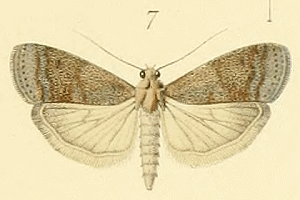
Assara seminivale has no English name on record in the checklists used here. It is a species of insect in the family Pyralidae (grass moths), order Lepidoptera. The name dates from 1904.
- Scientific name
- Assara seminivale (Turner, 1904)
- Genus
- Assara
- Family
- Pyralidae (Grass Moths)
- Order
- Lepidoptera
- Class
- Insecta
- Recorded in
- 1 country
- Name status
- accepted in the Catalogue of Life
Overview
Assara seminivale is a snout moth belonging to the genus Assara. The species is known from Australia. Its larvae feed on nuts of Macadamia species, seeds of Mangifera indica and fruit of Heritiera littoralis.
Written 27 November 2026 from the sources listed below. Each statement was checked against the passage it cites; statements that could not be supported were removed.
Habitat
The species is known from Australia. Unverified records have been reported from Sikkim, Tonkin, Sri Lanka, Sumatra and Borneo.[1][2]
Diet
The larvae feed on nuts of Macadamia species, including Macadamia integrifolia.[3]
The larvae also feed on seeds of Mangifera indica and fruit of Heritiera littoralis.[4][5]
Classification of Assara seminivale
| Kingdom | Animalia |
|---|---|
| Phylum | Arthropoda |
| Subphylum | Hexapoda |
| Class | Insecta (Insect) |
| Order | Lepidoptera |
| Superfamily | Pyraloidea |
| Family | Pyralidae (Grass Moths) |
| Subfamily | Phycitinae |
| Genus | Assara |
| Species | Assara seminivale (Turner, 1904) |
Where Assara seminivale is found
Checklists and occurrence records place Assara seminivale in 1 country. GBIF holds 73 georeferenced records of it.
Countries
Regions and cities with the most records
A number beside a place is its count of GBIF occurrence records. A place without a number comes from a checklist alone. Records show where a species has been observed or collected, which can include escapes and vagrants.
Synonyms
One other scientific name has been used for this species and is now treated as a synonym of Assara seminivale.
- Hyphantidium seminivale Turner, 1904
Related species
-
 Dark Spruce Knot-hornAssara terebrella
-
 Assara holophragma
- Assara subarcuella
- Assara turciella
- Assara leucarma
-
 Assara conicolella
- Assara albicostalis
- Assara korbi
Compare
Questions and answers
Who described Assara seminivale and when?
The species was described by Turner in 1904.[6]
Sources
Passages the profile rests on
- The species is known from Australia. Source passage: “and is known from Australia.” — English Wikipedia
- Unverified records of the species have been reported from Sikkim, Tonkin, Sri Lanka, Sumatra and Borneo. Source passage: “There are also records for Sikkim, Tonkin, Sri Lanka, Sumatra and Borneo, but these need verification.” — English Wikipedia
- The larvae feed on nuts of Macadamia species, including Macadamia integrifolia. Source passage: “The larvae feed on the nuts of Macadamia species (including Macadamia integrifolia)” — English Wikipedia
- The larvae feed on seeds of Mangifera indica. Source passage: “the seeds of Mangifera indica” — English Wikipedia
- The larvae feed on fruit of Heritiera littoralis. Source passage: “and fruit of Heritiera littoralis.” — English Wikipedia
- The species was described by Turner in 1904. Source passage: “It was described by Turner in 1904” — English Wikipedia
Data
- Catalogue of Life, 2026-10-16 XR cc by
- Global Biodiversity Information Facility CC BY 4.0
- Wikidata CC0
- GeoNames CC BY 4.0
- Within the Catalogue of Life, this name comes from Global Lepidoptera Index cc by
This species in other databases
Page built on 29 November 2026. See how the catalog is made and all sources and licences.
Cite this page
ScientificNames.org. (2026). Assara seminivale. Retrieved November 29, 2026, from https://scientificnames.org/species/assara-seminivale
“Assara seminivale.” ScientificNames.org, 2026, scientificnames.org/species/assara-seminivale. Accessed 29 Nov. 2026.
ScientificNames.org. “Assara seminivale.” Accessed November 29, 2026. https://scientificnames.org/species/assara-seminivale.
@misc{scientificnames_assara_seminivale,
  author = {{ScientificNames.org}},
  title = {Assara seminivale},
  year = {2026},
  url = {https://scientificnames.org/species/assara-seminivale},
  note = {Accessed 2026-11-29}
}