Species · Insects
Great Purple Hairstreak Atlides halesus
The scientific name of the Great Purple Hairstreak is Atlides halesus. It is a species of insect in the family Lycaenidae (blues), order Lepidoptera. The name dates from 1779.
- Scientific name
- Atlides halesus (Cramer, 1779)
- Common name
- Great Purple Hairstreak
- Genus
- Atlides
- Family
- Lycaenidae (Blues)
- Order
- Lepidoptera
- Class
- Insecta
- Red List category
- LC Least Concern
- Recorded in
- 3 countries
- Name status
- accepted in the Catalogue of Life

Overview
Atlides halesus occurs in valley and foothill riparian forests, foothill woodland, and older urban neighborhoods with well-developed tree canopies, from sea level to approximately 5,000 feet wherever its host plants grow. It has iridescent blue upper wing surfaces with black borders, black undersides with orange-gold spots, and two unequal tails on each hindwing.
Written 26 November 2026 from the sources listed below. Each statement was checked against the passage it cites; statements that could not be supported were removed.
Appearance
The upper surfaces of the wings are iridescent blue with black borders. Males generally have brighter and more extensive blue wing coloration than females.[1][2]
The undersides of the wings are black with orange-gold spots. Each hindwing has two tails of unequal lengths.[3][4]
The abdomen has a blue upper surface and an orange underside. The hindwings have markings and tails that resemble a false head.[5][6]
Adults have a wingspan ranging from 1.25 to 1.5 inches.[7]
Habitat
The species occurs in valley and foothill riparian forests and foothill woodland. It also occurs in older urban neighborhoods with well-developed tree canopies.[8][9][10]
Its habitat extends from sea level to approximately 5,000 feet wherever its host plants grow.[11]
Diet
The larvae feed exclusively on mistletoe, including plants in the genus Phoradendron. After hatching, larvae feed on mistletoe leaves and male flowers.[12][13][14]
Young caterpillars consume the epidermis of mistletoe leaves, whereas older caterpillars consume entire leaves. Larvae can completely defoliate their mistletoe host plants.[15][16]
Adult butterflies visit dogbane, milkweed, goldenrod, California buckeye, carrot-family plants, and perennial peppergrass. They also visit Lantana and Zinnias.[17][18]
Behaviour
Perching individuals orient their tails upward and their heads downward while moving their bodies back and forth. Adult butterflies rub their wings together, drawing attention to the markings on their hindwings.[19][20]
The false-head display helps direct predator attacks toward the less vulnerable hindwings.[21]
Males wait for potential mates on tall perches such as trees. Caterpillars are commonly observed during spring and early summer.[22][23]
Reproduction and life cycle
Females lay eggs on mistletoe plants, depositing them individually or in groups on host plants. They can lay as many as twenty individual eggs at different locations on mistletoe leaves.[24][25][26]
Females preferentially select isolated mistletoe plants with smaller-diameter trunks for egg laying. Eggs are white and have a hard, solid outer surface.[27][28]
Larvae hatch through an opening at the top of the egg. They pupate approximately 20 days after hatching.[29][30]
Pupae develop in protected locations near tree bases, beneath bark or fallen leaves. Adults emerge from pupae after a minimum of approximately 16 days.[31][32]
The species breeds continuously during warm weather from March through October in the Sacramento Valley and foothills. At Sierra Valley, it breeds from June through October.[33][34]
Conservation
Recorded natural enemies include the parasitoid wasps Apanteles sp. and Metadontia amoena.[35]
Similar species
The species is also known by the common name Great Blue Hairstreak.[36]
Classification of the Great Purple Hairstreak
| Kingdom | Animalia |
|---|---|
| Phylum | Arthropoda |
| Subphylum | Hexapoda |
| Class | Insecta (Insect) |
| Order | Lepidoptera |
| Superfamily | Papilionoidea |
| Family | Lycaenidae (Blues) |
| Subfamily | Theclinae |
| Tribe | Eumaeini |
| Genus | Atlides |
| Species | Atlides halesus (Cramer, 1779) |
Where the Great Purple Hairstreak is found
Checklists and occurrence records place Atlides halesus in 3 countries across North America. GBIF holds 9,935 georeferenced records of it.
Countries
Regions and cities with the most records
- Texas, United States 3,539
- California, United States 1,205
- Florida, United States 1,037
- Arizona, United States 991
- Austin, United States 501
- Georgia, United States 419
- Round Rock, United States 321
- Georgetown, United States 308
- North Carolina, United States 295
- Brushy Creek, United States 268
- Hutto, United States 250
- Pflugerville, United States 238
- Flowing Wells, United States 229
- Cedar Park, United States 228
- Casas Adobes, United States 218
- San Antonio, United States 215
- South Carolina, United States 212
- Catalina Foothills, United States 206
- Leander, United States 198
- Tucson, United States 187
- New Mexico, United States 169
- Spring Hill, United States 157
- Tanque Verde, United States 147
- Oro Valley, United States 143
- Rancho Mirage, United States 140
- Palm Desert, United States 138
- Cathedral City, United States 137
- Drexel Heights, United States 134
- Plano, United States 131
- La Quinta, United States 129
- McAllen, United States 127
- Reynosa, Mexico 126
- Pharr, United States 125
- Addison, United States 124
- Richardson, United States 123
- Alton, United States 122
A number beside a place is its count of GBIF occurrence records. A place without a number comes from a checklist alone. Records show where a species has been observed or collected, which can include escapes and vagrants.
Common names
English
- Great Purple Hairstreak
Names in 2 other languages
- Japanese
- オオムラサキシジミ
- Spanish
- Mariposa sedosa gigante azul
Synonyms
3 other scientific names have been used for this species and are now treated as synonyms of Atlides halesus.
- Atlides dolichos Hübner, 1823
- Thecla juanita Scudder, 1868
- Papilio halesus Cramer, 1779 ambiguous synonym
Subspecies and varieties
- Atlides halesus corcorani subspecies
- Atlides halesus halesus (Eastern Great Purple Hairstreak) subspecies
Related species
-
 Atlides atys
- Atlides brangas
-
 Twin BrangasBrangas dydimaon
- Atlides caranus
- Brangas extincta
-
 Common BluePolyommatus icarus
-
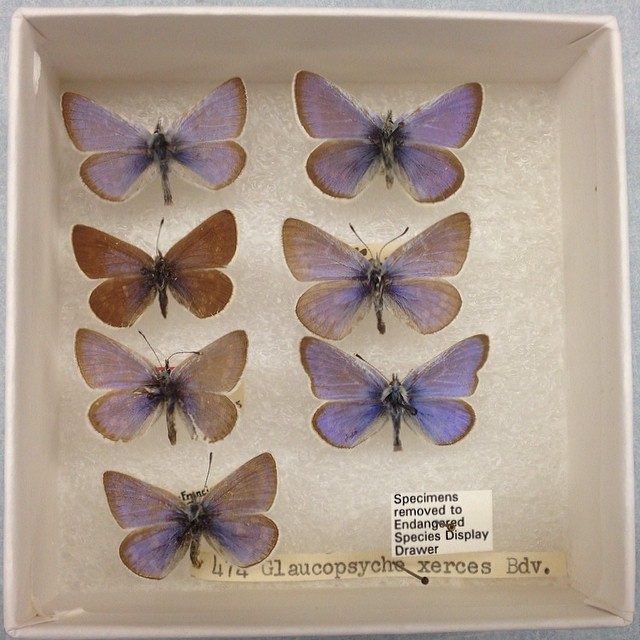 Xerces BlueGlaucopsyche xerces
-
 Adonis BlueLysandra bellargus
Compare
Questions and answers
What is the scientific name of the Great Purple Hairstreak?
The scientific name of the Great Purple Hairstreak is Atlides halesus. Written with its author, the full name is Atlides halesus (Cramer, 1779).
Which family does the Great Purple Hairstreak belong to?
Atlides halesus belongs to the family Lycaenidae, in the order Lepidoptera and the class Insecta.
Where is the Great Purple Hairstreak found?
Checklists and occurrence records place Atlides halesus in 3 countries: United States, Mexico and Costa Rica.
What is the conservation status of the Great Purple Hairstreak?
The IUCN Red List category recorded for Atlides halesus is Least Concern (LC).
What are great purple hair streaks?
The Great Purple Hairstreak is an insect in the family Lycaenidae and order Lepidoptera. Its wings have iridescent blue upper surfaces with black borders and black undersides with orange-gold spots.[1][3]
Why do hairstreak butterflies rub their wings together?
Adult Great Purple Hairstreaks rub their wings together to draw attention to the markings on their hindwings. These markings and tails resemble a false head, which helps direct predator attacks toward the less vulnerable hindwings.[6][21][20]
What do great purple hairstreak butterflies eat?
Adult butterflies visit dogbane, milkweed, goldenrod, California buckeye, carrot-family plants, perennial peppergrass, Lantana, and Zinnias. Their larvae feed exclusively on mistletoe.[12][17][18]
What do great purple hairstreaks eat?
Larvae feed on mistletoe leaves and male flowers. Young caterpillars consume the epidermis of mistletoe leaves, while older caterpillars consume entire leaves. Adults visit a range of flowering plants, including dogbane, milkweed, goldenrod, Lantana, and Zinnias.[15][14][17][18]
Sources
Passages the profile rests on
- The upper surfaces of the wings are iridescent blue with black borders. Source passage: “the upper-side of the wings are iridescent blue at the center, with a black border” — English Wikipedia
- Males generally have brighter and more extensive blue wing coloration than females. Source passage: “males typically have both a more extensive and brighter blue wing coloration when compared to their female counterparts.” — English Wikipedia
- The undersides of the wings are black with orange-gold spots. Source passage: “The under-side of the wings are black, with orange-gold colored spots” — English Wikipedia
- Each hindwing has two tails of unequal lengths. Source passage: “On the hind wings, the butterfly has two sets of tails of unequal length” — English Wikipedia
- The abdomen has a blue upper surface and an orange underside. Source passage: “The abdomen of the butterfly features a blue upper-side and an orange under-side.” — English Wikipedia
- The hindwings have markings and tails that resemble a false head. Source passage: “The combination of the tails, resembling antennae of a butterfly, along with the orange spots on each hind-wing, which resembles eyes, gives the butterfly a "false head".” — English Wikipedia
- Adults have a wingspan ranging from 1.25 to 1.5 inches. Source passage: “The wingspan on the adult butterfly ranges from 1.25 to 1.5 inches.” — English Wikipedia
- The species occurs in valley and foothill riparian forests. Source passage: “It is commonest in Valley and foothill riparian forest” — ucanr.edu
- The species also occurs in older urban neighborhoods with well-developed tree canopies. Source passage: “and in older urban neighborhoods with a well-developed canopy” — ucanr.edu
- The species occurs in foothill woodland. Source passage: “and in foothill woodland.” — ucanr.edu
- The species occurs from sea level to approximately 5,000 feet wherever its host plants grow. Source passage: “The Great Purple Hairstreak occurs from sea level to about 5000' wherever its host plants, broadleaf mistletoes, occur.” — ucanr.edu
- The larvae feed exclusively on mistletoe. Source passage: “The larvae of Atlides halesus eat only mistletoe.” — animaldiversity.org
- The larvae feed on plants in the mistletoe genus Phoradendron. Source passage: “Its caterpillar larvae feed on the mistletoe genus Phoradendron.” — English Wikipedia
- Larvae feed on mistletoe leaves and male flowers after hatching. Source passage: “they go straight into feeding on their host plant's leaves and male flowers” — English Wikipedia
- Young caterpillars consume the epidermis of mistletoe leaves, whereas older caterpillars consume entire leaves. Source passage: “The younger caterpillars eat the epidermis of the leaf while the older larvae eat the entire leaf.” — animaldiversity.org
- Larvae can completely defoliate their mistletoe host plants. Source passage: “caterpillars have been observed to entirely defoliate their host plant before, leaving behind only the stems.” — English Wikipedia
- Adult butterflies visit dogbane, milkweed, goldenrod, California buckeye, carrot-family plants, and perennial peppergrass. Source passage: “visits Dogbane, Milkweed, Goldenrod, California Buckeye, members of the Carrot Family (Apiaceae) and the obnoxious weed Perennial Peppergrass.” — ucanr.edu
- Adult butterflies also visit Lantana and Zinnias. Source passage: “visits such plants as Lantana and Zinnias” — ucanr.edu
- Perching individuals orient their tails upward and their heads downward while moving their bodies back and forth. Source passage: “the butterfly will also orient their body so the tails point upwards while the real head points downwards, in addition to moving their bodies back and forth.” — English Wikipedia
- Adult butterflies rub their wings together, drawing attention to the markings on their hindwings. Source passage: “even have a behavior of rubbing their wings together. This draws attention to the markings on their back wings” — English Wikipedia
- The false-head display helps direct predator attacks toward the less vulnerable hindwings. Source passage: “allowing the butterfly to minimize damage towards essential regions of the body by deflecting attack towards the less vulnerable hindwings.” — English Wikipedia
- Males wait for potential mates on tall perches such as trees. Source passage: “Males of this species wait for possible mates for mating on tall perches such as trees.” — English Wikipedia
- Caterpillars are commonly observed during spring and early summer. Source passage: “Caterpillars are commonly spotted in the spring to early summer” — English Wikipedia
- Females lay their eggs on mistletoe plants. Source passage: “The mated females then choose mistletoe plants for oviposition.” — English Wikipedia
- Eggs are deposited individually or in groups on host plants. Source passage: “The eggs are laid in either groups or by themselves on the host plant.” — English Wikipedia
- Females can lay as many as twenty individual eggs at different locations on mistletoe leaves. Source passage: “female butterflies will lay as many as twenty single eggs at different locations on the leaves of a mistletoe plant.” — English Wikipedia
- Females preferentially select isolated mistletoe plants with smaller-diameter trunks for egg laying. Source passage: “ovipositing females preferentially target isolated mistletoe plants that have trunks of a smaller diameter to lay their eggs on” — English Wikipedia
- Eggs are white and have a hard, solid outer surface. Source passage: “The eggs appear white with a hard and solid outer surface.” — English Wikipedia
- Larvae hatch through an opening at the top of the egg. Source passage: “After hatching, larvae will emerge from the top of the egg, leaving behind an opening at the top of the egg.” — English Wikipedia
- Larvae pupate approximately 20 days after hatching. Source passage: “which is around 20 days from hatching to pupation.” — English Wikipedia
- Pupae develop in protected locations near tree bases, beneath bark or fallen leaves. Source passage: “the larvae pupate in well-protected areas close to the base of trees under pieces of bark or fallen leaves.” — English Wikipedia
- Adults emerge from pupae after a minimum of approximately 16 days. Source passage: “after about a minimum of 16 days, pupae will emerge as the adult stage butterfly.” — English Wikipedia
- The species breeds continuously during warm weather from March through October in the Sacramento Valley and foothills. Source passage: “breeds continuously in warm weather (March-October in the Valley and foothills” — ucanr.edu
- The species breeds from June through October at Sierra Valley. Source passage: “June-October at Sierra Valley” — ucanr.edu
- Parasitoid wasps recorded as natural enemies include Apanteles sp. and Metadontia amoena. Source passage: “The great purple hairstreak has various natural enemies including parasitoid wasps, the species being Apanteles sp. as well as Metadontia amoena.” — English Wikipedia
- The species is also known by the common name Great Blue Hairstreak. Source passage: “also called the great blue hairstreak” — English Wikipedia
Data
- Catalogue of Life, 2026-10-16 XR cc by
- Global Biodiversity Information Facility CC BY 4.0
- Wikidata CC0
- GeoNames CC BY 4.0
- Wikimedia Commons per image; credit shown with each image
- Within the Catalogue of Life, this name comes from Global Lepidoptera Index cc by
References
- Cramer. (1777). Uitlandsche Kapellen, voorkomende in de drie Waereld-Deelen Asia, Africa en America, by een verzameld en bescreeven. 2. http://www.biodiversitylibrary.org/item/95175#page/10/mode/2up Link where the name was published
This species in other databases
Page built on 27 November 2026. See how the catalog is made and all sources and licences.
Cite this page
ScientificNames.org. (2026). Atlides halesus (Great Purple Hairstreak). Retrieved November 27, 2026, from https://scientificnames.org/species/atlides-halesus
“Atlides halesus (Great Purple Hairstreak).” ScientificNames.org, 2026, scientificnames.org/species/atlides-halesus. Accessed 27 Nov. 2026.
ScientificNames.org. “Atlides halesus (Great Purple Hairstreak).” Accessed November 27, 2026. https://scientificnames.org/species/atlides-halesus.
@misc{scientificnames_atlides_halesus_great_purple_hairstreak,
  author = {{ScientificNames.org}},
  title = {Atlides halesus (Great Purple Hairstreak)},
  year = {2026},
  url = {https://scientificnames.org/species/atlides-halesus},
  note = {Accessed 2026-11-27}
}