Species · Spiders and other arachnids
Sydney Funnel-web Spider Atrax robustus
The scientific name of the Sydney Funnel-web Spider is Atrax robustus. It is a species of arachnid in the family Atracidae (australian funnel-web spider), order Araneae. The name dates from 1877.
Overview
Atrax robustus inhabits bushy suburban areas, sclerophyll forests and woodlands, primarily within approximately 100 kilometres of Sydney. It constructs silk-lined burrows with funnel-shaped entrances and radiating silk trip-lines.
Written 24 November 2026 from the sources listed below. Each statement was checked against the passage it cites; statements that could not be supported were removed.
Appearance
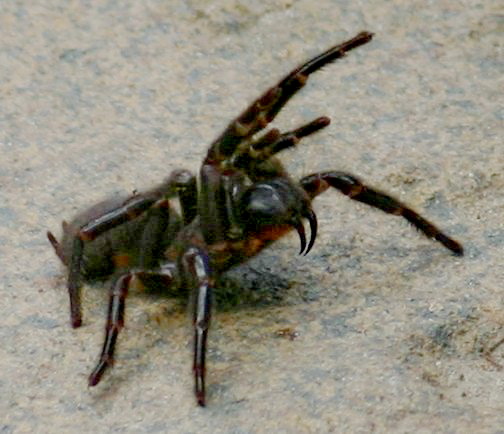
Adults have a shiny dark brown to black body with finger-like spinnerets at the end of the abdomen. The carapace is almost hairless and has a smooth, glossy appearance.[1][2]
Adult body length generally ranges from 2 to 4 centimetres. Male specimens can reach 25 mm in length, while female specimens can reach 35 mm.[3][4][5]
Males are smaller and slimmer than females but have longer legs. Adult males also have a mating spur projecting from the middle of their second pair of legs.[6][7]
The average leg length is approximately 6 to 7 centimetres.[8]
Habitat
The species inhabits bushy suburban areas, open and closed sclerophyll forests, and woodlands. It is primarily terrestrial and favours moist sand and clay habitats.[9][10]
It frequently occupies south- or east-facing slopes and shady gullies. Individuals construct burrows beneath logs, rocks and leaf litter in sheltered locations.[11][12]
The species also inhabits moist soil beneath houses, garden rockery crevices and compost heaps. Its burrows are associated with environments having stable, high humidity and low temperatures.[13][14]
Diet
Documented prey includes beetles, cockroaches, millipedes and small lizards. Other recorded prey includes insect larvae, native land snails and frogs.[15][16]
Behaviour
Individuals construct silk-lined burrows with funnel-shaped entrances and radiating silk trip-lines. They wait inside their burrows and rush out when prey touches the surrounding silk trip-lines.[17][18]
The species is predominantly active at night. Males leave their burrows and wander during summer and autumn in search of females.[19][20]
Females generally remain in one location unless flooding forces them to relocate. The spiders are solitary except during mating.[21][22]
When threatened, individuals raise their front body and display their fangs. Adult spiders respond faster than juveniles to a puff of air.[23][24]
Juveniles and adults become more defensive over time when exposed to a prod.[25]
Reproduction and life cycle
The species has separate male and female individuals. Males generally reach sexual maturity at approximately four years of age.[26][27]
Males locate females by detecting their pheromones. Females usually lay approximately 80 to 100 eggs in a silk egg sac inside their burrow.[28][29]
Females guard their egg sacs until the spiderlings hatch. Young spiders remain briefly with their mother before dispersing to establish their own burrows.[30][31]
Females can live for many years, whereas adult males survive for a much shorter period after maturity.[32]
Conservation
Recent research suggests that the species' distribution has declined in parts of Sydney. Protecting bushland and natural ground cover is identified as important for its survival.[33][34]
Uses
Silk produced by the species has been used as crosshairs in optical instruments.[35]
Classification of the Sydney Funnel-web Spider
| Kingdom | Animalia |
|---|---|
| Phylum | Arthropoda |
| Subphylum | Chelicerata |
| Class | Arachnida (Arachnid) |
| Order | Araneae (Spider) |
| Family | Atracidae (Australian Funnel-web Spider) |
| Genus | Atrax |
| Species | Atrax robustus O. Pickard-Cambridge, 1877 |
Where the Sydney Funnel-web Spider is found
Checklists and occurrence records place Atrax robustus in 1 country across Oceania. GBIF holds 550 georeferenced records of it.
Countries
Regions and cities with the most records
- New South Wales, Australia 454
- Sydney, Australia 178
- Central Coast, Australia 43
- Wollongong, Australia 27
- Queensland, Australia 5
- Coffs Harbour, Australia 4
Range as the checklists state it
Australia (New South Wales)
A number beside a place is its count of GBIF occurrence records. A place without a number comes from a checklist alone. Records show where a species has been observed or collected, which can include escapes and vagrants.
Common names
English
- Sydney Funnel-web Spider
- Sydney Funnel-Web
- Sydney Funnelweb Spider
Names in 7 other languages
- Czech
- sklípkanec jedovatý
- Danish
- Sydney tragtedderkop
- German
- Sydney-Trichternetzspinne
- Polish
- Ptasznik Australijski
- Portuguese
- Aranha-teia-de-funil-de-sydney
- Russian
- Сиднейский воронковый паук
- Swedish
- Trattminörspindel
Synonyms
2 other scientific names have been used for this species and are now treated as synonyms of Atrax robustus.
- Atrax tibialis (Rainbow, 1914)
- Euctimena tibialis Rainbow, 1914
Related species
- Newcastle Funnel-web SpiderAtrax christenseni
- Sutherland's Funnelweb SpiderAtrax sutherlandi
- Atrax yorkmainorum
- Southern Sydney Funnel-web SpiderAtrax montanus
- Northern Tree Funnel-webHadronyche formidabilis
-
 Southern Tree Funnel-webHadronyche cerberea
-
 Cascade Funnelweb SpiderHadronyche infensa
- Illawarra Funnel-web SpiderIllawarra wisharti
Compare
Questions and answers
What is the scientific name of the Sydney Funnel-web Spider?
The scientific name of the Sydney Funnel-web Spider is Atrax robustus. Written with its author, the full name is Atrax robustus O. Pickard-Cambridge, 1877.
Which family does the Sydney Funnel-web Spider belong to?
Atrax robustus belongs to the family Atracidae, in the order Araneae and the class Arachnida.
Where is the Sydney Funnel-web Spider found?
Checklists and occurrence records place Atrax robustus in 1 country: Australia.
What other names does the Sydney Funnel-web Spider have?
Atrax robustus is also known in English as Sydney Funnel-Web and Sydney Funnelweb Spider.
Sources
Passages the profile rests on
- Adults have a shiny dark brown to black body with finger-like spinnerets at the end of the abdomen. Source passage: “Sydney Funnel-webs are shiny, dark brown to black spiders with finger-like spinnerets (silk-spinning organs) at the end of their abdomen.” — australian.museum
- The carapace is almost hairless and has a smooth, glossy appearance. Source passage: “The carapace covering the cephalothorax is almost hairless and appears smooth and glossy.” — English Wikipedia
- Adult body length generally ranges from 2 to 4 centimetres. Source passage: “Adults are usually about 2 to 4 centimetres in body length.” — fieldofmar-e.schools.nsw.gov.au
- Male specimens can reach 25 mm in length. Source passage: “Males grow to 25mm long” — animaldiversity.org
- Female specimens can reach 35 mm in length. Source passage: “females grow to 35 mm long.” — animaldiversity.org
- Adult males have a mating spur projecting from the middle of their second pair of legs. Source passage: “Males have a large mating spur projecting from the middle of their second pair of legs.” — australian.museum
- Males are smaller and slimmer than females but have longer legs. Source passage: “Males are smaller, slimmer, and have longer legs.” — animaldiversity.org
- The average leg length of the spider is approximately 6 to 7 centimetres. Source passage: “The average leg length for the spider, in general, is six to seven centimetres.” — English Wikipedia
- The species inhabits bushy suburban areas, open and closed sclerophyll forests, and woodlands. Source passage: “Bushy suburban areas, open and closed sclerophyll forests and woodlands, often on south or east-facing slopes or in shady gullies.” — australian.museum
- The species is primarily terrestrial and favours moist sand and clay habitats. Source passage: “Sydney funnel-web spiders are mostly terrestrial spiders, favouring habitats with moist sand and clays.” — English Wikipedia
- It frequently occupies south- or east-facing slopes and shady gullies. Source passage: “often on south- or east-facing slopes or in shady gullies.” — fieldofmar-e.schools.nsw.gov.au
- Individuals construct burrows beneath logs, rocks and leaf litter in sheltered locations. Source passage: “Their burrows may be under logs, rocks and leaf litter, or in other protected places where the spider can stay cool and humid.” — fieldofmar-e.schools.nsw.gov.au
- The species also inhabits moist soil beneath houses, garden rockery crevices and compost heaps. Source passage: “They also live in moist soil beneath houses, crevices in garden rockeries and compost heaps.” — animaldiversity.org
- Its burrows are associated with environments having stable, high humidity and low temperatures. Source passage: “ground that has stable, high humidity and low temperatures.” — animaldiversity.org
- Its documented prey includes beetles, cockroaches, millipedes and small lizards. Source passage: “They eat beetles, cockroaches, millipedes and other small animals such as small lizards.” — fieldofmar-e.schools.nsw.gov.au
- Other recorded prey includes insect larvae, native land snails and frogs. Source passage: “The diet of Sydney funnel-web spiders consists of beetles, cockroaches, insect larvae, native land snails, millipedes and occasionally frogs and other small vertebrates.” — animaldiversity.org
- Individuals construct silk-lined burrows with funnel-shaped entrances and radiating silk trip-lines. Source passage: “They typically build silk-lined tubular burrow retreats with collapsed "tunnels" or open "funnel" entrances from which irregular trip-lines radiate over the ground.” — English Wikipedia
- Spiders wait inside their burrows and rush out when prey touches the surrounding silk trip-lines. Source passage: “They wait inside the entrance of their burrow and rush out when an animal brushes against the silk trip lines.” — fieldofmar-e.schools.nsw.gov.au
- The species is predominantly active at night. Source passage: “They are mostly active at night, which helps them avoid heat and drying daytime conditions.” — fieldofmar-e.schools.nsw.gov.au
- Males leave their burrows and wander during summer and autumn in search of females. Source passage: “Males leave their burrows and wander, mostly over summer and autumn to find females and mate.” — australian.museum
- Females generally remain in one location unless flooding forces them to relocate. Source passage: “Females tend to stay in the same location except when forced out by flooding.” — animaldiversity.org
- The spiders are solitary except during mating. Source passage: “Sydney funnel-web spiders are solitary animals except when mating.” — animaldiversity.org
- When threatened, individuals raise their front body and display their fangs. Source passage: “If threatened, both species show aggressive behaviour, rearing and displaying their impressive fangs.” — australian.museum
- Adult spiders respond faster than juveniles to a puff of air. Source passage: “Adults responded to a puff of air faster than juveniles” — pmc.ncbi.nlm.nih.gov
- Juveniles and adults become more defensive over time when exposed to a prod. Source passage: “in response to a prod, both juveniles and adults become more defensive over time.” — pmc.ncbi.nlm.nih.gov
- The species has separate male and female individuals. Source passage: “gonochoric/gonochoristic/dioecious (sexes separate)” — animaldiversity.org
- Males generally reach sexual maturity at approximately four years of age. Source passage: “Males reach sexual maturity at about four years of age” — animaldiversity.org
- Females usually lay approximately 80 to 100 eggs in a silk egg sac inside their burrow. Source passage: “A typical egg sac usually contains about 80 to 100 eggs, although some may contain more.” — fieldofmar-e.schools.nsw.gov.au
- Males locate females by detecting their pheromones. Source passage: “Males locate females by sensing the female's pheremones.” — animaldiversity.org
- Females guard their egg sacs until the spiderlings hatch. Source passage: “She guards the egg sac until the spiderlings hatch.” — fieldofmar-e.schools.nsw.gov.au
- Young spiders remain briefly with their mother before dispersing to establish their own burrows. Source passage: “Young spiders remain with the mother briefly before dispersing and making their own burrows.” — fieldofmar-e.schools.nsw.gov.au
- Females can live for many years, whereas adult males survive for a much shorter period after maturity. Source passage: “Female funnel-web spiders can live for many years, while adult males live for a much shorter time after maturity.” — fieldofmar-e.schools.nsw.gov.au
- Recent research suggests that the species' distribution has declined in parts of Sydney. Source passage: “Recent Australian Museum research suggests the range of the true Sydney funnel-web has declined in parts of Sydney” — fieldofmar-e.schools.nsw.gov.au
- Protecting bushland and natural ground cover is identified as important for the species' survival. Source passage: “protecting bushland and natural ground cover is important for the survival of this species and many other invertebrates.” — fieldofmar-e.schools.nsw.gov.au
- Silk produced by the species has been used as crosshairs in optical instruments. Source passage: “Silk made by Sydney funnel-web spiders is used as crosshairs in optical instruments.” — animaldiversity.org
Data
- Catalogue of Life, 2026-10-16 XR cc by
- Global Biodiversity Information Facility CC BY 4.0
- Wikidata CC0
- GeoNames CC BY 4.0
- Wikimedia Commons per image; credit shown with each image
- Within the Catalogue of Life, this name comes from The World Spider Catalog cc by
References
- Pickard-Cambridge, O. (1877c). On some new genera and species of Araneidea. Annals and Magazine of Natural History (4) 19(109): 26-39, pl. 6-7. doi: <a href="https://doi.org/10.1080/00222937708682093" target="_blank">10.1080/00222937708682093 Link where the name was published
This species in other databases
Page built on 24 November 2026. See how the catalog is made and all sources and licences.
Cite this page
ScientificNames.org. (2026). Atrax robustus (Sydney Funnel-web Spider). Retrieved November 24, 2026, from https://scientificnames.org/species/atrax-robustus
“Atrax robustus (Sydney Funnel-web Spider).” ScientificNames.org, 2026, scientificnames.org/species/atrax-robustus. Accessed 24 Nov. 2026.
ScientificNames.org. “Atrax robustus (Sydney Funnel-web Spider).” Accessed November 24, 2026. https://scientificnames.org/species/atrax-robustus.
@misc{scientificnames_atrax_robustus_sydney_funnel_web_spider,
  author = {{ScientificNames.org}},
  title = {Atrax robustus (Sydney Funnel-web Spider)},
  year = {2026},
  url = {https://scientificnames.org/species/atrax-robustus},
  note = {Accessed 2026-11-24}
}