Species · Flowering plants
Midgen Berry Austromyrtus dulcis
The scientific name of the Midgen Berry is Austromyrtus dulcis. It is a species of flowering plant in the family Myrtaceae (myrtle family), order Myrtales.
- Scientific name
- Austromyrtus dulcis (C.T.White) L.S.Sm.
- Common name
- Midgen Berry
- Genus
- Austromyrtus
- Family
- Myrtaceae (Myrtle Family)
- Order
- Myrtales
- Class
- Magnoliopsida
- Recorded in
- 1 country
- Name status
- accepted in the Catalogue of Life
Overview
Midgen Berry is a small, spreading shrub reaching a height of 1–2 m. It is native to eastern Australia and occurs in New South Wales and Queensland, extending from Grafton to Fraser Island. It produces sweet, dotted mauve-coloured berries containing between three and nine pale brown seeds.
Written 26 November 2026 from the sources listed below. Each statement was checked against the passage it cites; statements that could not be supported were removed.
Appearance
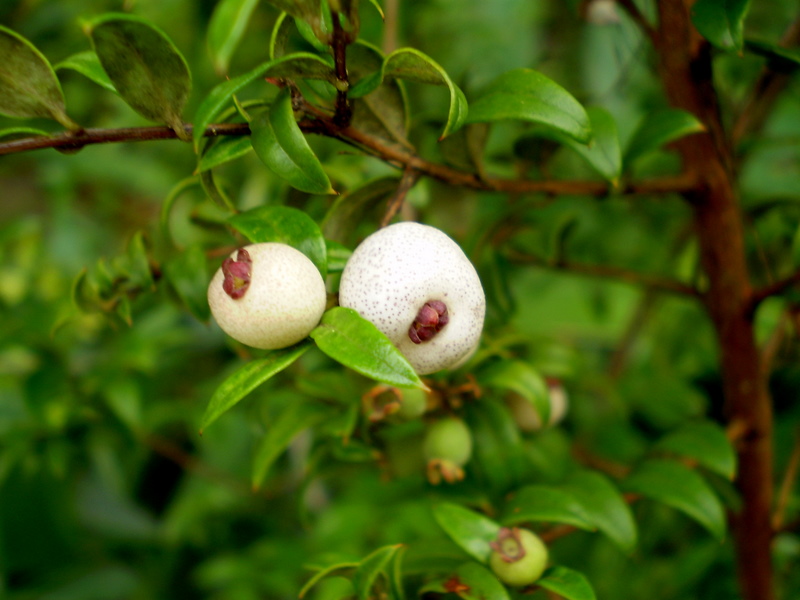
Midgen Berry is a spreading shrub that reaches 1–2 m in height. Its young growing shoots are copper-coloured and densely covered with silky hairs.[1][2][3]
Its leaves grow in opposite rows and are glossy dark green, lanceolate to elliptical, with numerous conspicuous oil glands. They measure 9–30 mm long and 3–10 mm wide, with dense appressed hairs underneath that give the undersides a pale appearance.[4][5][6][7][8][9]
Its berries are white with small blue-black spots that give them a mauvish appearance. They are dotted, mauve-coloured and sweet.[10][11]
Reproduction and life cycle
The flowers usually occur in clusters of two to five in the upper leaf axils, although solitary flowers are also common. In its natural habitat, flowering occurs during spring and summer.[12][13]
The berries usually ripen during summer and autumn. Each berry contains between three and nine pale brown seeds.[14][15]
Fresh, cleaned seeds germinate within three to four weeks. Uncleaned fruits take approximately one week longer to germinate, and the species can also be propagated through cuttings.[16][17][18]
Habitat
Midgen Berry is native to eastern Australia and occurs in New South Wales and Queensland, extending from Grafton to Fraser Island. It occurs commonly from around Valla in New South Wales to Fraser Island in Queensland.[19][20][21]
It commonly grows as an understorey plant in heathland and woodlands. Its most frequent habitats include sandy soils in heath, scrub and open forests, with occasional occurrence along rainforest margins.[22][23][24]
Diet
Its berries are edible and sweet-tasting, with a sweet, aromatic flavour and peppery or gingery notes.[25][26]
Uses
The berries are traditionally eaten as bushfood by Indigenous Australians and non-Indigenous people. They have not been commercialized because of harvesting and handling difficulties.[27][28]
The shrub is used in amenity horticulture because it adapts to various soils and climatic conditions. It performs well as a low shrub along the margins of a rainforest gully.[29][30]
Under full sun in cultivation, it forms a dense spreading shrub up to 40 cm high and 1.4 m in diameter. It also grows well in sandy coastal settings when protected from direct salt winds.[31][32]
Cultivated plants require reliable moisture and some overhead tree shelter in areas with severe frosts. The species generally requires little maintenance, with pruning needed only when a particular shape is desired.[33][34]
The plant appears relatively free from pests and diseases.[35]
Classification of the Midgen Berry
| Kingdom | Plantae |
|---|---|
| Subkingdom | Pteridobiotina |
| Phylum | Tracheophyta |
| Class | Magnoliopsida |
| Order | Myrtales |
| Family | Myrtaceae (Myrtle Family) |
| Subfamily | Myrtoideae |
| Tribe | Myrteae |
| Subtribe | Decasperminae |
| Genus | Austromyrtus |
| Species | Austromyrtus dulcis (C.T.White) L.S.Sm. |
Where the Midgen Berry is found
Checklists and occurrence records place Austromyrtus dulcis in 1 country across Oceania. GBIF holds 1,674 georeferenced records of it.
Countries
Regions and cities with the most records
- New South Wales, Australia 872
- Queensland, Australia 702
- Sunshine Coast, Australia 116
- Caloundra, Australia 84
- Gold Coast, Australia 58
- Capalaba, Australia 23
- Logan City, Australia 16
- Parramatta, Australia 13
- Brisbane, Australia 12
- Liverpool, Australia 10
- Narangba, Australia 5
- Coffs Harbour, Australia 4
- Hervey Bay, Australia 4
Range as the checklists state it
Australia (Queensland, New South Wales)
A number beside a place is its count of GBIF occurrence records. A place without a number comes from a checklist alone. Records show where a species has been observed or collected, which can include escapes and vagrants.
Common names
English
- Midgen Berry
- Migden-berry
Names in 2 other languages
- Chinese
- 蜜晶果
- Russian
- Австромирт сладкий, Австромиртус сладкий
Synonyms
2 other scientific names have been used for this species and are now treated as synonyms of Austromyrtus dulcis.
- Myrtus dulcis C.T.White
- Myrtus tenuifolia var. latifolia Maiden & Betche
Related species
-
 Narrow-leaf MyrtleAustromyrtus tenuifolia
- Austromyrtus glabra
- Austromyrtus mendute
-
 CloveSyzygium aromaticum
-
 Pineapple GuavaFeijoa sellowiana
-
 AllspicePimenta dioica
-
 JamunSyzygium cumini
-
 Rainbow EucalyptusEucalyptus deglupta
Compare
Questions and answers
What is the scientific name of the Midgen Berry?
The scientific name of the Midgen Berry is Austromyrtus dulcis. Written with its author, the full name is Austromyrtus dulcis (C.T.White) L.S.Sm..
Which family does the Midgen Berry belong to?
Austromyrtus dulcis belongs to the family Myrtaceae, in the order Myrtales and the class Magnoliopsida.
Where is the Midgen Berry found?
Checklists and occurrence records place Austromyrtus dulcis in 1 country: Australia.
What other names does the Midgen Berry have?
Austromyrtus dulcis is also known in English as Migden-berry.
What do midyim berries taste like?
They have a sweet, aromatic flavour with peppery or gingery notes.[25]
What are the ideal growing conditions for Austromyrtus dulcis?
Midgen Berry grows in sandy soils in heath, scrub and open forests, and occasionally along rainforest margins. In cultivation, it forms a dense spreading shrub under full sun and grows well in sandy coastal settings when protected from direct salt winds. Cultivated plants require reliable moisture and some overhead tree shelter in areas with severe frosts.[24][31][32][33]
Sources
Passages the profile rests on
- The species grows as a small, spreading shrub. Source passage: “Austromyrtus dulcis is a small spreading shrub” — English Wikipedia
- The shrub reaches a height of 1–2 m. Source passage: “1 to 2 m (3 ft 3 in to 6 ft 7 in) in height.” — English Wikipedia
- Its young growing shoots are copper-coloured and densely covered with silky hairs. Source passage: “The young coppery coloured growing shoots are densely silky hairy.” — anbg.gov.au
- Its leaves are opposite, lanceolate to elliptical, glossy on the upper surface and covered with silky hairs underneath. Source passage: “The leaves are 1–3 cm long and 0.5 cm wide, opposite, lanceolate to elliptical, glossy above with silky hairs beneath.” — English Wikipedia
- Its leaves are 1–3 cm long and approximately 0.5 cm wide. Source passage: “The leaves are 1–3 cm long and 0.5 cm wide” — English Wikipedia
- Its leaves are glossy dark green and lanceolate, with numerous conspicuous oil glands. Source passage: “The leaves of A. dulcis are glossy dark green lanceolate 9-30 mm long by 3-10 mm wide with numerous conspicuous oil glands.” — anbg.gov.au
- Its leaves measure 9–30 mm long and 3–10 mm wide. Source passage: “9-30 mm long by 3-10 mm wide” — anbg.gov.au
- Its leaves grow in opposite rows. Source passage: “They are arranged in opposite rows.” — anbg.gov.au
- The undersides of its leaves have dense appressed hairs that give them a pale appearance. Source passage: “The undersurface of the leaves has a dense covering of appressed hairs giving it a pale appearance.” — anbg.gov.au
- Its berries are dotted, mauve-coloured and sweet. Source passage: “dotted mauve sweet edible berries” — English Wikipedia
- Its berries are white with small blue-black spots that give them a mauvish appearance. Source passage: “They are white and covered in small blue black spots, giving the fruit a mauvish appearance.” — anbg.gov.au
- Its flowers usually occur in clusters of two to five in the upper leaf axils, although solitary flowers are also common. Source passage: “They are usually borne in clusters of 2-5 flowers in the upper axils, although solitary flowers are also common.” — anbg.gov.au
- In its natural habitat, it flowers during spring and summer. Source passage: “In its natural habitat A. dulcis flowers in spring and summer” — anbg.gov.au
- Its berries contain between three and nine pale brown seeds. Source passage: “contain three to nine pale brown seeds.” — English Wikipedia
- The berries usually ripen during summer and autumn. Source passage: “berries that usually ripen in summer and autumn.” — English Wikipedia
- Fresh, cleaned seeds germinate within three to four weeks. Source passage: “Fresh cleaned seed germinates in 3-4 weeks” — anbg.gov.au
- Uncleaned fruits take approximately one week longer to germinate than fresh, cleaned seeds. Source passage: “while uncleaned fruits take about a week longer.” — anbg.gov.au
- The species can be propagated through cuttings. Source passage: “Propagation from cuttings is also easy.” — anbg.gov.au
- The species is native to eastern Australia. Source passage: “Austromyrtus dulcis is a species of plant native to eastern Australia.” — English Wikipedia
- It occurs in New South Wales and Queensland, extending from Grafton to Fraser Island. Source passage: “The species occurs in New South Wales and Queensland, from Grafton to Fraser Island.” — English Wikipedia
- The species occurs commonly from around Valla in New South Wales to Fraser Island in Queensland. Source passage: “occurs commonly from around Valla, New South Wales, to Fraser Island, Queensland” — anbg.gov.au
- It commonly grows as an understorey plant in heathland and woodlands. Source passage: “It occurs as a common understorey plant of heathland and woodlands” — English Wikipedia
- It grows on sandy soils and occasionally along rainforest margins. Source passage: “also growing on sandy soils and occasionally on the margins of rainforests.” — English Wikipedia
- Its most frequent habitats include sandy soils in heath, scrub and open forests, with occasional occurrence along rainforest margins. Source passage: “Its most frequent occurrence is in sandy soils in heath, scrub or open forests and occasionally on the margins of rainforests.” — anbg.gov.au
- Its berries are edible and have a sweet, aromatic flavour with peppery or gingery notes. Source passage: “The melt-in-the-mouth berries are sweet and aromatic, with a pleasant peppery/gingery flavour.” — English Wikipedia
- Its berries are edible and sweet-tasting. Source passage: “The fruit are edible and have a sweet taste.” — anbg.gov.au
- Its berries are traditionally eaten as bushfood by Indigenous Australians and non-Indigenous people. Source passage: “The berries are a popular traditional bushfood, eaten by indigenous Australians and non-indigenous people.” — English Wikipedia
- The berries have not been commercialized because of harvesting and handling difficulties. Source passage: “the berries have not been commercialized due to harvesting and handling issues.” — English Wikipedia
- The shrub is used in amenity horticulture because it adapts to various soils and climatic conditions. Source passage: “Midgim is also popular in amenity horticulture as an adaptable shrub for a variety of situations, handling a range of soils and climatic conditions.” — English Wikipedia
- The species performs well in cultivation as a low shrub along the margins of a rainforest gully. Source passage: “The species has been performing well in cultivation at the Australian National Botanic Gardens as a low shrub on the margins of the rainforest gully.” — anbg.gov.au
- Under full sun in cultivation, it forms a dense spreading shrub up to 40 cm high and 1.4 m in diameter. Source passage: “In full sun it forms a dense spreading shrub up to 40 cm high by 1.4 m in diameter” — anbg.gov.au
- It forms an excellent shrub in sandy coastal settings when protected from direct salt winds. Source passage: “It forms an excellent shrub in sandy coastal situations where not directly exposed to salt winds.” — anbg.gov.au
- Cultivated plants require reliable moisture and some overhead tree shelter in areas with severe frosts. Source passage: “Other requirements for cultivation are an assured moisture level and some overhead tree shelter in areas of severe frosts.” — anbg.gov.au
- The species generally requires little maintenance, with pruning needed only when a particular shape is desired. Source passage: “Little maintenance is required and pruning is only necessary to achieve a particular shape such as. a low hedge.” — anbg.gov.au
- The plant appears relatively free from pests and diseases. Source passage: “The plant appears relatively free from pests and diseases.” — anbg.gov.au
Data
- Catalogue of Life, 2026-10-16 XR cc by
- Global Biodiversity Information Facility CC BY 4.0
- Wikidata CC0
- GeoNames CC BY 4.0
- Wikimedia Commons per image; credit shown with each image
- Within the Catalogue of Life, this name comes from Synonymic Checklists of the Vascular Plants of the World cc by
References
- L.S.Sm. (1956). Proc. Roy. Soc. Queensland 67: 35 (1956). where the name was published
This species in other databases
- Catalogue of Life JXHC
- Wikidata Q4056140
- iNaturalist 429695
- World Flora Online wfo-0000302302
- GRIN 312570
Page built on 27 November 2026. See how the catalog is made and all sources and licences.
Cite this page
ScientificNames.org. (2026). Austromyrtus dulcis (Midgen Berry). Retrieved November 27, 2026, from https://scientificnames.org/species/austromyrtus-dulcis
“Austromyrtus dulcis (Midgen Berry).” ScientificNames.org, 2026, scientificnames.org/species/austromyrtus-dulcis. Accessed 27 Nov. 2026.
ScientificNames.org. “Austromyrtus dulcis (Midgen Berry).” Accessed November 27, 2026. https://scientificnames.org/species/austromyrtus-dulcis.
@misc{scientificnames_austromyrtus_dulcis_midgen_berry,
  author = {{ScientificNames.org}},
  title = {Austromyrtus dulcis (Midgen Berry)},
  year = {2026},
  url = {https://scientificnames.org/species/austromyrtus-dulcis},
  note = {Accessed 2026-11-27}
}