Species · Birds
Greater Scaup Aythya marila
The scientific name of the Greater Scaup is Aythya marila. It is a species of bird in the family Anatidae (ducks), order Anseriformes. The name dates from 1761.
- Scientific name
- Aythya marila (Linnaeus, 1761)
- Common name
- Greater Scaup
- Genus
- Aythya
- Family
- Anatidae (Ducks)
- Order
- Anseriformes
- Class
- Aves
- Red List category
- LC Least Concern
- Environment
- freshwater, marine, terrestrial
- Recorded in
- 82 countries
- Name status
- accepted in the Catalogue of Life

Overview
Aythya marila breeds in Arctic regions of the Palearctic and Nearctic and winters along the coasts of North America, northwest Europe, and parts of Asia. It is distinguished by the male's dark iridescent head, black breast, pale back, and white underside, and the female's predominantly brown plumage.
Written 26 November 2026 from the sources listed below. Each statement was checked against the passage it cites; statements that could not be supported were removed.
Appearance
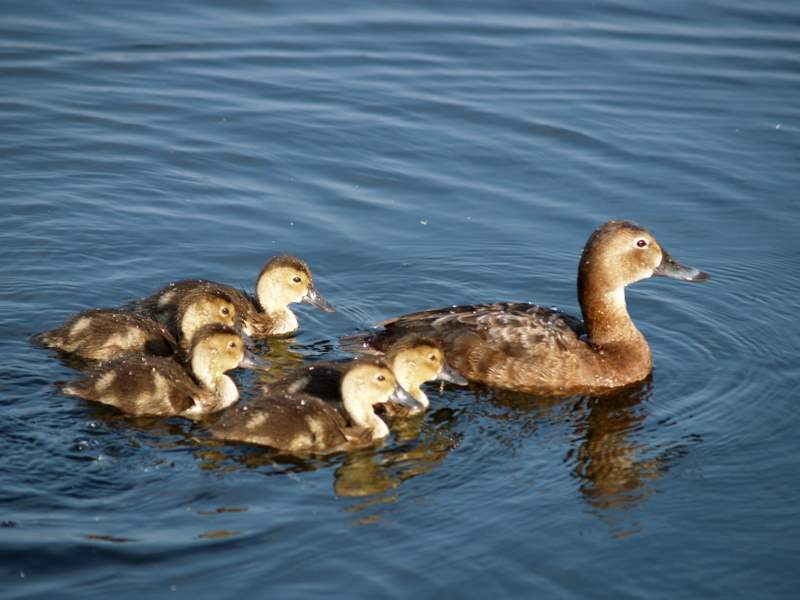
Adult females have predominantly brown bodies and heads with white markings on their wings. They have a white band and brown oval-shaped patches at the base of the bill.[1][2]
Both sexes have grey legs and feet. The species has a light blue bill with a small black nail at its tip and yellow eyes.[3][4]
Juveniles resemble adult females.[5]
Adults measure 39–56 cm in length, have a wingspan of 71 to 84 cm, and weigh between 726 and 1,360 g.[6][7][8]
Habitat
Greater Scaups breed in tundra and boreal forest environments. They typically nest on islands in large northern lakes.[9][10]
Summer habitat includes marshy lowland tundra and islands in freshwater lakes.[11]
During winter, Greater Scaups inhabit coastal bays, estuaries, and occasionally inland lakes.[12]
Diet
Greater Scaups primarily consume molluscs, aquatic plants, and aquatic insects. During summer, their diet also includes small aquatic crustaceans.[13][14]
In freshwater ecosystems, they consume seeds, leaves, stems, and roots of aquatic vegetation. Their plant foods include sedges, pondweeds, muskgrass, and American eelgrass.[15][16]
Behaviour
Greater Scaups obtain food by diving underwater. They can dive to depths of 6–10 metres and remain submerged for up to one minute.[17][18]
They form large aggregations known as rafts, sometimes numbering thousands of individuals.[19]
The species is mostly migratory, although small populations remain year-round in Iceland and the Aleutian Islands.[20]
Reproduction and life cycle
Greater Scaups generally begin breeding at two years of age, although nesting may begin at one year. Courtship takes place during the return migration to northern breeding grounds, from late winter to early spring, and results in the formation of monogamous pairs.[21][22][23]
Females lay clutches of six to nine olive-buff-coloured eggs. Egg incubation lasts between 24 and 28 days.[24][25]
Newly hatched ducklings can walk, swim, and feed themselves soon after hatching. Young Greater Scaups cannot fly until approximately 40–45 days after hatching.[26][27]
Conservation
The IUCN classifies Greater Scaup as a species of Least Concern. However, Greater Scaup populations have declined steadily since the 1980s.[28][29]
Habitat loss, contaminants, changes in breeding habitat, and reduced female survival are identified as factors contributing to population decline. Entanglement in fishing nets also threatens Greater Scaups and causes many individuals to drown annually.[30][31]
Uses
Greater Scaups are hunted as game birds in North America and Europe.[32]
Classification of the Greater Scaup
| Kingdom | Animalia |
|---|---|
| Phylum | Chordata |
| Subphylum | Vertebrata |
| Infraphylum | Gnathostomata |
| Parvphylum | Osteichthyes |
| Megaclass | Tetrapoda |
| Class | Aves (Bird) |
| Order | Anseriformes (Ducks) |
| Family | Anatidae (Ducks) |
| Genus | Aythya (Diving Ducks) |
| Species | Aythya marila (Linnaeus, 1761) |
Where the Greater Scaup is found
Checklists and occurrence records place Aythya marila in 82 countries across Asia, North America and Oceania. GBIF holds 1,468,554 georeferenced records of it.
Countries
- Aland Islands 266
- Armenia 4
- Aruba 9
- Austria 813
- Azerbaijan 45
- Bahamas 8
- Bangladesh 5
- Belarus 300
- Belgium 6,814
- Belize 10
- Bermuda 339
- Bhutan 16
- Bosnia and Herzegovina 5
- Bulgaria 183
- Cambodia 3
- Canada 294,919
- China 1,980
- Costa Rica 65
- Croatia 90
- Czechia 1,495
- Denmark 47,093
- Dominican Republic 5
- Estonia 13,012
- Faroe Islands 129
- Finland 6,789
- France 7,425
- Georgia 12
- Germany 6,237
- Greece 90
- Greenland 10
- Guadeloupe 13
- Guatemala 30
- Hong Kong 253
- Hungary 348
- Iceland 10,183
- India 295
- Iran 8
- Ireland 1,318
- Isle of Man 25
- Israel 22
- Italy 820
- Japan 20,453
- Jersey 4
- Kazakhstan 88
- Kuwait 9
- Kyrgyzstan 26
- Latvia 329
- Lithuania 412
- Luxembourg 9
- Mexico 232
- Moldova 7
- Mongolia 39
- Montenegro 5
- Myanmar 7
- Nepal 11
- Nicaragua 6
- North Korea 13
- Norway 48,607
- Philippines 117
- Poland 5,290
- Portugal 2,511
- Romania 245
- Russia 7,407
- Saint Pierre and Miquelon 458
- Serbia 268
- Slovakia 200
- Slovenia 100
- South Korea 2,537
- Spain 2,881
- Svalbard and Jan Mayen 14
- Sweden 146,158
- Switzerland 772
- Taiwan 5,399
- Thailand 33
- The Netherlands 15,041
- Turkey 171
- Ukraine 621
- United Arab Emirates 6
- United Kingdom 37,204
- United States 769,290
- United States Minor Outlying Islands 83
- Vietnam 5
Regions and cities with the most records
- Ontario, Canada 133,781
- California, United States 87,475
- New York, United States 79,120
- Washington, United States 51,571
- Quebec, Canada 49,805
- British Columbia, Canada 48,007
- Alaska, United States 42,694
- Michigan, United States 40,627
- Wisconsin, United States 40,455
- Alameda, United States 34,871
- San Francisco, United States 34,826
- Bayview-Hunters Point, United States 34,273
- Toronto, Canada 33,651
- Etobicoke, Canada 33,367
- Albany, United States 32,952
- Oakland, United States 32,489
- Massachusetts, United States 32,385
- Berkeley, United States 31,588
- Illinois, United States 31,025
- England, United Kingdom 28,060
- Kalmar, Sweden 27,115
- Ohio, United States 26,324
- El Cerrito, United States 25,733
- Richmond, United States 25,323
- Oregon, United States 25,319
- South San Francisco, United States 24,551
- Orinda, United States 24,445
- Willowdale, Canada 23,749
- San Leandro, United States 22,980
- San Pablo, United States 22,869
- New Jersey, United States 22,141
- San Lorenzo, United States 21,869
- Moraga, United States 21,638
- Maryland, United States 20,928
- Pennsylvania, United States 20,122
- Lafayette, United States 19,737
1 more country has a few records outside this range
These countries hold a few records of Aythya marila but lie outside the range the checklists give for it. Such records are often zoo or garden specimens, museum material or vagrants, so the species is not counted as occurring there.
Range as the checklists state it
Europe & Northern Asia (excluding China)
North America
Southern Asia
Caribbean
A number beside a place is its count of GBIF occurrence records. A place without a number comes from a checklist alone. Records show where a species has been observed or collected, which can include escapes and vagrants.
Common names
English
- Greater Scaup
- Big Black-head
- Bluebill
- Scaup Duck
- Shuffler
- Scaup
Names in 72 other languages
- Albanian
- laramani, rosa kredharake, rosa zhytëse
- Arabic
- بط أسكوبي كبير, بط إسكوبي, بط إسكوبي كبير
- Armenian
- Սուզաբադ ծովային
- Asturian
- Coríu les Amasueles, coríu calón de les amasueles
- Azerbaijani
- Dəniz qaraördəyi
- Basque
- Murgilari handi
- Belarusian
- Нырок-плёсаўка
- Bengali
- বড় স্কপ
- Breton
- Morilhon louet
- Bulgarian
- Планинска потапница
- Catalan
- morell buixot
- Chinese
- 斑背潛鴨, 斑背潜鸭
- Croatian
- Patka crnika, patka crninka
- Czech
- polák kaholka
- Danish
- bjergand
- Dutch
- topper, toppereend
- Esperanto
- Rokanaso, granda merganaso
- Estonian
- merivart
- Faroese
- Grábøka, grábøkut ont
- Finnish
- lapasotka
- French
- Fuligule milouinan
- Georgian
- ზღვის ყვინთია
- German
- Bergente
- Greek
- (Μεγάλη) Σταχτόπαπια, Μαριλόπαπια, Σταχτόπαπια
- Hebrew
- מרילה צולל ימי, צולל ימי
- Hungarian
- hegyi réce
- Icelandic
- Duggönd
- Irish
- Lacha iascán mór
- Italian
- moretta grigia
- Japanese
- スズガモ
- Kazakh
- Айдарсыз сүњгуір, Теңіз сүңгуірі
- Korean
- 검은머리흰죽지
- Latvian
- ķerra
- Lithuanian
- žiloji antis
- Luxembourgish
- Biergint
- Macedonian
- Морска патка, морски кожувар
- Maltese
- Brajmla Rasha Sewda
- Mongolian
- Тэнгисийн шумбуур
- Nepali
- कालोटाउके हाँस
- Northern Sami
- Fiehta, stuorrafiehta
- Norwegian
- bergand
- Persian
- اردک سرسیاه, اردک سرسیاه بزرگ
- Polish
- ogorzałka, ogorzałka (zwyczajna)
- Portuguese
- negrelho, negrelho-comum, zarro-bastardo
- Romanian
- Raţă cu cap negru, Rață cu cap negru, raţa cu cap negru, raţa cu capul negru
- Russian
- Чернеть морская, морская чернеть
- Scottish Gaelic
- Lach mhara, lach-mhara, lacha iascán, lachan-mara
- Serbian
- Morska crnka, морска црнка
- Slovak
- chochlačka morská
- Slovenian
- rjavka
- Spanish
- Pato Boludo Mayor, Pato boludo-mayor, Pato pechiblanco mayor, Porrón Mayor, Porrón bastardo
- Thai
- เป็ดดำหลังขาว, เป็ดดำใหญ่
- Turkish
- karabas patka, karabaş patka
- Ukrainian
- Морська чернь, Чернь морська
- Vietnamese
- Vịt biển
- Welsh
- Hwyaid Penddu, hwyaden benddu
- arg
- Cabezudo gran
- chv
- Тинӗс улачи
- cor
- Hos pendu
- esu
- allgirneq, kep'alek
- frr
- Beragan
- fry
- Jolling
- glv
- Thunnag chlaiginagh, Thunnag varrey
- kom
- Ыджыд турунчӧж
- lut
- bəlidəgʷəs
- oji
- ᑕᑲ.ᑯᔑᑊ ᒪᒋ ᑕᑲᐧᑯᔑᑊ
- pcd
- Cuymer
- pnb
- وڈا سکاؤپ
- roh
- Anda da muntogna
- sah
- Муора ханайа
- tyv
- Далай шымныраа
- yid
- באַרג־ענטל
Synonyms
7 other scientific names have been used for this species and are now treated as synonyms of Aythya marila.
- Anas albifrons Pallas, PS, 1764
- Anas frenata Sparrman, A, 1786
- Fuligula gesneri Eyton, TC, 1836
- Fuligula marila C.Linnaeus, 1761
- Fulix marila Linnaeus, C, 1761
- Marila marila Linnaeus, C, 1761
- Nyroca marila (Linnaeus, 1761)
Subspecies and varieties
- Aythya marila marila (Eurasian Greater Scaup) subspecies
- Aythya marila nearctica (Pacific Scaup) subspecies
Related species
-
 Tufted DuckAythya fuligula
-
 Common PochardAythya ferina
-
 CanvasbackAythya valisineria
-
 RedheadAythya americana
-
 Ring-necked DuckAythya collaris
-
 Lesser ScaupAythya affinis
-
 Ferruginous DuckAythya nyroca
-
 Madagascar PochardAythya innotata
Compare
Questions and answers
What is the scientific name of the Greater Scaup?
The scientific name of the Greater Scaup is Aythya marila. Written with its author, the full name is Aythya marila (Linnaeus, 1761).
Which family does the Greater Scaup belong to?
Aythya marila belongs to the family Anatidae, in the order Anseriformes and the class Aves.
Where is the Greater Scaup found?
Checklists and occurrence records place Aythya marila in 82 countries, including United States, Canada, Sweden, Norway, Denmark and United Kingdom.
What is the conservation status of the Greater Scaup?
The IUCN Red List category recorded for Aythya marila is Least Concern (LC).
What other names does the Greater Scaup have?
Aythya marila is also known in English as Big Black-head, Bluebill, Scaup Duck, Shuffler and Scaup.
Are Greater Scaup rare?
The IUCN classifies Greater Scaup as a species of Least Concern. However, their populations have declined steadily since the 1980s.[28][29]
What do scaup ducks eat?
Greater Scaups primarily eat molluscs, aquatic plants, and aquatic insects. Their summer diet also includes small aquatic crustaceans, while freshwater plant foods include sedges, pondweeds, muskgrass, and American eelgrass.[13][14][16]
Where do scaup ducks live?
Greater Scaups breed in Arctic regions of the Palearctic and Nearctic, including Iceland, Scandinavia, northern Russia, Siberia, Alaska, and northern Canada. Their wintering areas include the Pacific and Atlantic coasts of North America, northwest Europe, the Caspian Sea, the Black Sea, Japan, the Yellow Sea, and the East China Sea.[33][34][35]
Sources
Passages the profile rests on
- Adult females have predominantly brown bodies and heads with white markings on their wings. Source passage: “The adult female has a brown body and head, with white wing markings similar to those of the male but slightly duller.” — English Wikipedia
- Female Greater Scaups have a white band and brown oval-shaped patches at the base of the bill. Source passage: “It has a white band and brown oval shaped patches at the base of the bill” — English Wikipedia
- Both sexes have grey legs and feet. Source passage: “Legs and feet of both sexes are grey.” — English Wikipedia
- The species has a light blue bill with a small black nail at its tip and yellow eyes. Source passage: “It has a light blue bill with a small black nail on the tip, yellow eyes” — English Wikipedia
- Juvenile Greater Scaups resemble adult females. Source passage: “Juvenile greater scaup look similar to adult females.” — English Wikipedia
- Adults measure 39–56 cm in length. Source passage: “The adult greater scaup is 39–56 cm (15–22 in) long” — English Wikipedia
- The wingspan ranges from 71 to 84 cm. Source passage: “with a 71–84 cm (28–33 in) wingspan” — English Wikipedia
- Adult body weight ranges from 726 to 1,360 g. Source passage: “and a weight of 726–1,360 g (1.601–2.998 lb).” — English Wikipedia
- Greater Scaups breed in tundra and boreal forest environments. Source passage: “Greater scaup breed in the tundra and the boreal forest” — English Wikipedia
- They typically nest on islands in large northern lakes. Source passage: “They typically nest on islands in large northern lakes.” — English Wikipedia
- Summer habitat includes marshy lowland tundra and islands in freshwater lakes. Source passage: “The summer habitat is marshy lowland tundra and islands in fresh water lakes.” — English Wikipedia
- During winter, Greater Scaups inhabit coastal bays, estuaries, and occasionally inland lakes. Source passage: “During the winter months, they are found in coastal bays, estuaries, and sometimes inland lakes” — English Wikipedia
- Greater Scaups primarily consume molluscs, aquatic plants, and aquatic insects. Source passage: “They mainly eat molluscs, aquatic plants, and aquatic insects.” — English Wikipedia
- During summer, their diet includes small aquatic crustaceans. Source passage: “During the summer months, the greater scaup will eat small aquatic crustaceans.” — English Wikipedia
- In freshwater ecosystems, they consume seeds, leaves, stems, and roots of aquatic vegetation. Source passage: “In freshwater ecosystems, the greater scaup will eat seeds, leaves, stems and roots” — English Wikipedia
- Their freshwater plant foods include sedges, pondweeds, muskgrass, and American eelgrass. Source passage: “along with sedges, pondweeds, muskgrass, and American eelgrass.” — English Wikipedia
- Greater Scaups obtain food by diving underwater. Source passage: “The greater scaup dive to obtain food, which they eat on the surface.” — English Wikipedia
- They can dive to depths of 6–10 metres and remain submerged for up to one minute. Source passage: “the greater scaup's webbed feet and weight, it can dive up to 6–10 metres (20–30 ft) and stay submerged for up to a minute.” — English Wikipedia
- Greater Scaups form large aggregations known as rafts, sometimes numbering thousands of individuals. Source passage: “They form large groups, called "rafts", that can number in the thousands.” — English Wikipedia
- The species is mostly migratory, although small populations remain year-round in Iceland and the Aleutian Islands. Source passage: “It is mostly migratory, but small numbers are present in Iceland and the Aleutian Islands year round.” — English Wikipedia
- Greater Scaups generally begin breeding at two years of age, although nesting may begin at one year. Source passage: “Greater scaup begin breeding when they are two years old, although they may start nesting at age one.” — English Wikipedia
- Courtship takes place during the return migration to northern breeding grounds, from late winter to early spring. Source passage: “which takes place from late winter to early spring, on the way back to their northern breeding grounds.” — English Wikipedia
- Courtship results in the formation of monogamous pairs. Source passage: “The courtship is complex and results in the formation of monogamous pairs.” — English Wikipedia
- Females lay clutches of six to nine olive-buff-coloured eggs. Source passage: “The female lays six to nine olive-buff-coloured eggs” — English Wikipedia
- Egg incubation lasts between 24 and 28 days. Source passage: “which she incubates for 24–28 days.” — English Wikipedia
- Newly hatched ducklings can walk, swim, and feed themselves soon after hatching. Source passage: “The newly hatched ducklings are covered with down and are soon able to walk, swim, and feed themselves” — English Wikipedia
- Young Greater Scaups cannot fly until approximately 40–45 days after hatching. Source passage: “they are not able to fly until 40–45 days after hatching.” — English Wikipedia
- The IUCN classifies Greater Scaup as a species of Least Concern. Source passage: “Greater scaup are rated as a species of least concern by the IUCN Redlist.” — English Wikipedia
- Greater Scaup populations have declined steadily since the 1980s. Source passage: “Since the 1980s, scaup populations have been steadily decreasing.” — English Wikipedia
- Habitat loss, contaminants, changes in breeding habitat, and reduced female survival are identified as factors contributing to population decline. Source passage: “Some of the primary factors contributing to this decline are habitat loss, contaminants, changes in breeding habitat, and a lower female survival rate.” — English Wikipedia
- Greater Scaups are threatened by entanglement in fishing nets, which causes many individuals to drown annually. Source passage: “Greater scaup often become entangled in fishing nets, and large numbers of them drown in this way each year.” — English Wikipedia
- Greater Scaups are hunted as game birds in North America and Europe. Source passage: “Greater scaup are a popular game bird in North America and Europe.” — English Wikipedia
- The species has a circumpolar breeding distribution in the Arctic regions of the Palearctic and Nearctic. Source passage: “The greater scaup has a circumpolar distribution, breeding within the Arctic Circle both in the Old World (the Palearctic) and in North America (the Nearctic).” — English Wikipedia
- Summer breeding areas include Iceland, Scandinavia, northern Russia, Siberia, Alaska, and northern Canada. Source passage: “It spends the summer months in Iceland, east across Scandinavia, northern Russia and Siberia, Alaska, and northern Canada.” — English Wikipedia
- Wintering areas include the Pacific and Atlantic coasts of North America, northwest Europe, the Caspian Sea, the Black Sea, Japan, the Yellow Sea, and the East China Sea. Source passage: “They winter along the Pacific and Atlantic coasts of North America, the coasts of northwest Europe, the Caspian Sea, the Black Sea, the coast of Japan, Yellow Sea and East China Sea.” — English Wikipedia
Data
- Catalogue of Life, 2026-10-16 XR cc by
- Global Biodiversity Information Facility CC BY 4.0
- Wikidata CC0
- GeoNames CC BY 4.0
- Wikimedia Commons per image; credit shown with each image
- Within the Catalogue of Life, this name comes from The Integrated Taxonomic Information System cc0
References
- Fauna Svecica, ed. 2: 39. 1761 where the name was published
- Banks, R. C., R. W. McDiarmid, and A. L. Gardner. (1987). Checklist of Vertebrates of the United States, the U.S. Territories, and Canada. Resource Publication, No. 166.
- Gill, Frank, & and Minturn Wright. (2006). Birds of the World: Recommended English Names.
- Dickinson, E. C., and J. V. Remsen Jr., eds. (2013). The Howard and Moore Complete Checklist of the Birds of the World, 4th Edition, Vol. 1 Non-Passerines.
This species in other databases
- Catalogue of Life K56W
- Wikidata Q26635
- iNaturalist 7047
- WoRMS urn:lsid:marinespecies.org:taxname:159172
- Avibase gresca
Page built on 26 November 2026. See how the catalog is made and all sources and licences.
Cite this page
ScientificNames.org. (2026). Aythya marila (Greater Scaup). Retrieved November 26, 2026, from https://scientificnames.org/species/aythya-marila
“Aythya marila (Greater Scaup).” ScientificNames.org, 2026, scientificnames.org/species/aythya-marila. Accessed 26 Nov. 2026.
ScientificNames.org. “Aythya marila (Greater Scaup).” Accessed November 26, 2026. https://scientificnames.org/species/aythya-marila.
@misc{scientificnames_aythya_marila_greater_scaup,
  author = {{ScientificNames.org}},
  title = {Aythya marila (Greater Scaup)},
  year = {2026},
  url = {https://scientificnames.org/species/aythya-marila},
  note = {Accessed 2026-11-26}
}