Species · Ferns and allies
Pacific Azolla Azolla filiculoides
The scientific name of the Pacific Azolla is Azolla filiculoides. It is a species of fern or lycophyte in the family Salviniaceae (floating-fern family), order Salviniales.
- Scientific name
- Azolla filiculoides Lam.
- Common name
- Pacific Azolla
- Genus
- Azolla
- Family
- Salviniaceae (Floating-fern Family)
- Order
- Salviniales
- Class
- Polypodiopsida
- Recorded in
- 62 countries
- Name status
- accepted in the Catalogue of Life

Overview
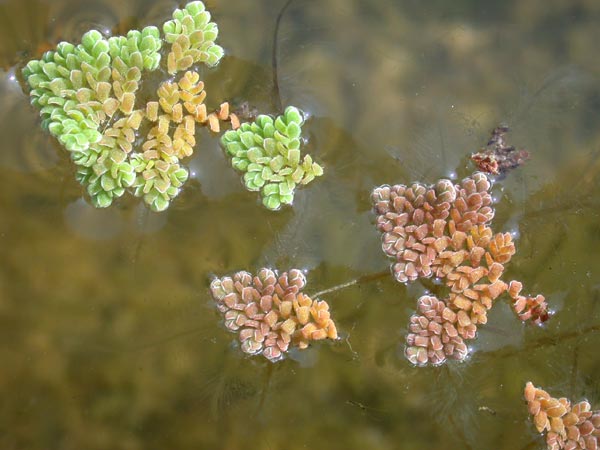
Pacific azolla is a floating aquatic fern. It grows floating on the surfaces of lakes. It hosts the nitrogen-fixing organism Anabaena azollae in specialized pockets within its leaves.
Written 24 November 2026 from the sources listed below. Each statement was checked against the passage it cites; statements that could not be supported were removed.
Appearance
Individual plants measure approximately 1–2 cm across. The plant is green with pink, orange, or red coloration along its edges.[1][2]
The plant branches freely as it grows.[3]
Habitat
Pacific azolla grows floating on the surfaces of lakes.[4]
Behaviour
The species can cover an entire lake surface within a few months. It is intolerant of cold temperatures.[5][6]
Reproduction and life cycle
In temperate regions, the plant largely dies back during winter but survives through submerged buds.[7]
Similar species
Pacific azolla can be distinguished from Azolla cristata by examining the trichomes on the upper leaf surfaces. Its trichomes are unicellular, whereas those of Azolla cristata are two-celled and septate.[8][9]
Pacific azolla is smaller than Azolla pinnata.[10]
Uses
Pacific azolla is cultivated for its nitrogen-fixing ability to enhance the growth of crops grown in water, including rice. It can also be harvested from lakes and used as green manure.[11][12]
The species is frequently cultivated in aquariums and ponds. It can become dominant over other species in these environments.[13][14]
Conservation
In introduced regions, Pacific azolla can grow rapidly, particularly in nutrient-rich aquatic ecosystems. Dense growth can outcompete native aquatic plants.[15][16]
Dense mats reduce light penetration into the water. Decomposition of plant detritus within these mats can create anaerobic aquatic conditions.[17][18]
Dense mats can substantially reduce water quality, aquatic biodiversity, and ecosystem functioning.[19]
Classification of the Pacific Azolla
| Kingdom | Plantae |
|---|---|
| Subkingdom | Pteridobiotina |
| Phylum | Tracheophyta |
| Class | Polypodiopsida (Fern) |
| Order | Salviniales |
| Family | Salviniaceae (Floating-fern Family) |
| Genus | Azolla (Water Fern) |
| Species | Azolla filiculoides Lam. |
Where the Pacific Azolla is found
Checklists and occurrence records place Azolla filiculoides in 62 countries across Africa, Asia, Europe, North America and South America. GBIF holds 42,269 georeferenced records of it.
Countries where it is native or its origin is not stated
- Argentina 298
- Australia 319
- Bolivia 90
- Brazil 535
- Canada 84
- Chile 247
- Colombia 478
- Costa Rica 5
- Cuba 5
- Ecuador 63
- El Salvador
- Guatemala 16
- Honduras 9
- Kenya 8
- Madagascar 38
- Malawi 4
- Mexico 289
- Mozambique 5
- Nicaragua 2
- Paraguay 30
- Peru 94
- Puerto Rico 3
- Rwanda 4
- Saint Helena 8
- Tanzania 11
- The Netherlands 11,298
- Trinidad and Tobago 13
- Uganda 6
- Uruguay 144
- Venezuela 15
- Zambia 7
Countries where it has been introduced
- Albania
- Bangladesh 1
- Belgium 2,387
- China 25
- Croatia 2
- Czechia 14
- Egypt 6
- France 5,791
- Germany 829
- Greece 12
- Hungary 21
- India 13
- Iraq 3
- Ireland 157
- Italy 194
- Japan 630
- Lesotho
- Moldova 1
- Morocco 3
- Namibia 1
- Nepal 25
- Portugal 253
- Romania 131
- Slovakia 16
- South Africa 242
- Spain 1,064
- Taiwan 34
- Tajikistan
- United Kingdom 13,299
- United States 2,982
- Zimbabwe 5
Regions and cities with the most records
- England, United Kingdom 11,785
- Gouda, The Netherlands 3,253
- Woerden, The Netherlands 2,945
- Alphen aan den Rijn, The Netherlands 2,854
- Zoetermeer, The Netherlands 2,809
- Capelle aan den IJssel, The Netherlands 2,789
- Rotterdam, The Netherlands 2,304
- Ridderkerk, The Netherlands 2,291
- Leiden, The Netherlands 1,931
- Dordrecht, The Netherlands 1,785
- Nieuwegein, The Netherlands 1,753
- Zwijndrecht, The Netherlands 1,706
- Utrecht, The Netherlands 1,668
- Schiedam, The Netherlands 1,626
- Delft, The Netherlands 1,613
- The Hague, The Netherlands 1,452
- Rijswijk, The Netherlands 1,451
- Utrecht, The Netherlands 1,430
- California, United States 1,396
- Vlaardingen, The Netherlands 1,312
- Amstelveen, The Netherlands 1,291
- Hoofddorp, The Netherlands 1,165
- Spijkenisse, The Netherlands 1,155
- Hilversum, The Netherlands 1,111
- Amsterdam, The Netherlands 995
- Zeist, The Netherlands 970
- Centre-Val de Loire, France 933
- Hauts-de-France, France 930
- Soest, The Netherlands 810
- Auvergne-Rhône-Alpes, France 716
- Friesland, The Netherlands 642
- Zaandam, The Netherlands 595
- Wales, United Kingdom 593
- Haarlem, The Netherlands 591
- Almere Stad, The Netherlands 549
- Gelderland, The Netherlands 547
20 more countries have a few records outside this range
These countries hold a few records of Azolla filiculoides but lie outside the range the checklists give for it. Such records are often zoo or garden specimens, museum material or vagrants, so the species is not counted as occurring there.
Range as the checklists state it
England [I] (England [I], Wales [I], S-Scotland [I], Isle of Man [I]); Ireland [I] (Ireland [I], Northern Ireland [I]); Netherlands [I]; Belgium [I]; Germany [I] (Brandenburg [I], Berlin [I], Baden-Württemberg [I], Bayern [I], Hessen [I], Hamburg [I], Mecklenburg-Vorpommern [I], Niedersachsen [I], Nordrhein-Westfalen [I], Rheinland-Pfalz [I], Schleswig-Holstein [I], Saarland [I], Sachsen [I], Sachsen-Anhalt [I]); Czech Republic [I]; Slovakia [I]; Hungary [I]; Portugal [I]; Spain [I]; France [I]; Channel Isl. [I]; Sardinia [I]; Italy [I]; Croatia [I]; Albania [I]; Romania [I]; European Turkey [I]; Greece [I]; European Russia [I]; Moldova [I]; Morocco [I]; Egypt [I]; Canary Isl. [I] (Tenerife [I], Gran Canaria [I]); Zimbabwe [I]; Namibia [I]; South Africa [I] (widespread [I]); Lesotho [I]; Tajikistan [I]; Iraq [I]; S-China [I]; Japan [I]; Ryukyu Isl. [I]; Taiwan [I]; Nepal [I]; India [I] (widespread); Bangladesh [I]; Hawaii [I] (Kauai [I], Oahu [I], Molokai [I], Maui [I], Hawaii Isl. [I]); Alaska; Canada (British Columbia); USA (Arizona, California, Oregon, Texas, Washington State); Mexico (Baja California Norte, Chihuahua, Colima, Ciudad de Mexico, Guanajuato, Guerrero, Hidalgo, Jalisco, México State, Michoacán, Morelos, Oaxaca, Puebla, Queretaro, Sinaloa, Tabasco, Tlaxcala, Veracruz); Guatemala; El Salvador; Honduras; Nicaragua; Trinidad; Colombia (Amazonas, Antioquia, Boyacá, Córdoba, Cundinamarca, Huila, Meta, Risaralda, Vaupés); Venezuela (Falcón, Guárico, Lara, Mérida, Miranda, Monagas, Nueva Esparta, Sucre, Táchira, Zulia); Ecuador; Peru; Bolivia (Beni, Chuquisaca, Cochabamba, La Paz, Santa Cruz, Tarija); Brazil (Acre, Amazonas, Bahia, Ceará, Espírito Santo, Maranhão, Minas Gerais, Mato Grosso do Sul, Mato Grosso, Pará, Paraíba, Pernambuco, Paraná, Rio de Janeiro, Rio Grande do Norte, Rio Grande do Sul, Santa Catarina, São Paulo); Paraguay (Alto Paraguay, Alto Paraná, Cordillera, Neembucu, Pres. Hayes); Uruguay (Artigas, Colonia, Maldonado, Montevideo, Rio Negro, Rocha, Salto, Soriano); Argentina (Buenos Aires, Catamarca, Chaco, Córdoba, Corrientes, Chaco, Formosa Prov., Jujuy, La Pampa, La Rioja, Mendoza, Rio Negro, Salta, Santa Cruz Prov., Santa Fe Prov., San Juan); Chile (Arica y Parinacota, Tarapacá, Antofagasta, Atacama, Coquimbo, Valparaíso, Metropolitana de Santiago, O'Higgins, Maule, Ñuble, Biobío, Araucanía, Los Rios, Los Lagos, Aisén); Tristan da Cunha (Inaccessible Isl.)
A number beside a place is its count of GBIF occurrence records. A place without a number comes from a checklist alone. Records show where a species has been observed or collected, which can include escapes and vagrants.
Common names
English
- Pacific Azolla
- Floating Fern
- Pacific Mosquito Fern
- Red Fern
- Water Fern
- Azolla
- Duckweed Fern
- Fern Azolla
- Large Mosquito Fern
- Mosquito Fern
- Moss Fern
- Red Azolla
- Red-water Fern
- Redwater Fern
- Retoreto
Names in 25 other languages
- Afrikaans
- rooiwatervaring, watervaring
- Arabic
- سرخس الماء
- Chinese
- 細葉滿江紅
- Czech
- azola americká
- Danish
- Andemadsbregne
- Dutch
- Grote kroosvaren
- Finnish
- Limaskasaniainen, nyppylimaskasaniainen
- French
- Azolla commun, Azolle, Azolle fausse-fougère, azolla fausse-filicule, azolle fausse-filicule
- German
- Großer Algenfarn
- Hebrew
- אזולה שרכית
- Hungarian
- nagylevelű moszatpáfrány
- Italian
- Felce acquatica americana, Felce acquatica rossa
- Japanese
- オオアカウキクサ, ニシノオオアカウキクサ
- Korean
- 큰물개구리밥
- Lithuanian
- Šakotoji azolė
- Norwegian Bokmål
- andematbregne
- Polish
- azolla paprotkowa
- Portuguese
- azola
- Russian
- Азолла папоротниковидная
- Slovak
- azola papraďovitá
- Spanish
- helecho lentejita
- Swedish
- mossbräken
- Turkish
- Kızıl Eğrelti
- Ukrainian
- Азола папоротеподібна
- Welsh
- Rhedyn y Dŵr, Rhedynen y Dŵr
Synonyms
6 other scientific names have been used for this species and are now treated as synonyms of Azolla filiculoides.
- Azolla arbuscula Desv.
- Azolla filiculoides var. filiculoides
- Azolla japonica Franch. & Sav.
- Azolla magellanica Willd.
- Azolla pinnata var. japonica Franch. & Sav.
- Azolla squamosa Molina
Subspecies and varieties
- Azolla filiculoides subsp. filiculoides subspecies
Related species
-
 Ferny AzollaAzolla pinnata
-
 Fairy-mossAzolla caroliniana
- Red AzollaAzolla rubra
- Atlantic AzollaAzolla cristata
- Azolla nilotica
-
 Floating FernSalvinia natans
-
 African PayalSalvinia auriculata
- Giant SalviniaSalvinia biloba
Compare
Questions and answers
What is the scientific name of the Pacific Azolla?
The scientific name of the Pacific Azolla is Azolla filiculoides. Written with its author, the full name is Azolla filiculoides Lam..
Which family does the Pacific Azolla belong to?
Azolla filiculoides belongs to the family Salviniaceae, in the order Salviniales and the class Polypodiopsida.
Where is the Pacific Azolla found?
Checklists and occurrence records place Azolla filiculoides in 62 countries, including The Netherlands, Brazil, Colombia, Australia, Argentina and Mexico.
What other names does the Pacific Azolla have?
Azolla filiculoides is also known in English as Floating Fern, Pacific Mosquito Fern, Red Fern, Water Fern, Azolla and Duckweed Fern.
What's another name for Azolla?
Pacific mosquitofern is recorded as a common name for Azolla filiculoides.[20]
What is Azolla used for?
Pacific azolla is cultivated to enhance the growth of crops grown in water, including rice, through its nitrogen-fixing ability. It can be harvested from lakes and used as green manure, and is frequently cultivated in aquariums and ponds. It is also distributed internationally as a research model for studying the Azolla–Anabaena symbiosis.[11][12][13][21]
What are the disadvantages of Azolla?
Pacific azolla can become dominant over other species in aquariums and ponds. In introduced regions, rapid growth and dense mats can outcompete native aquatic plants, reduce light penetration, create anaerobic aquatic conditions, and substantially reduce water quality, aquatic biodiversity, and ecosystem functioning.[14][15][16][17][18][19]
Sources
Passages the profile rests on
- Individual plants measure approximately 1–2 cm across. Source passage: “Each individual plant is 1–2 cm across” — English Wikipedia
- The plant is green with pink, orange, or red coloration along its edges. Source passage: “green tinged pink, orange, or red at the edges” — English Wikipedia
- The plant branches freely as it grows. Source passage: “branching freely, and breaking into smaller sections as it grows.” — English Wikipedia
- The species grows floating on the surfaces of lakes. Source passage: “spreading over the surfaces of lakes” — English Wikipedia
- The species can cover an entire lake surface within a few months. Source passage: “give complete coverage of the water in only a few months.” — English Wikipedia
- The species is intolerant of cold temperatures. Source passage: “It is not tolerant of cold temperatures” — English Wikipedia
- In temperate regions, the plant largely dies back during winter but survives through submerged buds. Source passage: “in temperate regions it largely dies back in winter, surviving by means of submerged buds.” — English Wikipedia
- Azolla filiculoides can be distinguished from Azolla cristata by examining the trichomes on the upper leaf surfaces. Source passage: “The only sure method of distinguishing this species from A. cristata (long incorrectly known as A. caroliniana) is to examine the trichomes on the upper surfaces of the leaves.” — English Wikipedia
- The trichomes of Azolla filiculoides are unicellular, whereas those of Azolla cristata are two-celled and septate. Source passage: “They are unicellular in A. filiculoides but septate (two-celled) in A. cristata.” — English Wikipedia
- Azolla filiculoides is smaller than Azolla pinnata. Source passage: “A. pinnata is noticeably larger than A. filiculoides” — plant-directory.ifas.ufl.edu
- The species is cultivated for its nitrogen-fixing ability to enhance the growth of crops grown in water, including rice. Source passage: “grown for its nitrogen-fixing ability that may be used to enhance the growth rate of crops grown in water, such as rice” — English Wikipedia
- The plant can be harvested from lakes and used as green manure. Source passage: “by removal from lakes for use as green manure.” — English Wikipedia
- The species is frequently cultivated in aquariums and ponds. Source passage: “A. filiculoides is frequently cultivated in aquariums and ponds” — English Wikipedia
- The species can become dominant over other species when cultivated in aquariums and ponds. Source passage: “where it can become easily dominant over other species.” — English Wikipedia
- In introduced regions, the species can grow rapidly, particularly in nutrient-rich aquatic ecosystems. Source passage: “A. filiculoides is capable of rapid growth, especially in eutrophic ecosystems” — English Wikipedia
- Dense growth of the species can outcompete native aquatic plants in introduced regions. Source passage: “and outcompetes native aquatic plants.” — English Wikipedia
- Dense mats of the species reduce light penetration into the water. Source passage: “The dense mat of A. filiculoides causes lack of light penetration” — English Wikipedia
- Decomposition of plant detritus within dense mats can create anaerobic aquatic conditions. Source passage: “and an anaerobic environment due to detritus decomposition” — English Wikipedia
- Dense mats can substantially reduce water quality, aquatic biodiversity, and ecosystem functioning. Source passage: “causing a drastic reduction of water quality, aquatic biodiversity, and ecosystem function.” — English Wikipedia
- The USDA Plants Database records Pacific mosquitofern as a common name for Azolla filiculoides. Source passage: “Azolla filiculoides Lam. - Pacific mosquitofern” — plants.sc.egov.usda.gov
- The species has been distributed internationally as a research model for studying the Azolla–Anabaena symbiosis. Source passage: “A. filiculoides has also been spread around the world as a research model plant for the study of Azolla–Anabaena symbiosis.” — English Wikipedia
- The species is native to warm temperate and tropical regions of the Americas. Source passage: “It is native to warm temperate and tropical regions of the Americas” — English Wikipedia
Data
- Catalogue of Life, 2026-10-16 XR cc by
- Global Biodiversity Information Facility CC BY 4.0
- Wikidata CC0
- GeoNames CC BY 4.0
- Wikimedia Commons per image; credit shown with each image
- Within the Catalogue of Life, this name comes from Checklist of Ferns and Lycophytes of the World cc by
References
- Lam. (1783). Encycl. [J.Lamarck et al.] 1: 3 (1783). where the name was published
This species in other databases
- Catalogue of Life 67YM7
- Wikidata Q2705087
- iNaturalist 58754
- World Flora Online wfo-0001109620
- GRIN 400375
Page built on 24 November 2026. See how the catalog is made and all sources and licences.
Cite this page
ScientificNames.org. (2026). Azolla filiculoides (Pacific Azolla). Retrieved November 24, 2026, from https://scientificnames.org/species/azolla-filiculoides
“Azolla filiculoides (Pacific Azolla).” ScientificNames.org, 2026, scientificnames.org/species/azolla-filiculoides. Accessed 24 Nov. 2026.
ScientificNames.org. “Azolla filiculoides (Pacific Azolla).” Accessed November 24, 2026. https://scientificnames.org/species/azolla-filiculoides.
@misc{scientificnames_azolla_filiculoides_pacific_azolla,
  author = {{ScientificNames.org}},
  title = {Azolla filiculoides (Pacific Azolla)},
  year = {2026},
  url = {https://scientificnames.org/species/azolla-filiculoides},
  note = {Accessed 2026-11-24}
}