Species · Insects
Banisia myrtaea
Banisia myrtaea has no English name on record in the checklists used here. It is a species of insect in the family Thyrididae (window-winged moths), order Lepidoptera. The name dates from 1773.
- Scientific name
- Banisia myrtaea (Drury, 1773)
- Genus
- Banisia
- Family
- Thyrididae (Window-Winged Moths)
- Order
- Lepidoptera
- Class
- Insecta
- Name status
- accepted in the Catalogue of Life

Overview
The antennae are brown and bristle-shaped.
Written 28 November 2026 from the sources listed below. Each statement was checked against the passage it cites; statements that could not be supported were removed.
Appearance
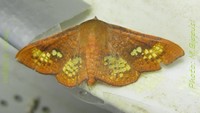
The upper surfaces of the wings have faint wavy lines crossing them. The outer edges of the forewings have a dark brown patch near their tips.[1][2]
The breast, sides, legs, and abdomen have the same coloration on the underside as on the upper side. The undersides of the wings are yellowish and marked with numerous small, narrow streaks.[3][4]
Classification of Banisia myrtaea
| Kingdom | Animalia |
|---|---|
| Phylum | Arthropoda |
| Subphylum | Hexapoda |
| Class | Insecta (Insect) |
| Order | Lepidoptera |
| Superfamily | Thyridoidea |
| Family | Thyrididae (Window-Winged Moths) |
| Subfamily | Striglininae |
| Genus | Banisia |
| Species | Banisia myrtaea (Drury, 1773) |
Synonyms
2 other scientific names have been used for this species and are now treated as synonyms of Banisia myrtaea.
- Durdara fenestrata Moore, 1883
- Noctua myrtaea Drury, 1773
Related species
-
 Sapodilla Borer MothBanisia myrsusalis
-
 Banisia clathrula
- Banisia apicale
- Banisia aldabrana
- Banisia tibiale
- Banisia lobata
-
 Banisia ovifera
- Banisia owadai
Compare
Questions and answers
What is the wingspan of Banisia myrtaea?
The wingspan is approximately 32 mm.[5]
Where was Banisia myrtaea first described?
The species was first described from Madras.[6]
Who first described Banisia myrtaea and when?
Dru Drury first described the species in 1773.[7]
Sources
Passages the profile rests on
- The upper surfaces of the wings have faint wavy lines crossing them. Source passage: “the latter having some very faint waved lines crossing them.” — English Wikipedia
- The outer edges of the forewings have a dark brown patch near their tips. Source passage: “On the external edges of the anterior wings is a dark brown patch, near the tips.” — English Wikipedia
- The breast, sides, legs, and abdomen have the same coloration on the underside as on the upper side. Source passage: “Under side: breast, sides, legs, and abdomen coloured as on the upper side.” — English Wikipedia
- The undersides of the wings are yellowish and marked with numerous small, narrow streaks. Source passage: “Wings yellowish, with many small narrow streaks.” — English Wikipedia
- The wingspan of this moth is approximately 32 mm. Source passage: “Wing-span 1¼ inches (32 mm).” — English Wikipedia
- The species was first described from Madras. Source passage: “It was first described by Dru Drury in 1773 from Madras.” — English Wikipedia
- The species was first described by Dru Drury in 1773. Source passage: “It was first described by Dru Drury in 1773 from Madras.” — English Wikipedia
Data
- Catalogue of Life, 2026-10-16 XR cc by
- Wikidata CC0
- Wikimedia Commons per image; credit shown with each image
- Within the Catalogue of Life, this name comes from Global Lepidoptera Index cc by
References
- Drury. (1773). Illustrations of natural history; wherein are exhibited ... Figures of exotic insects, &c. http://www.biodiversitylibrary.org/item/125982#page/60/mode/2up Link where the name was published
This species in other databases
Page built on 29 November 2026. See how the catalog is made and all sources and licences.
Cite this page
ScientificNames.org. (2026). Banisia myrtaea. Retrieved November 29, 2026, from https://scientificnames.org/species/banisia-myrtaea
“Banisia myrtaea.” ScientificNames.org, 2026, scientificnames.org/species/banisia-myrtaea. Accessed 29 Nov. 2026.
ScientificNames.org. “Banisia myrtaea.” Accessed November 29, 2026. https://scientificnames.org/species/banisia-myrtaea.
@misc{scientificnames_banisia_myrtaea,
  author = {{ScientificNames.org}},
  title = {Banisia myrtaea},
  year = {2026},
  url = {https://scientificnames.org/species/banisia-myrtaea},
  note = {Accessed 2026-11-29}
}