Species · Flowering plants
American Wintercress Barbarea orthoceras
The scientific name of the American Wintercress is Barbarea orthoceras. It is a species of flowering plant in the family Brassicaceae (crucifer), order Capparales.
- Scientific name
- Barbarea orthoceras Ledeb.
- Common name
- American Wintercress
- Genus
- Barbarea
- Family
- Brassicaceae (Crucifer)
- Order
- Capparales
- Class
- Magnoliopsida
- Recorded in
- 11 countries
- Name status
- accepted in the Catalogue of Life

Overview
Barbarea orthoceras is native to North America and parts of Asia. It has branched stems, oval leaves with rounded lobes, bright yellow flowers, and straight, narrow fruits.
Written 26 November 2026 from the sources listed below. Each statement was checked against the passage it cites; statements that could not be supported were removed.
Appearance
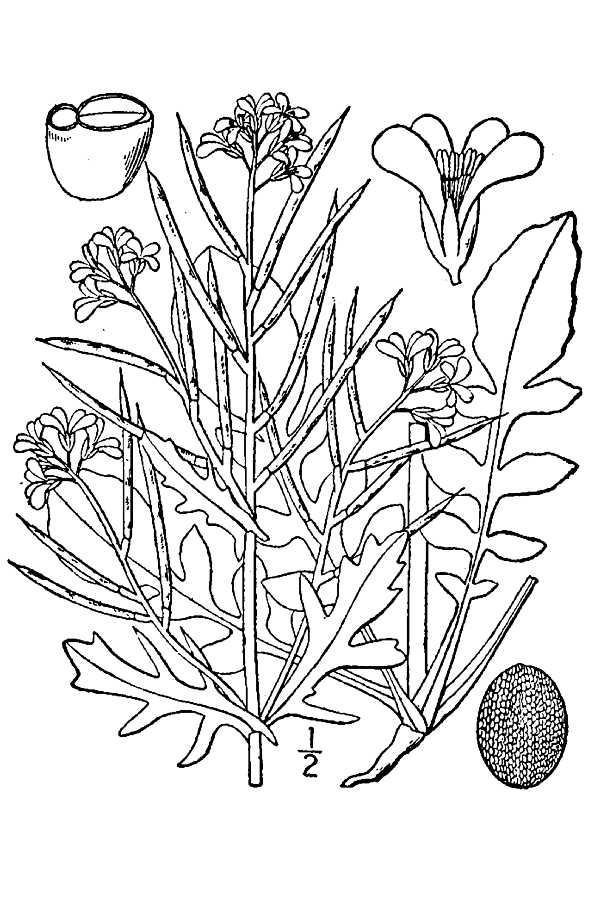
American wintercress develops a stiff stem with multiple branches. Its stems reach heights of 10 to 60 centimeters.[1][2]
Its leaves are generally oval and have several rounded lobes near their ends. The bright yellow flowers grow in spikes or clusters at the tips of stem branches.[3][4]
The fruit is a straight, narrow silique that can reach 5 centimeters in length.[5][6]
Habitat
American wintercress is native to North America and parts of Asia. It grows in moist habitats, including meadows and riverbanks.[7][8]
Uses
The leaves of American wintercress are edible both raw and cooked. Its roots can have a flavor resembling horseradish.[9][10]
Classification of the American Wintercress
| Kingdom | Plantae |
|---|---|
| Subkingdom | Pteridobiotina |
| Phylum | Tracheophyta |
| Class | Magnoliopsida |
| Order | Capparales |
| Family | Brassicaceae (Crucifer) |
| Subfamily | Brassicoideae |
| Tribe | Cardamineae |
| Genus | Barbarea (Wintercress) |
| Species | Barbarea orthoceras Ledeb. |
Where the American Wintercress is found
Checklists and occurrence records place Barbarea orthoceras in 11 countries across Asia and North America. GBIF holds 11,913 georeferenced records of it.
Countries
- Afghanistan 77
- Canada 1,131
- China 134
- Japan 557
- Mexico 54
- Mongolia 13
- North Korea 9
- Russia 1,003
- South Korea 1,009
- Taiwan 176
- United States 7,750
Regions and cities with the most records
- California, United States 2,294
- Oregon, United States 473
- British Columbia, Canada 452
- Alaska, United States 354
- Gangwon-do, South Korea 332
- Kamchatka, Russia 291
- Washington, United States 247
- Menlo Park, United States 224
- Palo Alto, United States 223
- East Palo Alto, United States 222
- Belmont, United States 220
- San Carlos, United States 219
- Millbrae, United States 217
- Redwood City, United States 217
- Foster City, United States 215
- Los Altos, United States 215
- San Mateo, United States 214
- Burlingame, United States 213
- Colorado, United States 195
- Idaho, United States 174
- Nevada, United States 172
- Mountain View, United States 139
- Taiwan, Taiwan 128
- Lafayette, United States 126
- Walnut Creek, United States 120
- Yukon, Canada 120
- Primorye, Russia 119
- Moraga, United States 116
- Pleasant Hill, United States 108
- Gyeongsangbuk-do, South Korea 107
- Sakhalin Oblast, Russia 107
- San Bruno, United States 102
- Danville, United States 97
- San Ramon, United States 97
- Columbine, United States 94
- Ken Caryl, United States 94
Range as the checklists state it
Siberia (Altay, Buryatia, Chita, Irkutsk, Krasnoyarsk, NW-Siberia, S-Yakutia, N-Yakutia); Russian Far East (Upper Amur, Kamchatka, Khabarovsk, Kuril Isl., Magadan, Primorye, Sakhalin, Chukotka); China (Gansu, Heilongjiang, Jilin, Liaoning, Nei Mongol, Xinjiang); Mongolia; North Korea; South Korea; Japan (Hokkaido, Honshu); Alaska; Canada (Alberta, British Columbia, Manitoba, New Brunswick, Newfoundland, Labrador, N. W. T., Ontario, Quebec, Saskatchewan, Yukon); USA (Arizona, California, Colorado, Idaho, +Maine, Michigan, Minnesota, Montana, Nevada, New Hampshire, New Mexico, Oregon, South Dakota, Utah, Washington State, Wyoming)
A number beside a place is its count of GBIF occurrence records. A place without a number comes from a checklist alone. Records show where a species has been observed or collected, which can include escapes and vagrants.
Common names
English
- American Wintercress
- American Yellow-rocket
- Erect-fruit Wintercress
- Northern Winter-cress
- Northern Wintercress
- Straight-horned Wintercress
Names in 5 other languages
- Chinese
- 山芥菜
- French
- barbarée à fruits dressés
- Japanese
- ヤマガラシ
- Korean
- 나도냉이
- Russian
- Сурепка американская, Сурепка пряморогая, Сурепка хондоская
Synonyms
20 other scientific names have been used for this species and are now treated as synonyms of Barbarea orthoceras.
- Barbarea americana Rydb.
- Barbarea apoiensis Nakai
- Barbarea cochlearifolia H.Boissieu
- Barbarea hondoensis Nakai
- Barbarea orthoceras subsp. dolichocarpa (Fernald) Piper & Beattie
- Barbarea orthoceras var. dolichocarpa Fernald
- Barbarea orthoceras var. formosana Kitam.
- Barbarea orthoceras var. orthoceras
- Barbarea patens H.Boissieu
- Barbarea pinnatifida H.Boissieu
- Barbarea sibirica (Regel) Nakai
- Barbarea stricta Fellm.
- Barbarea vulgaris var. orthoceras (Ledeb.) Regel
- Barbarea vulgaris var. pinnatifida Regel
- Barbarea vulgaris var. sibirica (Regel) Kom.
- Barbarea vulgaris var. tenella Regel
- Campe americana (Rydb.) Cockerell ex Daniels
- Campe orthoceras (Ledeb.) A.Heller
- Campe orthoceras var. dolichocarpa (Fernald) Gilkey
- Sisymbrium japonicum H.Boissieu
Related species
-
 Winter CressBarbarea vulgaris
-
 Land CressBarbarea verna
-
 Small-Flowered Winter-CressBarbarea stricta
-
 Early Winter-CressBarbarea intermedia
- Balkan Yellow RocketBarbarea balcana
- Bosnian Yellow RocketBarbarea bosniaca
- Barbarea arcuata
- Small YellowrocketBarbarea brachycarpa
Compare
Questions and answers
What is the scientific name of the American Wintercress?
The scientific name of the American Wintercress is Barbarea orthoceras. Written with its author, the full name is Barbarea orthoceras Ledeb..
Which family does the American Wintercress belong to?
Barbarea orthoceras belongs to the family Brassicaceae, in the order Capparales and the class Magnoliopsida.
Where is the American Wintercress found?
Checklists and occurrence records place Barbarea orthoceras in 11 countries, including United States, Canada, South Korea, Russia, Japan and Taiwan.
What other names does the American Wintercress have?
Barbarea orthoceras is also known in English as American Yellow-rocket, Erect-fruit Wintercress, Northern Winter-cress, Northern Wintercress and Straight-horned Wintercress.
What is wintercress good for?
American wintercress can be used as an edible plant. Its leaves can be eaten raw or cooked, and its roots can have a flavor resembling horseradish.[9][10]
Can you eat wintercress?
Yes. The leaves of American wintercress are edible both raw and cooked.[9]
Sources
Passages the profile rests on
- The plant develops a stiff stem with multiple branches. Source passage: “This is a perennial herb producing a stiff, branching stem to heights between 10 and 60 centimeters.” — English Wikipedia
- The stems reach heights of 10 to 60 centimeters. Source passage: “This is a perennial herb producing a stiff, branching stem to heights between 10 and 60 centimeters.” — English Wikipedia
- Its leaves are generally oval and have several rounded lobes near their ends. Source passage: “The leaves are a few centimeters long and generally oval in shape with several rounded lobes toward the end.” — English Wikipedia
- The flowers are bright yellow and grow in spikes or clusters at the tips of stem branches. Source passage: “The inflorescence is a spike or cluster of bright yellow flowers at the tip of each stem branch.” — English Wikipedia
- The fruit is a straight, narrow silique. Source passage: “The fruit is a straight, narrow silique up to 5 centimeters long.” — English Wikipedia
- Its fruit can reach 5 centimeters in length. Source passage: “The fruit is a straight, narrow silique up to 5 centimeters long.” — English Wikipedia
- Barbarea orthoceras is native to North America and parts of Asia. Source passage: “It is native to North America, including much of Canada and the western United States, as well as parts of Asia.” — English Wikipedia
- The species grows in moist habitats, including meadows and riverbanks. Source passage: “It grows in moist areas such as meadows and riverbanks.” — English Wikipedia
- The leaves are edible both raw and cooked. Source passage: “The leaves can be eaten raw or cooked” — English Wikipedia
- The roots can have a flavor resembling horseradish. Source passage: “the roots can have a horseradish-like flavor.” — English Wikipedia
Data
- Catalogue of Life, 2026-10-16 XR cc by
- Global Biodiversity Information Facility CC BY 4.0
- Wikidata CC0
- GeoNames CC BY 4.0
- Wikimedia Commons per image; credit shown with each image
- Within the Catalogue of Life, this name comes from Synonymic Checklists of the Vascular Plants of the World cc by
References
- Ledeb. Index Sem. (Dorpat) p. ? (1824). where the name was published
This species in other databases
- Catalogue of Life KM66
- Wikidata Q4446496
- iNaturalist 52976
- World Flora Online wfo-0000560020
- GRIN 465429
Page built on 29 November 2026. See how the catalog is made and all sources and licences.
Cite this page
ScientificNames.org. (2026). Barbarea orthoceras (American Wintercress). Retrieved November 29, 2026, from https://scientificnames.org/species/barbarea-orthoceras
“Barbarea orthoceras (American Wintercress).” ScientificNames.org, 2026, scientificnames.org/species/barbarea-orthoceras. Accessed 29 Nov. 2026.
ScientificNames.org. “Barbarea orthoceras (American Wintercress).” Accessed November 29, 2026. https://scientificnames.org/species/barbarea-orthoceras.
@misc{scientificnames_barbarea_orthoceras_american_wintercress,
  author = {{ScientificNames.org}},
  title = {Barbarea orthoceras (American Wintercress)},
  year = {2026},
  url = {https://scientificnames.org/species/barbarea-orthoceras},
  note = {Accessed 2026-11-29}
}