Species · Molluscs
Globose Octopus Bathypolypus sponsalis
The scientific name of the Globose Octopus is Bathypolypus sponsalis. It is a species of mollusc in the family Bathypolypodidae (bathyal octopuses). The name dates from 1892.
- Scientific name
- Bathypolypus sponsalis (P. Fischer & H. Fischer, 1892)
- Common name
- Globose Octopus
- Genus
- Bathypolypus
- Family
- Bathypolypodidae (Bathyal Octopuses)
- Class
- Cephalopoda
- Red List category
- LC Least Concern
- Environment
- marine
- Recorded in
- 4 countries
- Name status
- accepted in the Catalogue of Life
Overview
Bathypolypus sponsalis inhabits benthic and demersal deep-sea communities at depths between 200 and 1,835 metres. It has reduced gills, lacks an ink sac, and possesses subgelatinous tissues.
Written 27 November 2026 from the sources listed below. Each statement was checked against the passage it cites; statements that could not be supported were removed.
Appearance
Juvenile individuals are white before changing to dark brown and eventually dark purple upon reaching maturity.[1]
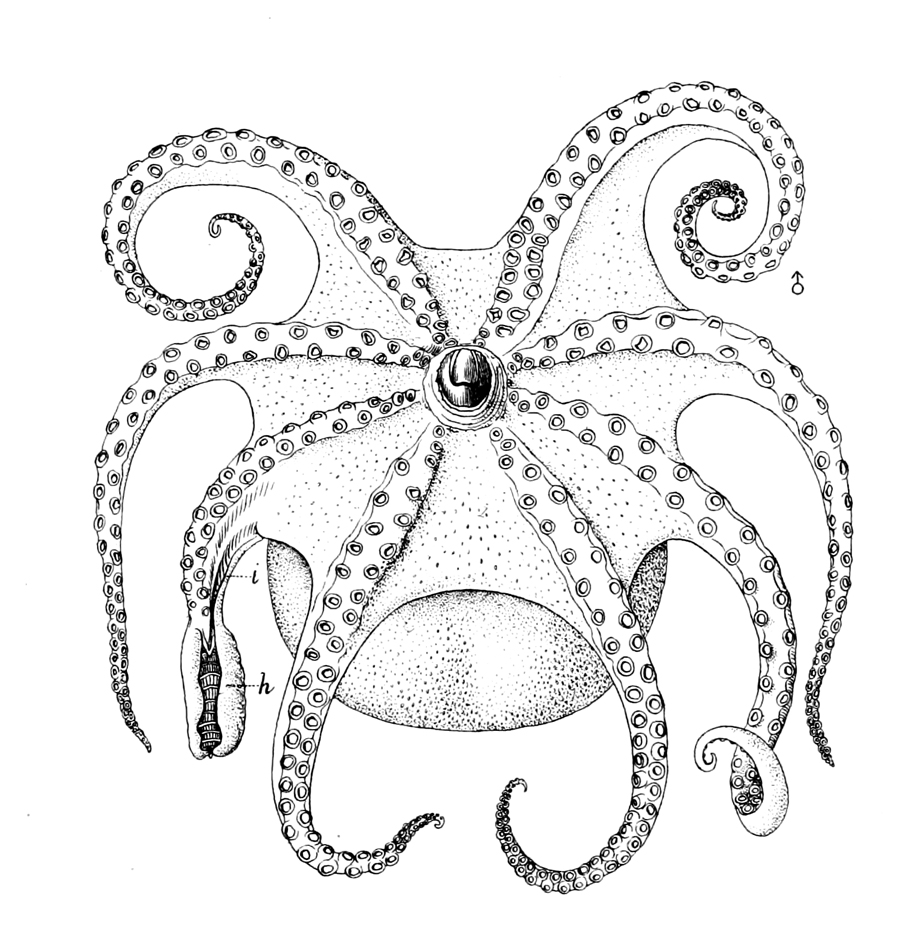
The species has reduced gills, lacks an ink sac, and possesses subgelatinous tissues. Its reproductive organs are relatively large compared with its other morphological characteristics.[2][3]
Sexually mature females have a mantle length of at least 34 mm, while sexually mature males have a mantle length of approximately 24 mm.[4][5]
Habitat
The globose octopus inhabits deep-sea environments at depths between 200 and 1,835 metres. It is most frequently found at depths between 400 and 700 metres.[6][7]
The species occupies benthic and demersal deep-sea communities, including upper slopes, lower slopes, and abyssal plains.[8][9]
It occurs in water temperatures of approximately 12 °C and salinity between 38.40 and 38.50 parts per thousand.[10][11]
Rocky-bottom habitats provide stable locations for spawning.[12]
Diet
The globose octopus primarily consumes crustaceans and molluscs, with occasional consumption of fish.[13]
Approximately 76% of examined stomachs contained crustaceans, while bony fish were present in approximately 6% of examined stomachs.[14][15]
Approximately 37% of examined individuals had empty stomachs.[16]
Behaviour
The species frequently undertakes vertical migrations to access pelagic prey. Larger individuals occur at shallower depths than smaller individuals.[17][18]
Juveniles remain at greater depths before gradually moving into shallower waters as they grow.[19]
The globose octopus acts as both a predator and prey within its ecosystem.[20]
The species hatches into planktonic organisms that remain in the water column before developing into benthic adults.[21]
Reproduction and life cycle
The maximum recorded mature egg size exceeds 15 mm, and the oviducal gland measures more than 11 mm.[22][23]
The species exhibits synchronous ovulation followed by simultaneous terminal spawning. Its eggs contain abundant yolk, which contributes to larval survival.[24][25]
The reproductive period extends from April through November.[26]
Females display solitary behaviour while preparing a den for reproduction. Males attract potential mates through different displays.[27][28]
Males fertilize females by inserting their hectocotylus into the female's mantle cavity.[29]
The species generally reproduces only once during its lifetime. Both sexes usually die following spawning and brooding.[30][31]
Classification of the Globose Octopus
| Kingdom | Animalia |
|---|---|
| Phylum | Mollusca |
| Class | Cephalopoda (Cephalopod) |
| Subclass | Coleoidea |
| Superorder | Octopodiformes |
| Family | Bathypolypodidae (Bathyal Octopuses) |
| Genus | Bathypolypus (Bathyal Octopuses) |
| Species | Bathypolypus sponsalis (P. Fischer & H. Fischer, 1892) |
Where the Globose Octopus is found
Checklists and occurrence records place Bathypolypus sponsalis in 4 countries. GBIF holds 739 georeferenced records of it.
Countries
Regions and cities with the most records
4 more countries have a few records outside this range
These countries hold a few records of Bathypolypus sponsalis but lie outside the range the checklists give for it. Such records are often zoo or garden specimens, museum material or vagrants, so the species is not counted as occurring there.
A number beside a place is its count of GBIF occurrence records. A place without a number comes from a checklist alone. Records show where a species has been observed or collected, which can include escapes and vagrants.
Common names
English
- Globose Octopus
Names in 2 other languages
- Greek
- Σφαιροχτάποδο
- Thai
- ปลาหมึกสายหัวกลม
Synonyms
One other scientific name has been used for this species and is now treated as a synonym of Bathypolypus sponsalis.
- Octopus sponsalis P. Fischer & H. Fischer, 1892
Related species
-
 Spoonarm OctopusBathypolypus arcticus
-
 Boxer OctopusBathypolypus valdiviae
- Bathypolypus rubrostictus
- Spoonarm OctopusBathypolypus bairdii
- Fischers' Bathyal OctopusBathypolypus ergasticus
- Bathypelagic OctopusBathypolypus pugniger
- Bathypolypus validus
Compare
Questions and answers
What is the scientific name of the Globose Octopus?
The scientific name of the Globose Octopus is Bathypolypus sponsalis. Written with its author, the full name is Bathypolypus sponsalis (P. Fischer & H. Fischer, 1892).
Which family does the Globose Octopus belong to?
Bathypolypus sponsalis belongs to the family Bathypolypodidae and the class Cephalopoda.
Where is the Globose Octopus found?
Checklists and occurrence records place Bathypolypus sponsalis in 4 countries: Spain, Ireland, France and Italy.
What is the conservation status of the Globose Octopus?
The IUCN Red List category recorded for Bathypolypus sponsalis is Least Concern (LC).
Sources
Passages the profile rests on
- Juvenile individuals are white before changing to dark brown and eventually dark purple upon reaching maturity. Source passage: “Juveniles are white and transition to dark brown then to dark purple once maturity is reached.” — English Wikipedia
- The species has reduced gills, lacks an ink sac, and possesses subgelatinous tissues. Source passage: “including large eggs, reduced gills, no ink sac, and subgelatinous tissues.” — English Wikipedia
- The species has relatively large reproductive organs compared with its other morphological characteristics. Source passage: “A distinguishing factor are the relatively large reproductive organs.” — English Wikipedia
- Sexually mature females have a mantle length of at least 34 mm. Source passage: “Sexually mature females have a mantle length of at least 34 mm” — English Wikipedia
- Sexually mature males have a mantle length of approximately 24 mm. Source passage: “sexually mature males have a mantle length of about 24 mm.” — English Wikipedia
- The species inhabits deep-sea environments at depths between 200 and 1,835 metres. Source passage: “They typically reside in the deep-sea at depths ranging from 200 meters to 1835 meters” — English Wikipedia
- The species is most frequently found at depths between 400 and 700 metres. Source passage: “they are most commonly found between 400 meters to 700 meters” — English Wikipedia
- The species occupies benthic and demersal deep-sea communities. Source passage: “Predominantly residing in the benthic and demersal deep-sea communities” — English Wikipedia
- Its habitats include upper slopes, lower slopes, and abyssal plains. Source passage: “they also inhabit the upper slope, lower slope, and abyssal plains.” — English Wikipedia
- The species occurs in water temperatures of approximately 12 °C. Source passage: “they resided in water temperatures of 12 °C” — English Wikipedia
- The species inhabits waters with salinity between 38.40 and 38.50 parts per thousand. Source passage: “a salinity ranging from 38.40 to 38.50 parts per thousand.” — English Wikipedia
- The species uses rocky-bottom habitats as stable locations for spawning. Source passage: “Bathypolypus sponsalis resides in habitats that contain rocky bottoms in order to yield for stable and safe environments in order to spawn.” — English Wikipedia
- The species primarily consumes crustaceans and molluscs, with occasional consumption of fish. Source passage: “Their diet consists of predominantly crustaceans and molluscs, but they sometimes consume fish as well.” — English Wikipedia
- Approximately 76% of examined stomachs contained crustaceans. Source passage: “about 76% contained crustaceans” — English Wikipedia
- Bony fish were present in approximately 6% of examined stomachs. Source passage: “with bony fish only appearing in about 6% of the stomachs.” — English Wikipedia
- Approximately 37% of examined individuals had empty stomachs. Source passage: “About 37% of the individuals examined had empty stomachs” — English Wikipedia
- The species frequently undertakes vertical migrations to access pelagic prey. Source passage: “they frequently undergo vertical migration in order to have access to pelagic prey” — English Wikipedia
- Larger individuals occur at shallower depths than smaller individuals. Source passage: “The larger organisms of the species were found at shallower depths than the smaller members of the species” — English Wikipedia
- Juveniles remain at greater depths before gradually moving into shallower waters as they grow. Source passage: “the juveniles remain at deeper depths and then gradually throughout their life they move to shallower depths.” — English Wikipedia
- The species acts as both a predator and prey within its ecosystem. Source passage: “it serves as both predator and prey in its habitat.” — English Wikipedia
- The species hatches into planktonic organisms that remain in the water column before developing into benthic adults. Source passage: “the Bathypolypus sponsalis hatches into planktonic organisms that float in the water column until they eventually mature and become adults that reside in benthic habitats on the sea floor.” — English Wikipedia
- The maximum recorded mature egg size exceeds 15 mm. Source passage: “the size of a mature egg at maximum was greater than 15 mm” — English Wikipedia
- The oviducal gland measures more than 11 mm. Source passage: “the oviducal gland was greater than 11 mm” — English Wikipedia
- The species exhibits synchronous ovulation followed by simultaneous terminal spawning. Source passage: “which indicates a synchronous ovulation in that species which then leads to a simultaneous terminal spawning strategy.” — English Wikipedia
- The eggs contain abundant yolk, which contributes to larval survival. Source passage: “they are also rich in yolk which aids in increasing the larval survival.” — English Wikipedia
- The reproductive period extends from April through November. Source passage: “Bathypolypus sponsalis has a reproductive period that lasts from April to November.” — English Wikipedia
- Females display solitary behaviour while preparing a den for reproduction. Source passage: “During the reproductive stage of a female's life, she displays solitary behavior in order to prepare a den.” — English Wikipedia
- Males attract potential mates through different displays. Source passage: “In order to attract a mate, males often put on different displays.” — English Wikipedia
- Males fertilize females by inserting their hectocotylus into the female's mantle cavity. Source passage: “he proceeds to insert his hectocotylus into the mantle cavity of the female.” — English Wikipedia
- The species generally reproduces only once during its lifetime. Source passage: “only spawns once in their lifetime.” — English Wikipedia
- Both sexes usually die following spawning and brooding. Source passage: “After they mate, both the male and the females usually die after spawning and brooding.” — English Wikipedia
Data
- Catalogue of Life, 2026-10-16 XR cc by
- Global Biodiversity Information Facility CC BY 4.0
- Wikidata CC0
- GeoNames CC BY 4.0
- Within the Catalogue of Life, this name comes from World Register of Marine Species cc by
This species in other databases
Page built on 29 November 2026. See how the catalog is made and all sources and licences.
Cite this page
ScientificNames.org. (2026). Bathypolypus sponsalis (Globose Octopus). Retrieved November 29, 2026, from https://scientificnames.org/species/bathypolypus-sponsalis
“Bathypolypus sponsalis (Globose Octopus).” ScientificNames.org, 2026, scientificnames.org/species/bathypolypus-sponsalis. Accessed 29 Nov. 2026.
ScientificNames.org. “Bathypolypus sponsalis (Globose Octopus).” Accessed November 29, 2026. https://scientificnames.org/species/bathypolypus-sponsalis.
@misc{scientificnames_bathypolypus_sponsalis_globose_octopus,
  author = {{ScientificNames.org}},
  title = {Bathypolypus sponsalis (Globose Octopus)},
  year = {2026},
  url = {https://scientificnames.org/species/bathypolypus-sponsalis},
  note = {Accessed 2026-11-29}
}