Species · Fishes
Duckbill Flathead Bembrops anatirostris
The scientific name of the Duckbill Flathead is Bembrops anatirostris. It is a species of fish in the family Bembropidae (duckbill flatheads), order Perciformes. The name dates from 1955.
- Scientific name
- Bembrops anatirostris Ginsburg, 1955
- Common name
- Duckbill Flathead
- Genus
- Bembrops
- Family
- Bembropidae (Duckbill Flatheads)
- Order
- Perciformes
- Class
- Teleostei
- Red List category
- LC Least Concern
- Environment
- marine
- Recorded in
- 13 countries
- Name status
- accepted in the Catalogue of Life

Overview
The duckbill flathead (Bembrops anatirostris Ginsburg, 1955) is a fish in the family Bembropidae, order Perciformes and class Teleostei. It occurs in the western Atlantic Ocean and is recorded as endemic to the Greater Caribbean region. It is distinguished by its depressed head, long snout, strongly projecting lower jaw and long, thin tentacle behind the upper jawbone.
Written 27 November 2026 from the sources listed below. Each statement was checked against the passage it cites; statements that could not be supported were removed.
Appearance
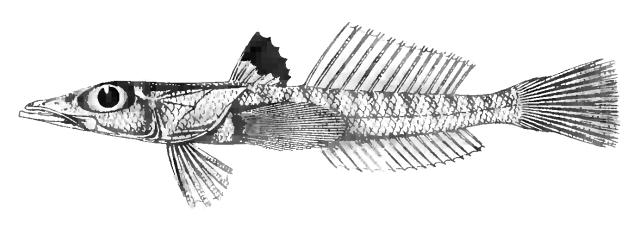
The duckbill flathead has a depressed head and a long snout that exceeds the eye in length. Its lower jaw projects strongly and often exposes its teeth. A long, thin tentacle on the rear of the upper jawbone measures 3.3–7.1% of standard length.[1][2][3]
Its gill arches have 18–22 rakers. It has two dorsal fins, with the second dorsal spine filamentous in males, 25–29 pectoral fin rays and 10–11 branched tail fin rays.[4][5][6][7]
Its head and body are covered with rough scales, and its lateral line has 58–69 scales. The upper surface of its eye lacks scales.[8][9][10]
The upper body is grey-green, while the underside is white and the breast is silver. Two alternating rows of ten irregular dark grey-brown spots mark the flanks, and yellowish spots are scattered across the upper body.[11][12][13]
The first two membranes of the first dorsal fin are black. The outer half of the second dorsal fin is dark, while its inner half is clear.[14][15]
In females, the outer half to two-thirds of the anal fin is black, while in males its inner half is dusky. The pectoral fin rays are dusky, with a dark blotch at the bases of rays two and three, and the rear half of the pelvic fins is dusky.[16][17][18]
The species can reach a length of 35 centimetres.[19]
Habitat
The duckbill flathead inhabits deep water, typically at depths of 100–400 metres. Its recorded depth range extends from 82 to 1,170 metres.[20][21]
Its recorded geographic range includes tropical, equatorial and subtropical waters.[22]
Diet
Its recorded food includes mobile benthic crustaceans such as shrimps and crabs.[23]
Conservation
Its reported vulnerability score is 27 out of 100, classified as low to moderate.[24]
Classification of the Duckbill Flathead
| Kingdom | Animalia |
|---|---|
| Phylum | Chordata |
| Subphylum | Vertebrata |
| Infraphylum | Gnathostomata |
| Parvphylum | Osteichthyes |
| Gigaclass | Actinopterygii |
| Superclass | Actinopteri |
| Class | Teleostei (Teleost) |
| Order | Perciformes |
| Suborder | Bembropoidei |
| Family | Bembropidae (Duckbill Flatheads) |
| Genus | Bembrops |
| Species | Bembrops anatirostris Ginsburg, 1955 |
Where the Duckbill Flathead is found
Checklists and occurrence records place Bembrops anatirostris in 13 countries. GBIF holds 423 georeferenced records of it.
Countries
- Colombia 15
- Cuba 3
- Dominican Republic 4
- French Guiana 14
- Honduras 5
- Jamaica 3
- Mexico 78
- Nicaragua 5
- Panama 12
- Puerto Rico 6
- Suriname 15
- United States 259
- Venezuela 4
Regions and cities with the most records
A number beside a place is its count of GBIF occurrence records. A place without a number comes from a checklist alone. Records show where a species has been observed or collected, which can include escapes and vagrants.
Common names
English
- Duckbill Flathead
- Longnose Duckbill
Names in 2 other languages
- Japanese
- アヒルアイトラギス
- Spanish
- pico de pato
Related species
-
 New Zealand FlatheadBembrops morelandi
-
 Goby FlatheadBembrops gobioides
-
 Natal DuckbillBembrops platyrhynchus
- Bigscale DuckbillBembrops curvatura
- Bembrops heterurus
- Bembrops greyae
-
 Opal FishBembrops caudimacula
- Bembrops cadenati
Compare
Questions and answers
What is the scientific name of the Duckbill Flathead?
The scientific name of the Duckbill Flathead is Bembrops anatirostris. Written with its author, the full name is Bembrops anatirostris Ginsburg, 1955.
Which family does the Duckbill Flathead belong to?
Bembrops anatirostris belongs to the family Bembropidae, in the order Perciformes and the class Teleostei.
Where is the Duckbill Flathead found?
Checklists and occurrence records place Bembrops anatirostris in 13 countries, including United States, Mexico, Colombia, Suriname, French Guiana and Panama.
What is the conservation status of the Duckbill Flathead?
The IUCN Red List category recorded for Bembrops anatirostris is Least Concern (LC).
What other names does the Duckbill Flathead have?
Bembrops anatirostris is also known in English as Longnose Duckbill.
How large can the duckbill flathead grow?
It can reach a length of 35 centimetres.[19]
Where does the duckbill flathead occur?
It occurs in the western Atlantic Ocean and is recorded as endemic to the Greater Caribbean region.[25][26]
At what depths does the duckbill flathead live?
It typically inhabits depths of 100–400 metres, with a recorded depth range of 82 to 1,170 metres.[20][21]
What does the duckbill flathead eat?
Its recorded food includes mobile benthic crustaceans such as shrimps and crabs.[23]
What is the conservation vulnerability score of the duckbill flathead?
Its reported vulnerability score is 27 out of 100, classified as low to moderate.[24]
What is the phylogenetic diversity index of the duckbill flathead?
Its phylogenetic diversity index is reported as 0.5000.[27]
Sources
Passages the profile rests on
- The species has a depressed head and a long snout that exceeds the eye in length. Source passage: “Head depressed; snout long (>eye); eye large, above, close-set” — biogeodb.stri.si.edu
- Its lower jaw projects strongly and often exposes its teeth. Source passage: “lower jaw strongly projecting, often with lower teeth exposed” — biogeodb.stri.si.edu
- The rear of its upper jawbone bears a long, thin tentacle measuring 3.3–7.1% of standard length. Source passage: “rear of top jawbone with a long, thin rear tentacle (5.1 (3.3-7.1)% SL)” — biogeodb.stri.si.edu
- Its gill arches have 18–22 rakers. Source passage: “gill rakers 20 (18-22)” — biogeodb.stri.si.edu
- The species has two dorsal fins, with the second dorsal spine filamentous in males. Source passage: “two dorsal fins, VI (front spines crowded), 2nd spine filamentous in male + 15 (rarely 14)” — biogeodb.stri.si.edu
- Its pectoral fins have 25–29 rays. Source passage: “pectoral fin long and wide, 27 (25-29) rays” — biogeodb.stri.si.edu
- Its tail fin has 10–11 branched rays. Source passage: “tail fin straight, with 10-11 branched rays” — biogeodb.stri.si.edu
- Its head and body are covered with rough scales. Source passage: “scales rough on head and body” — biogeodb.stri.si.edu
- Its lateral line has 58–69 scales. Source passage: “lateral line 62-64 (58-69) scales” — biogeodb.stri.si.edu
- The upper surface of its eye lacks scales. Source passage: “scales absent from top surface of eye” — biogeodb.stri.si.edu
- Its upper body is grey-green, while its underside is white and its breast is silver. Source passage: “Grey- green above, white below, breast silver” — biogeodb.stri.si.edu
- Its flanks have two alternating rows of ten irregular dark grey-brown spots. Source passage: “2 alternating rows of 10 irregular dark grey-brown spots along flank” — biogeodb.stri.si.edu
- Yellowish spots are scattered across its upper body. Source passage: “upper body with scattered yellowish spots” — biogeodb.stri.si.edu
- The first two membranes of its first dorsal fin are black. Source passage: “1st dorsal with 1st 2 membranes black” — biogeodb.stri.si.edu
- The outer half of its second dorsal fin is dark, while the inner half is clear. Source passage: “2nd dorsal outer ½ dark, inner ½ clear” — biogeodb.stri.si.edu
- The outer half to two-thirds of the anal fin is black in females and the inner half is dusky in males. Source passage: “outer ½-2/3 of anal fin black, inner ½ clear in female, dusky in male” — biogeodb.stri.si.edu
- Its pectoral fin rays are dusky, with a dark blotch at the bases of rays two and three. Source passage: “pectoral rays dusky, dark blotch on base rays 2-3” — biogeodb.stri.si.edu
- The rear half of its pelvic fins is dusky. Source passage: “pelvics dusky on rear ½” — biogeodb.stri.si.edu
- The species can reach a length of 35 centimetres. Source passage: “It can grow to a length of 35 centimetres (14 in).” — English Wikipedia
- The species inhabits deep water, typically at depths of 100–400 metres. Source passage: “typically found at depths between 100–400 metres (330–1,310 ft)” — English Wikipedia
- Its recorded depth range extends from 82 to 1,170 metres. Source passage: “Depth range: 82-1170 m, usually well below 100 m.” — biogeodb.stri.si.edu
- Its recorded geographic range includes tropical, equatorial and subtropical waters. Source passage: “Tropical (10-23N, Nicaragua / Cuba) Equatorial (0-10N, Costa Rica / Venezuela) Subtropical (23-35N, Florida / Carolinas / Bermuda)” — biogeodb.stri.si.edu
- Its recorded food includes mobile benthic crustaceans such as shrimps and crabs. Source passage: “Mobile benthic crustacea (shrimps/crabs)” — biogeodb.stri.si.edu
- Its reported vulnerability score is 27 out of 100, classified as low to moderate. Source passage: “Low to moderate vulnerability (27 of 100).” — fishbase.se
- The species occurs in the western Atlantic Ocean. Source passage: “in the western Atlantic Ocean” — English Wikipedia
- The species is recorded as endemic to the Greater Caribbean region. Source passage: “Greater Caribbean endemic” — biogeodb.stri.si.edu
- Its phylogenetic diversity index is reported as 0.5000. Source passage: “PD50 = 0.5000 [Uniqueness, from 0.5 = low to 2.0 = high].” — fishbase.se
Data
- Catalogue of Life, 2026-10-16 XR cc by
- Global Biodiversity Information Facility CC BY 4.0
- Wikidata CC0
- GeoNames CC BY 4.0
- Wikimedia Commons per image; credit shown with each image
- Within the Catalogue of Life, this name comes from World Register of Marine Species cc by
References
- Ginsburg, I. (1955). Fishes of the family Percophididae from the coasts of eastern United States and the West Indies, with descriptions of four new species. Proceedings of the United States National Museum, 104 (3347): 623–639. https://doi.org/10.5479/si.00963801.104-3347.623 Link where the name was published
This species in other databases
- Catalogue of Life LGRK
- Wikidata Q265974
- iNaturalist 316996
- WoRMS urn:lsid:marinespecies.org:taxname:159842
- ITIS 170997
Page built on 28 November 2026. See how the catalog is made and all sources and licences.
Cite this page
ScientificNames.org. (2026). Bembrops anatirostris (Duckbill Flathead). Retrieved November 28, 2026, from https://scientificnames.org/species/bembrops-anatirostris
“Bembrops anatirostris (Duckbill Flathead).” ScientificNames.org, 2026, scientificnames.org/species/bembrops-anatirostris. Accessed 28 Nov. 2026.
ScientificNames.org. “Bembrops anatirostris (Duckbill Flathead).” Accessed November 28, 2026. https://scientificnames.org/species/bembrops-anatirostris.
@misc{scientificnames_bembrops_anatirostris_duckbill_flathead,
  author = {{ScientificNames.org}},
  title = {Bembrops anatirostris (Duckbill Flathead)},
  year = {2026},
  url = {https://scientificnames.org/species/bembrops-anatirostris},
  note = {Accessed 2026-11-28}
}