Species · Insects
Benhamyia apicalis
Benhamyia apicalis has no English name on record in the checklists used here. It is a species of insect in the family Stratiomyidae (soldier flies), order Diptera. The name dates from 1849.
- Scientific name
- Benhamyia apicalis (Walker, 1849)
- Genus
- Benhamyia
- Family
- Stratiomyidae (Soldier Flies)
- Order
- Diptera
- Class
- Insecta
- Recorded in
- 1 country
- Name status
- accepted in the Catalogue of Life

Overview
The species occurs on both the North Island and South Island of New Zealand. It has a tawny abdomen with a purple tip, a four-toothed scutellum and a blackish band across its wings.
Written 27 November 2026 from the sources listed below. Each statement was checked against the passage it cites; statements that could not be supported were removed.
Appearance
The head is black, with a hoary front and pitchy-black eyes. The palpi and sucker are tawny.[1][2]
The antennae are black and thread-like, with dark red colouring towards their bases. The thorax and breast are dark purple, and the thorax has three stripes formed by golden down.[3][4]
The scutellum is tawny and has four teeth. The abdomen is tawny, slightly narrower than the thorax, nearly twice its length and purple at the tip.[5][6]
The legs are tawny, with long, club-shaped thighs on the hind legs.[7]
The wings are colourless on the disk, tawny along the front border and grey along the hind border and tip. A blackish band crosses the wings but does not reach the hind border.[8]
The wing ribs and veins are tawny, becoming pitchy over the blackish band.[9]
Habitat
The species is endemic to New Zealand and occurs on both the North Island and South Island.[10][11]
Classification of Benhamyia apicalis
| Kingdom | Animalia |
|---|---|
| Phylum | Arthropoda |
| Subphylum | Hexapoda |
| Class | Insecta (Insect) |
| Order | Diptera (Fly) |
| Family | Stratiomyidae (Soldier Flies) |
| Subfamily | Beridinae |
| Genus | Benhamyia |
| Species | Benhamyia apicalis (Walker, 1849) |
Where Benhamyia apicalis is found
Checklists and occurrence records place Benhamyia apicalis in 1 country. GBIF holds 272 georeferenced records of it.
Countries
Regions and cities with the most records
- Auckland, New Zealand 70
- Waikato Region, New Zealand 42
- Wellington Region, New Zealand 42
- Wellington, New Zealand 36
- Avondale, New Zealand 35
- Wainuiomata, New Zealand 35
- Auckland, New Zealand 34
- Karori, New Zealand 34
- Lower Hutt, New Zealand 34
- Mount Eden, New Zealand 34
- New Lynn, New Zealand 34
- Remuera, New Zealand 33
- Mangere, New Zealand 29
- Porirua, New Zealand 29
- Canterbury, New Zealand 28
- Otahuhu, New Zealand 26
- Papatoetoe, New Zealand 22
- Christchurch, New Zealand 20
- Cambridge, New Zealand 19
- Otara, New Zealand 19
- Hamilton, New Zealand 17
- Manawatu-Wanganui, New Zealand 17
- Rolleston, New Zealand 17
- Otago, New Zealand 15
- Dunedin, New Zealand 13
- Manukau City, New Zealand 13
- Northland, New Zealand 13
- Taranaki Region, New Zealand 9
- New Plymouth, New Zealand 8
- Bay of Plenty, New Zealand 7
- Manurewa, New Zealand 7
- Palmerston North, New Zealand 7
- Upper Hutt, New Zealand 7
- Tasman District, New Zealand 6
- Hastings, New Zealand 5
- Hawke's Bay Region, New Zealand 5
A number beside a place is its count of GBIF occurrence records. A place without a number comes from a checklist alone. Records show where a species has been observed or collected, which can include escapes and vagrants.
Synonyms
2 other scientific names have been used for this species and are now treated as synonyms of Benhamyia apicalis.
- Exaireta analis Nowicki, 1875
- Diphysa apicalis Walker, 1849 ambiguous synonym
Related species
-
 Benhamyia straznitzkii
- Benhamyia alpina
- Benhamyia hoheria
- Benhamyia smaragdina
-
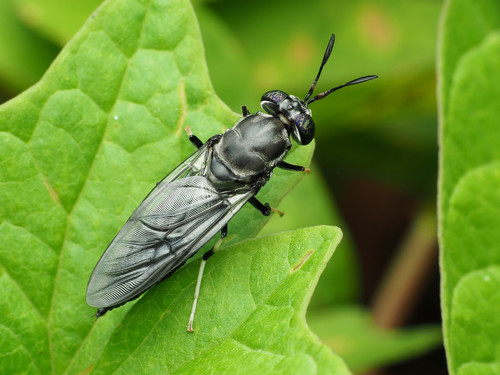 Black Soldier FlyHermetia illucens
-
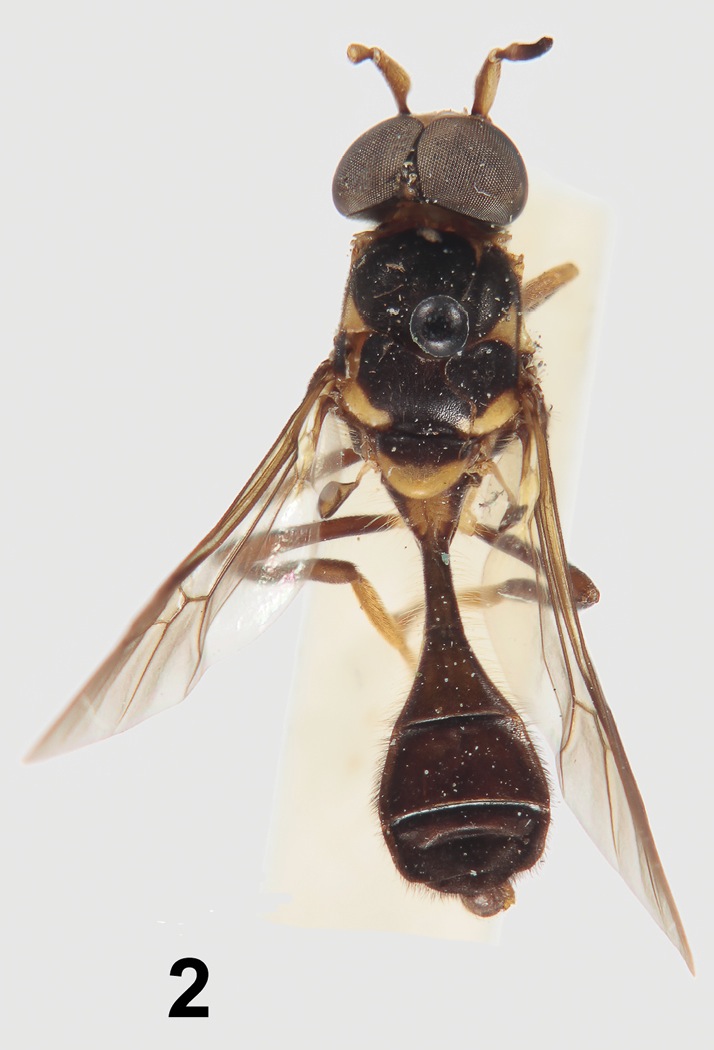 Parastratiosphecomyia stratiosphecomyioides
-
 Twin-spot CenturionSargus bipunctatus
-
 Garden Soldier FlyExaireta spiniger
Compare
Questions and answers
Where does Benhamyia apicalis occur?
It is endemic to New Zealand and occurs on both the North Island and South Island.[10][11]
How long is the body?
The body measures three and a half lines in length.[12]
How long are the wings?
The wings measure seven lines in length.[13]
What was the species originally named?
Francis Walker described the species in 1849 under the original name Diphysa apicalis.[14]
Sources
Passages the profile rests on
- The species has a black head with a hoary front and pitchy-black eyes. Source passage: “Head black, hoary in front: eyes pitchy-black” — English Wikipedia
- Its palpi and sucker are tawny. Source passage: “palpi and sucker tawny” — English Wikipedia
- Its antennae are black, thread-like and dark red towards their bases. Source passage: “feelers black, filiform, dark red towards the base” — English Wikipedia
- Its thorax and breast are dark purple, with three stripes formed by golden down on the thorax. Source passage: “chest and breast dark purple; chest adorned with golden down, which forms three stripes” — English Wikipedia
- Its tawny scutellum has four teeth. Source passage: “scutcheon tawny, armed with four teeth” — English Wikipedia
- Its abdomen is tawny, slightly narrower than the thorax, nearly twice its length and purple at the tip. Source passage: “abdomen tawny, a little narrower than the chest and nearly twice its length, slightly decreasing in breadth from the base to the tip, which is purple” — English Wikipedia
- Its legs are tawny, and its hind legs have long, club-shaped thighs. Source passage: “legs tawny; hind legs long, their thighs club-shaped” — English Wikipedia
- Its wings are colourless on the disk, tawny along the front border and grey along the hind border and tip, with a blackish band that does not reach the hind border. Source passage: “wings colourless on the disk, tawny along the fore border, gray along the hind border and at the tip, adorned with a blackish band which does not reach the hind border” — English Wikipedia
- Its wing ribs and veins are tawny, becoming pitchy over the blackish band. Source passage: “wing-ribs and veins tawny; veins pitchy on the blackish band” — English Wikipedia
- The species is endemic to New Zealand. Source passage: “It is endemic to New Zealand.” — English Wikipedia
- The species occurs on both the North Island and South Island of New Zealand. Source passage: “The species is endemic to New Zealand, found on both the North Island and South Island.” — English Wikipedia
- The body measures three and a half lines in length. Source passage: “Length of the body 31⁄2 lines” — English Wikipedia
- The wings measure seven lines in length. Source passage: “of the wings 7 lines” — English Wikipedia
- Francis Walker described the species in 1849 under the original name Diphysa apicalis. Source passage: “described by Francis Walker in 1849, who originally called the species Diphysa apicalis.” — English Wikipedia
Data
- Catalogue of Life, 2026-10-16 XR cc by
- Global Biodiversity Information Facility CC BY 4.0
- Wikidata CC0
- GeoNames CC BY 4.0
- Wikimedia Commons per image; credit shown with each image
- Within the Catalogue of Life, this name comes from Systema Dipterorum cc by
References
- Walker, F. (1849) List of the specimens of dipterous insects in the collection of the British Museum. Part IV. British Museum (Natural History), London. Pp. [3] + 689-1172 + [2] [1849.12.08]. where the name was published
This species in other databases
Page built on 27 November 2026. See how the catalog is made and all sources and licences.
Cite this page
ScientificNames.org. (2026). Benhamyia apicalis. Retrieved November 27, 2026, from https://scientificnames.org/species/benhamyia-apicalis
“Benhamyia apicalis.” ScientificNames.org, 2026, scientificnames.org/species/benhamyia-apicalis. Accessed 27 Nov. 2026.
ScientificNames.org. “Benhamyia apicalis.” Accessed November 27, 2026. https://scientificnames.org/species/benhamyia-apicalis.
@misc{scientificnames_benhamyia_apicalis,
  author = {{ScientificNames.org}},
  title = {Benhamyia apicalis},
  year = {2026},
  url = {https://scientificnames.org/species/benhamyia-apicalis},
  note = {Accessed 2026-11-27}
}