Species · Flowering plants
Chinese Ground Orchid Bletilla striata
The scientific name of the Chinese Ground Orchid is Bletilla striata. It is a species of flowering plant in the family Orchidaceae (orchid), order Asparagales.
- Scientific name
- Bletilla striata (Thunb.) Rchb.f.
- Common name
- Chinese Ground Orchid
- Genus
- Bletilla
- Family
- Orchidaceae (Orchid)
- Order
- Asparagales
- Class
- Liliopsida
- Recorded in
- 7 countries
- Name status
- accepted in the Catalogue of Life

Overview
Bletilla striata is native to Japan, Korea, Myanmar and China. It has pleated, spear-shaped leaves and magenta-pink flowers, with each mature flowering growth bearing between three and seven flowers.
Written 26 November 2026 from the sources listed below. Each statement was checked against the passage it cites; statements that could not be supported were removed.
Appearance
Chinese ground orchid is a terrestrial orchid with pleated, spear-shaped leaves. Its flowers are magenta-pink, and each mature flowering growth can bear between three and seven flowers.[1][2][3]
The specific epithet striata means striped and refers to the ribbed leaves.[4]
The species has decorative value.[5]
Habitat
Chinese ground orchid commonly grows in clumps alongside grassy slopes with sandy soil. It can also grow in various soil types.[6][7]
Behaviour
Chinese ground orchid breaks dormancy in early spring. A tuber from the previous year can produce multiple shoots, and new growths mature over approximately two months.[8][9][10]
The plant drops its leaves when entering winter dormancy. It tolerates moisture during winter dormancy better than most other terrestrial orchids.[11][12]
Conservation
Natural populations of Chinese ground orchid in China have been severely damaged by excessive exploitation and habitat destruction. The species was listed as one of China's key protected wild medicinal plants more than ten years before the cited study.[13][14]
Artificial cultivation of Chinese ground orchid and related species has been developed in most regions of China. Substantial genetic diversity has been identified among populations from different Chinese regions.[15][16]
Uses
Chinese ground orchid is used in Asian traditional medicine to address problems affecting the lining of the alimentary canal, including ulcers. Traditional Chinese Medicine attributes blood-stopping, swelling-reducing and tissue-regenerating properties to the plant.[17][18]
In China, the species is traditionally used to treat hematemesis, hemoptysis, traumatic bleeding, chapped skin and ulcerative carbuncle.[19]
Chinese ground orchid can be incorporated into medicated foods or drinks prepared with chicken or duck. The plant can be extracted by boiling water or used as an ingredient in wine preparation.[20][21]
The plant is used as a natural adhesive for making silk strings for traditional Chinese musical instruments. Its mucilaginous roots are also used for rubbing in inkstones with vermilion during writing.[22][23]
Chinese ground orchid has also been used as an insecticide. Its extracts are used as coating agents and cosmetic additives.[24][25]
Classification of the Chinese Ground Orchid
| Kingdom | Plantae |
|---|---|
| Subkingdom | Pteridobiotina |
| Phylum | Tracheophyta |
| Class | Liliopsida |
| Order | Asparagales |
| Family | Orchidaceae (Orchid) |
| Genus | Bletilla |
| Species | Bletilla striata (Thunb.) Rchb.f. |
Where the Chinese Ground Orchid is found
Checklists and occurrence records place Bletilla striata in 7 countries across Asia and North America. GBIF holds 1,325 georeferenced records of it.
Countries where it is native or its origin is not stated
Countries where it has been introduced
Regions and cities with the most records
- Sichuan, China 108
- Jeollanam-do, South Korea 49
- Tokyo, Japan 49
- Komae, Japan 48
- Noborito, Japan 48
- Chōfu, Japan 46
- Asagaya-minami, Japan 44
- Kamiigusa, Japan 43
- Musashino, Japan 43
- Shimoigusa, Japan 43
- Tokyo, Japan 43
- Azamino, Japan 41
- Inagi, Japan 41
- Nakano, Japan 41
- Sekimachi-minami, Japan 40
- Shimo’ochiai, Japan 40
- Den’enchōfu, Japan 39
- Minato City, Japan 39
- Chūō, Japan 37
- Ebara, Japan 35
- Nishi-Tokyo-shi, Japan 35
- Tōyō, Japan 35
- Fuchū, Japan 34
- Zhejiang, China 34
- Koganei, Japan 33
- Machiya, Japan 33
- Tama, Japan 33
- Ōta, Japan 33
- Narimasu, Japan 32
- Yamato, Japan 32
- Ōizumi-gakuenchō, Japan 32
- Ōizumimachi, Japan 32
- Ōgi, Japan 31
- Higashikurume, Japan 30
- Kita, Japan 30
- Machida, Japan 30
4 more countries have a few records outside this range
These countries hold a few records of Bletilla striata but lie outside the range the checklists give for it. Such records are often zoo or garden specimens, museum material or vagrants, so the species is not counted as occurring there.
A number beside a place is its count of GBIF occurrence records. A place without a number comes from a checklist alone. Records show where a species has been observed or collected, which can include escapes and vagrants.
Common names
English
- Chinese Ground Orchid
- Hyacinth Orchid
- Bletilla
- Hardy Orchid
- Hyacinth Bletilla
Names in 4 other languages
- Chinese
- bai ji
- Japanese
- shiran
- Korean
- jaran
- Swedish
- mikadoblomma
Synonyms
25 other scientific names have been used for this species and are now treated as synonyms of Bletilla striata.
- Bletia gebina Lindl.
- Bletia hyacinthina (Sm.) W.T.Aiton
- Bletia hyacinthina (J. E. Sm.) R. Br.
- Bletia hyacinthina var. gebina (Lindl.) Blume
- Bletia hyacinthina var. liukiuensis S.Sakag.
- Bletia striata (Thunb.) Druce
- Bletilla elegantula (Kraenzl.) Garay & G.A.Romero
- Bletilla gebina (Lindl.) Rchb.f.
- Bletilla hyacinthina (Sm.) Rchb.f.
- Bletilla striata (Thunb.) Reichb. f.
- Bletilla striata f. gebina (Lindl.) Ohwi
- Bletilla striata var. albomarginata Makino
- Bletilla striata var. gebina (Lindl.) Rchb.f.
- Calanthe gebina (Lindl.) Lindl.
- Coelogyne elegantula Kraenzl.
- Cymbidium hyacinthinum Sm.
- Cymbidium striatum (Thunb.) Sw.
- Epidendrum striatum (Thunb.) Thunb.
- Gyas humilis Salisb.
- Jimensia nervosa Raf.
- Jimensia striata (Thunb.) Garay & R.E.Schult.
- Limodorum hyacinthinum (Sm.) Donn
- Polytoma inodora Lour. ex B.A.Gomes
- Sobralia bletioides Brongn. ex Decne.
- Limodorum striatum Thunb. ambiguous synonym
Related species
-
 Taiwan Ground OrchidBletilla formosana
- Bletilla ochracea
- Bletilla chartacea
- Bletilla guizhouensis
-
 VanillaVanilla planifolia
-
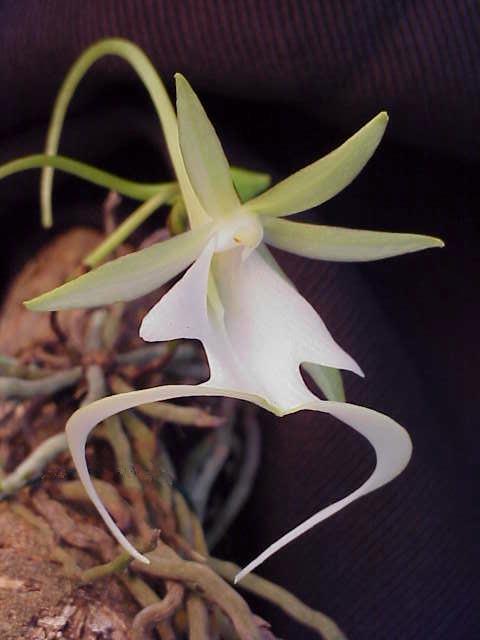 Ghost OrchidDendrophylax lindenii
-
 Noble DendrobiumDendrobium nobile
-
 Bee OrchidOphrys apifera
Compare
Questions and answers
What is the scientific name of the Chinese Ground Orchid?
The scientific name of the Chinese Ground Orchid is Bletilla striata. Written with its author, the full name is Bletilla striata (Thunb.) Rchb.f..
Which family does the Chinese Ground Orchid belong to?
Bletilla striata belongs to the family Orchidaceae, in the order Asparagales and the class Liliopsida.
Where is the Chinese Ground Orchid found?
Checklists and occurrence records place Bletilla striata in 7 countries, including China, Japan, South Korea, Myanmar, Taiwan and Vietnam.
What other names does the Chinese Ground Orchid have?
Bletilla striata is also known in English as Hyacinth Orchid, Bletilla, Hardy Orchid and Hyacinth Bletilla.
Sources
Passages the profile rests on
- Bletilla striata is a terrestrial orchid with pleated, spear-shaped leaves. Source passage: “Bletilla striata is a terrestrial orchid with pleated, spear-shaped leaves.” — English Wikipedia
- The flowers are magenta-pink. Source passage: “eventually bear 3-7 magenta-pink flowers.” — English Wikipedia
- Each mature flowering growth can bear between three and seven flowers. Source passage: “eventually bear 3-7 magenta-pink flowers.” — English Wikipedia
- The specific epithet striata means striped and refers to the ribbed leaves. Source passage: “The Latin specific epithet striata means "striped", in reference to the ribbed leaves.” — English Wikipedia
- The plant has decorative value. Source passage: “Moreover, the plant also has very high decorative value” — pmc.ncbi.nlm.nih.gov
- The species commonly grows in clumps alongside grassy slopes with sandy soil. Source passage: “It is most commonly found growing in clumps alongside grassy slopes with sandy soil.” — English Wikipedia
- Bletilla striata can grow in various soil types. Source passage: “It can grow in various soil types” — ucanr.edu
- The plant breaks dormancy in early spring. Source passage: “It breaks dormancy in early spring,” — English Wikipedia
- A tuber from the previous year can produce multiple shoots. Source passage: “with each tuber of the previous year potentially sending out multiple shoots.” — English Wikipedia
- New growths mature over approximately two months. Source passage: “These growths mature over the course of a couple months” — English Wikipedia
- The plant drops its leaves when entering winter dormancy. Source passage: “it drops its leaves as it enters winter dormancy;” — English Wikipedia
- The species tolerates moisture during winter dormancy better than most other terrestrial orchids. Source passage: “it tolerates moisture during this period much better than most others.” — English Wikipedia
- Natural populations of Bletilla striata in China have been severely damaged by excessive exploitation and habitat destruction. Source passage: “In China, the natural resources of Bletilla striata have been severely damaged because of the excessive exploitation and destruction of natural habitats.” — pmc.ncbi.nlm.nih.gov
- Bletilla striata was listed as one of China's key protected wild medicinal plants more than ten years before the cited study. Source passage: “More than 10 years ago, Bletilla striata was listed as one of the key protected wild medicinal plants” — pmc.ncbi.nlm.nih.gov
- Artificial cultivation of Bletilla striata and related species has been developed in most regions of China. Source passage: “the artificial cultivation of Bletilla striata and its related species has been developed in the majority of regions in China” — pmc.ncbi.nlm.nih.gov
- The study identified substantial genetic diversity among Bletilla striata populations from different Chinese regions. Source passage: “Results indicated the abundant genetic diversity of Bletilla striata among different areas.” — pmc.ncbi.nlm.nih.gov
- Bletilla striata is used in Asian traditional medicine to address problems affecting the lining of the alimentary canal, including ulcers. Source passage: “Bletilla striata is used in Asian traditional medicine for problems with the lining of the alimentary canal, such as ulcers.” — English Wikipedia
- Traditional Chinese Medicine attributes blood-stopping, swelling-reducing and tissue-regenerating properties to Bletilla striata. Source passage: “Traditional Chinese Medicine holds that Bletilla striata is capable of restraining blood leakage, stopping bleeding, dispersing swelling and promoting tissue regeneration.” — pmc.ncbi.nlm.nih.gov
- The species is traditionally used in China to treat hematemesis, hemoptysis, traumatic bleeding, chapped skin and ulcerative carbuncle. Source passage: “Thus it could be effectively applied in the treatment of hematemesis, hemoptysis, traumatic bleeding, chapped kin, and ulcerative carbuncle” — pmc.ncbi.nlm.nih.gov
- Bletilla striata can be incorporated into medicated foods or drinks prepared with chicken or duck. Source passage: “Bletilla striata can be added in medicated diets or drinks when stewed together with chicken or duck” — pmc.ncbi.nlm.nih.gov
- The plant can be extracted by boiling water or used as an ingredient in wine preparation. Source passage: “and extracted by boiling water or brewed as wine material.” — pmc.ncbi.nlm.nih.gov
- The plant is used as a natural adhesive for making silk strings for traditional Chinese musical instruments. Source passage: “It is also used as a natural glue for making silk strings for traditional Chinese instruments such as the guqin.” — English Wikipedia
- The mucilaginous roots are used for rubbing in inkstones with vermilion during writing. Source passage: “rubbing its mucilaginous roots in inkstones with vermilion for writing” — pmc.ncbi.nlm.nih.gov
- Bletilla striata has also been used as an insecticide. Source passage: “and another use is as an insecticide.” — pmc.ncbi.nlm.nih.gov
- Extracts of Bletilla striata are used as coating agents and cosmetic additives. Source passage: “In industry, Bletilla extract is used as a coating agent and cosmetic additive” — pmc.ncbi.nlm.nih.gov
Data
- Catalogue of Life, 2026-10-16 XR cc by
- Global Biodiversity Information Facility CC BY 4.0
- Wikidata CC0
- GeoNames CC BY 4.0
- Wikimedia Commons per image; credit shown with each image
- Within the Catalogue of Life, this name comes from The World Checklist of Vascular Plants (WCVP) cc by
References
- Bot. Zeitung (Berlin) 36: 75 (1878) where the name was published
This species in other databases
Page built on 27 November 2026. See how the catalog is made and all sources and licences.
Cite this page
ScientificNames.org. (2026). Bletilla striata (Chinese Ground Orchid). Retrieved November 27, 2026, from https://scientificnames.org/species/bletilla-striata
“Bletilla striata (Chinese Ground Orchid).” ScientificNames.org, 2026, scientificnames.org/species/bletilla-striata. Accessed 27 Nov. 2026.
ScientificNames.org. “Bletilla striata (Chinese Ground Orchid).” Accessed November 27, 2026. https://scientificnames.org/species/bletilla-striata.
@misc{scientificnames_bletilla_striata_chinese_ground_orchid,
  author = {{ScientificNames.org}},
  title = {Bletilla striata (Chinese Ground Orchid)},
  year = {2026},
  url = {https://scientificnames.org/species/bletilla-striata},
  note = {Accessed 2026-11-27}
}