Species · Amphibians
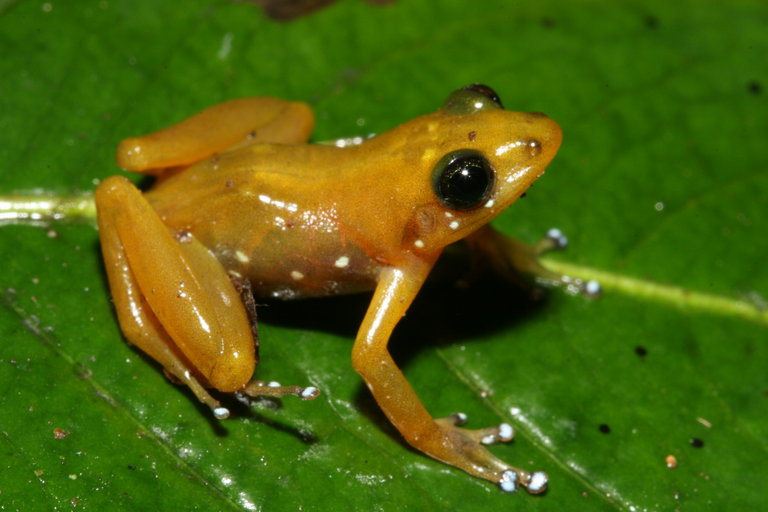
Blommersia variabilis
Blommersia variabilis has no English name on record in the checklists used here. It is a species of amphibian in the family Mantellidae (madagascar frogs), order Anura. The name dates from 2011.
- Scientific name
- Blommersia variabilis Pabijan, Gehring, Köhler, Glaw & Vences, 2011
- Genus
- Blommersia
- Family
- Mantellidae (Madagascar Frogs)
- Order
- Anura
- Class
- Amphibia
- Red List category
- LC Least Concern
- Recorded in
- 1 country
- Name status
- accepted in the Catalogue of Life
Overview
Wikidata describes Blommersia variabilis as “species of amphibian”.
Classification of Blommersia variabilis
| Kingdom | Animalia |
|---|---|
| Phylum | Chordata |
| Subphylum | Vertebrata |
| Infraphylum | Gnathostomata |
| Parvphylum | Osteichthyes |
| Megaclass | Tetrapoda |
| Class | Amphibia (Amphibians) |
| Order | Anura (Frogs) |
| Family | Mantellidae (Madagascar Frogs) |
| Subfamily | Mantellinae |
| Genus | Blommersia (Madagascar Frogs) |
| Species | Blommersia variabilis Pabijan, Gehring, Köhler, Glaw & Vences, 2011 |
Origin of the name. Etymology. The species name variabilis is an adjective referring to the remarkable variation observed in various characters of this new species, especially in the separation or connection of the lateral metatarsalia which otherwise is considered to be a very stable character within species of mantellids. Natural history. At the type locality in the vicinities of Ambodivoahangy village, B. variabilis was common outside of the forest in cultivated landscape. It was not seen or heard within primary or selectively logged forest. Calling males were observed in dense secondary vegetation on the borders of partially inundated ricefields, about 30 cm to 1 m off the ground. The male holotype was discovered while calling within a dense bush at the edge of a rice field. During the day specimens were difficult to find, hiding underneath the leaves of plants. Calling was most frequent in the evening and at night, but was also occasionally heard during the day, especially after rains. Calls were often intermingled with choruses of Aglyptodactylus sp., Guibemantis cf. kathrinae and Ptychadena mascareniensis. At Maroantsetra it is a common species living in ditches covered by dense vegetation within the town itself. Near Voloina we heard and collected the species in flooded areas in a mosaic of rice paddies, shrubs, and remains of primary rainforest. A single clutch of eggs deposited on the surface of a leaf was discovered within the village of Ambinanitelo on 1 April 2010. Mating in this species takes place on a leaf usually overhanging lentic water and has been observed by us in Voloina. As in other Blommersia, the male and female sit vertically on a leaf, the male on top of the female with his legs extending over the female's dorsum (Glaw & Vences 1994). FIGURE 6. Audiospectrogram and corresponding oscillogram of the advertisement call of Blommersia variabilis sp. nov. from the type locality Ambodivoahangy, recorded on 3 April 2010. Vocalization. The advertisement call of B. variabilis (Fig. 6) was recorded at the type locality (Ambodivoahangy) on 3 April 2010 at an estimated air temperature of 26 ° C. It consists of a series of short inharmonious notes, repeated at regular intervals in fast succession with a repetition rate of approximately 7.4 notes / second. Each call is composed of 3 - 6 notes, whereas in most cases a long call is followed by a shorter call containing fewer notes, in combination resulting in a call series with two calls. Within these call series, the interval between first and second call ranges between 500 and 720 ms. Within calls, the initial note is longer and contains more pulses than subsequent secondary notes. Numerical call parameters are as follows: call duration 344 - 887 ms (532 ± 219; n = 9); note duration 54 - 223 ms (107 ± 48; n = 23); pulses / note 3 - 14 (6.4 ± 3.0; n = 23); inter-note interval 21 - 33 ms (26.7 ± 3.2 ms; n = 19). Overall frequency is distributed in a broad band from app. 2000 - 6500 Hz, with a dominant frequency at around 5100 Hz. Calls were repeated at irregular intervals. Similar calls were recorded in 1991 in Maroantsetra, but due to the poor quality of the recordings we refrain from a detailed analysis. Detailed call data for various populations of B. galani, B. dejongi, and B. wittei are presented in Vences et al. (2010). In comparison, the call of B. variabilis differs from that of B. wittei by longer note duration, shorter internote intervals and a lower note repetition rate. Calls of B. galani differ from those of B. variabilis by shorter notes and much longer inter-note intervals. In calls of B. dejongi, notes are barely spaced and partly fused and separate pulses within notes are unrecognizable.
Where Blommersia variabilis is found
Checklists and occurrence records place Blommersia variabilis in 1 country. GBIF holds 9 georeferenced records of it.
Countries
A number beside a place is its count of GBIF occurrence records. A place without a number comes from a checklist alone. Records show where a species has been observed or collected, which can include escapes and vagrants.
Related species
-
 Ambrana Madagascar FrogBlommersia grandisonae
-
 Moramanga Madagascar FrogBlommersia blommersae
-
 Blommersia angolafa
- Manjakatompo Madagascar FrogBlommersia kely
- Witte's Madagascar FrogBlommersia wittei
- Domergue's Madagascar FrogBlommersia domerguei
- Difficult Madagascar FrogBlommersia sarotra
- Blommersia bara
Compare
Sources
Data
- Catalogue of Life, 2026-10-16 XR cc by
- Global Biodiversity Information Facility CC BY 4.0
- Wikidata CC0
- GeoNames CC BY 4.0
- Within the Catalogue of Life, this name comes from The Integrated Taxonomic Information System cc0
References
- A new microendemic frog species of the genus Blommersia (Anura: Mantellidae) from the east coast of Madagascar. (2011). Zootaxa, 2978, 34–50. https://doi.org/10.11646/zootaxa.2978.1.2 Link where the name was published
This species in other databases
Page built on 26 November 2026. See how the catalog is made and all sources and licences.
Cite this page
ScientificNames.org. (2026). Blommersia variabilis. Retrieved November 26, 2026, from https://scientificnames.org/species/blommersia-variabilis
“Blommersia variabilis.” ScientificNames.org, 2026, scientificnames.org/species/blommersia-variabilis. Accessed 26 Nov. 2026.
ScientificNames.org. “Blommersia variabilis.” Accessed November 26, 2026. https://scientificnames.org/species/blommersia-variabilis.
@misc{scientificnames_blommersia_variabilis,
  author = {{ScientificNames.org}},
  title = {Blommersia variabilis},
  year = {2026},
  url = {https://scientificnames.org/species/blommersia-variabilis},
  note = {Accessed 2026-11-26}
}