Species · Molluscs
Two-groove Odostome Boonea bisuturalis
The scientific name of the Two-groove Odostome is Boonea bisuturalis. It is a species of mollusc in the family Pyramidellidae (pyrams). The name dates from 1822.
- Scientific name
- Boonea bisuturalis (Say, 1822)
- Common name
- Two-groove Odostome
- Genus
- Boonea
- Family
- Pyramidellidae (Pyrams)
- Class
- Gastropoda
- Environment
- marine
- Recorded in
- 3 countries
- Name status
- accepted in the Catalogue of Life

Overview
The two-groove odostome is a mollusc in the family Pyramidellidae and class Gastropoda. It inhabits rocky intertidal areas, oyster bars, mudflats, marinas, and docks. It is an ectoparasite that commonly lives on the shells of other mollusks and feeds on their body fluids.
Written 27 November 2026 from the sources listed below. Each statement was checked against the passage it cites; statements that could not be supported were removed.
Appearance
The shell is elongate, conical, and dextrally coiled, with a sharply pointed apex. It is dull white and covered by a thin brownish periostracum.[1][2]
The shell has an oval aperture with a lower lip edge that projects outward. An oblique fold is present inside the aperture on the columella, and the operculum is horn-colored.[3][4][5]
Shell height ranges from 4 to 6 mm.[6]
Habitat
The species inhabits rocky intertidal areas, oyster bars, mudflats, marinas, and docks. In San Francisco Bay, it is known mostly from mudflats.[7][8]
It occurs in shallow water on the shells or bodies of other mollusks.[9]
Diet
The two-groove odostome feeds on the body fluids of host invertebrates. Recorded food hosts include eastern oysters and softshell clams.[10][11]
Frequently recorded hosts include common periwinkles, alternate bittiums, blue mussels, and eastern mudsnails.[12]
In experiments, starved individuals fed on 37 mollusk species. Experimental observations did not record feeding on polychaetes or tunicates.[13][14]
Behaviour
The species is an ectoparasite that commonly lives on the shells of other mollusks.[15]
Reproduction and life cycle
The species is a simultaneous hermaphrodite. Individuals born during June to September spawning events produce spermatophores by October when they are smaller than 3.5 mm.[16][17]
Spermatophores are transferred to another individual and stored over winter.[18]
Egg masses contain between 21 and 276 eggs, with a mean of 92 eggs. They are deposited on host shells, shells of other individuals, or other surfaces.[19][20]
At temperatures of 17–20°C, eggs hatch after four days. The planktotrophic larvae take 16–20 days to metamorphose.[21][22][23]
Conservation
High densities may affect the growth and survival of mollusks, although these effects have not been quantified.[24]
The species could threaten local oyster populations in Mexican waters, but its abundance and impacts there are unknown.[25]
Classification of the Two-groove Odostome
| Kingdom | Animalia |
|---|---|
| Phylum | Mollusca |
| Class | Gastropoda (Gastropod) |
| Subclass | Heterobranchia |
| Infraclass | Euthyneura |
| Subterclass | Tectipleura |
| Superorder | Pylopulmonata |
| Superfamily | Pyramidelloidea |
| Family | Pyramidellidae (Pyrams) |
| Subfamily | Odostomiinae |
| Genus | Boonea |
| Species | Boonea bisuturalis (Say, 1822) |
Where the Two-groove Odostome is found
Checklists and occurrence records place Boonea bisuturalis in 3 countries. GBIF holds 610 georeferenced records of it.
Countries
Regions and cities with the most records
- Massachusetts, United States 64
- Hanover, United States 49
- Duxbury, United States 46
- Winthrop, United States 24
- Quincy, United States 23
- Barrington, United States 22
- Cranston, United States 22
- Malden, United States 22
- Revere, United States 22
- Warwick, United States 22
- Chelsea, United States 20
- East Providence, United States 20
- Everett, United States 20
- Lynn, United States 20
- Melrose, United States 20
- Orient Heights, United States 20
- Providence, United States 20
- Saugus, United States 20
- West Warwick, United States 20
- Weymouth, United States 20
- Allston, United States 19
- Arlington, United States 19
- Ashmont, United States 19
- Back Bay, United States 19
- Belmont, United States 19
- Boston, United States 19
- Brighton, United States 19
- Bristol, United States 19
- Brookline, United States 19
- Cambridge, United States 19
- Charlestown, United States 19
- Chestnut Hill, United States 19
- Dorchester, United States 19
- East Boston, United States 19
- Mattapan, United States 19
- Medford, United States 19
A number beside a place is its count of GBIF occurrence records. A place without a number comes from a checklist alone. Records show where a species has been observed or collected, which can include escapes and vagrants.
Common names
English
- Two-groove Odostome
Names in 2 other languages
- Dutch
- Stippellijn-tandhoren, Stippellijn-tandslakje
- French
- odostomie à double suture
Synonyms
15 other scientific names have been used for this species and are now treated as synonyms of Boonea bisuturalis.
- Acteon trifidus Totten, 1834
- Boonea trifida (Totten, 1834)
- Jaminia exigua Couthouy, 1838
- Odostomia (Boonea) bisuturalis (Say, 1822)
- Odostomia (Boonea) bisuturalis ovilensis Bartsch, 1909
- Odostomia (Menestho) bisuturalis (Say, 1822)
- Odostomia (Menestho) bisuturalis ovilensis Bartsch, 1909
- Odostomia (Menestho) trifida (Totten, 1834)
- Odostomia (Menestho) trifida bedequensis Bartsch, 1909
- Odostomia bedequensis Bartsch, 1909
- Odostomia bisuturalis (Say, 1822)
- Odostomia trifida (Totten, 1834)
- Turritella bisuturalis Say, 1822
- Odostomia insculpta De Kay, 1844 ambiguous synonym
- Odostomia marginata Cailliaud, 1865 ambiguous synonym
Related species
-
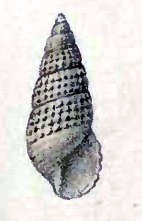 Impressed OdostomeBoonea impressa
- Boonea scymnocelata
-
 Half-smooth OdostomeBoonea seminuda
- Boonea jadisi
-
 Boonea cincta
- Boonea suoana
- Boonea umboniocola
- Boonea multituberculata
Compare
Questions and answers
What is the scientific name of the Two-groove Odostome?
The scientific name of the Two-groove Odostome is Boonea bisuturalis. Written with its author, the full name is Boonea bisuturalis (Say, 1822).
Which family does the Two-groove Odostome belong to?
Boonea bisuturalis belongs to the family Pyramidellidae and the class Gastropoda.
Where is the Two-groove Odostome found?
Checklists and occurrence records place Boonea bisuturalis in 3 countries: United States, Canada and Mexico.
Sources
Passages the profile rests on
- The shell is elongate, conical, and dextrally coiled, with a sharply pointed apex. Source passage: “The shell is elongate, conical, and dextrally coiled with 7-8 whorls. The sutures are well-defined with a deeply impressed channel below the suture. The apex of the shell is sharp.” — invasions.si.edu
- The shell is dull white and covered by a thin brownish periostracum. Source passage: “The color is dull white with a thin brownish periostracum” — invasions.si.edu
- The shell has an oval aperture with a lower lip edge that projects outward. Source passage: “The aperture is oval, with the lower edge of the lip projecting outwards.” — invasions.si.edu
- An oblique fold is present inside the shell aperture on the columella. Source passage: “The columella has an oblique fold inside the aperture.” — invasions.si.edu
- The operculum is horn-colored. Source passage: “and the operculum is horn-colored.” — invasions.si.edu
- Shell height ranges from 4 to 6 mm. Source passage: “Shell height is 4-6 mm.” — invasions.si.edu
- The species inhabits rocky intertidal areas, oyster bars, mudflats, marinas, and docks. Source passage: “As indicated by the range of its hosts, B. bisuturalis can inhabit a wide range of habitats, including the rocky intertidal, oyster bars, mudflats, marinas, and docks” — invasions.si.edu
- In San Francisco Bay, the species is known mostly from mudflats. Source passage: “In San Francisco Bay, it is so far known mostly from mudflats” — invasions.si.edu
- The species occurs in shallow water on the shells or bodies of other mollusks. Source passage: “Boonea bisuturalis is a small ectoparasitic gastropod, usually found on the shells or bodies of other mollusks, in shallow water.” — invasions.si.edu
- The species feeds on the body fluids of host invertebrates. Source passage: “Boonea bisuturalis, like other pyramidellid snails, feeds on the body fluids of host invertebrates” — invasions.si.edu
- Recorded food hosts include eastern oysters and softshell clams. Source passage: “Boonea bisuturalis feeds on Crassostrea virginica (Eastern Oyster), Mya arenaria (Softshell Clam), and other mollusks, both bivalves and gastropods” — invasions.si.edu
- Frequently recorded hosts include common periwinkles, alternate bittiums, blue mussels, and eastern mudsnails. Source passage: “Some of the more frequent hosts are: Crassostrea virginica (Eastern Oyster); Mya arenaria (Softshell Clam); Littorina littorea (Common Periwinkle); Bittium alternatum (Alternate Bittium); Mytilus edulis (Blue Mussel); Ilyanassa obsoleta (Eastern Mudsnail);” — invasions.si.edu
- In experiments, starved individuals fed on 37 mollusk species. Source passage: “However, in experiments, starved B. bisuturalis fed on 37 species of mollusks.” — invasions.si.edu
- Experimental observations did not record feeding on polychaetes or tunicates. Source passage: “Feeding on non-mollscan invertebrates (e.g. the polychaetes Nereis virens and Hydroides dianthus; the tunicate Molgula manhattensis) was not seen” — invasions.si.edu
- The species is an ectoparasite that commonly lives on the shells of other mollusks. Source passage: “Boonea bisuturalis is a small ectoparasitic gastropod, usually found on the shells of other mollusks.” — invasions.si.edu
- The species is a simultaneous hermaphrodite. Source passage: “This snail, like other pyramidellids, is a simultaneous hermaphrodite.” — invasions.si.edu
- Individuals born during June to September spawning events produce spermatophores by October when they are smaller than 3.5 mm. Source passage: “Animals born during June-September spawning events will produce spermatophores by October, at a size of less than 3.5 mm.” — invasions.si.edu
- Spermatophores are transferred to another individual and stored over winter. Source passage: “The spermatophores are transferred to another animal and stored over the winter, for the summer spawning.” — invasions.si.edu
- Egg masses contain between 21 and 276 eggs, with a mean of 92 eggs. Source passage: “Egg masses, of 21-276 eggs (mean = 92)” — invasions.si.edu
- Egg masses are deposited on host shells, shells of other individuals, or other surfaces. Source passage: “are laid on the host shell, a shell of another B. bisuturalis or another surface (glass in laboratory observations)” — invasions.si.edu
- At temperatures of 17–20°C, eggs hatch after four days. Source passage: “At 17-20°C eggs took 4 days to hatch” — invasions.si.edu
- The planktotrophic larvae take 16–20 days to metamorphose. Source passage: “produced planktotrophic larvae which took 16-20 days to metamorphose” — invasions.si.edu
- Larval development is planktotrophic. Source passage: “Larval development of B. bisuturalis is planktotrophic.” — invasions.si.edu
- High densities may affect the growth and survival of mollusks, although these effects have not been quantified. Source passage: “High densities of this species can affect mollusk growth and survival, but these effects have not been quantified.” — invasions.si.edu
- The species could threaten local oyster populations in Mexican waters, but its abundance and impacts there are unknown. Source passage: “This snail could represent a threat to local oyster populations. However, we have no information on its abundance and impacts in Mexican waters.” — invasions.si.edu
Data
- Catalogue of Life, 2026-10-16 XR cc by
- Global Biodiversity Information Facility CC BY 4.0
- Wikidata CC0
- GeoNames CC BY 4.0
- Wikimedia Commons per image; credit shown with each image
- Within the Catalogue of Life, this name comes from World Register of Marine Species cc by
This species in other databases
Page built on 28 November 2026. See how the catalog is made and all sources and licences.
Cite this page
ScientificNames.org. (2026). Boonea bisuturalis (Two-groove Odostome). Retrieved November 28, 2026, from https://scientificnames.org/species/boonea-bisuturalis
“Boonea bisuturalis (Two-groove Odostome).” ScientificNames.org, 2026, scientificnames.org/species/boonea-bisuturalis. Accessed 28 Nov. 2026.
ScientificNames.org. “Boonea bisuturalis (Two-groove Odostome).” Accessed November 28, 2026. https://scientificnames.org/species/boonea-bisuturalis.
@misc{scientificnames_boonea_bisuturalis_two_groove_odostome,
  author = {{ScientificNames.org}},
  title = {Boonea bisuturalis (Two-groove Odostome)},
  year = {2026},
  url = {https://scientificnames.org/species/boonea-bisuturalis},
  note = {Accessed 2026-11-28}
}