Species · Flowering plants
Tall Boronia Boronia molloyae
The scientific name of the Tall Boronia is Boronia molloyae. It is a species of flowering plant in the family Rutaceae (rue family), order Sapindales.
- Scientific name
- Boronia molloyae J.R.Drumm.
- Common name
- Tall Boronia
- Genus
- Boronia
- Family
- Rutaceae (Rue Family)
- Order
- Sapindales
- Class
- Magnoliopsida
- Recorded in
- 1 country
- Name status
- accepted in the Catalogue of Life
Overview
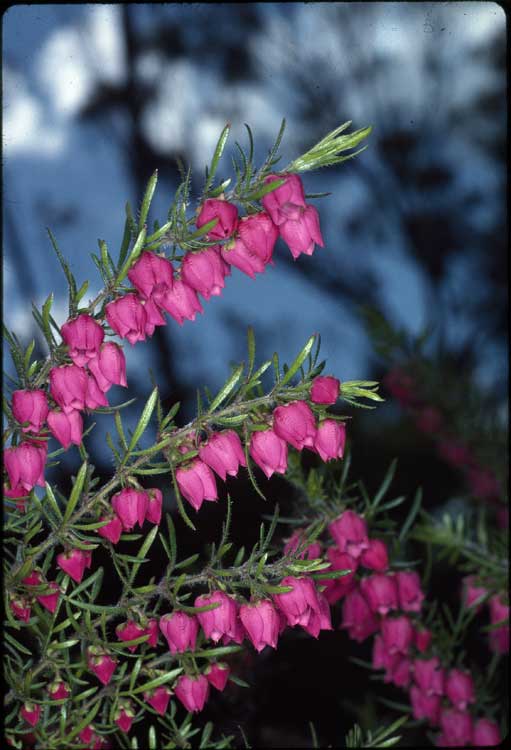
Boronia molloyae occurs between Gingin and Albany in Western Australia. It has pinnate leaves and deep rose-pink flowers with four petals.
Written 27 November 2026 from the sources listed below. Each statement was checked against the passage it cites; statements that could not be supported were removed.
Appearance
Tall boronia is a shrub with hairy branches and pinnate leaves that usually contain three to seven narrow elliptic leaflets. The leaflets measure between 10 and 50 millimetres in length, and the shrub typically reaches a height of 3 metres.[1][2][3][4]
Its flowers grow singly in the leaf axils on thin stalks measuring between 4 and 11 millimetres long. The stalks have top-shaped tips.[5][6][7]
Each flower has four approximately round, papery and hairy sepals measuring approximately 8 millimetres long. Its four petals are deep rose pink, broadly elliptic and approximately 8 millimetres long.[8][9][10][11]
The flowers contain eight stamens. The four nearest the sepals are sterile and longer than those nearest the petals.[12]
Its stigma is sessile and pyramid-shaped, measuring approximately 3 millimetres high.[13][14]
A reserve management plan describes tall boronia as a slender shrub with pink and red flowers.[15]
Habitat
Tall boronia grows in sandy soils along watercourses and near swamps.[16]
The species is endemic to coastal regions of south-western Western Australia. Its distribution includes the Jarrah Forest, Swan Coastal Plain and Warren biogeographic regions.[17][18]
Reproduction and life cycle
Tall boronia flowers between September and December.[19]
Conservation
The Western Australian Government classifies tall boronia as not threatened.[20]
Classification of the Tall Boronia
| Kingdom | Plantae |
|---|---|
| Subkingdom | Pteridobiotina |
| Phylum | Tracheophyta |
| Class | Magnoliopsida |
| Order | Sapindales |
| Family | Rutaceae (Rue Family) |
| Subfamily | Zanthoxyloideae |
| Tribe | Zanthoxyleae |
| Subtribe | Boroniinae |
| Genus | Boronia |
| Species | Boronia molloyae J.R.Drumm. |
Where the Tall Boronia is found
Checklists and occurrence records place Boronia molloyae in 1 country across Oceania. GBIF holds 275 georeferenced records of it.
Countries
Regions and cities with the most records
1 more country has a few records outside this range
These countries hold a few records of Boronia molloyae but lie outside the range the checklists give for it. Such records are often zoo or garden specimens, museum material or vagrants, so the species is not counted as occurring there.
Range as the checklists state it
Australia (SW-Western Australia)
A number beside a place is its count of GBIF occurrence records. A place without a number comes from a checklist alone. Records show where a species has been observed or collected, which can include escapes and vagrants.
Common names
English
- Tall Boronia
Names in 1 other language
- Slovak
- borónia Mollyovej
Synonyms
3 other scientific names have been used for this species and are now treated as synonyms of Boronia molloyae.
- Boronia elatior Bartl.
- Boronia psoraleoides DC.
- Boronia semifertilis F.Muell.
Related species
-
 Brown BoroniaBoronia megastigma
-
 Aniseed BoroniaBoronia crenulata
-
 Kalgan BoroniaBoronia heterophylla
-
 Native RoseBoronia serrulata
-
 Boronia ledifolia
-
 Forest BoroniaBoronia muelleri
-
 Pink BoroniaBoronia pinnata
-
 Hairy BoroniaBoronia pilosa
Compare
Questions and answers
What is the scientific name of the Tall Boronia?
The scientific name of the Tall Boronia is Boronia molloyae. Written with its author, the full name is Boronia molloyae J.R.Drumm..
Which family does the Tall Boronia belong to?
Boronia molloyae belongs to the family Rutaceae, in the order Sapindales and the class Magnoliopsida.
Where is the Tall Boronia found?
Checklists and occurrence records place Boronia molloyae in 1 country: Australia.
Sources
Passages the profile rests on
- The shrub typically reaches a height of 3 metres. Source passage: “Boronia molloyae is a shrub that typically grows to a height of 3 m (9.8 ft)” — English Wikipedia
- The branches of this species are hairy. Source passage: “and has hairy branches.” — English Wikipedia
- Its pinnate leaves usually contain three to seven narrow elliptic leaflets. Source passage: “The leaves are pinnate with mostly between three and seven narrow elliptic leaflets” — English Wikipedia
- Its leaflets measure between 10 and 50 millimetres in length. Source passage: “10–50 mm (0.39–1.97 in) long.” — English Wikipedia
- Its flowers grow singly in the leaf axils on thin stalks. Source passage: “The flowers are borne singly in leaf axils on a thin pedicel” — English Wikipedia
- The flower stalks measure between 4 and 11 millimetres long. Source passage: “4–11 mm (0.16–0.43 in) long” — English Wikipedia
- The flower stalks have top-shaped tips. Source passage: “and with a top-shaped tip.” — English Wikipedia
- Its four sepals are approximately round, papery and hairy. Source passage: “The four sepals are more or less round, papery, hairy” — English Wikipedia
- Its sepals are approximately 8 millimetres long. Source passage: “and about 8 mm (0.31 in) long.” — English Wikipedia
- Its four petals are deep rose pink and broadly elliptic. Source passage: “The four petals are deep rose pink, broadly elliptic” — English Wikipedia
- Its petals are approximately 8 millimetres long. Source passage: “and about 8 mm (0.31 in) long.” — English Wikipedia
- The flowers contain eight stamens, of which the four nearest the sepals are sterile and longer than those nearest the petals. Source passage: “There are eight stamens, with the four nearest the sepals sterile and longer than those near the petals.” — English Wikipedia
- Its stigma is sessile and pyramid-shaped. Source passage: “The stigma is sessile, pyramid-shaped” — English Wikipedia
- Its stigma is approximately 3 millimetres high. Source passage: “and about 3 mm (0.12 in) high.” — English Wikipedia
- A reserve management plan describes tall boronia as a slender shrub with pink and red flowers. Source passage: “Tall Boronia. Slender sh to 5m pink, red fl.” — yourdenmark.wa.gov.au
- This species grows in sandy soils along watercourses and near swamps. Source passage: “Tall boronia grows in sandy soils along watercourses and near swamps” — English Wikipedia
- Its distribution includes the Jarrah Forest, Swan Coastal Plain and Warren biogeographic regions. Source passage: “in the Jarrah Forest, Swan Coastal Plain and Warren biogeographic regions.” — English Wikipedia
- The species is endemic to coastal regions of south-western Western Australia. Source passage: “is endemic to coastal regions in the south-west of Western Australia.” — English Wikipedia
- Boronia molloyae flowers between September and December. Source passage: “Flowering occurs from September to December.” — English Wikipedia
- The Western Australian Government classifies Boronia molloyae as not threatened. Source passage: “Boronia molloyae is classified as "not threatened" by the Government of Western Australia Department of Parks and Wildlife.” — English Wikipedia
Data
- Catalogue of Life, 2026-10-16 XR cc by
- Global Biodiversity Information Facility CC BY 4.0
- Wikidata CC0
- GeoNames CC BY 4.0
- Wikimedia Commons per image; credit shown with each image
- Within the Catalogue of Life, this name comes from Synonymic Checklists of the Vascular Plants of the World cc by
References
- J.R.Drumm. (1843). London J. Bot. 2: 169, 170 (1843), as ‘molloyi’. where the name was published
This species in other databases
- Catalogue of Life MKWX
- Wikidata Q4946276
- iNaturalist 1124894
- World Flora Online wfo-0000569234
- GRIN 455023
Page built on 27 November 2026. See how the catalog is made and all sources and licences.
Cite this page
ScientificNames.org. (2026). Boronia molloyae (Tall Boronia). Retrieved November 27, 2026, from https://scientificnames.org/species/boronia-molloyae
“Boronia molloyae (Tall Boronia).” ScientificNames.org, 2026, scientificnames.org/species/boronia-molloyae. Accessed 27 Nov. 2026.
ScientificNames.org. “Boronia molloyae (Tall Boronia).” Accessed November 27, 2026. https://scientificnames.org/species/boronia-molloyae.
@misc{scientificnames_boronia_molloyae_tall_boronia,
  author = {{ScientificNames.org}},
  title = {Boronia molloyae (Tall Boronia)},
  year = {2026},
  url = {https://scientificnames.org/species/boronia-molloyae},
  note = {Accessed 2026-11-27}
}