Species · Reptiles
Patagonian Lancehead Bothrops ammodytoides
The scientific name of the Patagonian Lancehead is Bothrops ammodytoides. It is a species of reptile in the family Viperidae (viper), order Squamata. The name dates from 1873.
Overview
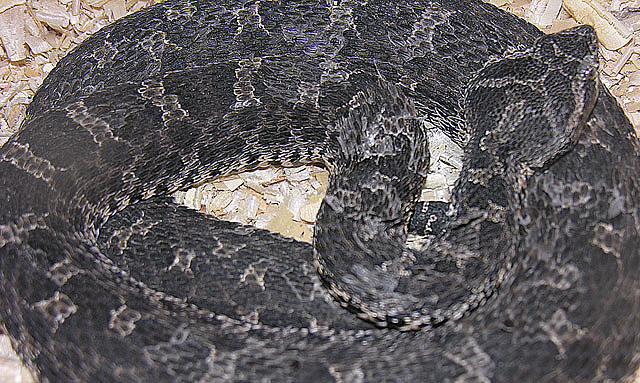
The Patagonian lancehead is a venomous pit viper in the family Viperidae, order Squamata and class Reptilia, described by Leybold in 1873. It is distinguished by its stocky body, upturned snout and pale brown dorsal coloration with dark brown markings edged in black.
Written 26 November 2026 from the sources listed below. Each statement was checked against the passage it cites; statements that could not be supported were removed.
Appearance
The Patagonian lancehead has a stocky body and an upturned snout resembling that of hog-nosed pitvipers in the genus Porthidium. Its rostral scale is elongated vertically.[1][2][3]
Its dorsal coloration is pale brown with large, squarish dark brown spots or crossbars edged in black. In some specimens, the markings alternate to form a zigzag stripe, and a dark streak runs behind each eye.[4][5][6]
The underside is yellowish with brown dots. Its dorsal scales are strongly keeled and arranged in 23 or 25 rows at midbody.[7][8][9]
The upper surface of its head is covered with small, overlapping, keeled scales. Its large supraocular scales are separated by eight or nine rows of smaller scales, and two rows of scales separate the eye from the upper labial scales.[10][11][12]
It has nine or ten upper labial scales, with the third and fourth being the largest. Its temporal scales are keeled.[13][14][15]
Its divided subcaudal scales number between 30 and 38. Its average total length ranges from 45 to 75 cm, and it can reach almost one metre.[16][17][18]
Habitat
The Patagonian lancehead occurs in temperate to subtropical savannas and steppes, mostly in sandy and rocky areas. Its habitats include coastal dunes, steep riverbanks and salt flats.[19][20][21]
Near the upper limits of its altitudinal range, it occasionally occurs in broadleaf evergreen forest. Its recorded vertical distribution extends from sea level to at least 2,000 metres.[22][23]
Behaviour
The Patagonian lancehead is defensive of its territory and aggressive when disturbed.[24][25]
Uses
The Patagonian lancehead is venomous, and its venom is potentially lethal to humans. It can cause internal bleeding and tissue damage around the wound.[26][27][28]
Conservation
No subspecies are currently recognized.[29]
Classification of the Patagonian Lancehead
| Kingdom | Animalia |
|---|---|
| Phylum | Chordata |
| Subphylum | Vertebrata |
| Infraphylum | Gnathostomata |
| Parvphylum | Osteichthyes |
| Megaclass | Tetrapoda |
| Class | Reptilia (Reptile) |
| Order | Squamata (Snakes) |
| Suborder | Serpentes (Snakes) |
| Infraorder | Alethinophidia |
| Family | Viperidae (Viper) |
| Subfamily | Crotalinae |
| Genus | Bothrops (Lanceheads) |
| Species | Bothrops ammodytoides Leybold, 1873 |
Where the Patagonian Lancehead is found
Checklists and occurrence records place Bothrops ammodytoides in 1 country. GBIF holds 608 georeferenced records of it.
Countries
Regions and cities with the most records
- San Luis, Argentina 105
- Buenos Aires, Argentina 77
- Chubut, Argentina 68
- Mendoza, Argentina 58
- La Pampa, Argentina 52
- Cordoba, Argentina 51
- Rio Negro, Argentina 15
- Neuquen, Argentina 13
- General Acha, Argentina 10
- Catamarca, Argentina 9
- Mendoza, Argentina 9
- San Juan, Argentina 9
- Tunuyán, Argentina 8
- Bahía Blanca, Argentina 6
- La Rioja, Argentina 6
- San Luis, Argentina 5
- Villa Mercedes, Argentina 5
- Balcarce, Argentina 4
- La Falda, Argentina 4
- Luján de Cuyo, Argentina 4
- General Roca, Argentina 3
- Toay, Argentina 3
- Tupungato, Argentina 3
Range as the checklists state it
Argentina (Tucuman to Chubut and Patagonia, Neuquén, Rio Negro, Mendoza, La Pampa, Buenos Aires, San Juan, San Luis, La Rioja, Córdoba, Catamarca).
A number beside a place is its count of GBIF occurrence records. A place without a number comes from a checklist alone. Records show where a species has been observed or collected, which can include escapes and vagrants.
Common names
English
- Patagonian Lancehead
- Patagonia Lancehead
- Yararanata
Names in 8 other languages
- Chinese
- 阿根廷矛頭蝮
- Czech
- křovinář růžkatý
- Danish
- Patagonisk Lanseslange
- German
- Cenicienta, Patagonienlanzenotter, Yararanata
- Hungarian
- patagóniai lándzsakígyó
- Portuguese
- Jararaca-da-Patagônia
- Russian
- Курносый ботропс
- Spanish
- Yarará ñata
Synonyms
4 other scientific names have been used for this species and are now treated as synonyms of Bothrops ammodytoides.
- Bothrops burmeisteri Koslowsky, 1895
- Bothrops patagonicus Müller, 1885
- Rhinocerophis ammodytoides (Leybold, 1873)
- Rhinocerophis nasus Garman, 1881
Related species
-
 Golden LanceheadBothrops insularis
-
 TerciopeloBothrops asper
-
 Common LanceheadBothrops atrox
-
 JararacaBothrops jararaca
-
 Urutu LanceheadBothrops alternatus
-
 Martinique LanceheadBothrops lanceolatus
-
 JararacussuBothrops jararacussu
-
 Saint Lucia LanceheadBothrops caribbaeus
Compare
Questions and answers
What is the scientific name of the Patagonian Lancehead?
The scientific name of the Patagonian Lancehead is Bothrops ammodytoides. Written with its author, the full name is Bothrops ammodytoides Leybold, 1873.
Which family does the Patagonian Lancehead belong to?
Bothrops ammodytoides belongs to the family Viperidae, in the order Squamata and the class Reptilia.
Where is the Patagonian Lancehead found?
Checklists and occurrence records place Bothrops ammodytoides in 1 country: Argentina.
What is the conservation status of the Patagonian Lancehead?
The IUCN Red List category recorded for Bothrops ammodytoides is Least Concern (LC).
What other names does the Patagonian Lancehead have?
Bothrops ammodytoides is also known in English as Patagonia Lancehead and Yararanata.
Sources
Passages the profile rests on
- The species has a stocky body and an upturned snout. Source passage: “This species has a stocky build” — English Wikipedia
- Its rostral scale is elongated vertically. Source passage: “The rostral scale is elongated vertically” — English Wikipedia
- Its snout is upturned, resembling that of hog-nosed pitvipers in the genus Porthidium. Source passage: “the snout is upturned, similar to the hog-nosed pitvipers of the genus Porthidium.” — English Wikipedia
- Its dorsal coloration is pale brown with large, squarish dark brown spots or crossbars edged in black. Source passage: “Dorsally, it is pale brown, with a series of large squarish dark brown spots or crossbars which are edged with black.” — English Wikipedia
- In some specimens, the dorsal markings alternate to create a zigzag stripe. Source passage: “On some specimens these markings alternate to form a zigzag stripe.” — English Wikipedia
- The species has a dark streak behind each eye. Source passage: “There is a dark streak behind the eye.” — English Wikipedia
- Its underside is yellowish and marked with brown dots. Source passage: “Ventrally, it is yellowish with brown dots.” — English Wikipedia
- Its dorsal scales are strongly keeled. Source passage: “The very strongly keeled dorsal scales” — English Wikipedia
- The dorsal scales are arranged in 23 or 25 rows at midbody. Source passage: “are arranged in 23 or 25 rows at midbody.” — English Wikipedia
- The upper surface of its head is covered with small, overlapping, keeled scales. Source passage: “The dorsal surface of the head is covered by small, imbricate, keeled scales.” — English Wikipedia
- Its large supraocular scales are separated by eight or nine rows of smaller scales. Source passage: “The large supraoculars are separated by 8 or 9 rows of these small scales.” — English Wikipedia
- Two rows of scales separate its eye from the upper labial scales. Source passage: “Two rows of scales separate the eye from the upper labials.” — English Wikipedia
- It has nine or ten upper labial scales. Source passage: “Upper labials 9 or 10” — English Wikipedia
- Its third and fourth upper labial scales are the largest. Source passage: “the 3rd and 4th largest.” — English Wikipedia
- Its temporal scales are keeled. Source passage: “The temporal scales are keeled.” — English Wikipedia
- Its subcaudal scales number between 30 and 38 and are divided. Source passage: “subcaudals 30–38, divided.” — English Wikipedia
- Its average total length ranges from 45 to 75 cm. Source passage: “grows to an average total length of 45–75 cm (18-30 inches)” — English Wikipedia
- It can reach almost one metre in total length. Source passage: “but is capable reaching almost 1 m (39 inches) in total length.” — English Wikipedia
- It occurs in temperate to subtropical savannas and steppes. Source passage: “occurring in temperate to subtropical savannas and steppes.” — English Wikipedia
- It is found mostly in sandy and rocky areas. Source passage: “Found mostly in sandy, rocky areas” — English Wikipedia
- Its habitats include coastal dunes, steep riverbanks and salt flats. Source passage: “including coastal dunes, steep riverbanks and salt flats.” — English Wikipedia
- Near the upper limits of its altitudinal range, it occasionally occurs in broadleaf evergreen forest. Source passage: “Around the upper limits of its altitude range it can occasionally be found in broadleaf evergreen forest.” — English Wikipedia
- Its recorded vertical distribution extends from sea level to at least 2,000 metres. Source passage: “The vertical distribution ranges from sea level to at least 2,000 m (6,600 ft) altitude.” — English Wikipedia
- The species is defensive of its territory. Source passage: “The snakes are defensive of their territory” — English Wikipedia
- It is aggressive when disturbed. Source passage: “aggressive when disturbed.” — English Wikipedia
- Its venom is potentially lethal to humans. Source passage: “Bothrops ammodytiodes venom is potentially lethal to humans” — English Wikipedia
- Its venom can cause internal bleeding and tissue damage around the wound. Source passage: “causing internal bleeding and tissue damage around the wound.” — English Wikipedia
- The species is classified as a venomous pit viper. Source passage: “Bothrops ammodytoides is a venomous pit viper species endemic to Argentina.” — inaturalist.org
- No subspecies are currently recognized. Source passage: “No subspecies are currently recognized.” — English Wikipedia
Data
- Catalogue of Life, 2026-10-16 XR cc by
- Global Biodiversity Information Facility CC BY 4.0
- Wikidata CC0
- GeoNames CC BY 4.0
- Wikimedia Commons per image; credit shown with each image
- Within the Catalogue of Life, this name comes from The Reptile Database cc by
References
- Leybold, F. (1873). Excursión a las Pampas argentinas, Hojas de mi diario. Santiago, 108 Pp.
- Müller, F. (1887). Fünfter Nachtrag zum Katalog der herpetologischen Sammlung des Basler Museums. Verh. Naturf. Ges. Basel 8: 249-296.
- Koslowsky, J. (1895). Batracios y reptiles de Rioja y Catamarca. Rev. Mus. La Plata 6: 359-370.
- Campbell, J. A., & Lamar, W. W. (1989). The Venomous Reptiles of Latin America. Comstock Publishing/Cornell University Press, Ithaca.
- Scrocchi, G. J. (1997). Acerca de la localidad tipo de Bothrops ammodytoides Leybold (Serpentes, viperidae) y Pseudotomodon trigonatus (Leybold) (Serpentes: Colubridae). Cuadernos de Herpetologia 11 (1-2):69-70.
- McDiarmid, R.W.; Campbell, J.A. & Touré,T.A. (1999). Snake species of the world. Vol. 1. [type catalogue]. Herpetologists’ League, 511 Pp.
- Scrocchi, G.J.; Moreta, J.C. & Kretzschmar, S. (2006). Serpientes del Noroeste Argento [Jujuy, Salta, Tucumán, Catamarca, La Rioja, Santiago del Estero]. Fundación Miguel Lillo, Tucumán, 178 Pp.
- FENWICK, ALLYSON M.; RONALD L. GUTBERLET JR, JENNAFER A. EVANS, CHRISTOPHER L. PARKINSON. (2009). Morphological and molecular evidence for phylogeny and classification of South American pitvipers, genera Bothrops, Bothriopsis, and Bothrocophias (Serpentes: Viperidae). Zoological Journal of the Linnean Society 156 (3): 617-640.
- Carrasco, P.A.; Harvey, M.B. & Muñoz Saravia, A. (2009). The rare Andean pitviper Rhinocerophis jonathani (Serpentes: Viperidae: Crotalinae): redescription with comments on its systematics and biogeography. Zootaxa 2283: 1–15.
- Scrocchi, Gustavo J.; Cristian S. Abdala,Javier Nori, Hussam Zaher. (2010). Reptiles de la provincia de Río Negro, Argentina. Fondo Ed. Rionegrino, 249 Pp.
- Carrasco, Paola A.; Leynaud, Gerardo C.; Scrocchi, Gustavo J. (2010). Redescription of the southernmost snake species, Bothrops ammodytoides (Serpentes: Viperidae: Crotalinae). Amphibia-Reptilia 31: 323-338.
- Carrasco, P.A., C.I. Mattoni, G.C. Leynaud, and G.J. Scrocchi. (2012). Morphology, phylogeny and taxonomy of South American bothropoid pitvipers (Serpentes, Viperidae). Zoologica Scripta 41: 109-124.
- Wallach, Van; Kenneth L. Williams, Jeff Boundy. (2014). Snakes of the World: A Catalogue of Living and Extinct Species. [type catalogue]. Taylor and Francis, CRC Press, 1237 Pp.
- Minoli I, Morando M, & Avila LJ. (2015). Reptiles of Chubut province, Argentina: richness, diversity, conservation status and geographic distribution maps. ZooKeys 498: 103-126.
- O’Shea, M. (2018). The Book of Snakes. Ivy Press / Quarto Publishing, London,.
- Vera, David G, Diego O Di Pietro, Clara Trofino Falasco, Germán Tettamanti, Luciana Iriarte, Micaela Harkes, Federico P Kacoliris, and Igor Berkunsky. (2022). Identifying Key Conservation Sites for the Reptiles of the Tandilia Mountains in Pampas Highlands. Journal for Nature Conservation, 126321.
- BRIZIO, M. V., MINOLI, I., PÉREZ, D. R., & AVILA, L. J. (2023). Reptiles of the Auca Mahuida natural protected area, Argentina. Rev. Mus. Argentino Cienc. Nat., N.S. 25(1): 133-142.
- Rolón MCJ, Vera DG, De Los Santos FL, Harkes M, Tettamanti G, Calvo R, Di Pietro DO, Velasco MA, Avila LJ, Williams JD, & Kacoliris FP. (2024). Herpetofauna of Laguna Blanca National Park, Argentinean Patagonia: species list and conservation status. Neotropical Biology and Conservation 19(1): 35-50.
- Cabral, H., A. Romero-Muñoz, D. J. Santana, et al. (2025). Diversity Loss and Homogenization in Snake Communities in a Deforestation Hotspot. Diversity and Distributions 31, No. 10: E70105.
- Arzamendia, V., Bellini, G. P., Ulibarrie, A. A., & Giraudo, A. R. (2026). Fighting biodiversity loss in the Anthropocene: the INALI snake collection as a key resource for natural history in the Global South. Biological Journal of the Linnean Society, 147(1), Blaf132.
This species in other databases
Page built on 28 November 2026. See how the catalog is made and all sources and licences.
Cite this page
ScientificNames.org. (2026). Bothrops ammodytoides (Patagonian Lancehead). Retrieved November 28, 2026, from https://scientificnames.org/species/bothrops-ammodytoides
“Bothrops ammodytoides (Patagonian Lancehead).” ScientificNames.org, 2026, scientificnames.org/species/bothrops-ammodytoides. Accessed 28 Nov. 2026.
ScientificNames.org. “Bothrops ammodytoides (Patagonian Lancehead).” Accessed November 28, 2026. https://scientificnames.org/species/bothrops-ammodytoides.
@misc{scientificnames_bothrops_ammodytoides_patagonian_lancehead,
  author = {{ScientificNames.org}},
  title = {Bothrops ammodytoides (Patagonian Lancehead)},
  year = {2026},
  url = {https://scientificnames.org/species/bothrops-ammodytoides},
  note = {Accessed 2026-11-28}
}