Species · Other invertebrates
Rotifer Brachionus calyciflorus
The scientific name of the Rotifer is Brachionus calyciflorus. It is a species of animal in the family Brachionidae, order Ploima. The name dates from 1766.
- Scientific name
- Brachionus calyciflorus Pallas, 1766
- Common name
- Rotifer
- Genus
- Brachionus
- Family
- Brachionidae
- Order
- Ploima
- Class
- Eurotatoria
- Environment
- freshwater
- Recorded in
- 53 countries
- Name status
- accepted in the Catalogue of Life

Overview
The rotifer is a planktonic species that inhabits freshwater environments.
Written 26 November 2026 from the sources listed below. Each statement was checked against the passage it cites; statements that could not be supported were removed.
Uses
Its average generation time is approximately 2.2 days at 24 °C.[1]
Habitat
The rotifer occurs in freshwater environments and is a planktonic species inhabiting freshwater.[2][3]
Diet
The rotifer feeds on bacteria, although it consumes fewer bacteria than algae.[4]
Behaviour
Adding bacteria from natural water can promote population growth in the rotifer and improve life expectancy at hatching. It can also increase the intrinsic growth rate without significantly affecting generation time.[5][6][7][8]
The bacterial community associated with the rotifer is mainly composed of Proteobacteria, Bacteroidota, Actinobacteriota, Cyanobacteria and Firmicutes.[9]
Burkholderiales, Pseudomonadales, Micrococcales, Caulobacterales and Bifidobacteriales are identified as keystone taxa among associated bacteria.[10]
The relative abundance of Hydrogenophaga, Acidovorax, Flavobacterium, Rheinheimera, Novosphingobium and Limnobacter increases with rotifer population density, particularly during the slow and exponential population growth phases.[11][12]
The relative abundance of Elizabethkingia and Rickettsiales decreases significantly as rotifer population density increases.[13]
The bacteria closely associated with the rotifer are insufficient to support its best growth without external bacterioplankton.[14]
Reproduction and life cycle
The rotifer normally reproduces through cyclical parthenogenesis. Some populations have undergone transitions to obligate parthenogenesis.[15][16]
Obligately parthenogenetic individuals were homozygous for a recessive allele associated with an inability to respond to chemical signals that normally induce sexual reproduction.[17]
Classification of the Rotifer
| Kingdom | Animalia |
|---|---|
| Phylum | Rotifera |
| Class | Eurotatoria |
| Subclass | Monogononta |
| Superorder | Pseudotrocha |
| Order | Ploima |
| Family | Brachionidae |
| Genus | Brachionus |
| Species | Brachionus calyciflorus Pallas, 1766 |
Where the Rotifer is found
Checklists and occurrence records place Brachionus calyciflorus in 53 countries. GBIF holds 7,448 georeferenced records of it.
Countries
- Algeria 25
- Belarus 24
- Belgium 11
- Benin 11
- Botswana 22
- Bulgaria 20
- Burundi 16
- Cameroon 18
- Chad 5
- China 3,461
- Democratic Republic of the Congo 19
- Egypt 156
- Estonia 343
- Ethiopia 64
- France 156
- Germany 104
- Greece 3
- India 8
- Italy 182
- Ivory Coast 45
- Japan 22
- Kenya 77
- Latvia 8
- Lithuania 39
- Malawi 6
- Mali 26
- Mauritania 31
- Morocco 4
- Niger 3
- Nigeria 106
- Norway 83
- Poland 254
- Portugal 12
- Romania 64
- Russia 176
- Rwanda 11
- Senegal 7
- South Africa 90
- South Korea 35
- South Sudan 10
- Spain 66
- Sudan 47
- Sweden 59
- Tanzania 42
- Thailand 44
- The Netherlands 629
- Uganda 604
- Ukraine 153
- United Kingdom 24
- Uzbekistan 5
- Vietnam 4
- Zambia 3
- Zimbabwe 11
Regions and cities with the most records
- Tartu, Estonia 279
- Tartu, Estonia 216
- Soest, The Netherlands 211
- Gelderland, The Netherlands 206
- Amersfoort, The Netherlands 204
- Barneveld, The Netherlands 203
- Bennekom, The Netherlands 203
- Ede, The Netherlands 203
- Leusden, The Netherlands 203
- Nijkerk, The Netherlands 203
- Putten, The Netherlands 203
- Rhenen, The Netherlands 203
- Veenendaal, The Netherlands 203
- Wageningen, The Netherlands 203
- Badhoevedorp, The Netherlands 164
- Bugembe, Uganda 162
- Jinja, Uganda 162
- Kakira, Uganda 160
- Njeru, Uganda 160
- Hoofddorp, The Netherlands 148
- Benthuizen, The Netherlands 143
- Boskoop, The Netherlands 143
- Waddinxveen, The Netherlands 143
- Delft, The Netherlands 132
- Nootdorp, The Netherlands 132
- Rijswijk, The Netherlands 132
- Schiedam, The Netherlands 132
- Vlaardingen, The Netherlands 132
- Voorburg, The Netherlands 132
- Ypenburg, The Netherlands 132
- Gouda, The Netherlands 129
- Maassluis, The Netherlands 129
- Pijnacker, The Netherlands 128
- Haarlem, The Netherlands 125
- Velserbroek, The Netherlands 125
- The Hague, The Netherlands 123
9 more countries have a few records outside this range
These countries hold a few records of Brachionus calyciflorus but lie outside the range the checklists give for it. Such records are often zoo or garden specimens, museum material or vagrants, so the species is not counted as occurring there.
A number beside a place is its count of GBIF occurrence records. A place without a number comes from a checklist alone. Records show where a species has been observed or collected, which can include escapes and vagrants.
Common names
English
- Rotifer
- Box-like Rotifer
Names in 2 other languages
- German
- Wappen-Rädertier
- Korean
- 꽃받침완미윤충
Synonyms
35 other scientific names have been used for this species and are now treated as synonyms of Brachionus calyciflorus.
- Anourella cithara Bory de St. Vincent, 1826
- Anuraea divaricata Weisse, 1845
- Anuraea palea Ehrenberg, 1830
- Arthracanthus biremis Schmarda, 1854
- Arthracanthus quadriremis Schmarda, 1854
- Brachionis calyciflorus Pallas, 1766
- Brachionus amphiceros Ehrenberg, 1838
- Brachionus anuraeiformis Brehm, 1909
- Brachionus biremis (Schmarda, 1854)
- Brachionus calyciflorus f. amphiceros Ehrenberg, 1838
- Brachionus calyciflorus f. anuraeiformis Brehm, 1909
- Brachionus calyciflorus f. anuraeiformis anuraeiformis Brehm, 1909
- Brachionus calyciflorus f. forficula Rodewald-Rudescu, 1960
- Brachionus calyciflorus f. heterospina Saksena, 1989
- Brachionus calyciflorus f. heterospina heterospina Saksena, 1989
- Brachionus calyciflorus f. monstruosus De Ridder, 1987
- Brachionus calyciflorus f. spinosus Wierzejski, 1891
- Brachionus calyciflorus f. spinus Sudzuki, 1992
- Brachionus calyciflorus f. taketomiensis Sudzuki, 1992
- Brachionus calyciflorus var. amphiceros Ehrenberg, 1838
- Brachionus calyciflorus var. forficula Rodewald-Rudescu, 1960
- Brachionus decipiens Plate, 1886
- Brachionus dorcas f. spinosus Wierzejski, 1891
- Brachionus dorcas f. spinosus spinosus Wierzejski, 1891
- Brachionus dorcas var. spinosus Wierzejski, 1891
- Brachionus margoi Daday, 1883
- Brachionus pala f. amphiceros Ehrenberg, 1838
- Brachionus pala f. spinosa Wierzejski, 1891
- Brachionus pala var. anuraeiformis Brehm, 1909
- Brachionus pala var. brycei Beauchamp, 1932
- Brachionus pala var. mucronatus Spandl, 1922
- Brachionus pala var. willeyi Apstein, 1907
- Brachionus palea Ehrenberg, 1830
- Brachionus pentacanthus France, 1894
- Brachionus pala Ehrenberg, 1838 ambiguous synonym
Subspecies and varieties
- Brachionus calyciflorus borgerti subspecies
- Brachionus calyciflorus calyciflorus subspecies
- Brachionus calyciflorus giganteus subspecies
Related species
-
 Box-like RotiferBrachionus plicatilis
- Brachionus forficula
-
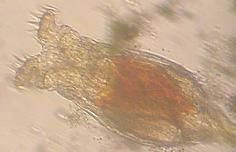 Brachionus nilsoni
- Brachionus angularis
-
 Brachionus falcatus
- Brachionus manjavacas
- Brachionus rotundiformis
- Brachionus diversicornis
Compare
Questions and answers
What is the scientific name of the Rotifer?
The scientific name of the Rotifer is Brachionus calyciflorus. Written with its author, the full name is Brachionus calyciflorus Pallas, 1766.
Which family does the Rotifer belong to?
Brachionus calyciflorus belongs to the family Brachionidae, in the order Ploima and the class Eurotatoria.
Where is the Rotifer found?
Checklists and occurrence records place Brachionus calyciflorus in 53 countries, including China, The Netherlands, Uganda, Estonia, Poland and Italy.
What other names does the Rotifer have?
Brachionus calyciflorus is also known in English as Box-like Rotifer.
Is rotifer phytoplankton or zooplankton?
The rotifer is a planktonic species.[3]
What does a rotifer eat?
The rotifer feeds on bacteria, although it consumes fewer bacteria than algae.[4]
Sources
Passages the profile rests on
- The average generation time of Brachionus calyciflorus is approximately 2.2 days at 24 °C. Source passage: “average generation time of B. calyciflorus is around 2.2 days at 24 °C” — English Wikipedia
- Brachionus calyciflorus occurs in freshwater environments. Source passage: “It is commonly used as a model organism in toxicology, ecology and evolutionary biology.” — English Wikipedia
- Brachionus calyciflorus is a planktonic species inhabiting freshwater. Source passage: “Brachionus calyciflorus is a planktonic species of rotifer occurring in freshwater.” — English Wikipedia
- Brachionus calyciflorus feeds on bacteria, although it consumes fewer bacteria than algae. Source passage: “Although rotifers feed on bacteria, they prey on fewer bacteria than algae” — pmc.ncbi.nlm.nih.gov
- Adding bacteria from natural water can promote population growth in Brachionus calyciflorus. Source passage: “the addition of bacteria from natural water can promote the population growth” — pmc.ncbi.nlm.nih.gov
- Adding bacteria from natural water improves life expectancy at hatching in Brachionus calyciflorus. Source passage: “exhibited by the improvement of its life expectancy at hatching” — pmc.ncbi.nlm.nih.gov
- Adding bacteria from natural water increases the intrinsic growth rate of Brachionus calyciflorus. Source passage: “and intrinsic growth rate” — pmc.ncbi.nlm.nih.gov
- Adding bacteria from natural water does not significantly affect generation time in Brachionus calyciflorus. Source passage: “no significant effects on the generation time” — pmc.ncbi.nlm.nih.gov
- The bacterial community associated with Brachionus calyciflorus is mainly composed of Proteobacteria, Bacteroidota, Actinobacteriota, Cyanobacteria and Firmicutes. Source passage: “The B. calyciflorus-associated bacterial community was mainly composed of Proteobacteria, Bacteroidota, Actinobacteriota, Cyanobacteria and Firmicutes.” — pmc.ncbi.nlm.nih.gov
- Burkholderiales, Pseudomonadales, Micrococcales, Caulobacterales and Bifidobacteriales are identified as keystone taxa among bacteria associated with Brachionus calyciflorus. Source passage: “the members of Burkholderiales, Pseudomonadales, Micrococcales, Caulobacterales and Bifidobacteriales were the keystone taxa of B. calyciflorus-associated bacteria.” — pmc.ncbi.nlm.nih.gov
- The relative abundance of Hydrogenophaga, Acidovorax, Flavobacterium, Rheinheimera, Novosphingobium and Limnobacter increases as Brachionus calyciflorus population density increases. Source passage: “the relative abundance of some specific bacteria strains increased as the population density of B. calyciflorus increased, such as Hydrogenophaga, Acidovorax, Flavobacterium, Rheinheimera, Novosphingobium and Limnobacter” — pmc.ncbi.nlm.nih.gov
- Hydrogenophaga, Acidovorax, Flavobacterium, Rheinheimera, Novosphingobium and Limnobacter increase in relative abundance particularly during the slow and exponential population growth phases. Source passage: “their relative abundance increased obviously during the slow and exponential phases of population growth.” — pmc.ncbi.nlm.nih.gov
- The relative abundance of Elizabethkingia and Rickettsiales decreases significantly as Brachionus calyciflorus population density increases. Source passage: “the relative abundance of adverse taxa (such as Elizabethkingia and Rickettsiales) decreased significantly with the increase in rotifer population density.” — pmc.ncbi.nlm.nih.gov
- The bacteria closely associated with Brachionus calyciflorus are insufficient to support its best growth without external bacterioplankton. Source passage: “the closely associated bacteria are not sufficient for the best growth of B. calyciflorus, and external bacterioplankton is necessary.” — pmc.ncbi.nlm.nih.gov
- Brachionus calyciflorus normally reproduces through cyclical parthenogenesis. Source passage: “Brachionus calyciflorus normally reproduces by cyclical parthenogenesis.” — English Wikipedia
- Some populations of Brachionus calyciflorus have undergone transitions to obligate parthenogenesis. Source passage: “Transitions to obligate parthenogenesis have been described.” — English Wikipedia
- Obligately parthenogenetic individuals were homozygous for a recessive allele associated with an inability to respond to chemical signals that normally induce sexual reproduction. Source passage: “Obligate parthenogens were homozygous for a recessive allele, which caused inability to respond to the chemical signals that normally induce sexual reproduction in this species.” — English Wikipedia
Data
- Catalogue of Life, 2026-10-16 XR cc by
- Global Biodiversity Information Facility CC BY 4.0
- Wikidata CC0
- GeoNames CC BY 4.0
- Wikimedia Commons per image; credit shown with each image
- Within the Catalogue of Life, this name comes from Rotifer World Catalogue cc by
References
- Pallas, P. S. (1766). Elenchus zoophytorum sistens generum adumbrationes generaliores et specierum cognitarum succintas descriptiones, cum selectis auctorum synonymis. [List of zoophytes containing general outlines of genera and brief descriptions of known species, with selected synonyms of the authors.]. Fransiscum Varrentrapp, Hagae. 451 pp. where the name was published
This species in other databases
- Catalogue of Life 5X2DW
- Wikidata Q2547210
- iNaturalist 256162
- WoRMS urn:lsid:marinespecies.org:taxname:134980
- ITIS 58438
Page built on 27 November 2026. See how the catalog is made and all sources and licences.
Cite this page
ScientificNames.org. (2026). Brachionus calyciflorus (Rotifer). Retrieved November 27, 2026, from https://scientificnames.org/species/brachionus-calyciflorus
“Brachionus calyciflorus (Rotifer).” ScientificNames.org, 2026, scientificnames.org/species/brachionus-calyciflorus. Accessed 27 Nov. 2026.
ScientificNames.org. “Brachionus calyciflorus (Rotifer).” Accessed November 27, 2026. https://scientificnames.org/species/brachionus-calyciflorus.
@misc{scientificnames_brachionus_calyciflorus_rotifer,
  author = {{ScientificNames.org}},
  title = {Brachionus calyciflorus (Rotifer)},
  year = {2026},
  url = {https://scientificnames.org/species/brachionus-calyciflorus},
  note = {Accessed 2026-11-27}
}