Species · Birds
Canada Goose Branta canadensis
The scientific name of the Canada Goose is Branta canadensis. It is a species of bird in the family Anatidae (ducks), order Anseriformes. The name dates from 1758.
- Scientific name
- Branta canadensis (Linnaeus, 1758)
- Common name
- Canada Goose
- Genus
- Branta
- Family
- Anatidae (Ducks)
- Order
- Anseriformes
- Class
- Aves
- Red List category
- LC Least Concern
- Environment
- freshwater, terrestrial
- Recorded in
- 50 countries
- Name status
- accepted in the Catalogue of Life

Overview
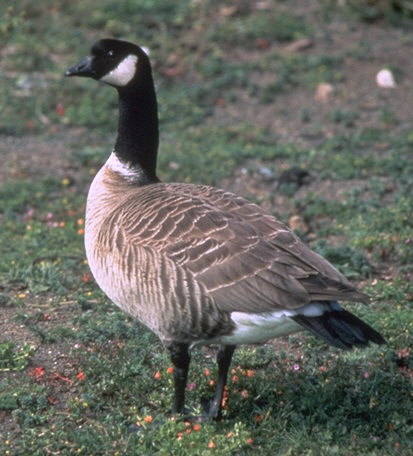
Branta canadensis inhabits freshwater environments, brackish marshes, estuaries, and lagoons. It has a black head and neck, white cheeks and chin, and a brown body.
Written 24 November 2026 from the sources listed below. Each statement was checked against the passage it cites; statements that could not be supported were removed.
Appearance
The Canada Goose has a black head and neck, white cheeks and chin, and a brown body. Its distinctive white chin patch extends along the sides of its head toward the ears.[1][2]
Its upperparts are brownish-grey, while its breast and sides are paler brown. The species has seven subspecies that differ in body size and plumage coloration.[3][4]
Adults measure approximately 75–110 cm in length and have a wingspan of 127–185 cm. Adult males typically weigh 2.6–6.5 kg, while females typically weigh 2.4–5.5 kg and are generally about 10% smaller in linear dimensions than males.[5][6][7]
The largest subspecies can reach 45 inches in length, have wingspans of up to 75 inches, and weigh more than eight pounds.[8]
Habitat
The Canada Goose inhabits freshwater environments, brackish marshes, estuaries, and lagoons.[9]
Manicured lawns beside stormwater retention ponds are particularly attractive habitats for the species.[10]
Diet
Canada geese primarily consume vegetation but occasionally eat small insects and fish. Their diet includes grasses, aquatic vegetation, clover, grains, berries, and seeds.[11][12]
Corn, wheat, and milo become important food sources from autumn through early spring. The species also consumes crustaceans, insects, and small fish in some circumstances.[13][14]
Behaviour
Canada geese normally migrate seasonally, with wintering areas extending across much of the United States. Migrating birds commonly fly in V-shaped formations.[15][16]
Some populations have become nonmigratory where winter food is sufficient and former predators are scarce. The species is capable of walking well on land and feeds as both dabblers and grazers.[17][18]
Adult Canada geese can be aggressive when protecting their young. Family groups sometimes combine into summer creches guarded by several adults.[19][20]
Reproduction and life cycle
Canada geese form lifelong mating pairs and generally reach sexual maturity at two to three years of age. Pairs generally produce four or five eggs and raise their offspring as a family unit.[21][22]
Females incubate eggs for approximately 25–30 days. Newly hatched goslings can see and walk almost immediately and leave the nest within 24 hours to feed.[23][24]
Goslings remain flightless for approximately ten weeks.[25]
Conservation
Overhunting and habitat loss caused a serious decline in Canada goose numbers during the late nineteenth and early twentieth centuries. The Migratory Bird Treaty Act protects Canada geese, their nests, and their eggs.[26][27]
Uses
Canada geese have been popular game birds and were introduced into New Zealand for hunting. More than 2.5 million Canada geese are harvested annually in North America.[28][29]
Classification of the Canada Goose
| Kingdom | Animalia |
|---|---|
| Phylum | Chordata |
| Subphylum | Vertebrata |
| Infraphylum | Gnathostomata |
| Parvphylum | Osteichthyes |
| Megaclass | Tetrapoda |
| Class | Aves (Bird) |
| Order | Anseriformes (Ducks) |
| Family | Anatidae (Ducks) |
| Genus | Branta (Brent Geese) |
| Species | Branta canadensis (Linnaeus, 1758) |
Where the Canada Goose is found
Checklists and occurrence records place Branta canadensis in 50 countries across North America and Oceania. GBIF holds 25,280,076 georeferenced records of it.
Countries
- Aland Islands 339
- Australia 83
- Austria 2,022
- Bahamas 95
- Belarus 35
- Belgium 408,051
- Belize 3
- Bermuda 579
- Bulgaria 5
- Canada 3,560,862
- Cayman Islands 13
- Czechia 667
- Denmark 114,209
- Estonia 2,726
- Faroe Islands 41
- Finland 33,909
- France 66,130
- Germany 139,189
- Greece 118
- Greenland 546
- Guernsey 15
- Hungary 19
- Iceland 390
- Ireland 953
- Isle of Man 904
- Italy 886
- Jersey 4
- Latvia 82
- Lithuania 178
- Luxembourg 3,124
- Mexico 548
- New Caledonia 7
- New Zealand 52,465
- Norfolk Island 6
- Norway 173,274
- Poland 961
- Portugal 348
- Romania 142
- Russia 288
- Saint Pierre and Miquelon 382
- Serbia 6
- Slovakia 69
- Spain 934
- Svalbard and Jan Mayen 54
- Sweden 882,907
- Switzerland 413
- The Netherlands 374,366
- Ukraine 19
- United Kingdom 797,732
- United States 18,658,978
Regions and cities with the most records
- Ontario, Canada 1,506,482
- New York, United States 1,457,301
- California, United States 1,036,181
- Ohio, United States 953,352
- Pennsylvania, United States 897,294
- Illinois, United States 863,403
- Michigan, United States 825,648
- Wisconsin, United States 717,230
- England, United Kingdom 705,488
- Massachusetts, United States 701,000
- Quebec, Canada 673,282
- New Jersey, United States 655,055
- Colorado, United States 608,804
- Maryland, United States 582,922
- British Columbia, Canada 561,334
- Washington, United States 545,704
- Virginia, United States 544,857
- Minnesota, United States 490,588
- Oregon, United States 489,619
- Indiana, United States 354,095
- North Carolina, United States 344,155
- Alberta, Canada 319,226
- New York City, United States 305,522
- Brooklyn, United States 279,811
- Hoboken, United States 273,003
- Queens, United States 271,330
- Bayonne, United States 269,974
- Union City, United States 268,751
- North Bergen, United States 267,259
- Manhattan, United States 266,460
- West New York, United States 264,279
- Jersey City, United States 261,685
- Connecticut, United States 253,601
- Newark, United States 251,164
- Missouri, United States 223,116
- Brighton, United States 223,033
8 more countries have a few records outside this range
These countries hold a few records of Branta canadensis but lie outside the range the checklists give for it. Such records are often zoo or garden specimens, museum material or vagrants, so the species is not counted as occurring there.
Range as the checklists state it
Middle America
North America
Oceania
A number beside a place is its count of GBIF occurrence records. A place without a number comes from a checklist alone. Records show where a species has been observed or collected, which can include escapes and vagrants.
Common names
English
- Canada Goose
- Greater Canada Goose
Names in 67 other languages
- Afrikaans
- Kanadese gans
- Arabic
- إوز كندي, إوزة كندية
- Asturian
- Gansu Canadiense, gansu canadianu
- Basque
- Branta kanadarra
- Belarusian
- Казарка канадская
- Breton
- Garreli-Kanada
- Bulgarian
- Канадска гъска
- Catalan
- oca del Canadà
- Chinese
- 加拿大雁, 加拿大黑雁
- Czech
- berneška velká
- Danish
- Canadagås
- Dutch
- canadese gans, grote Canadese gans
- Esperanto
- Kanada berniklo, kanada ansero
- Estonian
- kanada lagle
- Faroese
- Øshvít gás
- Finnish
- Kanadahanhi, kanadanhanhi
- French
- Bernache du Canada, outarde
- German
- Kanadagans
- Greek
- Καναδέζικη Χήνα, Καναδική χήνα
- Hebrew
- אווז קנדי, ברנטה, ברנטה קנדית
- Hungarian
- kanadai lúd
- Icelandic
- Kanadagæs
- Irish
- Gé cheanadach
- Italian
- Oca canadese, oca del Canada
- Japanese
- カナダガン
- Kazakh
- Канада қарашақазы
- Korean
- 캐나다기러기, 큰캐나다기러기
- Latvian
- Kanādas zoss
- Lithuanian
- Kanadinė berniklė
- Luxembourgish
- Kanadagäns
- Malay
- Angsa Kanada
- Māori
- Kuihi
- Northern Sami
- Kanádačuonjá
- Polish
- bernikla kanadyjska
- Portuguese
- Ganso do Canadá, ganso-do-canadá
- Romanian
- Gâsca canadiană, Gâscă canadiană
- Russian
- канадская казарка
- Scottish Gaelic
- Gèadh Chanada, geòidh dhubha, giadh, gèadh dubh
- Serbian
- Kanadska guska, Канадска Гуска
- Slovak
- Bernikľa veľká, bernikla veľká
- Slovenian
- Kanadska gos
- Spanish
- Barnacla canadiense grande, Ganso Canadiense Mayor, Ganso canadiense, barnacla Canadiense
- Swedish
- Kanadagås
- Tamil
- கனடா வாத்து
- Thai
- ห่านแคนาดา
- Turkish
- Kanada kazı
- Ukrainian
- Казарка канадська, Канадська казарка
- Vietnamese
- Ngỗng Canada
- Welsh
- Gwyddau Canada, Gŵydd Canada, gwydd Canada
- arp
- nenebiihi' nei'ii
- bla
- áápsspini
- chr
- ᏌᏌ
- chy
- Héna'e
- cor
- Goth Canada
- cre
- Niska, ᓂᔅᒃ
- frr
- Kanadagus
- glv
- Guiy Canadagh
- hat
- Zwa Kanada
- ipk
- Iqsraġutilik
- kal
- Nerlernaarsuk
- lil
- k̓ʷsixʷ
- mic
- sinumkw
- myh
- ha·diq
- nav
- Naalʼeełítsoh bitsiiʼ halzhinígíí
- oji
- Nika, wawa
- roh
- Auca da Canada
- wam
- Wawpatucke
Synonyms
74 other scientific names have been used for this species and are now treated as synonyms of Branta canadensis.
- Anser canadensis Linnaeus, C, 1758
- Branta canadensis akimiskiae Hanson, HC, 2006
- Branta canadensis albertae Hanson, HC, 2007
- Branta canadensis andersoni Hanson, HC, 2007
- Branta canadensis anticostiae Hanson, HC, 2006
- Branta canadensis assiniboineae Hanson, HC, 2007
- Branta canadensis athabascae Hanson, HC, 2007
- Branta canadensis auduboni Hanson, HC, 2006
- Branta canadensis bartletti Hanson, HC, 2006
- Branta canadensis basinensis Hanson, HC, 2007
- Branta canadensis belcheri Hanson, HC, 2006
- Branta canadensis blancheti Hanson, HC; Anderson, BW, 2007
- Branta canadensis bostocki Hanson, HC; Anderson, BW, 2007
- Branta canadensis brevirostra Hanson, HC, 2007
- Branta canadensis bridgeri Hanson, HC; Anderson, BW, 2007
- Branta canadensis brunnescens Hanson, HC, 2006
- Branta canadensis californica Hanson, HC, 2007
- Branta canadensis charltonensis Hanson, HC, 2006
- Branta canadensis chipewyanensis Hanson, HC, 2007
- Branta canadensis churchillensis Hanson, HC, 2006
- Branta canadensis clarki Hanson, HC; Anderson, BW, 2007
- Branta canadensis columbiana Hanson, HC, 2007
- Branta canadensis costalama Hanson, HC, 2006
- Branta canadensis creeorum Hanson, HC, 2006
- Branta canadensis curriei Hanson, HC, 2006
- Branta canadensis dawsoni Hanson, HC; Anderson, BW, 2007
- Branta canadensis deltensis Hanson, HC; Anderson, BW, 2007
- Branta canadensis eirikssoni Hanson, HC, 2006
- Branta canadensis fidleri Hanson, HC; Anderson, BW, 2007
- Branta canadensis grinnelli Hanson, HC, 2007
- Branta canadensis haydeni Hanson, HC; Anderson, BW, 2007
- Branta canadensis hendayi Hanson, HC, 2007
- Branta canadensis hoodi Hanson, HC, 2007
- Branta canadensis hudsonica Hanson, HC, 2006
- Branta canadensis hunti Hanson, HC, 2006
- Branta canadensis hustichi Hanson, HC; Anderson, BW, 2007
- Branta canadensis idahoensis Hanson, HC, 2007
- Branta canadensis ingstadi Hanson, HC, 2007
- Branta canadensis jamesi Hanson, HC, 2006
- Branta canadensis jeffersoni Hanson, HC; Anderson, BW, 2007
Showing 40 of 74.
Subspecies and varieties
- Branta canadensis canadensis (Atlantic Canada Goose) subspecies
- Branta canadensis fulva (Vancouver Canada Goose) subspecies
- Branta canadensis interior (Todd's Canada Goose) subspecies
- Branta canadensis maxima (Giant Canada Goose) subspecies
- Branta canadensis moffitti (Large Canada Goose) subspecies
- Branta canadensis occidentalis (Dusky Canada Goose) subspecies
- Branta canadensis parvipes (Lesser Canada Goose) subspecies
Related species
-
 Hawaiian GooseBranta sandvicensis
-
 Barnacle GooseBranta leucopsis
-
 BrantBranta bernicla
-
 Cackling GooseBranta hutchinsii
-
 Red-breasted GooseBranta ruficollis
- Barnacle Goose X Canada GooseBranta leucopsis x canadensis
- Branta hutchinsii x leucopsis
-
 MallardAnas platyrhynchos
Compare
Questions and answers
What is the scientific name of the Canada Goose?
The scientific name of the Canada Goose is Branta canadensis. Written with its author, the full name is Branta canadensis (Linnaeus, 1758).
Which family does the Canada Goose belong to?
Branta canadensis belongs to the family Anatidae, in the order Anseriformes and the class Aves.
Where is the Canada Goose found?
Checklists and occurrence records place Branta canadensis in 50 countries, including United States, Canada, Sweden, United Kingdom, Belgium and The Netherlands.
What is the conservation status of the Canada Goose?
The IUCN Red List category recorded for Branta canadensis is Least Concern (LC).
What other names does the Canada Goose have?
Branta canadensis is also known in English as Greater Canada Goose.
What is the diet of a Canada goose?
The Canada Goose primarily eats vegetation, including grasses, aquatic vegetation, clover, grains, berries, and seeds. Corn, wheat, and milo become important food sources from autumn through early spring. It occasionally consumes crustaceans, insects, and small fish.[11][12][13][14]
Sources
Passages the profile rests on
- The Canada goose has a black head and neck, white cheeks and chin, and a brown body. Source passage: “The Canada goose (Branta canadensis) is a large species of goose with a black head and neck, white cheeks, white under its chin, and a brown body.” — English Wikipedia
- The species has a distinctive white chin patch extending along the sides of its head toward the ears. Source passage: “A white chin patch extends along the sides of the head to the ears.” — mdc.mo.gov
- Its upperparts are brownish-grey, while its breast and sides are paler brown. Source passage: “They have brownish-grey upper parts and paler brown breast and sides.” — adfg.alaska.gov
- The species has seven subspecies that differ in body size and plumage coloration. Source passage: “They are classed into seven subspecies varying in body size and plumage coloration.” — adfg.alaska.gov
- Adults measure approximately 75–110 cm in length and have a wingspan of 127–185 cm. Source passage: “Canada geese range from 75 to 110 cm (30 to 43 in) in length and have a 127–185 cm (50–73 in) wingspan.” — English Wikipedia
- Adult males typically weigh 2.6–6.5 kg. Source passage: “The male Canada goose usually weighs 2.6–6.5 kg (5+3⁄4–14+1⁄4 lb)” — English Wikipedia
- Adult females typically weigh 2.4–5.5 kg and are generally about 10% smaller in linear dimensions than males. Source passage: “The female looks virtually identical but is slightly lighter at 2.4–5.5 kg (5+1⁄4–12+1⁄4 lb), averaging amongst all subspecies 3.6 kg (8 lb), and generally 10% smaller in linear dimensions than the male counterparts.” — English Wikipedia
- The largest subspecies can reach 45 inches in length, have wingspans of up to 75 inches, and weigh more than eight pounds. Source passage: “the largest can reach 45-inches long with a wingspan up to 75 inches; and can weigh more than eight pounds.” — adfg.alaska.gov
- The species inhabits freshwater environments, brackish marshes, estuaries, and lagoons. Source passage: “often found on or close to fresh water, the Canada goose is also common in brackish marshes, estuaries, and lagoons.” — English Wikipedia
- Manicured lawns beside stormwater retention ponds are particularly attractive habitats for the species. Source passage: “Manicured lawns with adjacent stormwater retention ponds (e.g., golf courses, corporate lawns, etc.) are highly attractive habitats.” — extension.rutgers.edu
- Canada geese primarily consume vegetation but occasionally eat small insects and fish. Source passage: “Canada geese are primarily herbivores, although they sometimes eat small insects and fish.” — English Wikipedia
- The species feeds on grasses, aquatic vegetation, clover, grains, berries, and seeds. Source passage: “preferring grasses, aquatic vegetation, clover, grains (e.g., corn, soybeans), berries, and seeds.” — extension.rutgers.edu
- Corn, wheat, and milo become important food sources from autumn through early spring. Source passage: “During fall through early spring, agricultural crops such as corn, wheat, and milo become important food sources.” — mdc.mo.gov
- The species also consumes crustaceans, insects, and small fish in some circumstances. Source passage: “In some cases, this species will consume crustaceans, insects, and small fish.” — extension.rutgers.edu
- Canada geese normally migrate seasonally, with wintering areas extending across much of the United States. Source passage: “Like most geese, the Canada goose is naturally migratory with the wintering range being most of the United States.” — English Wikipedia
- Migrating Canada geese commonly fly in V-shaped formations. Source passage: “During migration, they fly in chevrons (V-shaped groups).” — mdc.mo.gov
- Some populations have become nonmigratory where winter food is sufficient and former predators are scarce. Source passage: “In mild climates from southwestern British Columbia to California to the Great Lakes, some of the population has become nonmigratory due to adequate winter food supply and a lack of former predators.” — English Wikipedia
- Canada geese are capable of walking well on land and feed as both dabblers and grazers. Source passage: “These geese are considered dabblers and grazers, and can walk well on land.” — adfg.alaska.gov
- Adult Canada geese can be aggressive when protecting their young. Source passage: “Adults are well-known to be protective of young and can be aggressive” — adfg.alaska.gov
- Family groups sometimes combine into summer creches guarded by several adults. Source passage: “Like some other waterfowl, family groups are combined in summer to form "creches" which may be guarded by several parents.” — adfg.alaska.gov
- Canada geese form lifelong mating pairs, generally reaching sexual maturity at two to three years of age. Source passage: “Geese reach sexual maturity at two to three years of age, after which they form life-long monogamous mating pairs.” — extension.rutgers.edu
- Pairs generally produce four or five eggs and raise their offspring as a family unit. Source passage: “Pairs generally establish a nesting territory; they produce an average of four or five eggs and raise the young as a family unit.” — adfg.alaska.gov
- Females incubate eggs for approximately 25–30 days. Source passage: “Incubation is done by the female and lasts 25-30 days.” — adfg.alaska.gov
- Newly hatched goslings can see and walk almost immediately and leave the nest within 24 hours to feed. Source passage: “As precocial animals, they can see and walk almost immediately after hatching and must leave the nest within 24 hours to begin feeding.” — extension.rutgers.edu
- Goslings remain flightless for approximately ten weeks. Source passage: “Goslings are flightless for about 10 weeks and are restricted to feeding areas within walking distance of water.” — mdc.mo.gov
- Overhunting and habitat loss caused a serious decline in Canada goose numbers during the late nineteenth and early twentieth centuries. Source passage: “By the early 20th century, overhunting and loss of habitat in the late 19th and early 20th centuries had resulted in a serious decline in the numbers of this bird in its native range.” — English Wikipedia
- The Migratory Bird Treaty Act protects Canada geese, their nests, and their eggs. Source passage: “The Migratory Bird Treaty Act protects these geese, their nests, and eggs” — mdc.mo.gov
- Canada geese have been popular game birds and were introduced into New Zealand for hunting. Source passage: “Canada geese were introduced as a game bird into New Zealand in 1905.” — English Wikipedia
- More than 2.5 million Canada geese are harvested annually in North America. Source passage: “More than 2.5 million Canada geese are harvested each year in North America.” — mdc.mo.gov
- In New Jersey, the species occurs in lakes, ponds, rivers, open fields, airports, and parks. Source passage: “In New Jersey, Canada geese occur in lakes, ponds, rivers, open fields, airports, and parks.” — extension.rutgers.edu
Data
- Catalogue of Life, 2026-10-16 XR cc by
- Global Biodiversity Information Facility CC BY 4.0
- Wikidata CC0
- GeoNames CC BY 4.0
- Wikimedia Commons per image; credit shown with each image
- Within the Catalogue of Life, this name comes from The Integrated Taxonomic Information System cc0
References
- Syst. Nat., ed. 10, 1: 123. 1758 where the name was published
- Banks, R. C., R. W. McDiarmid, and A. L. Gardner. (1987). Checklist of Vertebrates of the United States, the U.S. Territories, and Canada. Resource Publication, No. 166.
- Dickinson, Edward C., ed. (2003). The Howard and Moore Complete Checklist of the Birds of the World, 3rd Edition.
- American Ornithologists’ Union. (2004). Forty-fifth supplement to the American Ornithologists’ Union Check-list of North American birds. The Auk, Vol. 121, No. 3.
- Gill, Frank, & and Minturn Wright. (2006). Birds of the World: Recommended English Names.
- Dickinson, E. C., and J. V. Remsen Jr., eds. (2013). The Howard and Moore Complete Checklist of the Birds of the World, 4th Edition, Vol. 1 Non-Passerines.
This species in other databases
- Catalogue of Life 5WRC3
- Wikidata Q26733
- iNaturalist 7089
- WoRMS urn:lsid:marinespecies.org:taxname:159176
- Avibase cangoo
Page built on 24 November 2026. See how the catalog is made and all sources and licences.
Cite this page
ScientificNames.org. (2026). Branta canadensis (Canada Goose). Retrieved November 24, 2026, from https://scientificnames.org/species/branta-canadensis
“Branta canadensis (Canada Goose).” ScientificNames.org, 2026, scientificnames.org/species/branta-canadensis. Accessed 24 Nov. 2026.
ScientificNames.org. “Branta canadensis (Canada Goose).” Accessed November 24, 2026. https://scientificnames.org/species/branta-canadensis.
@misc{scientificnames_branta_canadensis_canada_goose,
  author = {{ScientificNames.org}},
  title = {Branta canadensis (Canada Goose)},
  year = {2026},
  url = {https://scientificnames.org/species/branta-canadensis},
  note = {Accessed 2026-11-24}
}