Species · Insects
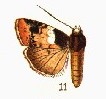
Half-banded Bryolymnia Bryolymnia semifascia
The scientific name of the Half-banded Bryolymnia is Bryolymnia semifascia. It is a species of insect in the family Noctuidae (cutworms), order Lepidoptera. The name dates from 1900.
- Scientific name
- Bryolymnia semifascia Smith, 1900
- Common name
- Half-banded Bryolymnia
- Genus
- Bryolymnia
- Family
- Noctuidae (Cutworms)
- Order
- Lepidoptera
- Class
- Insecta
- Recorded in
- 1 country
- Name status
- accepted in the Catalogue of Life

Overview
The Half-banded Bryolymnia is a moth belonging to the family Noctuidae. It occurs in the United States from northern Colorado and southern Utah southward to southeastern Arizona and south-central New Mexico. The adult moth has a wingspan of 26–29 mm.
Written 28 November 2026 from the sources listed below. Each statement was checked against the passage it cites; statements that could not be supported were removed.
Appearance
The Half-banded Bryolymnia is a moth in the family Noctuidae. Adults have a wingspan of 26–29 mm.[1][2]
Habitat
Adults have been collected in conifer forests.[3]
Behaviour
Adult specimens have been collected between mid-June and mid-September.[4]
Classification of the Half-banded Bryolymnia
| Kingdom | Animalia |
|---|---|
| Phylum | Arthropoda |
| Subphylum | Hexapoda |
| Class | Insecta (Insect) |
| Order | Lepidoptera |
| Superfamily | Noctuoidea |
| Family | Noctuidae (Cutworms) |
| Subfamily | Bryophilinae |
| Genus | Bryolymnia |
| Species | Bryolymnia semifascia Smith, 1900 |
Where the Half-banded Bryolymnia is found
Checklists and occurrence records place Bryolymnia semifascia in 1 country. GBIF holds 242 georeferenced records of it.
Countries
Regions and cities with the most records
- Arizona, United States 81
- New Mexico, United States 69
- Colorado, United States 50
- Sierra Vista, United States 20
- Texas, United States 14
- Boulder, United States 8
- Colorado Springs, United States 7
- Security-Widefield, United States 7
- Fountain, United States 5
- Lafayette, United States 5
- Louisville, United States 5
- Utah, United States 5
- Tanque Verde, United States 4
- Alamogordo, United States 3
- Flagstaff, United States 3
- Longmont, United States 3
A number beside a place is its count of GBIF occurrence records. A place without a number comes from a checklist alone. Records show where a species has been observed or collected, which can include escapes and vagrants.
Common names
English
- Half-banded Bryolymnia
Synonyms
One other scientific name has been used for this species and is now treated as a synonym of Bryolymnia semifascia.
- Chytonix semifascia Smith, 1900
Related species




Questions and answers
What is the scientific name of the Half-banded Bryolymnia?
The scientific name of the Half-banded Bryolymnia is Bryolymnia semifascia. Written with its author, the full name is Bryolymnia semifascia Smith, 1900.
Which family does the Half-banded Bryolymnia belong to?
Bryolymnia semifascia belongs to the family Noctuidae, in the order Lepidoptera and the class Insecta.
Where is the Half-banded Bryolymnia found?
Checklists and occurrence records place Bryolymnia semifascia in 1 country: United States.
How large is the Half-banded Bryolymnia?
The adult moth has a wingspan of 26–29 mm.[2]
Where does the Half-banded Bryolymnia occur?
It occurs in the United States from northern Colorado and southern Utah southward to southeastern Arizona and south-central New Mexico.[5]
When have adult specimens been collected?
Adult specimens have been collected between mid-June and mid-September.[4]
Who described the Half-banded Bryolymnia and when?
John Bernhardt Smith first described the species in 1900.[6]
Sources
Passages the profile rests on
- The species is a moth belonging to the family Noctuidae. Source passage: “Bryolymnia semifascia, the half-banded bryolymnia, is a moth of the family Noctuidae.” — English Wikipedia
- The adult moth has a wingspan of 26–29 mm. Source passage: “The wingspan is 26–29 mm.” — English Wikipedia
- Adults have been collected in conifer forests. Source passage: “Adults have been collected from mid-June to mid-September in conifer forests.” — English Wikipedia
- Adult specimens have been collected between mid-June and mid-September. Source passage: “Adults have been collected from mid-June to mid-September in conifer forests.” — English Wikipedia
- The species occurs in the United States from northern Colorado and southern Utah southward to southeastern Arizona and south-central New Mexico. Source passage: “It is found in the US from northern Colorado and southern Utah southward to south-eastern Arizona and south-central New Mexico.” — English Wikipedia
- The species was first described by John Bernhardt Smith in 1900. Source passage: “The species was first described by John Bernhardt Smith in 1900.” — English Wikipedia
Data
- Catalogue of Life, 2026-10-16 XR cc by
- Global Biodiversity Information Facility CC BY 4.0
- Wikidata CC0
- GeoNames CC BY 4.0
- Wikimedia Commons per image; credit shown with each image
- Within the Catalogue of Life, this name comes from Global Lepidoptera Index cc by
References
- Smith JB (1900) A hundred new moths of the family Noctuidae. Proceedings of the United States National Museum 22: 413 - 495. where the name was published
This species in other databases
Page built on 29 November 2026. See how the catalog is made and all sources and licences.
Cite this page
ScientificNames.org. (2026). Bryolymnia semifascia (Half-banded Bryolymnia). Retrieved November 29, 2026, from https://scientificnames.org/species/bryolymnia-semifascia
“Bryolymnia semifascia (Half-banded Bryolymnia).” ScientificNames.org, 2026, scientificnames.org/species/bryolymnia-semifascia. Accessed 29 Nov. 2026.
ScientificNames.org. “Bryolymnia semifascia (Half-banded Bryolymnia).” Accessed November 29, 2026. https://scientificnames.org/species/bryolymnia-semifascia.
@misc{scientificnames_bryolymnia_semifascia_half_banded_bryolymnia,
  author = {{ScientificNames.org}},
  title = {Bryolymnia semifascia (Half-banded Bryolymnia)},
  year = {2026},
  url = {https://scientificnames.org/species/bryolymnia-semifascia},
  note = {Accessed 2026-11-29}
}