Species · Insects
Oak Bent-wing Bucculatrix ulmella
The scientific name of the Oak Bent-wing is Bucculatrix ulmella. It is a species of insect in the family Bucculatricidae (ribbed cocoon-maker moths), order Lepidoptera. The name dates from 1848.
- Scientific name
- Bucculatrix ulmella Zeller, 1848
- Common name
- Oak Bent-wing
- Genus
- Bucculatrix
- Family
- Bucculatricidae (Ribbed Cocoon-maker Moths)
- Order
- Lepidoptera
- Class
- Insecta
- Recorded in
- 19 countries
- Name status
- accepted in the Catalogue of Life

Overview
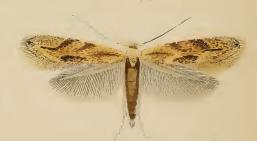
The species occurs in most of Europe, excluding the Iberian Peninsula, Slovenia and Bulgaria. The adult moth has ochreous-whitish forewings with brown speckling, four oblique dark fuscous costal spots and a large median dorsal spot.
Written 26 November 2026 from the sources listed below. Each statement was checked against the passage it cites; statements that could not be supported were removed.
Appearance
The adult moth has a ferruginous head, sometimes mixed with dark fuscous in the middle, and ochreous-whitish antennal eyecaps. Its forewing cilia have a more ochreous tint.[1][2][3]
The adult moth has a wingspan of 7–8 mm.[4]
The larva is pale grey-greenish, with a darker lateral line and whitish dots. The second larval segment is brownish-grey and dotted with black.[5][6]
Diet
The larvae feed on sweet chestnut (Castanea sativa).[7]
Behaviour
The larvae mine the leaves of their host plants.[8]
Larvae can be found in July and again from September to October.[9]
Reproduction and life cycle
Adults are active on the wing from May to June and again in August.[10]
Classification of the Oak Bent-wing
| Kingdom | Animalia |
|---|---|
| Phylum | Arthropoda |
| Subphylum | Hexapoda |
| Class | Insecta (Insect) |
| Order | Lepidoptera |
| Superfamily | Gracillarioidea |
| Family | Bucculatricidae (Ribbed Cocoon-maker Moths) |
| Genus | Bucculatrix (Eyebrow Moths) |
| Species | Bucculatrix ulmella Zeller, 1848 |
Where the Oak Bent-wing is found
Checklists and occurrence records place Bucculatrix ulmella in 19 countries. GBIF holds 3,089 georeferenced records of it.
Countries
- Aland Islands 13
- Austria 78
- Belgium 62
- Denmark 305
- Estonia 14
- Finland 45
- France 38
- Germany 158
- Italy 27
- Luxembourg 24
- Norway 126
- Poland 47
- Portugal 32
- Russia 4
- Serbia 3
- Sweden 422
- The Netherlands 800
- Ukraine 13
- United Kingdom 878
Regions and cities with the most records
- England, United Kingdom 831
- Capital Region, Denmark 248
- Birkerød, Denmark 237
- Ballerup, Denmark 236
- Farum, Denmark 236
- Virum, Denmark 236
- Albertslund, Denmark 235
- Charlottenlund, Denmark 235
- Glostrup, Denmark 235
- Hellerup, Denmark 235
- Rødovre, Denmark 235
- Taastrup, Denmark 235
- Avedøre, Denmark 234
- Brøndbyvester, Denmark 234
- Copenhagen, Denmark 234
- Frederiksberg, Denmark 234
- Hvidovre, Denmark 234
- Ishøj, Denmark 234
- Vallensbæk, Denmark 234
- Huntingdon, United Kingdom 200
- Pijnacker, The Netherlands 169
- Saint Ives, United Kingdom 166
- Berkel en Rodenrijs, The Netherlands 162
- Delft, The Netherlands 161
- Voorburg, The Netherlands 140
- Ypenburg, The Netherlands 137
- Bergschenhoek, The Netherlands 136
- Nootdorp, The Netherlands 134
- The Hague, The Netherlands 133
- Rijswijk, The Netherlands 130
- Zoetermeer, The Netherlands 129
- Schiedam, The Netherlands 127
- Benthuizen, The Netherlands 124
- Rotterdam, The Netherlands 124
- Barendrecht, The Netherlands 122
- Rhoon, The Netherlands 121
A number beside a place is its count of GBIF occurrence records. A place without a number comes from a checklist alone. Records show where a species has been observed or collected, which can include escapes and vagrants.
Common names
English
- Oak Bent-wing
Names in 9 other languages
- Czech
- chobotníček jilmový
- Danish
- Ege-øjeklapmøl
- Dutch
- Eikenooglapmot
- Finnish
- tammitöyhtökoi
- Hebrew
- רכסן האלון
- Hungarian
- erdei bordásmoly
- Lithuanian
- Ąžuolinė skeletuojanti kandelė
- Slovak
- plôškavec dubový
- Swedish
- ekkronmal, ekögonlappmal
Synonyms
2 other scientific names have been used for this species and are now treated as synonyms of Bucculatrix ulmella.
- Bucculatrix sircomella Stainton, 1848
- Bucculatrix vetustella Stainton, 1846
Related species
-
 Daisy Bent-wingBucculatrix nigricomella
-
 Highland Bent-wingBucculatrix humiliella
-
 Birch Bent-wingBucculatrix demaryella
-
 Hawthorn Bent-wingBucculatrix bechsteinella
-
 Lime Bent-wingBucculatrix thoracella
-
 Bucculatrix ulmifoliae
- Bucculatrix recognita
-
 Crested Bent-wingBucculatrix cristatella
Compare
Questions and answers
What is the scientific name of the Oak Bent-wing?
The scientific name of the Oak Bent-wing is Bucculatrix ulmella. Written with its author, the full name is Bucculatrix ulmella Zeller, 1848.
Which family does the Oak Bent-wing belong to?
Bucculatrix ulmella belongs to the family Bucculatricidae, in the order Lepidoptera and the class Insecta.
Where is the Oak Bent-wing found?
Checklists and occurrence records place Bucculatrix ulmella in 19 countries, including United Kingdom, The Netherlands, Sweden, Denmark, Germany and Norway.
Sources
Passages the profile rests on
- The adult moth has a ferruginous head that is sometimes mixed with dark fuscous in the middle. Source passage: “The head is ferruginous, sometimes mixed with dark fuscous in middle.” — English Wikipedia
- The moth has ochreous-whitish antennal eyecaps. Source passage: “Antennal eyecaps ochreous-whitish.” — English Wikipedia
- The forewing cilia have a more ochreous tint. Source passage: “cilia more ochreous tinged.” — English Wikipedia
- The adult moth has a wingspan of 7–8 mm. Source passage: “The wingspan is 7–8 mm.” — English Wikipedia
- The larva is pale grey-greenish, with a darker lateral line and whitish dots. Source passage: “The larva is pale grey-greenish; lateral line darker; dots whitish;” — English Wikipedia
- The second larval segment is brownish-grey and dotted with black. Source passage: “segment 2 brownish-grey, black-dotted.” — English Wikipedia
- The larvae feed on sweet chestnut (Castanea sativa). Source passage: “The larvae feed on Castanea sativa,” — English Wikipedia
- The larvae mine the leaves of their host plants. Source passage: “They mine the leaves of their host plant.” — English Wikipedia
- Larvae can be found in July and again from September to October. Source passage: “Larvae can be found in July and again from September to October.” — English Wikipedia
- Adults are active on the wing from May to June and again in August. Source passage: “Adults are on wing from May to June and again in August.” — English Wikipedia
Data
- Catalogue of Life, 2026-10-16 XR cc by
- Global Biodiversity Information Facility CC BY 4.0
- Wikidata CC0
- GeoNames CC BY 4.0
- Wikimedia Commons per image; credit shown with each image
- Within the Catalogue of Life, this name comes from Global Lepidoptera Index cc by
This species in other databases
Page built on 28 November 2026. See how the catalog is made and all sources and licences.
Cite this page
ScientificNames.org. (2026). Bucculatrix ulmella (Oak Bent-wing). Retrieved November 28, 2026, from https://scientificnames.org/species/bucculatrix-ulmella
“Bucculatrix ulmella (Oak Bent-wing).” ScientificNames.org, 2026, scientificnames.org/species/bucculatrix-ulmella. Accessed 28 Nov. 2026.
ScientificNames.org. “Bucculatrix ulmella (Oak Bent-wing).” Accessed November 28, 2026. https://scientificnames.org/species/bucculatrix-ulmella.
@misc{scientificnames_bucculatrix_ulmella_oak_bent_wing,
  author = {{ScientificNames.org}},
  title = {Bucculatrix ulmella (Oak Bent-wing)},
  year = {2026},
  url = {https://scientificnames.org/species/bucculatrix-ulmella},
  note = {Accessed 2026-11-28}
}