Species · Birds
Red-tailed Hawk Buteo jamaicensis
The scientific name of the Red-tailed Hawk is Buteo jamaicensis. It is a species of bird in the family Accipitridae (hawks), order Accipitriformes. The name dates from 1788.
- Scientific name
- Buteo jamaicensis (J. F. Gmelin, 1788)
- Common name
- Red-tailed Hawk
- Genus
- Buteo
- Family
- Accipitridae (Hawks)
- Order
- Accipitriformes
- Class
- Aves
- Red List category
- LC Least Concern
- Environment
- terrestrial
- Recorded in
- 26 countries
- Name status
- accepted in the Catalogue of Life

Overview
Buteo jamaicensis breeds from Alaska and northern Canada south to Panama and the West Indies, with a winter range extending from southern Canada throughout the remainder of its breeding range. It has a stocky body, broad wings, and a distinctive brick-red upper tail with a light buff-orange underside.
Written 24 November 2026 from the sources listed below. Each statement was checked against the passage it cites; statements that could not be supported were removed.
Appearance
The Red-tailed Hawk has a stocky body and broad wings. Its distinctive tail has a brick-red upper surface and a light buff-orange underside.[1]
Adults typically have a red tail ending in a single black band, while immature individuals have tails patterned with approximately six darker bars. The species has yellow legs, feet, and cere.[2][3][4]
The western North American subspecies B. j. calurus occurs in light, dark, and intermediate or rufous color morphs. Dark and intermediate morphs together account for 10–20% of its population.[5][6]
The B. j. harlani subspecies has blackish-and-white plumage without warm tones except in the tail. The B. j. kriderii subspecies is paler than other red-tailed hawks, particularly on the head.[7][8]
The species typically measures approximately 45–65 cm in length and has a wingspan of 110 to 145 cm. It typically weighs between 690 and 1,600 grams, and females can be up to 25% larger than males.[9][10][11][12]
Male individuals weigh approximately 690–1,300 grams, while females weigh approximately 900–2,000 grams.[13]
Habitat
The Red-tailed Hawk commonly inhabits mixed forests and fields with elevated bluffs or trees suitable for perching. Its habitats include deserts, grasslands, coastal regions, mountains, foothills, forests, tropical rainforests, agricultural fields, and urban areas.[14][15]
The species avoids tundra and dense forests. Urban populations use buildings and bridges as nesting sites.[16][17]
Diet
The Red-tailed Hawk primarily eats small mammals, including rodents and lagomorphs, but also consumes birds, fish, reptiles, and amphibians. Rodents can constitute up to 85% of its diet.[18][19]
Common mammalian prey includes mice, gophers, voles, chipmunks, and ground and tree squirrels. Urban populations consume rats and mice as the majority of their diet.[20][21]
On Caribbean islands, snakes and lizards may be its predominant food sources. The species may become ill after consuming poisoned rodents.[22][23]
Behaviour
The Red-tailed Hawk commonly hunts by watching for prey from an elevated perch and swooping down to capture it. It sometimes hunts cooperatively in pairs.[24][25]
During soaring flight, the species commonly holds its wings in a slight dihedral and minimizes flapping to conserve energy. Its active flight is slow and deliberate, with deep wing beats.[26][27]
In windy conditions, the species may hover stationary above the ground by beating its wings. Its soaring or flapping flight speed typically ranges from 32 to 64 km/h, and it may exceed 190 km/h when diving.[28][29][30]
Migration can be triggered by inadequate food resources and generally occurs in late fall or early spring.[31]
Reproduction and life cycle
Pairs generally remain together for life and obtain another mate only after the original mate dies. The species constructs stick nests in high trees.[32][33]
A typical clutch contains one to three eggs. Manhattan had at least 20 red-tailed hawk nests in 2016, up from eight in 2010.[34][35][36]
Conservation
The Red-tailed Hawk is protected under the Migratory Bird Treaty Act. Possession, transportation, and sale of red-tailed hawks and their eggs are prohibited under this protection.[37][38]
Rat poison can harm red-tailed hawks that consume poisoned rodents. The New York City government recommends snap traps instead of poison for controlling rodents.[39][40]
Uses
Red-tailed hawks are commonly captured for falconry in the United States because they are abundant and trainable hunters. The species also provides rodent pest control in urban environments.[41][42]
Classification of the Red-tailed Hawk
| Kingdom | Animalia |
|---|---|
| Phylum | Chordata |
| Subphylum | Vertebrata |
| Infraphylum | Gnathostomata |
| Parvphylum | Osteichthyes |
| Megaclass | Tetrapoda |
| Class | Aves (Bird) |
| Order | Accipitriformes (Hawks) |
| Family | Accipitridae (Hawks) |
| Genus | Buteo (Buteonine Hawks) |
| Species | Buteo jamaicensis (J. F. Gmelin, 1788) |
Where the Red-tailed Hawk is found
Checklists and occurrence records place Buteo jamaicensis in 26 countries across North America. GBIF holds 11,317,921 georeferenced records of it.
Countries
- Antigua and Barbuda 3
- Bahamas 1,651
- Belize 384
- Bermuda 76
- Bonaire, Saint Eustatius and Saba 280
- British Virgin Islands 276
- Canada 988,310
- Cayman Islands 3
- Costa Rica 15,165
- Cuba 4,917
- Dominican Republic 2,540
- El Salvador 671
- Guadeloupe 4
- Guatemala 5,879
- Haiti 825
- Honduras 2,149
- Jamaica 3,280
- Mexico 69,925
- Nicaragua 1,032
- Panama 1,953
- Puerto Rico 29,142
- Saint Barthelemy 6
- Saint Kitts and Nevis 271
- Saint Martin 9
- U.S. Virgin Islands 2,004
- United States 10,187,166
Regions and cities with the most records
- California, United States 1,636,988
- New York, United States 667,267
- Pennsylvania, United States 575,148
- Texas, United States 508,880
- Colorado, United States 475,039
- Ontario, Canada 427,138
- Massachusetts, United States 390,582
- Washington, United States 390,186
- Arizona, United States 387,927
- Oregon, United States 382,983
- Illinois, United States 377,708
- Ohio, United States 360,769
- Michigan, United States 297,711
- New Jersey, United States 282,169
- Wisconsin, United States 259,434
- British Columbia, Canada 238,643
- Virginia, United States 183,867
- Union City, United States 165,812
- North Bergen, United States 165,663
- West New York, United States 164,595
- Missouri, United States 162,441
- Hoboken, United States 160,753
- Manhattan, United States 159,086
- New York City, United States 158,900
- Maryland, United States 158,555
- Minnesota, United States 155,489
- Jersey City, United States 151,314
- Indiana, United States 151,068
- Newark, United States 146,447
- North Carolina, United States 144,320
- Bayonne, United States 140,676
- Connecticut, United States 139,208
- Brooklyn, United States 138,733
- Kansas, United States 138,087
- Florida, United States 136,294
- Georgia, United States 136,282
5 more countries have a few records outside this range
These countries hold a few records of Buteo jamaicensis but lie outside the range the checklists give for it. Such records are often zoo or garden specimens, museum material or vagrants, so the species is not counted as occurring there.
Range as the checklists state it
Middle America
North America
Caribbean
A number beside a place is its count of GBIF occurrence records. A place without a number comes from a checklist alone. Records show where a species has been observed or collected, which can include escapes and vagrants.
Common names
English
- Red-tailed Hawk
- Chicken Hawk
- Hen Hawk
- Macaw
- Macou
- Mouse Hawk
- Red-tailed Buzzard
- Redtail
Names in 49 other languages
- Arabic
- باز أحمر الذيل
- Azerbaijani
- Qızıl quyruqlu şahin
- Breton
- Baou lost rous
- Bulgarian
- Червеноопашат мишелов
- Catalan
- aligot cua-roig
- Chinese
- 紅尾鵟, 红尾鵟
- Croatian
- crvenorepi škanjac
- Czech
- Káně rudoocasá, káně rudochvostá
- Danish
- Rødhalet Våge
- Dutch
- roodstaartbuizerd
- Esperanto
- Jamajka buteo, ruĝvosta buteo
- Estonian
- punasaba-viu
- Finnish
- amerikanhiirihaukka
- French
- Buse à queue rousse
- German
- Rotschwanzbussard
- Greek
- Αμερικανική Γερακίνα
- Hebrew
- עקב אדום-זנב
- Hungarian
- rőtfarkú ölyv
- Irish
- Clamhán earrdhearg
- Italian
- Poiana codarossa, Poiana della Giamaica
- Japanese
- アカオノスリ
- Korean
- 붉은꼬리말똥가리, 붉은꼬리매
- Latvian
- rudastes klijāns
- Lithuanian
- jamaikinis suopis
- Macedonian
- Црвеноопашен јастреб
- Malayalam
- ചുവപ്പുവാലൻ പരുന്ത്
- Norwegian
- rødhalevåk
- Persian
- شاهین دمسرخ
- Polish
- myszołów rdzawosterny
- Portuguese
- Búteo-de-cauda-vermelha, bútio-de-cauda-vermelha, bútio-de-rabo-vermelho, gavião-de-rabo-vermelho
- Romanian
- Șorecar de coadă roșie
- Russian
- Краснохвостый канюк, Краснохвостый сарыч
- Scottish Gaelic
- clamhan
- Serbian
- Crvenorepi mišar, црвенорепи мишар
- Slovak
- myšiak hrdzavochvostý
- Spanish
- Aguililla cola roja, Busardo colirrojo, Cola Roja, Gavilán Colirrojo, Guaraguao, Guaraguao colirrojo
- Swedish
- rödstjärtad vråk
- Turkish
- Kızıl Kuyruklu Şahin
- Ukrainian
- Канюк червонохвостий, канюк неоарктичний
- Vietnamese
- Ưng đuôi lửa
- Welsh
- Bwncath Cynffongoch y Gogledd
- akz
- Hachihomma
- bla
- ksikkapiitaipanikimm
- chr
- ᏔᏬᏗ ᎡᏆ
- lkt
- Čháŋška upíɡ̌i
- mus
- ayo hvce-catakv, hvce-catakv, keyakkv
- nav
- Atseełtsoi, Atseełtsoii
- oji
- Gekek, Miskwananiisi
- see
- Oswë́’gä́:da’gé:a’
Synonyms
One other scientific name has been used for this species and is now treated as a synonym of Buteo jamaicensis.
- Falco jamaicensis J. F. Gmelin, 1788
Subspecies and varieties
- Buteo jamaicensis alascensis (Alaska Red-tailed Hawk) subspecies
- Buteo jamaicensis borealis (Eastern Red-tailed Hawk) subspecies
- Buteo jamaicensis calurus (红尾𫛭大平原亚种) subspecies
- Buteo jamaicensis costaricensis (Costa Rican Red-tailed Hawk) subspecies
- Buteo jamaicensis fuertesi (Fuertes' Red-tailed Hawk) subspecies
- Buteo jamaicensis fumosus (Tres Marías Red-tailed Hawk) subspecies
- Buteo jamaicensis hadropus (Mexican Highlands Red-tailed Hawk) subspecies
- Buteo jamaicensis harlani (Black Warrior) subspecies
- Buteo jamaicensis jamaicensis (Jamaican Red-tailed Hawk) subspecies
- Buteo jamaicensis kemsiesi subspecies
- Buteo jamaicensis socorroensis (Socorro Red-tailed Hawk) subspecies
- Buteo jamaicensis suttoni (Sutton's Red-tailed Hawk) subspecies
- Buteo jamaicensis umbrinus (Florida Red-tailed Hawk) subspecies
Related species
-
 Common BuzzardButeo buteo
-
 Red-shouldered HawkButeo lineatus
-
 Ferruginous HawkButeo regalis
-
 Broad-winged HawkButeo platypterus
-
 Rough-legged BuzzardButeo lagopus
-
 Swainson's HawkButeo swainsoni
-
 Augur BuzzardButeo augur
-
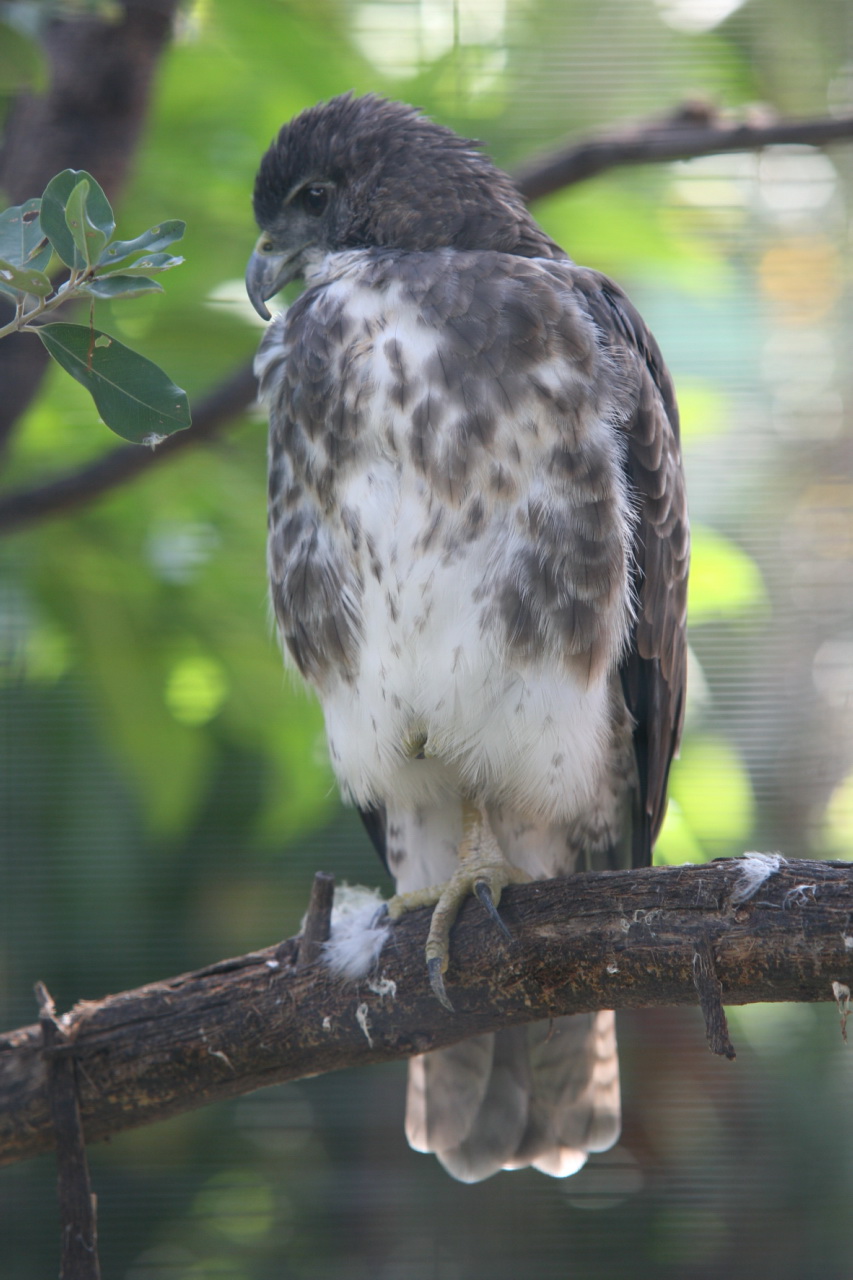 Hawaiian HawkButeo solitarius
Compare
Questions and answers
What is the scientific name of the Red-tailed Hawk?
The scientific name of the Red-tailed Hawk is Buteo jamaicensis. Written with its author, the full name is Buteo jamaicensis (J. F. Gmelin, 1788).
Which family does the Red-tailed Hawk belong to?
Buteo jamaicensis belongs to the family Accipitridae, in the order Accipitriformes and the class Aves.
Where is the Red-tailed Hawk found?
Checklists and occurrence records place Buteo jamaicensis in 26 countries, including United States, Canada, Mexico, Puerto Rico, Costa Rica and Guatemala.
What is the conservation status of the Red-tailed Hawk?
The IUCN Red List category recorded for Buteo jamaicensis is Least Concern (LC).
What other names does the Red-tailed Hawk have?
Buteo jamaicensis is also known in English as Chicken Hawk, Hen Hawk, Macaw, Macou, Mouse Hawk and Red-tailed Buzzard.
What is another name for a Red-tailed Hawk?
Other recorded English names include Chicken Hawk, Hen Hawk, Macaw, Macou, Mouse Hawk, Red-tailed Buzzard, and Redtail.[43]
What is the diet of a Red-tailed Hawk?
The Red-tailed Hawk primarily eats small mammals, including rodents and lagomorphs. It also consumes birds, fish, reptiles, and amphibians.[18]
What habitat do red-tailed hawks live in?
They inhabit deserts, grasslands, coastal regions, mountains, foothills, forests, tropical rainforests, agricultural fields, and urban areas. They commonly use mixed forests and fields with elevated bluffs or trees suitable for perching.[14][15]
Are red-tailed hawks carnivores or omnivores?
The Red-tailed Hawk eats small mammals, birds, fish, reptiles, and amphibians.[18]
Sources
Passages the profile rests on
- The species has a stocky body, broad wings, and a distinctive brick-red upper tail with a light buff-orange underside. Source passage: “It has a stocky body with broad wings and can be distinguished from other North American hawks by the eponymous tail, which is uniformly brick-red above and light buff-orange below.” — English Wikipedia
- Adults typically have a red tail ending in a single black band. Source passage: “Adults are usually easy to identify by their red tails that end in a single black band.” — English Wikipedia
- The species has yellow legs, feet, and cere. Source passage: “The cere, legs, and feet of the red-tailed hawk are all yellow.” — English Wikipedia
- Immature individuals have tails patterned with approximately six darker bars. Source passage: “Immature birds are more difficult to identify, and their tails are patterned with about six darker bars.” — English Wikipedia
- The western North American subspecies B. j. calurus occurs in light, dark, and intermediate or rufous color morphs. Source passage: “The western North American population, B. j. calurus, is the most variable subspecies and has three color morphs - light, dark, and intermediate or rufus.” — English Wikipedia
- The dark and intermediate color morphs together account for 10–20% of the B. j. calurus population. Source passage: “The dark and intermediate morphs constitute 10–20% of the population.” — English Wikipedia
- The B. j. harlani subspecies has blackish-and-white plumage without warm tones except in the tail. Source passage: “In both color morphs, the plumage is blackish and white, lacking warm tones (save the tail).” — English Wikipedia
- The B. j. kriderii subspecies is paler than other red-tailed hawks, particularly on the head. Source passage: “B. j. kriderii is paler than other red-tails, especially on the head; the tail may be pinkish or white.” — English Wikipedia
- The species typically weighs between 690 and 1,600 grams. Source passage: “typically weighing from 690 to 1,600 g (1.5 to 3.5 lb)” — English Wikipedia
- The species measures approximately 45–65 cm in length. Source passage: “measuring 45–65 cm (18–26 in) in length” — English Wikipedia
- Its wingspan typically ranges from 110 to 145 cm. Source passage: “with a wingspan from 110–145 cm (43–57 in).” — English Wikipedia
- Females can be up to 25% larger than males. Source passage: “females are up to 25% larger than males.” — English Wikipedia
- Male individuals weigh approximately 690–1,300 grams, while females weigh approximately 900–2,000 grams. Source passage: “male red-tailed hawks may weigh from 690 to 1,300 g (1.52 to 2.87 lb) and females from 900 to 2,000 g (2.0 to 4.4 lb).” — English Wikipedia
- The species commonly inhabits mixed forests and fields with elevated bluffs or trees suitable for perching. Source passage: “Its preferred habitat is mixed forest and field, with high bluffs or trees that may be used as perch sites.” — English Wikipedia
- Its habitats include deserts, grasslands, coastal regions, mountains, foothills, forests, tropical rainforests, agricultural fields, and urban areas. Source passage: “It occupies a wide range of habitats and altitudes, including deserts, grasslands, coastal regions, mountains, foothills, coniferous and deciduous woodlands, tropical rainforests, agricultural fields, and urban areas.” — English Wikipedia
- The species avoids tundra and dense forests. Source passage: “They avoid tundra and dense forests” — fs.usda.gov
- Buildings and bridges provide nesting sites for urban populations. Source passage: “City buildings and bridges also provide ideal nesting sites for urban hawks.” — nyc.gov
- The species primarily eats small mammals, including rodents and lagomorphs, but also consumes birds, fish, reptiles, and amphibians. Source passage: “The red-tailed hawk preys on small mammals such as rodents and lagomorphs, but also opportunistically consumes birds, fish, reptiles, and amphibians.” — English Wikipedia
- Rodents can constitute up to 85% of the species' diet. Source passage: “but usually centers on rodents, comprising up to 85% of a hawk's diet.” — English Wikipedia
- Common mammalian prey includes mice, gophers, voles, chipmunks, and ground and tree squirrels. Source passage: “Most commonly reported prey types include mice, including both native Peromyscus species and house mice; gophers, voles, chipmunks, ground squirrels, and tree squirrels.” — English Wikipedia
- Urban populations consume rats and mice as the majority of their diet. Source passage: “They provide free pest control for the city, with a majority of their diet consisting of rats and mice.” — nyc.gov
- The species may prey on snakes and lizards as its predominant food sources on Caribbean islands. Source passage: “In exceptional case, red-tailed hawks in Caribbean islands prey mostly on reptiles such as snakes and lizards” — English Wikipedia
- The species may consume poisoned rodents and consequently become ill. Source passage: “Eating rodents that have been poisoned can make red-tailed hawks ill.” — nyc.gov
- The species commonly hunts by watching for prey from an elevated perch and swooping down to capture it. Source passage: “Often, they scan for prey activity from an elevated perch site, swooping down from the perch to seize the prey.” — English Wikipedia
- Red-tailed hawks sometimes hunt cooperatively in pairs. Source passage: “Red-tailed hawks, like some other raptors, have been observed to hunt in pairs.” — English Wikipedia
- During soaring flight, the species commonly holds its wings in a slight dihedral and minimizes flapping to conserve energy. Source passage: “In flight, this hawk soars with wings often in a slight dihedral, flapping as little as possible to conserve energy.” — English Wikipedia
- Its active flight is slow and deliberate, with deep wing beats. Source passage: “Active flight is slow and deliberate, with deep wing beats.” — English Wikipedia
- The species may hover stationary above the ground by beating its wings in windy conditions. Source passage: “In wind, it occasionally hovers on beating wings and remains stationary above the ground.” — English Wikipedia
- Its soaring or flapping flight speed typically ranges from 32 to 64 km/h. Source passage: “When soaring or flapping its wings, it typically travels from 32 to 64 km/h (40 mph)” — English Wikipedia
- The species may exceed 190 km/h when diving. Source passage: “but when diving, may exceed 190 km/h (120 mph).” — English Wikipedia
- Migration can be triggered by inadequate food resources and generally occurs in late fall or early spring. Source passage: “Migration does not occur often, but can be triggered by inadequate food resources. When it does occur, it takes place in the late fall and early spring” — nyc.gov
- Pairs generally remain together for life and obtain another mate only after the original mate dies. Source passage: “Pairs stay together for life, taking a new mate only when the original mate dies.” — English Wikipedia
- The species constructs stick nests in high trees. Source passage: “The pair constructs a stick nest in a high tree” — English Wikipedia
- A typical clutch contains one to three eggs. Source passage: “in which a clutch of one to three eggs is laid.” — English Wikipedia
- Manhattan had at least 20 red-tailed hawk nests in 2016. Source passage: “As of 2016, there were at least 20 red-tailed hawk nests in Manhattan.” — nyc.gov
- The number of red-tailed hawk nests in Manhattan increased from eight in 2010 to at least 20 in 2016. Source passage: “In 2010 there were just eight (The National Audubon Society, 2016).” — nyc.gov
- The species is protected under the Migratory Bird Treaty Act. Source passage: “Red-tailed hawks fall under the protection of the Migratory Bird Treaty Act.” — nyc.gov
- Possession, transportation, and sale of red-tailed hawks and their eggs are prohibited under the cited protection. Source passage: “The possession, transportation, or sale of hawks and their eggs is strictly prohibited.” — nyc.gov
- Rat poison can harm red-tailed hawks that consume poisoned rodents. Source passage: “a hawk that ingests rodents that have consumed rat poison can itself be affected.” — English Wikipedia
- The New York City government recommends snap traps instead of poison for controlling rodents. Source passage: “Use snap traps rather than poison to control rodent populations.” — nyc.gov
- Red-tailed hawks are commonly captured for falconry in the United States because they are abundant and trainable hunters. Source passage: “Because they are so common and easily trained as capable hunters, most hawks captured for falconry in the United States are red-tailed hawks.” — English Wikipedia
- The species provides rodent pest control in urban environments. Source passage: “They provide free pest control for the city, with a majority of their diet consisting of rats and mice.” — nyc.gov
- The species is one of three North American hawks colloquially called chickenhawks in the United States. Source passage: “In the United States, it is one of three species colloquially known as the "chickenhawk".” — English Wikipedia
Data
- Catalogue of Life, 2026-10-16 XR cc by
- Global Biodiversity Information Facility CC BY 4.0
- Wikidata CC0
- GeoNames CC BY 4.0
- Wikimedia Commons per image; credit shown with each image
- Within the Catalogue of Life, this name comes from The Integrated Taxonomic Information System cc0
References
- Syst. Nat., 1(1): 266. 1788 where the name was published
- Banks, R. C., R. W. McDiarmid, and A. L. Gardner. (1987). Checklist of Vertebrates of the United States, the U.S. Territories, and Canada. Resource Publication, No. 166.
- Gill, Frank, & and Minturn Wright. (2006). Birds of the World: Recommended English Names.
This species in other databases
- Catalogue of Life 69669
- Wikidata Q457471
- iNaturalist 5212
- WoRMS urn:lsid:marinespecies.org:taxname:159109
- Avibase rethaw
Page built on 24 November 2026. See how the catalog is made and all sources and licences.
Cite this page
ScientificNames.org. (2026). Buteo jamaicensis (Red-tailed Hawk). Retrieved November 24, 2026, from https://scientificnames.org/species/buteo-jamaicensis
“Buteo jamaicensis (Red-tailed Hawk).” ScientificNames.org, 2026, scientificnames.org/species/buteo-jamaicensis. Accessed 24 Nov. 2026.
ScientificNames.org. “Buteo jamaicensis (Red-tailed Hawk).” Accessed November 24, 2026. https://scientificnames.org/species/buteo-jamaicensis.
@misc{scientificnames_buteo_jamaicensis_red_tailed_hawk,
  author = {{ScientificNames.org}},
  title = {Buteo jamaicensis (Red-tailed Hawk)},
  year = {2026},
  url = {https://scientificnames.org/species/buteo-jamaicensis},
  note = {Accessed 2026-11-24}
}