Species · Flowering plants
Cajanus kerstingii
Cajanus kerstingii has no English name on record in the checklists used here. It is a species of flowering plant in the family Fabaceae (bean), order Fabales.
- Scientific name
- Cajanus kerstingii Harms
- Genus
- Cajanus
- Family
- Fabaceae (Bean)
- Order
- Fabales
- Class
- Magnoliopsida
- Recorded in
- 10 countries
- Name status
- accepted in the Catalogue of Life
Overview
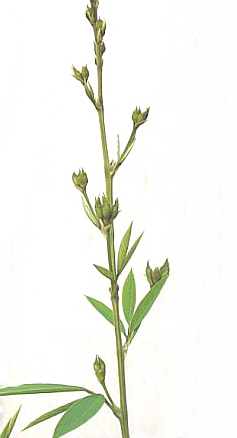
Cajanus kerstingii Harms is an erect, perennial shrub in the family Fabaceae, order Fabales and class Magnoliopsida. The species grows in open savannah environments at elevations between 50 and 500 metres, primarily in Burkina Faso, Nigeria and Ghana. It reaches 90–200 centimetres in height, has green or occasionally brownish-purple branches, and is resistant to flames.
Written 27 November 2026 from the sources listed below. Each statement was checked against the passage it cites; statements that could not be supported were removed.
Appearance
Cajanus kerstingii is an erect shrub with branches that are green or occasionally brownish-purple. Its leaves have faint striations and sunken glands.[1][2][3]
The shrub reaches a height of 90–200 centimetres.[4]
Habitat
The species grows in open savannah environments at elevations between 50 and 500 metres. It commonly occurs on hilltops and hillsides among grasses and large granite boulders.[5][6][7]
It is occasionally found among shrubby trees and grows best in fine, gravel-like soil.[8][9]
The species occurs primarily in Burkina Faso, Nigeria and Ghana. Additional records document its presence in Benin, Mali, Senegal and Togo.[10][11]
Behaviour
Cajanus kerstingii is a non-climbing, perennial shrub that survives for more than two years. It is resistant to flames.[12][13][14]
Reproduction and life cycle
The species is propagated through its fruit.[15]
Uses
Cajanus kerstingii can be consumed by humans as a cereal or used as a pulse. Its harvested fruit can also be consumed for nutritional purposes.[16][17][18]
The species can provide fibre for human use and can be used as forage.[19][20]
Classification of Cajanus kerstingii
| Kingdom | Plantae |
|---|---|
| Subkingdom | Pteridobiotina |
| Phylum | Tracheophyta |
| Class | Magnoliopsida |
| Order | Fabales |
| Family | Fabaceae (Bean) |
| Genus | Cajanus (Cajanuses) |
| Species | Cajanus kerstingii Harms |
Where Cajanus kerstingii is found
Checklists and occurrence records place Cajanus kerstingii in 10 countries across Africa. GBIF holds 251 georeferenced records of it.
Countries
- Benin 103
- Burkina Faso 45
- Cameroon 40
- Ghana 12
- Guinea
- Ivory Coast 7
- Mali 20
- Nigeria 16
- Senegal 2
- Togo 6
Regions and cities with the most records
- Atakora, Benin 99
- Tanguiéta, Benin 57
- Toukountouna, Benin 56
- North, Cameroon 13
- Delta, Nigeria 11
- Maroua, Cameroon 8
- Ughelli, Nigeria 8
- Bamako, Mali 6
- Boucle du Mouhoun, Burkina Faso 6
- Boundiali, Ivory Coast 6
- Dialakorodji, Mali 6
- Kati, Mali 6
- Kolia, Ivory Coast 6
- Sangarébougou, Mali 6
- Savanes District, Ivory Coast 6
- Sirakoro Méguétana, Mali 6
- Upper East, Ghana 6
- Est, Burkina Faso 5
- Sikasso, Mali 5
- Warri, Nigeria 5
- Borgou, Benin 4
- Cobly, Benin 4
- Matéri, Benin 4
- Moribabougou, Mali 4
- Pèrèrè, Benin 4
- Bamako, Mali 3
- Bawku, Ghana 3
- Borno State, Nigeria 3
- Boromo, Burkina Faso 3
- Centre-Ouest, Burkina Faso 3
- Koulikoro, Mali 3
A number beside a place is its count of GBIF occurrence records. A place without a number comes from a checklist alone. Records show where a species has been observed or collected, which can include escapes and vagrants.
Related species
-
 Pigeon PeaCajanus cajan
-
 Cajanus goensis
-
 Cajanus crassus
-
 Cajanus confertiflorus
-
 Jungle TurCajanus lineatus
- Cajanus mollis
-
 RanturCajanus sericeus
- Cajanus grandiflorus
Compare
Sources
Passages the profile rests on
- Cajanus kerstingii is an erect shrub. Source passage: “Cajanus kerstingii is an erect shrub” — English Wikipedia
- Its branches are green or occasionally brownish-purple. Source passage: “green branches, or occasionally browny-purple.” — English Wikipedia
- Its leaves have faint striations and sunken glands. Source passage: “The leaves are faintly striate (marked by ridges or grooves) and a glandular punctate, meaning the glands of the leaf are sunken in” — English Wikipedia
- The shrub reaches a height of 90–200 centimetres. Source passage: “grows to be 90–200 centimetres (35–79 in).” — English Wikipedia
- The species grows in open savannah environments. Source passage: “thrives in open savannah conditions” — English Wikipedia
- The species grows at elevations between 50 and 500 metres. Source passage: “can survive at altitudes of 50–500 metres (160–1,640 ft).” — English Wikipedia
- The species commonly occurs on hilltops and hillsides among grasses and large granite boulders. Source passage: “it is common on hilltops or hillsides, among grasses, large granite boulders” — English Wikipedia
- The species is occasionally found among shrubby trees. Source passage: “and occasionally shrubby trees.” — English Wikipedia
- The species grows best in fine, gravel-like soil. Source passage: “It grows best in soil that is fine and gravel-like.” — English Wikipedia
- The species occurs primarily in Burkina Faso, Nigeria and Ghana. Source passage: “namely Burkina Faso, Nigeria and Ghana.” — English Wikipedia
- Additional records document the species in Benin, Mali, Senegal and Togo. Source passage: “Other records show its presence in more countries, such as Benin, Mali, Senegal and Togo.” — English Wikipedia
- Cajanus kerstingii is a perennial shrub that survives for more than two years. Source passage: “Cajanus kerstingii is also a perennial, non-climbing shrub, meaning it survives for more than two years.” — English Wikipedia
- The shrub is non-climbing. Source passage: “a perennial, non-climbing shrub” — English Wikipedia
- The shrub is resistant to flames. Source passage: “Further advantages include its resistance to flames.” — English Wikipedia
- The species is propagated through its fruit. Source passage: “Cajanus kerstingii is propagated via fruit.” — English Wikipedia
- The species can be consumed by humans as a cereal. Source passage: “Cajanus kerstingii can be consumed by humans as a cereal” — English Wikipedia
- The species can be used as a pulse. Source passage: “as a cereal, pulse, fibre or forage.” — English Wikipedia
- Its harvested fruit can be consumed by humans for nutritional purposes. Source passage: “When fully harvested, C. kerstingii produces a fruit that can be consumed by humans for various nutritional purposes.” — English Wikipedia
- The species can provide fibre for human use. Source passage: “as a cereal, pulse, fibre or forage.” — English Wikipedia
- The species can be used as forage. Source passage: “as a cereal, pulse, fibre or forage.” — English Wikipedia
Data
- Catalogue of Life, 2026-10-16 XR cc by
- Global Biodiversity Information Facility CC BY 4.0
- Wikidata CC0
- GeoNames CC BY 4.0
- Within the Catalogue of Life, this name comes from The World Checklist of Vascular Plants (WCVP): Fabaceae cc by
References
- Repert. Spec. Nov. Regni Veg. 14: 196 (1915) where the name was published
This species in other databases
- Catalogue of Life PBJC
- Wikidata Q15378708
- iNaturalist 506632
- World Flora Online wfo-0000179110
- GRIN 470552
Page built on 27 November 2026. See how the catalog is made and all sources and licences.
Cite this page
ScientificNames.org. (2026). Cajanus kerstingii. Retrieved November 27, 2026, from https://scientificnames.org/species/cajanus-kerstingii
“Cajanus kerstingii.” ScientificNames.org, 2026, scientificnames.org/species/cajanus-kerstingii. Accessed 27 Nov. 2026.
ScientificNames.org. “Cajanus kerstingii.” Accessed November 27, 2026. https://scientificnames.org/species/cajanus-kerstingii.
@misc{scientificnames_cajanus_kerstingii,
  author = {{ScientificNames.org}},
  title = {Cajanus kerstingii},
  year = {2026},
  url = {https://scientificnames.org/species/cajanus-kerstingii},
  note = {Accessed 2026-11-27}
}