Species · Insects
Angled Pierrot Caleta caleta
The scientific name of the Angled Pierrot is Caleta caleta. It is a species of insect in the family Lycaenidae (blues), order Lepidoptera. The name dates from 1876.
- Scientific name
- Caleta caleta (Hewitson, 1876)
- Common name
- Angled Pierrot
- Genus
- Caleta
- Family
- Lycaenidae (Blues)
- Order
- Lepidoptera
- Class
- Insecta
- Red List category
- LC Least Concern
- Recorded in
- 2 countries
- Name status
- accepted in the Catalogue of Life

Overview
Caleta caleta, known as the Angled Pierrot, is an insect in the family Lycaenidae, order Lepidoptera and class Insecta. The species inhabits jungle and lightly forested areas receiving moderate to heavy precipitation. Males have a broad oblique white medial wing band with a hook-like projection below vein 3 on the forewing.
Written 27 November 2026 from the sources listed below. Each statement was checked against the passage it cites; statements that could not be supported were removed.
Appearance
Male Angled Pierrot butterflies have a dark brownish-black upper surface with a broad oblique white medial band across both pairs of wings. The band forms a hook-like projection below vein 3 on the forewing.[1][2]
The male underside is white with black markings on both forewings and hindwings. The antennae, head, thorax and abdomen are black, while the underside of the palpi, thorax and abdomen is white.[3][4][5]
Females resemble males on both wing surfaces but have a narrower white medial band above and broader black markings below.[6]
The dry-season form is smaller than the other seasonal form.[7]
Habitat
The Angled Pierrot inhabits jungle and lightly forested areas receiving moderate to heavy precipitation. It occurs along nullahs and shady paths.[8][9]
The butterfly visits damp patches.[10]
Diet
The larvae feed on tender leaves of Zizyphus rugosa. This plant belongs to the family Rhamnaceae and is recorded as the species' food plant.[11][12]
Behaviour
The butterfly flies rapidly close to the ground and visits low-flying bushes.[13][14]
Reproduction and life cycle
The larva is pale green with a woodlouse-like body shape. It conceals its head beneath the second body segment.[15][16]
The larval body is covered with fine hairs and has a fringe of longer hairs on each side.[17]
The pupa is short and stout, with a constriction between the thorax and abdomen. Its body is covered with short hairs.[18][19]
The pupa attaches closely to a surface using its tail and a supporting band. It is ochreous, mottled with brown, and has two green bands on its back.[20][21][22]
Classification of the Angled Pierrot
| Kingdom | Animalia |
|---|---|
| Phylum | Arthropoda |
| Subphylum | Hexapoda |
| Class | Insecta (Insect) |
| Order | Lepidoptera |
| Superfamily | Papilionoidea |
| Family | Lycaenidae (Blues) |
| Subfamily | Polyommatinae |
| Tribe | Polyommatini |
| Genus | Caleta (Pierrots) |
| Species | Caleta caleta (Hewitson, 1876) |
Where the Angled Pierrot is found
Checklists and occurrence records place Caleta caleta in 2 countries. GBIF holds 115 georeferenced records of it.
Countries
Regions and cities with the most records
A number beside a place is its count of GBIF occurrence records. A place without a number comes from a checklist alone. Records show where a species has been observed or collected, which can include escapes and vagrants.
Common names
English
- Angled Pierrot
Synonyms
One other scientific name has been used for this species and is now treated as a synonym of Caleta caleta.
- Lycaena caleta Hewitson, 1876
Subspecies and varieties
- Caleta caleta garasa subspecies
- Caleta caleta kalawara subspecies
Related species
-
 Angled PierrotCaleta decidia
-
 Common BluePolyommatus icarus
-
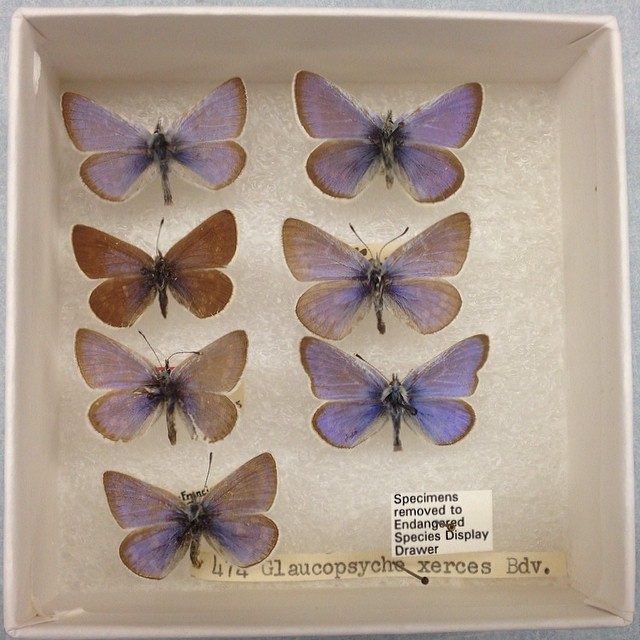 Xerces BlueGlaucopsyche xerces
-
 Adonis BlueLysandra bellargus
-
 Western Pygmy BlueBrephidium exilis
-
 AtalaEumaeus atala
-
 Holly BlueCelastrina argiolus
-
 Long-tailed BlueLampides boeticus
Compare
Questions and answers
What is the scientific name of the Angled Pierrot?
The scientific name of the Angled Pierrot is Caleta caleta. Written with its author, the full name is Caleta caleta (Hewitson, 1876).
Which family does the Angled Pierrot belong to?
Caleta caleta belongs to the family Lycaenidae, in the order Lepidoptera and the class Insecta.
Where is the Angled Pierrot found?
Checklists and occurrence records place Caleta caleta in 2 countries: Indonesia and Philippines.
What is the conservation status of the Angled Pierrot?
The IUCN Red List category recorded for Caleta caleta is Least Concern (LC).
Sources
Passages the profile rests on
- Male Caleta caleta butterflies have a dark brownish-black upper surface with a broad oblique white medial band across both pairs of wings. Source passage: “The male's upperside is dark brownish black, a broad medial oblique white band across both forewings and hindwings” — English Wikipedia
- The male's white medial band forms a hook-like projection below vein 3 on the forewing. Source passage: “above vein 3 produced shortly outwards and downwards into a hook-like form.” — English Wikipedia
- The male's underside is white with black markings on both forewings and hindwings. Source passage: “Underside: white with the following black markings:” — English Wikipedia
- Male butterflies have black antennae, head, thorax and abdomen. Source passage: “Antennae, head, thorax and abdomen black;” — English Wikipedia
- The underside of the male's palpi, thorax and abdomen is white. Source passage: “beneath: the palpi, thorax and abdomen white.” — English Wikipedia
- Females resemble males on both wing surfaces but have a narrower white medial band above and broader black markings below. Source passage: “Similar to the male on both upper and under sides, but on the former the white medial band is narrower, on the latter the black markings are broader.” — English Wikipedia
- The dry-season form is smaller than the other seasonal form. Source passage: “Dry-season form is smaller with less prominent markings.” — English Wikipedia
- The species inhabits jungle and lightly forested areas receiving moderate to heavy precipitation. Source passage: “The species is found in jungle and lightly forested country with moderate to heavy precipitation.” — English Wikipedia
- The butterfly occurs along nullahs and shady paths. Source passage: “Found along nullahs and shady paths.” — English Wikipedia
- The species visits damp patches. Source passage: “It visits damp patches.” — English Wikipedia
- The larvae feed on tender leaves of Zizyphus rugosa. Source passage: “Feeds on the tender leaves of the chorna (Zizyphus rugosa)” — English Wikipedia
- Zizyphus rugosa, a member of the Rhamnaceae, is recorded as the species' food plant. Source passage: “Zizyphus rugosa, Rhamnaceae.” — English Wikipedia
- The butterfly flies rapidly close to the ground. Source passage: “The butterfly flies rapidly, close to the ground” — English Wikipedia
- The butterfly visits low-flying bushes. Source passage: “visiting low flying bushes.” — English Wikipedia
- The larva is pale green and has a woodlouse-like body shape. Source passage: “pale green, of the usual woodlouse form” — English Wikipedia
- The larva conceals its head beneath the second body segment. Source passage: “with the head concealed under the second segment.” — English Wikipedia
- The larval body is covered with fine hairs and has a fringe of longer hairs on each side. Source passage: “The whole body is more or less pubescent and there is a fringe of longer hairs on each side.” — English Wikipedia
- The pupa is short and stout, with a constriction between the thorax and abdomen. Source passage: “Short and stout, constricted between the thorax and abdomen,” — English Wikipedia
- The pupa is covered with short hairs. Source passage: “clothed with short hair,” — English Wikipedia
- The pupa attaches closely to a surface using its tail and a supporting band. Source passage: “closely attached by tail and band to any convenient surface;” — English Wikipedia
- The pupa has an ochreous coloration mottled with brown. Source passage: “colour ochreous mottled with brown.” — English Wikipedia
- The pupa has two green bands on its back. Source passage: “but has two green bands on the back.” — English Wikipedia
Data
- Catalogue of Life, 2026-10-16 XR cc by
- Global Biodiversity Information Facility CC BY 4.0
- Wikidata CC0
- GeoNames CC BY 4.0
- Wikimedia Commons per image; credit shown with each image
- Within the Catalogue of Life, this name comes from Global Lepidoptera Index cc by
References
- Hewitson. (1876). Illustrations of new species of exotic butterflies, selected chiefly from the collections of W. W. Saunders and W. C. Hewitson. 5. http://www.biodiversitylibrary.org/item/47491#page/120/mode/2up Link where the name was published
This species in other databases
Page built on 28 November 2026. See how the catalog is made and all sources and licences.
Cite this page
ScientificNames.org. (2026). Caleta caleta (Angled Pierrot). Retrieved November 28, 2026, from https://scientificnames.org/species/caleta-caleta
“Caleta caleta (Angled Pierrot).” ScientificNames.org, 2026, scientificnames.org/species/caleta-caleta. Accessed 28 Nov. 2026.
ScientificNames.org. “Caleta caleta (Angled Pierrot).” Accessed November 28, 2026. https://scientificnames.org/species/caleta-caleta.
@misc{scientificnames_caleta_caleta_angled_pierrot,
  author = {{ScientificNames.org}},
  title = {Caleta caleta (Angled Pierrot)},
  year = {2026},
  url = {https://scientificnames.org/species/caleta-caleta},
  note = {Accessed 2026-11-28}
}