Species · Spiders and other arachnids
Callilepis imbecilla
Callilepis imbecilla has no English name on record in the checklists used here. It is a species of arachnid in the family Gnaphosidae (ground spider), order Araneae. The name dates from 1887.
- Scientific name
- Callilepis imbecilla (Keyserling, 1887)
- Genus
- Callilepis
- Family
- Gnaphosidae (Ground Spider)
- Order
- Araneae
- Class
- Arachnida
- Recorded in
- 2 countries
- Name status
- accepted in the Catalogue of Life

Overview
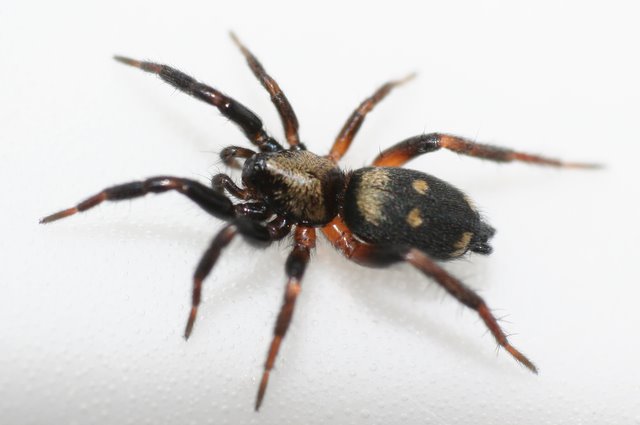
Callilepis imbecilla shelters beneath rocks, bark and in sandy soils during daylight hours. Adults usually measure between 3 and 6 mm and have dark brown to black coloration.
Written 27 November 2026 from the sources listed below. Each statement was checked against the passage it cites; statements that could not be supported were removed.
Appearance
Adult spiders usually measure between 3 and 6 mm. Their coloration ranges from dark brown to black.[1][2]
The cephalothorax is generally oval-shaped and unmarked.[3]
Behaviour
This species is primarily active at night.[4]
Habitat
During daylight hours, this species shelters beneath rocks and bark. It also uses sandy soils as daytime shelter.[5][6][7]
Classification of Callilepis imbecilla
| Kingdom | Animalia |
|---|---|
| Phylum | Arthropoda |
| Subphylum | Chelicerata |
| Class | Arachnida (Arachnid) |
| Order | Araneae (Spider) |
| Family | Gnaphosidae (Ground Spider) |
| Genus | Callilepis |
| Species | Callilepis imbecilla (Keyserling, 1887) |
Origin of the name. Etymology. Latin, feeble
Where Callilepis imbecilla is found
Checklists and occurrence records place Callilepis imbecilla in 2 countries across North America. GBIF holds 96 georeferenced records of it.
Countries
Regions and cities with the most records
- Ohio, United States 53
- Delaware, United States 7
- Texas, United States 6
- Illinois, United States 5
- Mississippi, United States 4
- Oklahoma, United States 4
- Oxford, United States 4
- Florida, United States 3
- Lancaster, United States 3
- New Mexico, United States 3
Range as the checklists state it
Canada, USA
USA
A number beside a place is its count of GBIF occurrence records. A place without a number comes from a checklist alone. Records show where a species has been observed or collected, which can include escapes and vagrants.
Synonyms
2 other scientific names have been used for this species and are now treated as synonyms of Callilepis imbecilla.
- Callilepis munda Chamberlin, 1935
- Pythonissa imbecilla Keyserling, 1887
Related species
-
 Callilepis pluto
-
 Callilepis schuszteri
-
 Callilepis nocturna
- Callilepis gosoga
- Callilepis concolor
- Callilepis eremella
- Callilepis chakanensis
- Callilepis chisos
Compare
Sources
Passages the profile rests on
- Adult spiders of this species usually measure between 3 and 6 mm. Source passage: “These are small spiders, usually 3 to 6 mm.” — fieldreport.caes.uga.edu
- This species has a dark brown to black coloration. Source passage: “They are dark brown to black.” — fieldreport.caes.uga.edu
- The cephalothorax of this species is generally oval-shaped and unmarked. Source passage: “The cephalothorax tends to be oval-shaped and lacks markings.” — fieldreport.caes.uga.edu
- This species is primarily active at night. Source passage: “They are mostly nocturnal (active at night)” — fieldreport.caes.uga.edu
- This species shelters beneath rocks during daylight hours. Source passage: “hide under rocks, bark, or in sandy soils during the day.” — fieldreport.caes.uga.edu
- This species shelters beneath bark during the day. Source passage: “hide under rocks, bark, or in sandy soils during the day.” — fieldreport.caes.uga.edu
- This species uses sandy soils as daytime shelter. Source passage: “hide under rocks, bark, or in sandy soils during the day.” — fieldreport.caes.uga.edu
Data
- Catalogue of Life, 2026-10-16 XR cc by
- Global Biodiversity Information Facility CC BY 4.0
- Wikidata CC0
- GeoNames CC BY 4.0
- Wikimedia Commons per image; credit shown with each image
- Within the Catalogue of Life, this name comes from The World Spider Catalog cc by
References
- Keyserling, E. (1887b). Neue Spinnen aus America. VII. Verhandlungen der Kaiserlich-Königlichen Zoologisch-Botanischen Gesellschaft in Wien 37: 421-490, pl. 6. Link where the name was published
This species in other databases
Page built on 28 November 2026. See how the catalog is made and all sources and licences.
Cite this page
ScientificNames.org. (2026). Callilepis imbecilla. Retrieved November 28, 2026, from https://scientificnames.org/species/callilepis-imbecilla
“Callilepis imbecilla.” ScientificNames.org, 2026, scientificnames.org/species/callilepis-imbecilla. Accessed 28 Nov. 2026.
ScientificNames.org. “Callilepis imbecilla.” Accessed November 28, 2026. https://scientificnames.org/species/callilepis-imbecilla.
@misc{scientificnames_callilepis_imbecilla,
  author = {{ScientificNames.org}},
  title = {Callilepis imbecilla},
  year = {2026},
  url = {https://scientificnames.org/species/callilepis-imbecilla},
  note = {Accessed 2026-11-28}
}