Species · Birds
Nubian Woodpecker Campethera nubica
The scientific name of the Nubian Woodpecker is Campethera nubica. It is a species of bird in the family Picidae (woodpecker), order Piciformes. The name dates from 1783.
- Scientific name
- Campethera nubica (Boddaert, 1783)
- Common name
- Nubian Woodpecker
- Genus
- Campethera
- Family
- Picidae (Woodpecker)
- Order
- Piciformes
- Class
- Aves
- Red List category
- LC Least Concern
- Recorded in
- 13 countries
- Name status
- accepted in the Catalogue of Life
Overview
Campethera nubica occurs in Central and Eastern Africa, with a recorded range extending from Chad to Somalia and Tanzania. It is distinguished by olive-brown upperparts with extensive cream speckling and barring, and a greenish-yellow tail with brown barring and golden feather shafts.
Written 26 November 2026 from the sources listed below. Each statement was checked against the passage it cites; statements that could not be supported were removed.
Appearance
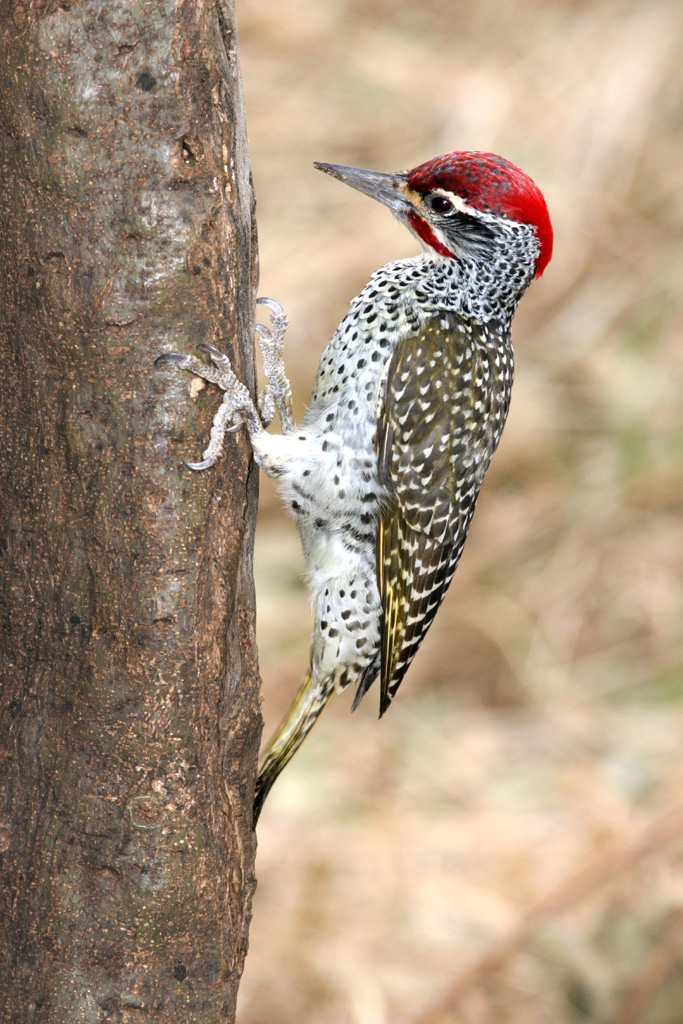
The Nubian Woodpecker reaches approximately 21 cm in length. The male has a red crown and nape, together with a reddish cheek streak.[1][2]
The female has a black crown speckled with white, a red nape, and a dark cheek stripe with white speckling.[3]
Its upperparts are olive-brown with extensive cream speckling and barring. Its wings are greenish-brown with white barring.[4][5]
Its tail is greenish-yellow with brown barring and golden feather shafts. Its throat is cream-coloured, while its head, neck, breast, and belly are white with black spots and bars.[6][7]
Its bill is grey with a dark tip, and its orbital ring is grey. Its feet are olive or grey.[8][9][10]
Habitat
The Nubian Woodpecker inhabits open savannah woodland, particularly woodland containing Acacia and Euphorbia. It also occurs in bushy areas and scrub.[11][12]
It occurs at elevations up to 2,000 metres.[13]
Diet
Its diet includes ants, termites, spiders, and beetles.[14][15]
Behaviour
The Nubian Woodpecker is non-migratory. It frequently forages alone while maintaining vocal contact with its mate.[16][17]
It searches for food mainly in trees but also forages on the ground.[18]
It produces repeated shrill ringing or piping vocalisations that can sound musical or metallic.[19]
Conservation
The Nubian Woodpecker is described as fairly common and having a wide geographic range. Its population is reported to appear stable.[20][21]
The species is classified as Least Concern by the International Union for Conservation of Nature. Its range size does not meet the threshold for Vulnerable under the extent-of-occurrence criterion.[22][23][24]
The species was most recently assessed for the IUCN Red List in 2024.[25]
Classification of the Nubian Woodpecker
| Kingdom | Animalia |
|---|---|
| Phylum | Chordata |
| Subphylum | Vertebrata |
| Infraphylum | Gnathostomata |
| Parvphylum | Osteichthyes |
| Megaclass | Tetrapoda |
| Class | Aves (Bird) |
| Order | Piciformes (Woodpeckers) |
| Family | Picidae (Woodpecker) |
| Subfamily | Picinae |
| Genus | Campethera (African Green Woodpeckers) |
| Species | Campethera nubica (Boddaert, 1783) |
Where the Nubian Woodpecker is found
Checklists and occurrence records place Campethera nubica in 13 countries across Africa. GBIF holds 25,325 georeferenced records of it.
Countries
- Democratic Republic of the Congo 69
- Djibouti 38
- Egypt 6
- Eritrea 28
- Ethiopia 1,731
- Kenya 15,260
- Malawi 7
- Rwanda 20
- Somalia 90
- South Sudan 38
- Sudan 56
- Tanzania 4,954
- Uganda 3,028
Regions and cities with the most records
- Nakuru County, Kenya 2,485
- Arusha, Tanzania 1,607
- Taita Taveta, Kenya 1,507
- Laikipia, Kenya 1,498
- Naivasha, Kenya 1,494
- Kajiado County, Kenya 1,437
- Baringo, Kenya 1,116
- Manyara, Tanzania 1,085
- Narok County, Kenya 953
- Oromiya, Ethiopia 905
- Samburu County, Kenya 835
- Isiolo County, Kenya 816
- Iringa, Tanzania 783
- Mara, Tanzania 641
- Mlolongo, Kenya 629
- Imara Daima Estate, Kenya 601
- Meru County, Kenya 599
- Nakivale Refugee Camp, Uganda 580
- Ongata Rongai, Kenya 575
- Nairobi, Kenya 566
- Nakuru, Kenya 548
- Arusha, Tanzania 536
- Pakwach, Uganda 528
- Kiserian, Kenya 519
- Njoro, Kenya 516
- Githunguri, Kenya 515
- Mombasa, Kenya 512
- Jomvu, Kenya 511
- Mtwapa, Kenya 511
- Kilifi County, Kenya 510
- Mazeras, Kenya 508
- Nairobi County, Kenya 507
- Mombasa County, Kenya 506
- Ngong, Kenya 503
- Voi, Kenya 486
- Simiyu, Tanzania 347
Range as the checklists state it
Africa
A number beside a place is its count of GBIF occurrence records. A place without a number comes from a checklist alone. Records show where a species has been observed or collected, which can include escapes and vagrants.
Common names
English
- Nubian Woodpecker
- NUWO
Names in 25 other languages
- Catalan
- picot núbic
- Chinese
- 东非啄木鸟, 東非啄木
- Croatian
- nubijski djetlić
- Czech
- datel núbijský
- Danish
- Nubisk Spætte
- Dutch
- Nubische Specht
- Esperanto
- nubia pego
- Estonian
- akaatsia-helmesrähn
- Finnish
- savannitäplätikka
- French
- Pic de Nubie
- German
- Drosselspecht, Nubierspecht, Nubischer Specht
- Irish
- Cnagaire Núibiach
- Italian
- Picchio di Nubia
- Japanese
- アフリカアオゲラ
- Lithuanian
- nubinė kampetera
- Norwegian
- akasiespett
- Polish
- dzięciolik moręgowany
- Portuguese
- pica-pau-da-núbia, pica-pau-núbio
- Russian
- Нубийская кампетера, Нубийский дятел
- Slovak
- žlna savanová
- Spanish
- Pito de Nubia
- Swedish
- nubisk hackspett
- Turkish
- Nübye Ağaçkakanı
- Ukrainian
- дятлик нубійський
- Welsh
- cnocell Niwbia
Synonyms
One other scientific name has been used for this species and is now treated as a synonym of Campethera nubica.
- Picus nubicus Boddaert, P, 1783
Subspecies and varieties
- Campethera nubica nubica subspecies
- Campethera nubica pallida subspecies
Related species
-
 Golden-tailed WoodpeckerCampethera abingoni
-
 Bennett's WoodpeckerCampethera bennettii
-
 Knysna WoodpeckerCampethera notata
-
 Little Green WoodpeckerCampethera maculosa
-
 Fine-spotted WoodpeckerCampethera punctuligera
-
 Mombasa WoodpeckerCampethera mombassica
-
 Tullberg's WoodpeckerCampethera tullbergi
- Speckle-throated WoodpeckerCampethera scriptoricauda
Compare
Questions and answers
What is the scientific name of the Nubian Woodpecker?
The scientific name of the Nubian Woodpecker is Campethera nubica. Written with its author, the full name is Campethera nubica (Boddaert, 1783).
Which family does the Nubian Woodpecker belong to?
Campethera nubica belongs to the family Picidae, in the order Piciformes and the class Aves.
Where is the Nubian Woodpecker found?
Checklists and occurrence records place Campethera nubica in 13 countries, including Kenya, Tanzania, Uganda, Ethiopia, Somalia and Democratic Republic of the Congo.
What is the conservation status of the Nubian Woodpecker?
The IUCN Red List category recorded for Campethera nubica is Least Concern (LC).
What other names does the Nubian Woodpecker have?
Campethera nubica is also known in English as NUWO.
What type of diet does a woodpecker have?
The Nubian Woodpecker eats ants, termites, spiders, and beetles.[14][15]
Sources
Passages the profile rests on
- The Nubian Woodpecker reaches approximately 21 cm in length. Source passage: “growing to a length of about 21 cm (8.3 in).” — English Wikipedia
- The male has a red crown and nape, together with a reddish cheek streak. Source passage: “The male has a red crown and nape and a reddish streak on the cheek” — English Wikipedia
- The female has a black crown speckled with white, a red nape, and a dark cheek stripe with white speckling. Source passage: “the female has a black crown speckled with white, a red nape, and a dark cheek stripe with white speckling.” — English Wikipedia
- Its upperparts are olive-brown with extensive cream speckling and barring. Source passage: “The upper parts are olive-brown with much cream speckling and barring.” — English Wikipedia
- Its wings are greenish-brown with white barring. Source passage: “The wings are greenish-brown barred with white” — English Wikipedia
- Its tail is greenish-yellow with brown barring and golden feather shafts. Source passage: “the tail greenish-yellow barred with brown, the shafts of the feathers being gold.” — English Wikipedia
- Its throat is cream-coloured, while its head, neck, breast, and belly are white with black spots and bars. Source passage: “The throat is cream and the head, neck, breast and belly are white, spotted and barred with black.” — English Wikipedia
- Its bill is grey with a dark tip. Source passage: “The beak is grey with a dark tip” — English Wikipedia
- Its orbital ring is grey. Source passage: “the orbital ring grey” — English Wikipedia
- Its feet are olive or grey. Source passage: “the feet olive or grey.” — English Wikipedia
- Its typical habitat includes open savannah woodland, particularly woodland containing Acacia and Euphorbia. Source passage: “Its typical habitat is open savannah woodland, especially with Acacia and Euphorbia” — English Wikipedia
- It also inhabits bushy areas and scrub. Source passage: “bushy areas and scrub.” — English Wikipedia
- It occurs at elevations up to 2,000 metres. Source passage: “is found at altitudes up to 2,000 m (6,600 ft).” — English Wikipedia
- Its diet includes ants and termites. Source passage: “for ants and termites” — English Wikipedia
- It also consumes spiders and beetles. Source passage: “also consuming spiders and beetles.” — English Wikipedia
- The Nubian Woodpecker is non-migratory. Source passage: “It is a non-migratory bird” — English Wikipedia
- It frequently forages alone while maintaining vocal contact with its mate. Source passage: “The Nubian woodpecker often feeds alone, keeping in touch with its mate vocally.” — English Wikipedia
- It searches for food mainly in trees but also forages on the ground. Source passage: “It forages mostly in trees, but also on the ground” — English Wikipedia
- It produces repeated shrill ringing or piping vocalisations that can sound musical or metallic. Source passage: “shrill ringing or piping notes repeated, often musical but sometimes metallic.” — English Wikipedia
- The species is described as fairly common and having a wide geographic range. Source passage: “It is a fairly common species with a wide range” — English Wikipedia
- Its population is reported to appear stable. Source passage: “the population seems stable” — English Wikipedia
- The species is classified as Least Concern by the International Union for Conservation of Nature. Source passage: “the International Union for Conservation of Nature has rated its conservation status as being of "least concern".” — English Wikipedia
- The species has an extremely large geographic range. Source passage: “This species has an extremely large range” — datazone.birdlife.org
- Its range size does not meet the threshold for Vulnerable under the extent-of-occurrence criterion. Source passage: “does not approach the thresholds for Vulnerable under the range size criterion (Extent of Occurrence” — datazone.birdlife.org
- The species was most recently assessed for the IUCN Red List in 2024. Source passage: “has most recently been assessed for The IUCN Red List of Threatened Species in 2024.” — iucnredlist.org
Data
- Catalogue of Life, 2026-10-16 XR cc by
- Global Biodiversity Information Facility CC BY 4.0
- Wikidata CC0
- GeoNames CC BY 4.0
- Wikimedia Commons per image; credit shown with each image
- Within the Catalogue of Life, this name comes from The Integrated Taxonomic Information System cc0
References
- Gill, Frank, & and Minturn Wright. (2006). Birds of the World: Recommended English Names.
This species in other databases
Page built on 26 November 2026. See how the catalog is made and all sources and licences.
Cite this page
ScientificNames.org. (2026). Campethera nubica (Nubian Woodpecker). Retrieved November 26, 2026, from https://scientificnames.org/species/campethera-nubica
“Campethera nubica (Nubian Woodpecker).” ScientificNames.org, 2026, scientificnames.org/species/campethera-nubica. Accessed 26 Nov. 2026.
ScientificNames.org. “Campethera nubica (Nubian Woodpecker).” Accessed November 26, 2026. https://scientificnames.org/species/campethera-nubica.
@misc{scientificnames_campethera_nubica_nubian_woodpecker,
  author = {{ScientificNames.org}},
  title = {Campethera nubica (Nubian Woodpecker)},
  year = {2026},
  url = {https://scientificnames.org/species/campethera-nubica},
  note = {Accessed 2026-11-26}
}