Species · Flowering plants
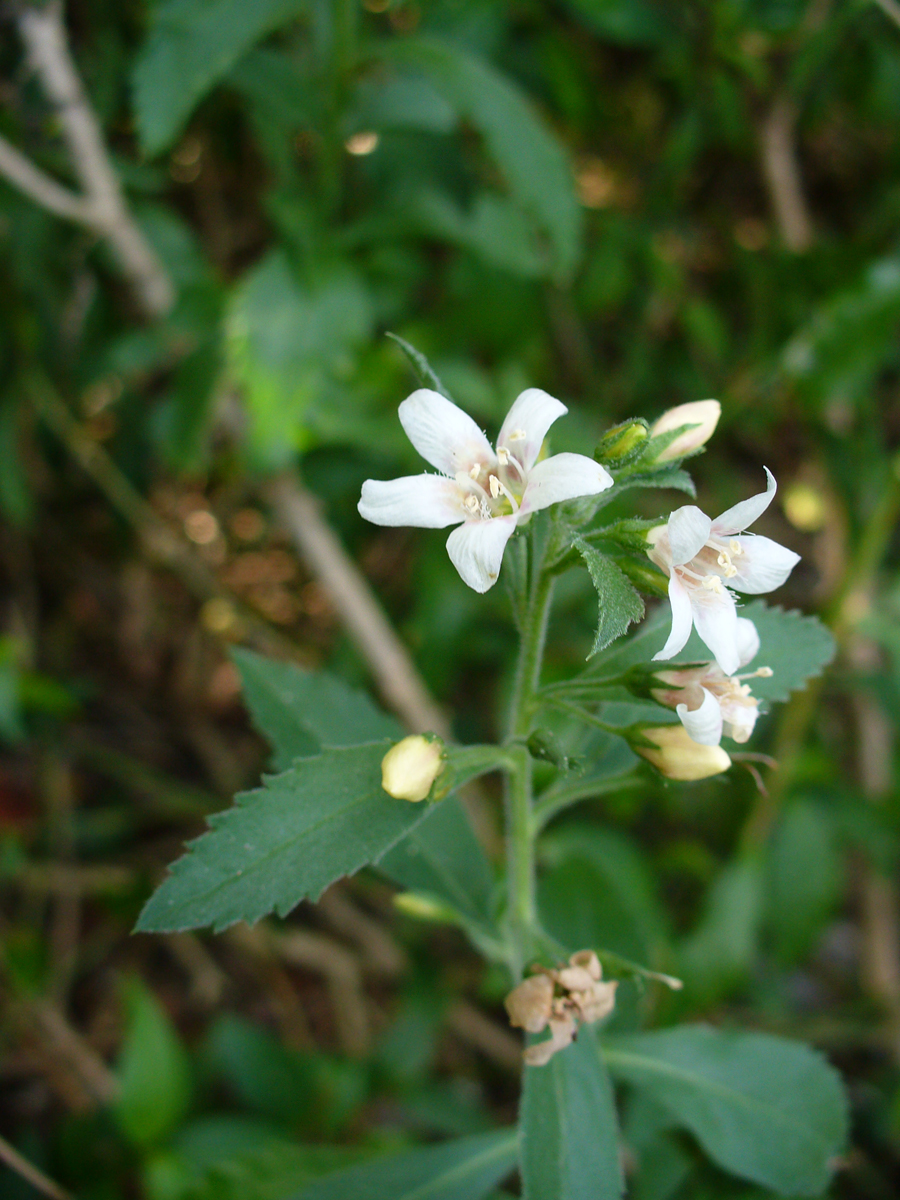
Wild Tea Capraria biflora
The scientific name of the Wild Tea is Capraria biflora. It is a species of flowering plant in the family Scrophulariaceae (figwort family), order Lamiales.
- Scientific name
- Capraria biflora L.
- Common name
- Wild Tea
- Genus
- Capraria
- Family
- Scrophulariaceae (Figwort Family)
- Order
- Lamiales
- Class
- Magnoliopsida
- Recorded in
- 51 countries
- Name status
- accepted in the Catalogue of Life
Overview
Wikidata describes Capraria biflora as “species of plant”.
Classification of the Wild Tea
| Kingdom | Plantae |
|---|---|
| Subkingdom | Pteridobiotina |
| Phylum | Tracheophyta |
| Class | Magnoliopsida |
| Order | Lamiales |
| Family | Scrophulariaceae (Figwort Family) |
| Tribe | Leucophylleae |
| Genus | Capraria (Goatweeds) |
| Species | Capraria biflora L. |
Where the Wild Tea is found
Checklists and occurrence records place Capraria biflora in 51 countries across Africa, North America and South America. GBIF holds 4,981 georeferenced records of it.
Countries where it is native or its origin is not stated
- Anguilla 3
- Antigua and Barbuda 13
- Argentina 23
- Aruba 54
- Bahamas 96
- Barbados 14
- Belize 39
- Bolivia 40
- Bonaire, Saint Eustatius and Saba 90
- Brazil 393
- British Virgin Islands 9
- Cayman Islands 7
- Colombia 267
- Costa Rica 115
- Cuba 111
- Curacao 235
- Dominica 21
- Dominican Republic 64
- Ecuador 88
- El Salvador 17
- French Guiana 12
- Grenada 7
- Guadeloupe 69
- Guatemala 52
- Guyana 37
- Haiti 25
- Honduras 28
- Jamaica 54
- Martinique 48
- Mexico 1,376
- Montserrat 8
- Nicaragua 156
- Panama 43
- Paraguay 18
- Peru 10
- Puerto Rico 122
- Saint Barthelemy 11
- Saint Kitts and Nevis 18
- Saint Martin 14
- Saint Vincent and the Grenadines 4
- Sint Maarten 10
- Suriname 27
- Trinidad and Tobago 53
- Turks and Caicos Islands 16
- U.S. Virgin Islands 47
- Venezuela 133
Countries where it has been introduced
Regions and cities with the most records
- Florida, United States 575
- Campeche, Mexico 230
- Yucatán, Mexico 227
- Oaxaca, Mexico 151
- Quintana Roo, Mexico 146
- Willemstad, Curacao 115
- Guanacaste Province, Costa Rica 79
- Veracruz, Mexico 79
- Chiapas, Mexico 65
- Kendall, United States 57
- Bonaire, Bonaire, Saint Eustatius and Saba 55
- Little Havana, United States 50
- Flagami, United States 48
- Cape Coral, United States 47
- Coral Gables, United States 46
- Galápagos, Ecuador 45
- Cutler Bay, United States 43
- Homestead, United States 43
- The Hammocks, United States 43
- Kendale Lakes, United States 42
- Bahia, Brazil 40
- Campeche, Mexico 39
- Allapattah, United States 38
- Miami, United States 38
- Miami Beach, United States 36
- Tamiami, United States 36
- Querétaro, Mexico 35
- Sinaloa, Mexico 33
- Les Abymes, Guadeloupe 30
- Fountainebleau, United States 29
- Tabasco, Mexico 27
- Bolívar, Colombia 25
- Cartagena, Colombia 25
- Matagalpa Department, Nicaragua 25
- Hialeah, United States 24
- Tamaulipas, Mexico 23
3 more countries have a few records outside this range
These countries hold a few records of Capraria biflora but lie outside the range the checklists give for it. Such records are often zoo or garden specimens, museum material or vagrants, so the species is not counted as occurring there.
Range as the checklists state it
Cape Verde Isl. [I] (Santo Antao Isl. [I], Ilha de Sao Nicolau [I]); Benin [I]; Mauritius [I]; USA [I] (Florida [I], Texas [I]); Bermuda [I]; Mexico (Campeche, Chiapas, Colima, Guanajuato, Guerrero, Hidalgo, Jalisco, Mexico State, Michoacán, Morelos, Nayarit, Oaxaca, Puebla, Queretaro, Quintana Roo, San Luis Potosí, Sinaloa, Sonora, Tabasco, Tamaulipas, Veracruz, Yucatán); Guatemala; Belize; El Salvador; Honduras; Nicaragua; Costa Rica; Isla del Coco; Panama; Bahamas; Turks & Caicos Isl.; Cuba; Cayman Isl.; Jamaica; Hispaniola; Puerto Rico; Virgin Isl. (Guana, St. Croix, St. John, St. Thomas, Tortola, Virgin Gorda); Anguilla; St. Martin/St. Maarten; Saba; St. Kitts; Antigua; Barbuda; Montserrat; Guadeloupe; Dominica; Martinique; St. Lucia; Grenadines; St. Vincent; Grenada; Barbados; Tobago; Trinidad; San Andrés y Providencia (San Andrés, Providencia y Santa Catalina); Colombia (Antioquia, Atlántico, Bolívar, Cesar, Córdoba, Cundinamarca, Huila, Magdalena); Venezuela (Amazonas, Apure, Aragua, Bolívar, Carabobo, Cojedes, Delta Amacuro, Venezuela Distrito Federal, Falcón, Mérida, Miranda, Monagas, Nueva Esparta, Portuguesa, Sucre, Táchira, Zulia); Guyana; Surinam; French Guiana; Ecuador; Galápagos; Peru; Bolivia (Chuquisaca, Santa Cruz, Tarija); N-Brazil (Amapá, Pará, Amazonas, Tocantins, Acre); NE-Brazil (Maranhão, Piauí, Ceará, Paraíba, Pernambuco, Bahia, Alagoas, Sergipe); WC-Brazil (Mato Grosso, Goiás); SE-Brazil (Minas Gerais, Espírito Santo, Rio de Janeiro); Paraguay (Alto Paraguay); Argentina (Formosa, Jujuy, Salta)
A number beside a place is its count of GBIF occurrence records. A place without a number comes from a checklist alone. Records show where a species has been observed or collected, which can include escapes and vagrants.
Common names
English
- Wild Tea
Names in 5 other languages
- Chinese
- 雙花羊芙蓉
- French
- Thé des Anglais
- Papiamento
- Tanchi
- Slovak
- kozička dvojkvetá
- Spanish
- Hierba del campo, Té de Santa Maria, hierba té, té del país
Synonyms
12 other scientific names have been used for this species and are now treated as synonyms of Capraria biflora.
- Capraria biflora f. hirta Loes.
- Capraria biflora subsp. havanensis Tzvelev
- Capraria biflora var. pilosa Griseb.
- Capraria hirsuta Kunth
- Capraria semiserrata Vahl
- Capraria semiserrata Willd.
- Capraria semiserrata var. berterii A.DC. ex Benth.
- Capraria semiserrata var. berteroi A.DC. ex Benth.
- Xuarezia biflora Ruiz & Pav.
- Xuarezia hirsuta (Kunth) Kuntze
- Xuarezia semiserrata (Vahl) Kuntze
- Capraria lanceolata Vahl ambiguous synonym
Subspecies and varieties
- Capraria biflora subsp. biflora subspecies
Related species
- Mexican GoatweedCapraria mexicana
- Capraria frutescens
- Capraria peruviana
- Capraria integerrima
- Capraria integrifolia
-
 MulleinVerbascum thapsus
-
 Purple-sageLeucophyllum frutescens
-
 BuddleiaBuddleja davidii
Compare
Questions and answers
What is the scientific name of the Wild Tea?
The scientific name of the Wild Tea is Capraria biflora. Written with its author, the full name is Capraria biflora L..
Which family does the Wild Tea belong to?
Capraria biflora belongs to the family Scrophulariaceae, in the order Lamiales and the class Magnoliopsida.
Where is the Wild Tea found?
Checklists and occurrence records place Capraria biflora in 51 countries, including Mexico, Brazil, Colombia, Curacao, Nicaragua and Venezuela.
Sources
Data
- Catalogue of Life, 2026-10-16 XR cc by
- Global Biodiversity Information Facility CC BY 4.0
- Wikidata CC0
- GeoNames CC BY 4.0
- Wikimedia Commons per image; credit shown with each image
- Within the Catalogue of Life, this name comes from Synonymic Checklists of the Vascular Plants of the World cc by
References
- L. (1753). Sp. Pl. [Linnaeus] 2: 628 (1753). where the name was published
This species in other databases
- Catalogue of Life QS79
- Wikidata Q13898056
- iNaturalist 159826
- World Flora Online wfo-0000585310
- GRIN 449983
Page built on 25 November 2026. See how the catalog is made and all sources and licences.
Cite this page
ScientificNames.org. (2026). Capraria biflora (Wild Tea). Retrieved November 25, 2026, from https://scientificnames.org/species/capraria-biflora
“Capraria biflora (Wild Tea).” ScientificNames.org, 2026, scientificnames.org/species/capraria-biflora. Accessed 25 Nov. 2026.
ScientificNames.org. “Capraria biflora (Wild Tea).” Accessed November 25, 2026. https://scientificnames.org/species/capraria-biflora.
@misc{scientificnames_capraria_biflora_wild_tea,
  author = {{ScientificNames.org}},
  title = {Capraria biflora (Wild Tea)},
  year = {2026},
  url = {https://scientificnames.org/species/capraria-biflora},
  note = {Accessed 2026-11-25}
}