Species · Spiders and other arachnids
Antilles Pinktoe Tarantula Caribena versicolor
The scientific name of the Antilles Pinktoe Tarantula is Caribena versicolor. It is a species of arachnid in the family Theraphosidae (tarantulas), order Araneae. The name dates from 1837.
- Scientific name
- Caribena versicolor (Walckenaer, 1837)
- Common name
- Antilles Pinktoe Tarantula
- Genus
- Caribena
- Family
- Theraphosidae (Tarantulas)
- Order
- Araneae
- Class
- Arachnida
- Recorded in
- 3 countries
- Name status
- accepted in the Catalogue of Life

Overview
The Antilles Pinktoe Tarantula is classified in the genus Caribena. Spiderlings are bright blue, while mature individuals develop green carapaces, red abdomens, and green legs with pink tarsi and purple hairs.
Written 26 November 2026 from the sources listed below. Each statement was checked against the passage it cites; statements that could not be supported were removed.
Appearance
Spiderlings have bright blue coloration and a black tree trunk pattern on their abdomens.[1]
As individuals mature, their carapaces become green and their abdomens become red. Their legs become green, with pink tarsi and purple hairs.[2]
Males are usually slightly more brightly colored than females.[3]
Classification of the Antilles Pinktoe Tarantula
| Kingdom | Animalia |
|---|---|
| Phylum | Arthropoda |
| Subphylum | Chelicerata |
| Class | Arachnida (Arachnid) |
| Order | Araneae (Spider) |
| Family | Theraphosidae (Tarantulas) |
| Genus | Caribena |
| Species | Caribena versicolor (Walckenaer, 1837) |
Where the Antilles Pinktoe Tarantula is found
Checklists and occurrence records place Caribena versicolor in 3 countries across North America and South America. GBIF holds 270 georeferenced records of it.
Countries
Regions and cities with the most records
- Saint-Joseph, Martinique 111
- Fort-de-France, Martinique 97
- Sainte-Marie, Martinique 94
- Le Lamentin, Martinique 89
- La Trinité, Martinique 81
- Le Robert, Martinique 74
- Ducos, Martinique 64
- Le François, Martinique 39
1 more country has a few records outside this range
These countries hold a few records of Caribena versicolor but lie outside the range the checklists give for it. Such records are often zoo or garden specimens, museum material or vagrants, so the species is not counted as occurring there.
Range as the checklists state it
Martinique
Colombia
A number beside a place is its count of GBIF occurrence records. A place without a number comes from a checklist alone. Records show where a species has been observed or collected, which can include escapes and vagrants.
Common names
English
- Antilles Pinktoe Tarantula
- Martinique Pinktoe Tarantula
Names in 7 other languages
- Czech
- sklípkan barvoměnný
- Dutch
- Veelkleurige boomspin
- French
- Aviculaire, Aviculaire antillaise
- German
- Martinique-Baumvogelspinne
- Hungarian
- Martinique-i madárpók
- Polish
- Ptasznik wielobarwny
- gcf
- Matoutou falaise
Synonyms
4 other scientific names have been used for this species and are now treated as synonyms of Caribena versicolor.
- Avicularia rutilans Ausserer, 1875
- Avicularia versicolor (Walckenaer, 1837)
- Caribena rutilans (Ausserer, 1875)
- Mygale versicolor Walckenaer, 1837
Related species
-
 Puerto Rican Pinktoe TarantulaCaribena laeta
-
 Goliath BirdeaterTheraphosa blondi
-
 Gooty Sapphire Ornamental TarantulaPoecilotheria metallica
- Curly Hair TarantulaTliltocatl albopilosus
-
 Mexican Orange-knee TarantulaBrachypelma hamorii
-
 Chilean Rose TarantulaGrammostola rosea
-
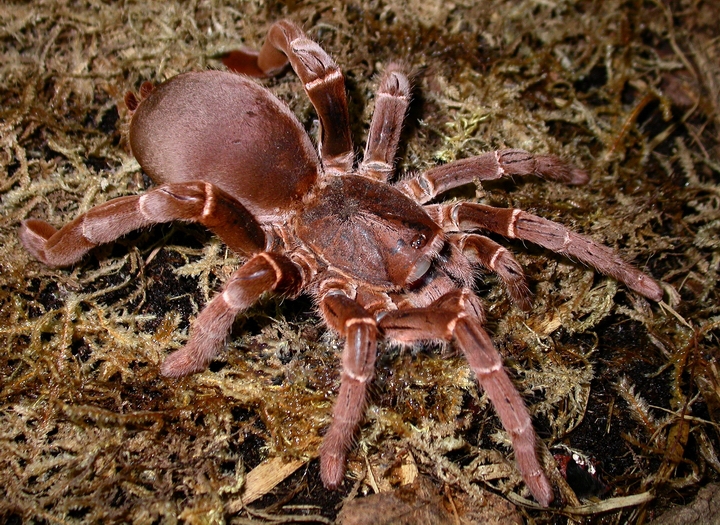 King Baboon SpiderPelinobius muticus
-
 Orange Baboon TarantulaPterinochilus murinus
Compare
Questions and answers
What is the scientific name of the Antilles Pinktoe Tarantula?
The scientific name of the Antilles Pinktoe Tarantula is Caribena versicolor. Written with its author, the full name is Caribena versicolor (Walckenaer, 1837).
Which family does the Antilles Pinktoe Tarantula belong to?
Caribena versicolor belongs to the family Theraphosidae, in the order Araneae and the class Arachnida.
Where is the Antilles Pinktoe Tarantula found?
Checklists and occurrence records place Caribena versicolor in 3 countries: Martinique, Brazil and Colombia.
What other names does the Antilles Pinktoe Tarantula have?
Caribena versicolor is also known in English as Martinique Pinktoe Tarantula.
Sources
Passages the profile rests on
- Spiderlings have bright blue coloration and a black tree trunk pattern on their abdomens. Source passage: “Spiderlings of C. versicolor are bright blue with a black tree trunk pattern on the abdomen.” — English Wikipedia
- As individuals mature, their carapaces become green, their abdomens become red, and their legs become green with pink tarsi and purple hairs. Source passage: “As they grow, they gradually lose their blue coloration; the carapace turns green, the abdomen red, and the legs turn green with pink tarsi and a covering of purple hairs.” — English Wikipedia
- Males are usually slightly more brightly colored than females. Source passage: “Males usually are slightly more brightly colored than females.” — English Wikipedia
- The species was first described by Charles Athanase Walckenaer in 1837 under the name Mygale versicolor. Source passage: “Mygale versicolor was first described by Charles Athanase Walckenaer in 1837.” — English Wikipedia
- The species was transferred to the genus Caribena in 2017. Source passage: “It was transferred to the genus Avicularia by Eugène Simon in 1892 and to the new genus Caribena in 2017.” — English Wikipedia
- The species is classified in the genus Caribena. Source passage: “Location in Taxonomic Tree. Genus. Caribena. Species. Caribena ...” — fws.gov
Data
- Catalogue of Life, 2026-10-16 XR cc by
- Global Biodiversity Information Facility CC BY 4.0
- Wikidata CC0
- GeoNames CC BY 4.0
- Wikimedia Commons per image; credit shown with each image
- Within the Catalogue of Life, this name comes from The World Spider Catalog cc by
References
- Walckenaer, C. A. (1837). Histoire naturelle des insectes. Aptères. Tome premier. Roret, Paris, 682 pp., pl. 1-15. doi: <a href="https://doi.org/10.5962/bhl.title.61095" target="_blank">10.5962/bhl.title.61095 Link where the name was published
This species in other databases
Page built on 29 November 2026. See how the catalog is made and all sources and licences.
Cite this page
ScientificNames.org. (2026). Caribena versicolor (Antilles Pinktoe Tarantula). Retrieved November 29, 2026, from https://scientificnames.org/species/caribena-versicolor
“Caribena versicolor (Antilles Pinktoe Tarantula).” ScientificNames.org, 2026, scientificnames.org/species/caribena-versicolor. Accessed 29 Nov. 2026.
ScientificNames.org. “Caribena versicolor (Antilles Pinktoe Tarantula).” Accessed November 29, 2026. https://scientificnames.org/species/caribena-versicolor.
@misc{scientificnames_caribena_versicolor_antilles_pinktoe_tarantula,
  author = {{ScientificNames.org}},
  title = {Caribena versicolor (Antilles Pinktoe Tarantula)},
  year = {2026},
  url = {https://scientificnames.org/species/caribena-versicolor},
  note = {Accessed 2026-11-29}
}