Species · Insects
Catoptria fulgidella
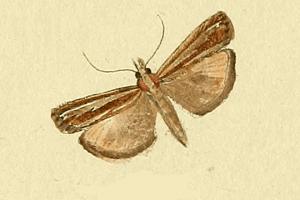
Catoptria fulgidella has no English name on record in the checklists used here. It is a species of insect in the family Crambidae (grass moth), order Lepidoptera.
- Scientific name
- Catoptria fulgidella Hübner
- Genus
- Catoptria
- Family
- Crambidae (Grass Moth)
- Order
- Lepidoptera
- Class
- Insecta
- Recorded in
- 17 countries
- Name status
- accepted in the Catalogue of Life
Overview
Catoptria fulgidella Hübner is a moth belonging to the family Crambidae. It occurs in most of Europe, excluding Ireland, Great Britain, Ukraine, Slovenia, Croatia and Bulgaria. Its wingspan ranges from 22 to 29 mm.
Written 28 November 2026 from the sources listed below. Each statement was checked against the passage it cites; statements that could not be supported were removed.
Appearance
The species is a moth in the family Crambidae. Its wingspan ranges from 22 to 29 mm.[1][2]
Diet
The larvae feed on plants in the genus Carex, including Carex arenaria.[3]
The larvae also feed on plants in the genus Gnaphalium, including Gnaphalium dicicum.[4]
The larvae possibly feed on plants in the genus Festuca.[5]
Behaviour
Adults have been recorded between June and August.[6]
Classification of Catoptria fulgidella
| Kingdom | Animalia |
|---|---|
| Phylum | Arthropoda |
| Subphylum | Hexapoda |
| Class | Insecta (Insect) |
| Order | Lepidoptera |
| Superfamily | Pyraloidea |
| Family | Crambidae (Grass Moth) |
| Subfamily | Crambinae |
| Genus | Catoptria |
| Species | Catoptria fulgidella Hübner |
Where Catoptria fulgidella is found
Checklists and occurrence records place Catoptria fulgidella in 17 countries. GBIF holds 1,527 georeferenced records of it.
Countries
- Denmark 163
- Estonia 33
- Finland 522
- France 18
- Germany 62
- Hungary 5
- Italy 3
- Latvia 3
- Lithuania 4
- Norway 93
- Poland 135
- Portugal 14
- Russia 9
- Spain 27
- Sweden 125
- The Netherlands 293
- Ukraine 18
Regions and cities with the most records
- Gelderland, The Netherlands 105
- Alkmaar, The Netherlands 92
- Bergen, The Netherlands 92
- Ede, The Netherlands 92
- Schagen, The Netherlands 92
- Veenendaal, The Netherlands 89
- Barneveld, The Netherlands 79
- Julianadorp, The Netherlands 73
- Den Helder, The Netherlands 71
- Skåne, Sweden 63
- Putten, The Netherlands 62
- Apeldoorn, The Netherlands 59
- Heerhugowaard, The Netherlands 49
- Capital Region, Denmark 42
- South Denmark, Denmark 37
- Saxony, Germany 34
- Kalmar, Sweden 32
- Venray, The Netherlands 32
- Goch, Germany 27
- Kevelaer, Germany 27
- Geldern, Germany 26
- Limburg, The Netherlands 26
- Zealand, Denmark 26
- Kristianstad, Sweden 23
- Rogaland, Norway 23
- Time, Norway 22
- Sandnes, Norway 20
- Luboń, Poland 17
- Poznań, Poland 17
- Sola, Norway 17
- Swarzędz, Poland 17
- Gotland, Sweden 16
- Raseborg, Finland 16
- Provence-Alpes-Côte d'Azur, France 15
- Bautzen, Germany 13
- Hoyerswerda, Germany 13
A number beside a place is its count of GBIF occurrence records. A place without a number comes from a checklist alone. Records show where a species has been observed or collected, which can include escapes and vagrants.
Common names
Names in 8 other languages
- Dutch
- Getande vlakjesmot
- Finnish
- hopeajuovakoisa
- French
- Crambus brillant
- Norwegian Bokmål
- sanddynenebbmott
- Polish
- Wachlarzyk białokresek, Wachlarzyk szarotnik
- Russian
- Травянка блистающая
- Slovak
- trávovec ligotavý
- Swedish
- vitstrimmigt sandgräsmott
Synonyms
2 other scientific names have been used for this species and are now treated as synonyms of Catoptria fulgidella.
- Crambus fulgidellus (Hübner, 1813)
- Tinea fulgidella Hübner, 1813
Related species
-
 Chequered Grass-veneerCatoptria falsella
-
 Pearl Grass-veneerCatoptria pinella
-
 Scotch Grass-veneerCatoptria permutatellus
-
 Catoptria conchella
-
 Catoptria corsicellus
-
 Northern Grass-veneerCatoptria furcatellus
-
 Yellow Grass-veneerCatoptria lythargyrella
-
 Catoptria myella
Compare
Questions and answers
What is the wingspan of Catoptria fulgidella?
Its wingspan ranges from 22 to 29 mm.[2]
When are adults recorded?
Adults have been recorded between June and August.[6]
What plants do the larvae feed on?
The larvae feed on Carex and Gnaphalium plants, including Carex arenaria and Gnaphalium dicicum. They possibly also feed on plants in the genus Festuca.[3][4][5]
Who described the species and when?
Jacob Hübner described the species in 1813.[7]
Sources
Passages the profile rests on
- The species is a moth belonging to the family Crambidae. Source passage: “Catoptria fulgidella is a species of moth in the family Crambidae” — English Wikipedia
- The wingspan ranges from 22 to 29 mm. Source passage: “The wingspan is 22–29 mm.” — English Wikipedia
- The larvae feed on plants in the genus Carex, including Carex arenaria. Source passage: “The larvae feed on Carex (including Carex arenaria)” — English Wikipedia
- The larvae feed on plants in the genus Gnaphalium, including Gnaphalium dicicum. Source passage: “Gnaphalium (including Gnaphalium dicicum)” — English Wikipedia
- The larvae possibly feed on plants in the genus Festuca. Source passage: “and possibly Antennaria and Festuca species.” — English Wikipedia
- Adults have been recorded between June and August. Source passage: “Adults have been recorded from June to August.” — English Wikipedia
- The species was described by Jacob Hübner in 1813. Source passage: “described by Jacob Hübner in 1813.” — English Wikipedia
Data
- Catalogue of Life, 2026-10-16 XR cc by
- Global Biodiversity Information Facility CC BY 4.0
- Wikidata CC0
- GeoNames CC BY 4.0
- Wikimedia Commons per image; credit shown with each image
- Within the Catalogue of Life, this name comes from Global Lepidoptera Index cc by
This species in other databases
Page built on 28 November 2026. See how the catalog is made and all sources and licences.
Cite this page
ScientificNames.org. (2026). Catoptria fulgidella. Retrieved November 28, 2026, from https://scientificnames.org/species/catoptria-fulgidella
“Catoptria fulgidella.” ScientificNames.org, 2026, scientificnames.org/species/catoptria-fulgidella. Accessed 28 Nov. 2026.
ScientificNames.org. “Catoptria fulgidella.” Accessed November 28, 2026. https://scientificnames.org/species/catoptria-fulgidella.
@misc{scientificnames_catoptria_fulgidella,
  author = {{ScientificNames.org}},
  title = {Catoptria fulgidella},
  year = {2026},
  url = {https://scientificnames.org/species/catoptria-fulgidella},
  note = {Accessed 2026-11-28}
}