Species · Amphibians
Buckley's Glassfrog Centrolene buckleyi
The scientific name of the Buckley's Glassfrog is Centrolene buckleyi. It is a species of amphibian in the family Centrolenidae (glass frog), order Anura. The name dates from 1882.
- Scientific name
- Centrolene buckleyi (Boulenger, 1882)
- Common name
- Buckley's Glassfrog
- Genus
- Centrolene
- Family
- Centrolenidae (Glass Frog)
- Order
- Anura
- Class
- Amphibia
- Red List category
- CR Critically Endangered
- Recorded in
- 4 countries
- Name status
- accepted in the Catalogue of Life

Overview
Centrolene buckleyi occurs in Colombia, Ecuador, and Peru, inhabiting subtropical or tropical moist montane forests, high-altitude shrubland, and high-altitude grassland.
Written 27 November 2026 from the sources listed below. Each statement was checked against the passage it cites; statements that could not be supported were removed.
Habitat
Buckley's Glassfrog inhabits subtropical or tropical moist montane forests, subtropical or tropical high-altitude shrubland, and subtropical or tropical high-altitude grassland.[1][2][3]
Appearance
Adult males possess a large humeral spine. The anterior portion of the ventral surface is opaque, while the posterior portion is translucent.[4][5][6]
Adult females measure between 29.3 and 34.4 mm in length.[7]
Conservation
Buckley's Glassfrog is becoming rare because of habitat loss. It is listed on the IUCN Red List of Threatened Species and was most recently assessed for the Red List in 2021.[8][9][10]
Classification of the Buckley's Glassfrog
| Kingdom | Animalia |
|---|---|
| Phylum | Chordata |
| Subphylum | Vertebrata |
| Infraphylum | Gnathostomata |
| Parvphylum | Osteichthyes |
| Megaclass | Tetrapoda |
| Class | Amphibia (Amphibians) |
| Order | Anura (Frogs) |
| Family | Centrolenidae (Glass Frog) |
| Subfamily | Centroleninae |
| Genus | Centrolene (Giant Glassfrogs) |
| Species | Centrolene buckleyi (Boulenger, 1882) |
Where the Buckley's Glassfrog is found
Checklists and occurrence records place Centrolene buckleyi in 4 countries. GBIF holds 555 georeferenced records of it.
Countries
Regions and cities with the most records
- Antioquia, Colombia 76
- Cundinamarca, Colombia 38
- Cotopaxi, Ecuador 37
- Pichincha, Ecuador 35
- Carchi, Ecuador 34
- Napo, Ecuador 33
- Machachi, Ecuador 29
- Bosconia, Colombia 27
- Cajicá, Colombia 27
- Tocancipá, Colombia 27
- Zipaquirá, Colombia 27
- Sucumbíos, Ecuador 26
- Tulcán, Ecuador 20
- Ipiales, Colombia 19
- Imbabura, Ecuador 16
- Valle del Cauca Department, Colombia 16
- Atuntaqui, Ecuador 13
- Bello, Colombia 13
- Copacabana, Colombia 13
- Otavalo, Ecuador 13
- Bolívar, Ecuador 12
- Loja, Ecuador 12
- Santa Fe de Antioquia, Colombia 12
- Sonsón, Colombia 12
- Medellín, Colombia 11
- Itagüí, Colombia 10
- Envigado, Colombia 9
- Guaranda, Ecuador 9
- Nariño, Colombia 9
- Boyacá, Colombia 8
- La Estrella, Colombia 8
- Sogamoso, Colombia 8
- Caldas Department, Colombia 6
- Ibarra, Ecuador 6
- Norte de Santander Department, Colombia 6
- Tolima Department, Colombia 6
A number beside a place is its count of GBIF occurrence records. A place without a number comes from a checklist alone. Records show where a species has been observed or collected, which can include escapes and vagrants.
Common names
English
- Buckley's Glassfrog
- Buckley's Giant Glass Frog
- Buckley’s Glassfrog
Names in 3 other languages
- Czech
- rosněnka Buckleyova
- Russian
- Горная стеклянная лягушка
- Spanish
- Rana de Cristal de Buckley, Rana de cristal altoandina de Buckley
Synonyms
6 other scientific names have been used for this species and are now treated as synonyms of Centrolene buckleyi.
- Centrolenella buckleyi (Boulenger, 1882)
- Centrolenella buckleyi buckleyi (Boulenger, 1882)
- Centrolenella johnelsi Cochran & Goin, 1970
- Cochranella buckleyi (Boulenger, 1882)
- Hyla purpurea Nieden, 1923
- Hylella buckleyi Boulenger, 1882
Related species
-
 Burrowes' Giant Glass FrogCentrolene ballux
-
 Centrolene robledoi
- Blue Giant Glass FrogCentrolene azulae
- Boyaca Giant Glass FrogCentrolene petrophilum
-
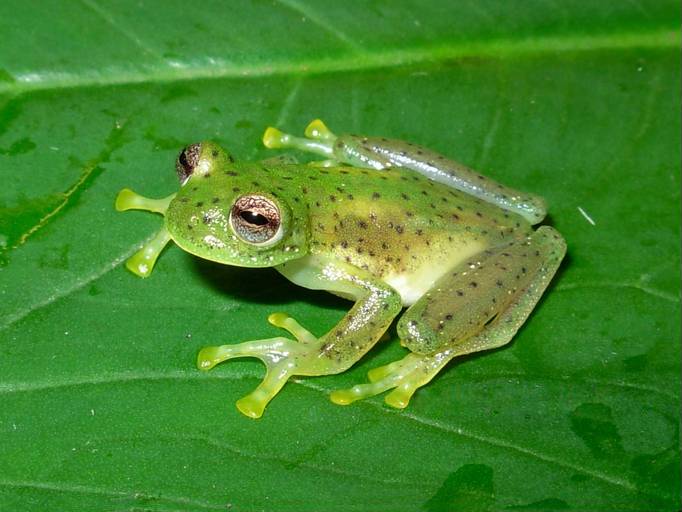 Glass FrogCentrolene quindianum
- Medem's GlassfrogCentrolene medemi
- Santander Giant Glass FrogCentrolene acanthidiocephalum
-
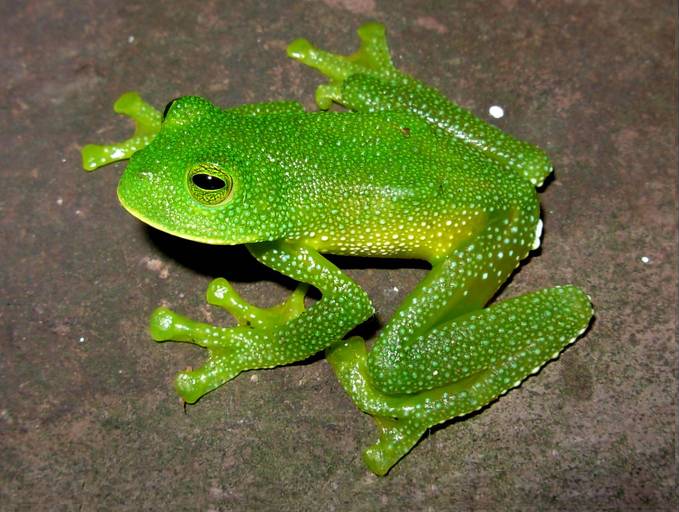 Colombian Giant Glass FrogCentrolene paezorum
Compare
Questions and answers
What is the scientific name of the Buckley's Glassfrog?
The scientific name of the Buckley's Glassfrog is Centrolene buckleyi. Written with its author, the full name is Centrolene buckleyi (Boulenger, 1882).
Which family does the Buckley's Glassfrog belong to?
Centrolene buckleyi belongs to the family Centrolenidae, in the order Anura and the class Amphibia.
Where is the Buckley's Glassfrog found?
Checklists and occurrence records place Centrolene buckleyi in 4 countries: Colombia, Ecuador, Peru and Venezuela.
What is the conservation status of the Buckley's Glassfrog?
The IUCN Red List category recorded for Centrolene buckleyi is Critically Endangered (CR).
What other names does the Buckley's Glassfrog have?
Centrolene buckleyi is also known in English as Buckley's Giant Glass Frog and Buckley’s Glassfrog.
Sources
Passages the profile rests on
- The species inhabits subtropical or tropical moist montane forests. Source passage: “subtropical or tropical moist montane forests” — English Wikipedia
- The species inhabits subtropical or tropical high-altitude shrubland. Source passage: “subtropical or tropical high-altitude shrubland” — English Wikipedia
- The species inhabits subtropical or tropical high-altitude grassland. Source passage: “subtropical or tropical high-altitude grassland” — English Wikipedia
- Adult males possess a large humeral spine. Source passage: “adult males have a large humeral spine” — English Wikipedia
- The anterior portion of the ventral surface is opaque. Source passage: “the anterior venter is opaque” — English Wikipedia
- The posterior portion of the ventral surface is translucent. Source passage: “the posterior portion is translucent.” — English Wikipedia
- Adult females measure between 29.3 and 34.4 mm in length. Source passage: “females 29.3–34.4 mm” — English Wikipedia
- The species is becoming rare because of habitat loss. Source passage: “It is becoming rare due to habitat loss.” — English Wikipedia
- The species was most recently assessed for the IUCN Red List in 2021. Source passage: “has most recently been assessed for The IUCN Red List of Threatened Species in 2021.” — iucnredlist.org
- The species is listed on the IUCN Red List of Threatened Species. Source passage: “Centrolene buckleyi is listed” — iucnredlist.org
Data
- Catalogue of Life, 2026-10-16 XR cc by
- Global Biodiversity Information Facility CC BY 4.0
- Wikidata CC0
- GeoNames CC BY 4.0
- Wikimedia Commons per image; credit shown with each image
- Within the Catalogue of Life, this name comes from The Integrated Taxonomic Information System cc0
This species in other databases
Page built on 27 November 2026. See how the catalog is made and all sources and licences.
Cite this page
ScientificNames.org. (2026). Centrolene buckleyi (Buckley's Glassfrog). Retrieved November 27, 2026, from https://scientificnames.org/species/centrolene-buckleyi
“Centrolene buckleyi (Buckley's Glassfrog).” ScientificNames.org, 2026, scientificnames.org/species/centrolene-buckleyi. Accessed 27 Nov. 2026.
ScientificNames.org. “Centrolene buckleyi (Buckley's Glassfrog).” Accessed November 27, 2026. https://scientificnames.org/species/centrolene-buckleyi.
@misc{scientificnames_centrolene_buckleyi_buckleys_glassfrog,
  author = {{ScientificNames.org}},
  title = {Centrolene buckleyi (Buckley's Glassfrog)},
  year = {2026},
  url = {https://scientificnames.org/species/centrolene-buckleyi},
  note = {Accessed 2026-11-27}
}