Species · Flowering plants
Prickly Hornwort Ceratophyllum echinatum
The scientific name of the Prickly Hornwort is Ceratophyllum echinatum. It is a species of flowering plant in the family Ceratophyllaceae (hornwort family), order Ceratophyllales.
- Scientific name
- Ceratophyllum echinatum A.Gray
- Common name
- Prickly Hornwort
- Genus
- Ceratophyllum
- Family
- Ceratophyllaceae (Hornwort Family)
- Order
- Ceratophyllales
- Class
- Magnoliopsida
- Recorded in
- 5 countries
- Name status
- accepted in the Catalogue of Life
Overview
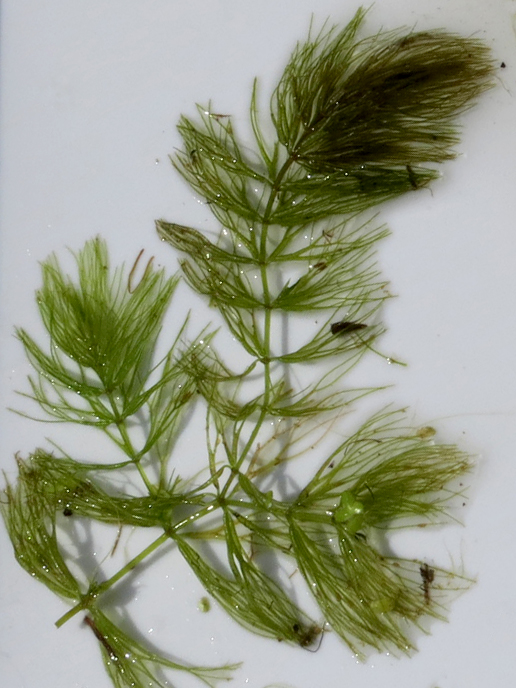
Ceratophyllum echinatum occurs in ponds and lakes and is found principally in eastern North America. It is distinguished by submerged leaves usually arranged in whorls of 5 to 12 and seeds with numerous spines.
Written 26 November 2026 from the sources listed below. Each statement was checked against the passage it cites; statements that could not be supported were removed.
Appearance
Prickly hornwort is an aquatic perennial plant with freely branching stems that can reach 4 metres (13 feet) in length. Its submerged leaves usually grow in whorls of 5 to 12, and their segment margins lack teeth.[1][2][3][4][5]
Its flowers are tiny, lack petals, and can be either male or female. They have between 3 and 15 sepals and contain approximately 12 to 16 stamens.[6][7][8]
Its fruits contain dry seeds with a rough surface and numerous spines. The species is named for the numerous spines on its seeds, which differ from the three-spined seeds described for C. demersum.[9][10][11]
Habitat
Prickly hornwort occurs in ponds and lakes. In Missouri, it occurs in spring branches, ponds, and sinkhole ponds.[12][13]
Reproduction and life cycle
Prickly hornwort flowers from February through July.[14]
Conservation
Prickly hornwort is listed as a special-concern species in Maine and Tennessee and as endangered in Maryland and New Jersey.[15][16]
In Missouri, the species is uncommon and widely scattered. Missouri classifies it as a conservation concern and ranks it as critically imperiled.[17][18]
Similar species
Prickly hornwort has numerous spines on its seeds, unlike the three-spined seeds described for C. demersum.[11]
Classification of the Prickly Hornwort
| Kingdom | Plantae |
|---|---|
| Subkingdom | Pteridobiotina |
| Phylum | Tracheophyta |
| Class | Magnoliopsida |
| Order | Ceratophyllales |
| Family | Ceratophyllaceae (Hornwort Family) |
| Genus | Ceratophyllum (Hornwort) |
| Species | Ceratophyllum echinatum A.Gray |
Where the Prickly Hornwort is found
Checklists and occurrence records place Ceratophyllum echinatum in 5 countries across North America and South America. GBIF holds 1,516 georeferenced records of it.
Countries
Regions and cities with the most records
- Pennsylvania, United States 114
- Wisconsin, United States 86
- Connecticut, United States 82
- Minnesota, United States 75
- Ontario, Canada 70
- British Columbia, Canada 61
- Quebec, Canada 35
- Massachusetts, United States 32
- Michigan, United States 30
- Washington, United States 28
- Florida, United States 21
- New York, United States 21
- New Brunswick, Canada 20
- Ohio, United States 20
- Harewood, Canada 19
- Nanaimo, Canada 19
- Storrs, United States 18
- New Hampshire, United States 16
- Maryland, United States 15
- Plainfield, United States 15
- Maine, United States 14
- Mansfield City, United States 14
- Vermont, United States 14
- Louisiana, United States 13
- Manchester, United States 12
- Arkansas, United States 11
- Auburn, United States 11
- Covington, United States 11
- East Hill-Meridian, United States 11
- Fairwood, United States 11
- North Carolina, United States 11
- Norwich, United States 11
- Southbridge, United States 11
- Willimantic, United States 11
- Windham, United States 11
- Windsor, United States 11
1 more country has a few records outside this range
These countries hold a few records of Ceratophyllum echinatum but lie outside the range the checklists give for it. Such records are often zoo or garden specimens, museum material or vagrants, so the species is not counted as occurring there.
Range as the checklists state it
Canada (British Columbia, Manitoba, New Brunswick, Nova Scotia, Ontario, Québec); USA (Alabama, Arkansas, Connecticut, Delaware, Florida, Georgia, Illinois, Indiana, Kansas, Kentucky, Louisiana, Massachusetts, Maryland, Maine, Michigan, Minnesota, Missouri, Mississippi, North Carolina, New Hampshire, New Jersey, New York, Ohio, Oklahoma, Oregon, Pennsylvania, Rhode Island, South Carolina, Tennessee, Texas, Virginia, Vermont, Washington State, Wisconsin, West Virginia); Mexico (Campeche, Tabasco); Trinidad; Peru; N-Brazil (Amazonas); WC-Brazil (Mato Grosso do Sul)
A number beside a place is its count of GBIF occurrence records. A place without a number comes from a checklist alone. Records show where a species has been observed or collected, which can include escapes and vagrants.
Common names
English
- Prickly Hornwort
- Prickly Coontail
- Spiny Coontail
- Spiny Hornwort
- Spring Hornwort
Names in 1 other language
- French
- cornifle échinée
Synonyms
3 other scientific names have been used for this species and are now treated as synonyms of Ceratophyllum echinatum.
- Ceratophyllum demersum var. echinatum (A.Gray) A.Gray
- Ceratophyllum submersum var. echinatum (A.Gray) Wilmot-Dear
- Fassettia echinata (A.Gray) Mavrodiev
Related species
-
 CoontailCeratophyllum demersum
-
 Soft HornwortCeratophyllum submersum
- Prickly HornwortCeratophyllum muricatum
- Ceratophyllum australe
- Ceratophyllum platyacanthum
Compare
Questions and answers
What is the scientific name of the Prickly Hornwort?
The scientific name of the Prickly Hornwort is Ceratophyllum echinatum. Written with its author, the full name is Ceratophyllum echinatum A.Gray.
Which family does the Prickly Hornwort belong to?
Ceratophyllum echinatum belongs to the family Ceratophyllaceae, in the order Ceratophyllales and the class Magnoliopsida.
Where is the Prickly Hornwort found?
Checklists and occurrence records place Ceratophyllum echinatum in 5 countries: United States, Canada, Brazil, Mexico and Peru.
What other names does the Prickly Hornwort have?
Ceratophyllum echinatum is also known in English as Prickly Coontail, Spiny Coontail, Spiny Hornwort and Spring Hornwort.
How long will hornwort grow?
Prickly hornwort stems can reach 4 metres (13 feet) in length.[2]
Sources
Passages the profile rests on
- The species is an aquatic herb with freely branching stems. Source passage: “Ceratophyllum echinatum is an aquatic herb. It does not typically have any roots with stems that are freely branching” — English Wikipedia
- Its stems can reach 4 metres (13 feet) in length. Source passage: “up to 4 m (13 ft) in length.” — English Wikipedia
- Its submerged leaves usually grow in whorls of 5 to 12. Source passage: “The leaves are submerged and they are usually in whorls of 5 to 12.” — English Wikipedia
- The leaf-segment margins of prickly hornwort lack teeth. Source passage: “In prickly hornwort, the edges of the leaf segments lack teeth” — mdc.mo.gov
- The species is an aquatic perennial plant. Source passage: “is an aquatic perennial plant of the genus Ceratophyllum.” — inaturalist.org
- Its flowers lack petals and have between 3 and 15 sepals. Source passage: “Its flowers do not have any petals but have sepals (3 to 15)” — English Wikipedia
- Its flowers are tiny and can be either male or female. Source passage: “The flower is tiny, may be male or female” — English Wikipedia
- Its flowers contain approximately 12 to 16 stamens. Source passage: “contains about 12 to 16 stamens.” — English Wikipedia
- Its fruits contain dry seeds with a rough surface and spines. Source passage: “The fruits have dry seeds with spines and a rough surface.” — English Wikipedia
- The species is named for the numerous spines on its seeds. Source passage: “It is named for its seeds, which have numerous spines” — mdc.mo.gov
- Prickly hornwort seeds have numerous spines, unlike the three-spined seeds described for C. demersum. Source passage: “which have numerous spines (while C. demersum's seeds have only 3 spines: 2 at the base and 1 at the tip).” — mdc.mo.gov
- The species occurs in ponds and lakes. Source passage: “Spiny coontail can be found in ponds and lakes” — English Wikipedia
- In Missouri, the species occurs in spring branches, ponds, and sinkhole ponds. Source passage: “occurring in spring branches, ponds, and sinkhole ponds.” — mdc.mo.gov
- The species flowers from February through July. Source passage: “It blooms from February to July.” — English Wikipedia
- The species is listed as a special-concern species in Maine and Tennessee. Source passage: “Several states list this species as special concern (Maine, Tennessee)” — English Wikipedia
- The species is listed as endangered in Maryland and New Jersey. Source passage: “endangered (Maryland, New Jersey).” — English Wikipedia
- The species occurs in Missouri, where it is uncommon and widely scattered. Source passage: “Prickly hornwort, or spiny hornwort (C. echinatum), is uncommon and widely scattered in Missouri” — mdc.mo.gov
- Missouri classifies the species as a conservation concern and ranks it as critically imperiled. Source passage: “It is a Missouri species of conservation concern, ranked as critically imperiled.” — mdc.mo.gov
Data
- Catalogue of Life, 2026-10-16 XR cc by
- Global Biodiversity Information Facility CC BY 4.0
- Wikidata CC0
- GeoNames CC BY 4.0
- Wikimedia Commons per image; credit shown with each image
- Within the Catalogue of Life, this name comes from Synonymic Checklists of the Vascular Plants of the World cc by
References
- Gray, A. Manual [A.Gray] 401 (1848). where the name was published
This species in other databases
Page built on 28 November 2026. See how the catalog is made and all sources and licences.
Cite this page
ScientificNames.org. (2026). Ceratophyllum echinatum (Prickly Hornwort). Retrieved November 28, 2026, from https://scientificnames.org/species/ceratophyllum-echinatum
“Ceratophyllum echinatum (Prickly Hornwort).” ScientificNames.org, 2026, scientificnames.org/species/ceratophyllum-echinatum. Accessed 28 Nov. 2026.
ScientificNames.org. “Ceratophyllum echinatum (Prickly Hornwort).” Accessed November 28, 2026. https://scientificnames.org/species/ceratophyllum-echinatum.
@misc{scientificnames_ceratophyllum_echinatum_prickly_hornwort,
  author = {{ScientificNames.org}},
  title = {Ceratophyllum echinatum (Prickly Hornwort)},
  year = {2026},
  url = {https://scientificnames.org/species/ceratophyllum-echinatum},
  note = {Accessed 2026-11-28}
}