Species · Mammals · Extinct
Northern Pig-footed Bandicoot Chaeropus yirratji
The scientific name of the Northern Pig-footed Bandicoot is Chaeropus yirratji. It is an extinct species of mammal in the family Chaeropodidae (pig-footed bandicoots), order Peramelemorphia. The name dates from 2019.
- Scientific name
- Chaeropus yirratji Travouillon et al., 2019
- Common name
- Northern Pig-footed Bandicoot
- Genus
- Chaeropus
- Family
- Chaeropodidae (Pig-footed Bandicoots)
- Order
- Peramelemorphia
- Class
- Mammalia
- Red List category
- EX Extinct
- Recorded in
- 1 country
- Name status
- accepted in the Catalogue of Life

Overview
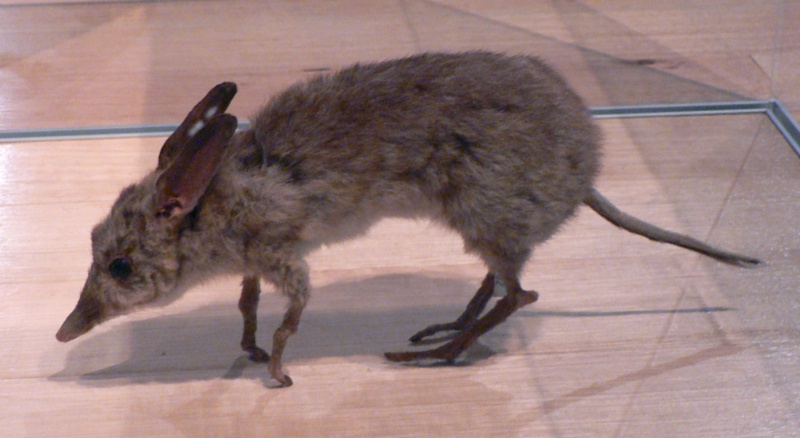
The Northern Pig-footed Bandicoot was a small marsupial. It occurred in central and western Australia, where it was restricted to grassland habitats in the deserts. It differed from the southern pig-footed bandicoot in tail and hind foot length, dentition, palate structure and coat coloration.
Written 26 November 2026 from the sources listed below. Each statement was checked against the passage it cites; statements that could not be supported were removed.
Similar species
The Northern Pig-footed Bandicoot was closely similar in appearance to the southern pig-footed bandicoot.[1]
Appearance
The species had at least two coat colour morphs, a light morph and a dark morph.[2]
It had a longer tail and longer hind feet than the southern pig-footed bandicoot. Its dentition and coat coloration also differed, and it had fewer holes in its palate.[3][4][5][6]
Habitat
The Northern Pig-footed Bandicoot was restricted to grassland habitats in the deserts of central and western Australia.[7]
Diet
The Northern Pig-footed Bandicoot was herbivorous.[8]
Conservation
The Northern Pig-footed Bandicoot is extinct and has been considered extinct since the middle of the twentieth century.[9][10]
The introduction of invasive red foxes and feral cats, together with habitat degradation for livestock, were proposed as likely causes of its extinction.[11]
Classification of the Northern Pig-footed Bandicoot
| Kingdom | Animalia |
|---|---|
| Phylum | Chordata |
| Subphylum | Vertebrata |
| Infraphylum | Gnathostomata |
| Parvphylum | Osteichthyes |
| Megaclass | Tetrapoda |
| Class | Mammalia (Mammal) |
| Subclass | Theria |
| Infraclass | Metatheria |
| Order | Peramelemorphia |
| Family | Chaeropodidae (Pig-footed Bandicoots) |
| Genus | Chaeropus |
| Species | Chaeropus yirratji Travouillon et al., 2019 |
Origin of the name. Etymology. Yirratji, Warlpiri (Aboriginal dialect of the Alice Springs area) word for the local Pig-footed Bandicoot.
Where the Northern Pig-footed Bandicoot is found
Checklists and occurrence records place Chaeropus yirratji in 1 country across Oceania. GBIF holds 44 georeferenced records of it.
Countries
Range as the checklists state it
Australia
A number beside a place is its count of GBIF occurrence records. A place without a number comes from a checklist alone. Records show where a species has been observed or collected, which can include escapes and vagrants.
Common names
English
- Northern Pig-footed Bandicoot
Related species
Compare
Questions and answers
What is the scientific name of the Northern Pig-footed Bandicoot?
The scientific name of the Northern Pig-footed Bandicoot is Chaeropus yirratji. Written with its author, the full name is Chaeropus yirratji Travouillon et al., 2019.
Which family does the Northern Pig-footed Bandicoot belong to?
Chaeropus yirratji belongs to the family Chaeropodidae, in the order Peramelemorphia and the class Mammalia.
Where is the Northern Pig-footed Bandicoot found?
Checklists and occurrence records place Chaeropus yirratji in 1 country: Australia.
What is the conservation status of the Northern Pig-footed Bandicoot?
The IUCN Red List category recorded for Chaeropus yirratji is Extinct (EX).
When did the pig-footed bandicoot go extinct?
The Northern Pig-footed Bandicoot has been considered extinct since the middle of the twentieth century. Its last confirmed specimen was collected near Alice Springs in 1901. Reports from local Aboriginal people suggest that it may have survived in the Gibson and Great Sandy Deserts until the 1950s.[12][13][10]
What is the diet of a bandicoot?
The Northern Pig-footed Bandicoot was herbivorous.[8]
What habitat do bandicoots live in?
The Northern Pig-footed Bandicoot was restricted to grassland habitats in the deserts of central and western Australia.[7]
Sources
Passages the profile rests on
- The species was closely similar in appearance to the southern pig-footed bandicoot. Source passage: “It very closely resembled and was formerly considered conspecific with the related southern pig-footed bandicoot” — English Wikipedia
- The species had at least two coat colour morphs, a light morph and a dark morph. Source passage: “It had at least two different color morphs; a light morph and a dark morph.” — English Wikipedia
- The species had a longer tail and longer hind feet than the southern pig-footed bandicoot. Source passage: “It also had a longer tail and hind feet” — English Wikipedia
- The species had dentition that differed from that of the southern pig-footed bandicoot. Source passage: “a different dentition” — English Wikipedia
- The species had fewer holes in its palate than the southern pig-footed bandicoot. Source passage: “fewer holes on its palate” — English Wikipedia
- The species had a coat coloration distinct from that of the southern pig-footed bandicoot. Source passage: “a distinct coat coloration” — English Wikipedia
- The species was restricted to grassland habitats in the deserts of central and western Australia. Source passage: “C. yirratji was restricted to grassland habitats in the deserts of central and western Australia.” — English Wikipedia
- The northern pig-footed bandicoot was herbivorous. Source passage: “small species of extinct herbivorous Australian marsupial” — English Wikipedia
- The species is extinct. Source passage: “was a small species of extinct herbivorous Australian marsupial” — English Wikipedia
- The species has been considered extinct since the middle of the twentieth century. Source passage: “It has been believed to be extinct since the mid-20th century” — English Wikipedia
- The introduction of invasive red foxes and feral cats, together with habitat degradation for livestock, were proposed as likely causes of the species' extinction. Source passage: “This species likely went extinct due to the introduction of invasive red foxes and feral cats, as well as habitat degradation for livestock.” — English Wikipedia
- The last confirmed specimen of the species was collected near Alice Springs in 1901. Source passage: “the last confirmed observation was a specimen collected near Alice Springs in 1901” — English Wikipedia
- Reports from local Aboriginal people suggest that the species may have survived in the Gibson and Great Sandy Deserts until the 1950s. Source passage: “reports from local Aborigines indicate that it may have survived in the Gibson and Great Sandy Deserts as late as the 1950s.” — English Wikipedia
Data
- Catalogue of Life, 2026-10-16 XR cc by
- Global Biodiversity Information Facility CC BY 4.0
- Wikidata CC0
- GeoNames CC BY 4.0
- Wikimedia Commons per image; credit shown with each image
- Within the Catalogue of Life, this name comes from The Integrated Taxonomic Information System cc0
References
- Travouillon, K. J., Bruno F. Simoes, Roberto Porterla Miguez, Selina Brace, Philippa Brewer, David Stemmer, Gilbert J. Price, Jonathan Cramb & Julien Louys. 2019. Hidden in plain sight: reassessment of the pig-footed bandicoot, Chaeropus ecaudatus (Peramelemorphia, Chaeropodidae), with a description of a new species from central australia, and use of the fossil record to trace its past distribution. Zootaxa 4566(1): 1–69. Link where the name was published
- Burgin, Connor J., Don E. Wilson, Russell A. Mittermeier, Anthony B. Rylands, et al. (2020). Illustrated Checklist of the Mammals of the World. Vol. 1. Monotremata to Rodentia.
This species in other databases
Page built on 29 November 2026. See how the catalog is made and all sources and licences.
Cite this page
ScientificNames.org. (2026). Chaeropus yirratji (Northern Pig-footed Bandicoot). Retrieved November 29, 2026, from https://scientificnames.org/species/chaeropus-yirratji
“Chaeropus yirratji (Northern Pig-footed Bandicoot).” ScientificNames.org, 2026, scientificnames.org/species/chaeropus-yirratji. Accessed 29 Nov. 2026.
ScientificNames.org. “Chaeropus yirratji (Northern Pig-footed Bandicoot).” Accessed November 29, 2026. https://scientificnames.org/species/chaeropus-yirratji.
@misc{scientificnames_chaeropus_yirratji_northern_pig_footed_bandicoot,
  author = {{ScientificNames.org}},
  title = {Chaeropus yirratji (Northern Pig-footed Bandicoot)},
  year = {2026},
  url = {https://scientificnames.org/species/chaeropus-yirratji},
  note = {Accessed 2026-11-29}
}