Species · Other invertebrates
Pigbutt Worm Chaetopterus pugaporcinus
The scientific name of the Pigbutt Worm is Chaetopterus pugaporcinus. It is a species of animal in the family Chaetopteridae (chaetopterid worms). The name dates from 2007.
- Scientific name
- Chaetopterus pugaporcinus Osborn, Rouse, Goffredi & Robison, 2007
- Common name
- Pigbutt Worm
- Genus
- Chaetopterus
- Family
- Chaetopteridae (Chaetopterid Worms)
- Class
- Polychaeta
- Environment
- marine
- Recorded in
- 2 countries
- Name status
- accepted in the Catalogue of Life
Overview
The pigbutt worm has been observed living just below the oxygen minimum zone at depths of 875 to 1,200 meters. The pigbutt worm has a round body with highly inflated middle segments and is neutrally buoyant.
Written 26 November 2026 from the sources listed below. Each statement was checked against the passage it cites; statements that could not be supported were removed.
Appearance
The pigbutt worm has a round body resembling a disembodied pair of buttocks. Its segmented body has highly inflated middle segments that produce its rounded shape.[1][2]
Its body characteristics are unique among chaetopterids.[3]
The pigbutt worm measures approximately 10 to 20 millimeters in length.[4]
Habitat
The pigbutt worm has been observed living just below the oxygen minimum zone at depths of 875 to 1,200 meters. It has also been observed at depths where the ocean floor is significantly deeper.[5][6]
The oxygen minimum zone has been proposed as a habitat for the pigbutt worm because it contains abundant detritus and marine snow.[7]
Diet
The pigbutt worm feeds mainly on pelagic phytoplankton. Its diet also includes pelagic foraminiferans, silicoflagellates, dinoflagellates, and marine protists.[8][9]
Behaviour
The pigbutt worm is neutrally buoyant. It has been observed floating with its mouth parts pointing downward and its hind parts oriented toward the ocean surface.[10][11]
The pigbutt worm has shown no ability to swim or otherwise propel itself through the water.[12]
The pigbutt worm relies on filter feeding to obtain food. It produces clouds of mucus that capture food particles and marine snow, which it subsequently draws into its mouth and ingests.[13][14]
Pigbutt worms have been observed producing bioluminescence when physically stimulated in laboratory settings. The bright blue bioluminescence lasts between three and six seconds.[15][16]
The pigbutt worm releases very small bioluminescent green particles into its mucus cloud. These particles glow for one to two seconds before fading.[17][18]
Reproduction and life cycle
It is unknown whether the pigbutt worm specimens observed to date were adults or larvae. The observed specimens were five to ten times larger than any previously known chaetopterid larvae.[19][20]
Similar species
DNA comparisons indicate that the pigbutt worm is most closely related to other worms in the genus Chaetopterus.[21]
Classification of the Pigbutt Worm
| Kingdom | Animalia |
|---|---|
| Phylum | Annelida |
| Class | Polychaeta |
| Subclass | Sedentaria |
| Infraclass | Canalipalpata |
| Family | Chaetopteridae (Chaetopterid Worms) |
| Genus | Chaetopterus |
| Species | Chaetopterus pugaporcinus Osborn, Rouse, Goffredi & Robison, 2007 |
Where the Pigbutt Worm is found
Checklists and occurrence records place Chaetopterus pugaporcinus in 2 countries. GBIF holds 99 georeferenced records of it.
Countries
Regions and cities with the most records
A number beside a place is its count of GBIF occurrence records. A place without a number comes from a checklist alone. Records show where a species has been observed or collected, which can include escapes and vagrants.
Common names
English
- Pigbutt Worm
Related species
-
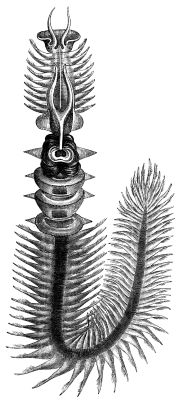 Parchment WormChaetopterus variopedatus
- Chaetopterus norvegicus
- Chaetopterus cautus
- Chaetopterus sarsii
- Chaetopterus aduncus
- Chaetopterus bruneli
- Chaetopterus macropus
- Chaetopterus antarcticus
Compare
Questions and answers
What is the scientific name of the Pigbutt Worm?
The scientific name of the Pigbutt Worm is Chaetopterus pugaporcinus. Written with its author, the full name is Chaetopterus pugaporcinus Osborn, Rouse, Goffredi & Robison, 2007.
Which family does the Pigbutt Worm belong to?
Chaetopterus pugaporcinus belongs to the family Chaetopteridae and the class Polychaeta.
Where is the Pigbutt Worm found?
Checklists and occurrence records place Chaetopterus pugaporcinus in 2 countries: Australia and United States.
What do pigbutt worms eat?
Pigbutt worms feed mainly on pelagic phytoplankton. They also eat pelagic foraminiferans, silicoflagellates, dinoflagellates, and marine protists.[8][9]
How big is a pigbutt worm?
A pigbutt worm measures approximately 10 to 20 millimeters in length.[4]
Sources
Passages the profile rests on
- The pigbutt worm has a round body resembling a disembodied pair of buttocks. Source passage: “The worm is round in shape, approximately 10 to 20 millimeters in length (roughly the size of a hazelnut), and bears a strong resemblance to a disembodied pair of buttocks.” — English Wikipedia
- The pigbutt worm has a segmented body with highly inflated middle segments that produce its rounded shape. Source passage: “The worm has a segmented body, but the middle segments are highly inflated, giving the animal a round shape.” — English Wikipedia
- The pigbutt worm's body characteristics are unique among chaetopterids. Source passage: “These morphological characteristics are unique among chaetopterids.” — English Wikipedia
- The pigbutt worm measures approximately 10 to 20 millimeters in length. Source passage: “approximately 10 to 20 millimeters in length” — English Wikipedia
- The pigbutt worm has been observed living just below the oxygen minimum zone at depths of 875 to 1,200 meters. Source passage: “The worm has been observed residing just below the oxygen minimum zone (OMZ) between 875 and 1,200 meters” — English Wikipedia
- The pigbutt worm has been observed at depths where the ocean floor is significantly deeper. Source passage: “even when the sea floor is significantly deeper.” — English Wikipedia
- The oxygen minimum zone has been proposed as a habitat for the pigbutt worm because it contains abundant detritus and marine snow. Source passage: “they reside in the oxygen minimum zone because of its cornucopia of detritus and marine snow” — English Wikipedia
- The pigbutt worm feeds mainly on pelagic phytoplankton. Source passage: “C. pugaporcinus has been found to feed mainly on pelagic phytoplankton” — English Wikipedia
- The pigbutt worm also feeds on pelagic foraminiferans, silicoflagellates, dinoflagellates, and marine protists. Source passage: “as well as pelagic foraminiferans, silicoflagellates, dinoflagellates, and marine protists.” — English Wikipedia
- The pigbutt worm is neutrally buoyant. Source passage: “The worms are neutrally buoyant” — English Wikipedia
- The pigbutt worm has been observed floating with its mouth parts pointing downward and its hind parts oriented toward the ocean surface. Source passage: “have been observed floating along with their mouth parts facing downward, and their hind parts towards the ocean surface.” — English Wikipedia
- The pigbutt worm has shown no ability to swim or otherwise propel itself through the water. Source passage: “these worms have shown no ability to swim or otherwise propel themselves through the water” — English Wikipedia
- The pigbutt worm relies on filter feeding to obtain food. Source passage: “they must rely on filter feeding to survive.” — English Wikipedia
- The pigbutt worm produces clouds of mucus that capture food particles and marine snow, which it subsequently draws into its mouth and ingests. Source passage: “the worms produce clouds of mucus to capture particles of food and "snow," which they later draw into their mouths and ingest.” — English Wikipedia
- Pigbutt worms have been observed producing bioluminescence when physically stimulated in laboratory settings. Source passage: “In laboratory settings, C. pugaporcinus has been found to produce bioluminescence when physically stimulated.” — English Wikipedia
- The pigbutt worm produces bright blue bioluminescence that lasts between three and six seconds. Source passage: “This bioluminescence is produced as a bright blue light that endures for 3 to 6 seconds.” — English Wikipedia
- The pigbutt worm releases very small bioluminescent green particles into its mucus cloud. Source passage: “the worm will produce very small bioluminescent green particles that are dispersed into its mucous cloud” — English Wikipedia
- The green bioluminescent particles produced by the pigbutt worm glow for one to two seconds before fading. Source passage: “glow for 1 to 2 seconds before fading.” — English Wikipedia
- It is unknown whether the pigbutt worm specimens observed to date were adults or larvae. Source passage: “It is unknown whether the specimens found to date were adult or larval forms.” — English Wikipedia
- The observed pigbutt worm specimens were five to ten times larger than any previously known chaetopterid larvae. Source passage: “five to ten times larger than any known chaetopterid larvae” — English Wikipedia
- DNA comparisons indicate that the pigbutt worm is most closely related to other worms in the genus Chaetopterus. Source passage: “found them to be most closely related to other worms of the genus Chaetopterus.” — English Wikipedia
Data
- Catalogue of Life, 2026-10-16 XR cc by
- Global Biodiversity Information Facility CC BY 4.0
- Wikidata CC0
- GeoNames CC BY 4.0
- Within the Catalogue of Life, this name comes from World Register of Marine Species cc by
References
- Osborn, Karen J.; Rouse, Greg W.; Goffredi, Shana K.; Robison, Bruce H. (2007). Description and relationships of Chaetopterus pugaporcinus, an unusual pelagic polychaete (Annelida, Chaetopteridae). The Biological Bulletin, 212. https://doi.org/10.2307/25066579 Link where the name was published
This species in other databases
- Catalogue of Life TDYR
- Wikidata Q7193261
- iNaturalist 1488383
- WoRMS urn:lsid:marinespecies.org:taxname:605520
Page built on 28 November 2026. See how the catalog is made and all sources and licences.
Cite this page
ScientificNames.org. (2026). Chaetopterus pugaporcinus (Pigbutt Worm). Retrieved November 28, 2026, from https://scientificnames.org/species/chaetopterus-pugaporcinus
“Chaetopterus pugaporcinus (Pigbutt Worm).” ScientificNames.org, 2026, scientificnames.org/species/chaetopterus-pugaporcinus. Accessed 28 Nov. 2026.
ScientificNames.org. “Chaetopterus pugaporcinus (Pigbutt Worm).” Accessed November 28, 2026. https://scientificnames.org/species/chaetopterus-pugaporcinus.
@misc{scientificnames_chaetopterus_pugaporcinus_pigbutt_worm,
  author = {{ScientificNames.org}},
  title = {Chaetopterus pugaporcinus (Pigbutt Worm)},
  year = {2026},
  url = {https://scientificnames.org/species/chaetopterus-pugaporcinus},
  note = {Accessed 2026-11-28}
}