Species · Mammals
Little Pied Bat Chalinolobus picatus
The scientific name of the Little Pied Bat is Chalinolobus picatus. It is a species of mammal in the family Vespertilionidae (vesper bats), order Chiroptera. The name dates from 1852.
- Scientific name
- Chalinolobus picatus (Gould, 1852)
- Common name
- Little Pied Bat
- Genus
- Chalinolobus
- Family
- Vespertilionidae (Vesper Bats)
- Order
- Chiroptera
- Class
- Mammalia
- Red List category
- NT Near Threatened
- Recorded in
- 1 country
- Name status
- accepted in the Catalogue of Life
Overview
Chalinolobus picatus occurs in semi-arid woodlands, tall shrublands and vine forests in eastern Australia. It has a glossy black coat, a grey-washed underside and a white V-shaped stripe along its sides.
Written 26 November 2026 from the sources listed below. Each statement was checked against the passage it cites; statements that could not be supported were removed.
Appearance
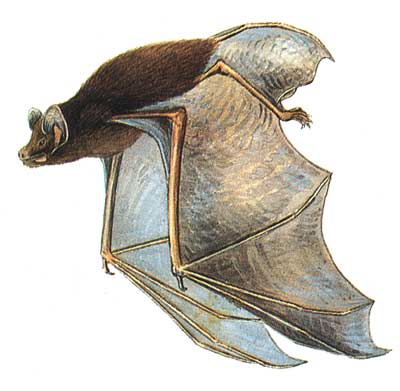
The Little Pied Bat has a glossy black coat with a slight grey wash on its underside. A pure white stripe runs along each side and the stripes join at the pubic area to form a V shape.[1][2]
Male and female Little Pied Bats do not differ significantly in appearance. The species is the smallest in its genus.[3][4]
The Little Pied Bat weighs between 4 and 8 grams. Its braincase breadth is approximately 7 mm, its total skull length is approximately 12 mm, and its forearm is commonly between 31 and 33 mm long.[5][6][7][8]
Habitat
The Little Pied Bat occurs in semi-arid woodlands in eastern Australia, as well as semi-arid tall shrublands and vine forests. It is frequently found in open woodlands dominated by Eucalyptus and Acacia.[9][10][11]
It commonly roosts in tree hollows in bushland trees in New South Wales and Queensland. It also occupies abandoned buildings in its woodland habitats.[12][13]
The Little Pied Bat occurs in north-western and south-western New South Wales, central and southern Queensland, eastern South Australia and north-western Victoria.[14][15][16][17]
Recorded locations include Idalia National Park in Queensland, Sturt National Park in New South Wales and Yarrara Flora and Fauna Reserve in Victoria.[18][19][20]
Diet
The Little Pied Bat feeds on moths, beetles, wingless ants, cockroaches, stoneflies, katydids, crickets, cicadas, spiders, flies, termites and grasshoppers.[21]
Behaviour
The Little Pied Bat hunts mainly in the lower and middle portions of the forest canopy. It uses echolocation to detect its surroundings and locate prey.[22][23]
Its echolocation pulses have an sR-shaped waveform. Colonies contain between a few individuals and 50 bats.[24][25]
Reproduction and life cycle
The Little Pied Bat is presumed to have breeding seasons.[26]
Conservation
The Little Pied Bat population is decreasing, and the species is listed as Near Threatened. Habitat loss is a threat.[27][28][29]
Cotton-related land clearing in New South Wales over the previous 50 years reduced the Little Pied Bat's habitat range by 10%. Roost disturbance, timber harvesting in state forest lands and changing fire regimes are identified as potential threats.[30][31][32][33]
Classification of the Little Pied Bat
| Kingdom | Animalia |
|---|---|
| Phylum | Chordata |
| Subphylum | Vertebrata |
| Infraphylum | Gnathostomata |
| Parvphylum | Osteichthyes |
| Megaclass | Tetrapoda |
| Class | Mammalia (Mammal) |
| Subclass | Theria |
| Infraclass | Eutheria |
| Order | Chiroptera (Bat) |
| Suborder | Yangochiroptera |
| Superfamily | Vespertilionoidea |
| Family | Vespertilionidae (Vesper Bats) |
| Subfamily | Vespertilioninae |
| Tribe | Vespertilionini |
| Genus | Chalinolobus (Wattled Bats) |
| Species | Chalinolobus picatus (Gould, 1852) |
Where the Little Pied Bat is found
Checklists and occurrence records place Chalinolobus picatus in 1 country across Oceania. GBIF holds 2,673 georeferenced records of it.
Countries
Regions and cities with the most records
- New South Wales, Australia 2,255
- Queensland, Australia 342
- South Australia, Australia 41
- Broken Hill, Australia 21
- Victoria, Australia 9
- Gladstone, Australia 8
- Dubbo, Australia 6
- Griffith, Australia 5
- Mildura, Australia 4
- Toowoomba, Australia 3
Range as the checklists state it
Australia
A number beside a place is its count of GBIF occurrence records. A place without a number comes from a checklist alone. Records show where a species has been observed or collected, which can include escapes and vagrants.
Common names
English
- Little Pied Bat
- Little Pied Wattled Bat
- Pied Bat
Names in 5 other languages
- Finnish
- pikkuperhoslepakko
- German
- Kleine Lappenfledermaus
- Japanese
- コミゾクチコウモリ
- Polish
- Mrocznik łaciaty
- Russian
- Смолистый выростогуб
Synonyms
One other scientific name has been used for this species and is now treated as a synonym of Chalinolobus picatus.
- Scotophilus picatus Gould, 1852
Related species
-
 New Zealand Long-tailed BatChalinolobus tuberculatus
-
 Gould's Wattled BatChalinolobus gouldii
-
 Chocolate Wattled BatChalinolobus morio
-
 Large-eared Pied BatChalinolobus dwyeri
- Hoary Wattled BatChalinolobus nigrogriseus
- New Caledonian Wattled BatChalinolobus neocaledonicus
- Coastal Lobe-lipped BatChalinolobus orarius
-
 Common PipistrellePipistrellus pipistrellus
Compare
Questions and answers
What is the scientific name of the Little Pied Bat?
The scientific name of the Little Pied Bat is Chalinolobus picatus. Written with its author, the full name is Chalinolobus picatus (Gould, 1852).
Which family does the Little Pied Bat belong to?
Chalinolobus picatus belongs to the family Vespertilionidae, in the order Chiroptera and the class Mammalia.
Where is the Little Pied Bat found?
Checklists and occurrence records place Chalinolobus picatus in 1 country: Australia.
What is the conservation status of the Little Pied Bat?
The IUCN Red List category recorded for Chalinolobus picatus is Near Threatened (NT).
What other names does the Little Pied Bat have?
Chalinolobus picatus is also known in English as Little Pied Wattled Bat and Pied Bat.
Sources
Passages the profile rests on
- The Little Pied Bat has a glossy black coat with a slight grey wash on its underside. Source passage: “The coat is a glossy black with a slight grey wash ventrally.” — English Wikipedia
- The Little Pied Bat has a pure white stripe along each side that joins at the pubic area to form a V shape. Source passage: “Along the sides is a pure white stripe that meets at the pubic area to form a 'V'.” — English Wikipedia
- Male and female Little Pied Bats do not differ significantly in appearance. Source passage: “There is no significant difference in appearance between the sexes of the species.” — English Wikipedia
- The Little Pied Bat is the smallest species in its genus. Source passage: “The little pied bat is the smallest bat of the genus.” — English Wikipedia
- The Little Pied Bat weighs between 4 and 8 grams. Source passage: “Weighing between 4-8 g.” — English Wikipedia
- The Little Pied Bat has a braincase breadth of approximately 7 mm. Source passage: “braincase breadth of only 7 mm.” — English Wikipedia
- The total skull length of the Little Pied Bat is approximately 12 mm. Source passage: “The total skull length is about 12 mm.” — English Wikipedia
- The Little Pied Bat's forearm is commonly between 31 and 33 mm long. Source passage: “The forearm commonly between 31 and 33 mm in length.” — English Wikipedia
- The Little Pied Bat occurs in semi-arid woodlands in eastern Australia. Source passage: “It is found only in semi-arid woodlands in eastern Australia.” — English Wikipedia
- The Little Pied Bat occurs in semi-arid tall shrublands and vine forests. Source passage: “such as semi-arid tall shrublands and vine forests” — English Wikipedia
- The Little Pied Bat is frequently found in open woodlands dominated by Eucalyptus and Acacia. Source passage: “however, are often found in Eucalypt and Acacia open woodlands.” — English Wikipedia
- The Little Pied Bat commonly roosts in tree hollows in bushland trees in New South Wales and Queensland. Source passage: “It often roosts in tree hollows of the various bushland trees of NSW and QLD” — English Wikipedia
- The Little Pied Bat also occupies abandoned buildings in its woodland habitats. Source passage: “The little pied bat is also found in abandoned buildings around these types of habitats.” — English Wikipedia
- The Little Pied Bat occurs in north-western and south-western New South Wales. Source passage: “north-western and south-western New South Wales” — English Wikipedia
- The Little Pied Bat occurs in central and southern Queensland. Source passage: “central and southern Queensland” — English Wikipedia
- The Little Pied Bat occurs in eastern South Australia. Source passage: “eastern South Australia” — English Wikipedia
- The Little Pied Bat occurs in north-western Victoria. Source passage: “north-western Victoria.” — English Wikipedia
- Recorded locations for the Little Pied Bat include Idalia National Park in Queensland. Source passage: “Idalia National Park QLD” — English Wikipedia
- Recorded locations for the Little Pied Bat include Sturt National Park in New South Wales. Source passage: “Sturt National Park NSW” — English Wikipedia
- Recorded locations for the Little Pied Bat include Yarrara Flora and Fauna Reserve in Victoria. Source passage: “Yarrara Flora and Fauna Reserve VIC.” — English Wikipedia
- The Little Pied Bat feeds on moths, beetles, wingless ants, cockroaches, stoneflies, katydids, crickets, cicadas, spiders, flies, termites and grasshoppers. Source passage: “It eats insects such as moths, beetles, wingless ants, cockroaches, stoneflies, katydids, crickets, cicadas, spiders, flies, termites and grasshoppers.” — English Wikipedia
- The Little Pied Bat hunts mainly in the lower and middle portions of the forest canopy. Source passage: “They hunt mainly in the low and midrange areas of the canopy.” — English Wikipedia
- The Little Pied Bat uses echolocation to detect its surroundings and locate prey. Source passage: “The little pied bat hunts and perceives its surrounding by emitting short pulses of high frequency sounds and interpreting the returning echoes.” — English Wikipedia
- The Little Pied Bat produces echolocation pulses with an sR-shaped waveform. Source passage: “The little pied bat uses pulses with an sR shape pulse” — English Wikipedia
- Little Pied Bat colonies contain between a few individuals and 50 bats. Source passage: “The colonies of little pied bats can range from a few individuals to 50 bats.” — English Wikipedia
- The Little Pied Bat is presumed to have breeding seasons. Source passage: “It is presumed they are similar to most bats, having breeding seasons” — English Wikipedia
- The Little Pied Bat population is decreasing. Source passage: “The population is decreasing.” — English Wikipedia
- The Little Pied Bat is listed as Near Threatened. Source passage: “The little pied bat is listed as Near Threatened” — English Wikipedia
- Habitat loss is a threat to the Little Pied Bat. Source passage: “The little pied bat is facing population decline and threatened by habitat loss.” — English Wikipedia
- Cotton-related land clearing in New South Wales over the previous 50 years reduced the Little Pied Bat's habitat range by 10%. Source passage: “Clearing for cotton in NSW over the last 50 years has reduced the range of its habitat by 10%” — English Wikipedia
- Roost disturbance is identified as a potential threat to the Little Pied Bat. Source passage: “Roost disturbance, timber harvesting in state forest lands and changing fire regimes are all potential threats to the Little Pied bat.” — English Wikipedia
- Timber harvesting in state forest lands is identified as a potential threat to the Little Pied Bat. Source passage: “timber harvesting in state forest lands” — English Wikipedia
- Changing fire regimes are identified as a potential threat to the Little Pied Bat. Source passage: “changing fire regimes are all potential threats to the Little Pied bat.” — English Wikipedia
Data
- Catalogue of Life, 2026-10-16 XR cc by
- Global Biodiversity Information Facility CC BY 4.0
- Wikidata CC0
- GeoNames CC BY 4.0
- Within the Catalogue of Life, this name comes from The Integrated Taxonomic Information System cc0
References
- Mamm. Aust. vol.pt. 4 vol. 3 p.pl. 43 where the name was published
- Wilson, Don E., and DeeAnn M. Reeder, eds. (1993). Mammal Species of the World: A Taxonomic and Geographic Reference, 2nd Ed., 3rd Printing.
- Wilson, Don E., and F. Russell Cole. (2000). Common Names of Mammals of the World.
- Simmons, Nancy B. / Wilson, Don E., and DeeAnn M. Reeder, eds. (2005). Order Chiroptera. Mammal Species of the World: A Taxonomic and Geographic Reference, 3rd Ed., Vols. 1 & 2.
- Wilson, D. E., and R. A. Mittermeier, eds. (2019). Handbook of the Mammals of the World. Vol. 9: Bats.
This species in other databases
Page built on 27 November 2026. See how the catalog is made and all sources and licences.
Cite this page
ScientificNames.org. (2026). Chalinolobus picatus (Little Pied Bat). Retrieved November 27, 2026, from https://scientificnames.org/species/chalinolobus-picatus
“Chalinolobus picatus (Little Pied Bat).” ScientificNames.org, 2026, scientificnames.org/species/chalinolobus-picatus. Accessed 27 Nov. 2026.
ScientificNames.org. “Chalinolobus picatus (Little Pied Bat).” Accessed November 27, 2026. https://scientificnames.org/species/chalinolobus-picatus.
@misc{scientificnames_chalinolobus_picatus_little_pied_bat,
  author = {{ScientificNames.org}},
  title = {Chalinolobus picatus (Little Pied Bat)},
  year = {2026},
  url = {https://scientificnames.org/species/chalinolobus-picatus},
  note = {Accessed 2026-11-27}
}