Species · Amphibians
Brown Thorny Frog Chaperina fusca
The scientific name of the Brown Thorny Frog is Chaperina fusca. It is a species of amphibian in the family Microhylidae (microhylids), order Anura. The name dates from 1892.
- Scientific name
- Chaperina fusca Mocquard, 1892
- Common name
- Brown Thorny Frog
- Genus
- Chaperina
- Family
- Microhylidae (Microhylids)
- Order
- Anura
- Class
- Amphibia
- Red List category
- LC Least Concern
- Recorded in
- 4 countries
- Name status
- accepted in the Catalogue of Life

Overview
Chaperina fusca occurs on the Malay Peninsula, in the Philippines, including Palawan, Mindanao, and Jolo, and in Borneo. It has a black upper surface with tiny white, light blue, or greenish spots and sharp dermal projections on its elbows and heels.
Written 27 November 2026 from the sources listed below. Each statement was checked against the passage it cites; statements that could not be supported were removed.
Appearance
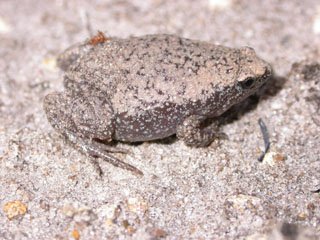
The Brown Thorny Frog has a black upper surface marked with tiny white, light blue, or greenish spots. Its skin is smooth with scattered tubercles, and it has sharp dermal projections on its elbows and heels.[1][2][3]
Habitat
The species inhabits primary lowland rainforests, montane rainforests, and forest-edge habitats. It has also been recorded in rural gardens and uses forest floors and low vegetation.[4][5][6][7][8]
The species occurs on the Malay Peninsula and in the Philippines, including Palawan, Mindanao, and Jolo. It is abundant in Borneo, uncommon on the Malay Peninsula, and has a patchy distribution in the Philippines.[9][10][11][12][13]
Behaviour
Individuals become active after rainfall. The species is capable of climbing well.[14][15]
Reproduction and life cycle
The species breeds in small, temporary water bodies that are rich in decaying organic matter.[16][17]
Conservation
Deforestation and conversion of habitat to agriculture are identified as threats to the species.[18][19]
The species is listed as Least Concern (LC) in the AmphibiaWeb search results. Its most recent assessment for the IUCN Red List was in 2020.[20][21]
Classification of the Brown Thorny Frog
| Kingdom | Animalia |
|---|---|
| Phylum | Chordata |
| Subphylum | Vertebrata |
| Infraphylum | Gnathostomata |
| Parvphylum | Osteichthyes |
| Megaclass | Tetrapoda |
| Class | Amphibia (Amphibians) |
| Order | Anura (Frogs) |
| Family | Microhylidae (Microhylids) |
| Subfamily | Microhylinae |
| Genus | Chaperina (Thorny Frogs) |
| Species | Chaperina fusca Mocquard, 1892 |
Where the Brown Thorny Frog is found
Checklists and occurrence records place Chaperina fusca in 4 countries. GBIF holds 984 georeferenced records of it.
Countries
Regions and cities with the most records
- Sabah, Malaysia 135
- Puerto Princesa, Philippines 118
- Sarawak, Malaysia 66
- Ranau, Malaysia 60
- Kuching, Malaysia 29
- Temburong, Brunei 22
- San Francisco, Philippines 11
- Bah-Bah, Philippines 9
- Bau, Malaysia 9
- Prosperidad, Philippines 9
- Johor, Malaysia 8
- Dapitan, Philippines 7
- Sandakan, Malaysia 7
- Jolo, Philippines 6
- Kuala Kubu Baharu, Malaysia 6
- Pahang, Malaysia 6
- Raub, Malaysia 6
- Recodo, Philippines 6
- Bunawan, Philippines 5
- Cabadbaran, Philippines 5
- Impasugong, Philippines 5
- Manolo Fortich, Philippines 5
- Selangor, Malaysia 5
- Trento, Philippines 5
- Veruela, Philippines 5
- Baguio, Philippines 3
- Hulu Yam Lama, Malaysia 3
- Itogon, Philippines 3
- Jose Rizal, Philippines 3
- La Trinidad, Philippines 3
A number beside a place is its count of GBIF occurrence records. A place without a number comes from a checklist alone. Records show where a species has been observed or collected, which can include escapes and vagrants.
Common names
English
- Brown Thorny Frog
- Saffron-bellied Frog
- Yellow-spotted Narrow-mouthed Frog
Names in 3 other languages
- Czech
- parosnička vločkovaná
- Indonesian
- Percil Perut-kunyit
- Russian
- шпорцевый узкорот
Synonyms
6 other scientific names have been used for this species and are now treated as synonyms of Chaperina fusca.
- Chaperina beyeri Taylor, 1920
- Microhyla leucostigma Boulenger, 1899
- Nectophryne picturata Smith, 1921
- Sphenophryne beyeri (Taylor, 1920)
- Sphenophryne fusca (Mocquard, 1892)
- Sphenophryne leucostigma (Boulenger, 1899)
Related species
-
 Galaxy FrogMelanobatrachus indicus
-
 New Guinea Amau FrogPaedophryne amauensis
- Banded BullfrogKaloula pulchra
-
 Dotted Humming FrogChiasmocleis ventrimaculata
-
 Mini mum
- Mini ature
-
 Eastern Narrow-mouthed ToadGastrophryne carolinensis
-
 Tomato FrogDyscophus antongilii
Compare
Questions and answers
What is the scientific name of the Brown Thorny Frog?
The scientific name of the Brown Thorny Frog is Chaperina fusca. Written with its author, the full name is Chaperina fusca Mocquard, 1892.
Which family does the Brown Thorny Frog belong to?
Chaperina fusca belongs to the family Microhylidae, in the order Anura and the class Amphibia.
Where is the Brown Thorny Frog found?
Checklists and occurrence records place Chaperina fusca in 4 countries: Malaysia, Philippines, Brunei and Indonesia.
What is the conservation status of the Brown Thorny Frog?
The IUCN Red List category recorded for Chaperina fusca is Least Concern (LC).
What other names does the Brown Thorny Frog have?
Chaperina fusca is also known in English as Saffron-bellied Frog and Yellow-spotted Narrow-mouthed Frog.
Sources
Passages the profile rests on
- The species has a black upper surface marked with tiny white, light blue, or greenish spots. Source passage: “They are black above with minute white, light blue, or greenish spots.” — English Wikipedia
- Its skin is smooth and bears scattered tubercles. Source passage: “The skin is smooth with scattered tubercles” — English Wikipedia
- The species has sharp dermal projections on its elbows and heels. Source passage: “they have a sharp dermal projection on elbows and heel.” — English Wikipedia
- The species inhabits primary lowland rainforests. Source passage: “Its natural habitats are primary lowland and montane rainforests” — English Wikipedia
- The species inhabits montane rainforests. Source passage: “primary lowland and montane rainforests” — English Wikipedia
- The species also occurs in forest-edge habitats. Source passage: “as well as edge habitats” — English Wikipedia
- The species has also been recorded in rural gardens. Source passage: “it has also been found in rural gardens.” — English Wikipedia
- The species uses forest floors and low vegetation. Source passage: “active after rainfall on forest floor and low vegetation” — English Wikipedia
- The species occurs on the Malay Peninsula. Source passage: “It is found on the Malay Peninsula” — English Wikipedia
- The species occurs in the Philippines, including Palawan, Mindanao, and Jolo. Source passage: “in the Philippines (Palawan, Mindanao, and Jolo islands).” — English Wikipedia
- The species is abundant in Borneo. Source passage: “It is abundant in Borneo” — English Wikipedia
- The species is uncommon on the Malay Peninsula. Source passage: “uncommon on the Malay Peninsula” — English Wikipedia
- The species has a patchy distribution in the Philippines. Source passage: “patchily distributed in the Philippines.” — English Wikipedia
- Individuals become active after rainfall. Source passage: “These frogs are active after rainfall” — English Wikipedia
- The species is capable of climbing well. Source passage: “they are good climbers.” — English Wikipedia
- The species breeds in small, temporary water bodies. Source passage: “It breeds in small, temporary water bodies” — English Wikipedia
- Its breeding water bodies are rich in decaying organic matter. Source passage: “temporary water bodies rich in decaying organic matter.” — English Wikipedia
- Deforestation is identified as a threat to the species. Source passage: “Threats to this species include deforestation” — English Wikipedia
- Conversion of habitat to agriculture is identified as a threat to the species. Source passage: “habitat conversion to agriculture” — English Wikipedia
- The species is listed as Least Concern (LC) in the AmphibiaWeb search results. Source passage: “Chaperina fusca · photos, Least Concern (LC)” — amphibiaweb.org
- The species was most recently assessed for the IUCN Red List in 2020. Source passage: “has most recently been assessed for The IUCN Red List of Threatened Species in 2020.” — iucnredlist.org
Data
- Catalogue of Life, 2026-10-16 XR cc by
- Global Biodiversity Information Facility CC BY 4.0
- Wikidata CC0
- GeoNames CC BY 4.0
- Wikimedia Commons per image; credit shown with each image
- Within the Catalogue of Life, this name comes from The Integrated Taxonomic Information System cc0
References
- Mocquard, François. 1892. Description de deux ophidiens et d'un batracien d'especes nouvelles. Le Naturaliste: revue illustrée des sciences naturelles (2e série) 6(118): 35. where the name was published
This species in other databases
Page built on 27 November 2026. See how the catalog is made and all sources and licences.
Cite this page
ScientificNames.org. (2026). Chaperina fusca (Brown Thorny Frog). Retrieved November 27, 2026, from https://scientificnames.org/species/chaperina-fusca
“Chaperina fusca (Brown Thorny Frog).” ScientificNames.org, 2026, scientificnames.org/species/chaperina-fusca. Accessed 27 Nov. 2026.
ScientificNames.org. “Chaperina fusca (Brown Thorny Frog).” Accessed November 27, 2026. https://scientificnames.org/species/chaperina-fusca.
@misc{scientificnames_chaperina_fusca_brown_thorny_frog,
  author = {{ScientificNames.org}},
  title = {Chaperina fusca (Brown Thorny Frog)},
  year = {2026},
  url = {https://scientificnames.org/species/chaperina-fusca},
  note = {Accessed 2026-11-27}
}