Species · Mammals
European Snow Vole Chionomys nivalis
The scientific name of the European Snow Vole is Chionomys nivalis. It is a species of mammal in the family Cricetidae (new world mice and rats), order Rodentia. The name dates from 1842.
- Scientific name
- Chionomys nivalis (Martins, 1842)
- Common name
- European Snow Vole
- Genus
- Chionomys
- Family
- Cricetidae (New World Mice and Rats)
- Order
- Rodentia
- Class
- Mammalia
- Red List category
- LC Least Concern
- Recorded in
- 22 countries
- Name status
- accepted in the Catalogue of Life
Overview
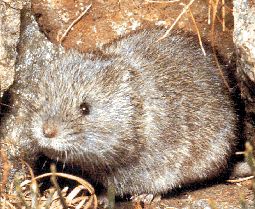
Chionomys nivalis is native to mountainous regions of southern and eastern Europe and southwestern Asia. It has long, soft, dense fur that is generally pale grey with brown tinges, long whitish whiskers and a comparatively long tail.
Written 26 November 2026 from the sources listed below. Each statement was checked against the passage it cites; statements that could not be supported were removed.
Appearance
The European Snow Vole has long, soft, dense fur that is pale grey with brown tinges. Fur colour varies between populations, although grey shades are consistently present.[1][2]
Its belly is paler than the rest of its body, and its tail and paws are frequently whitish. It has a rounded nose, black beady eyes, long whitish whiskers and moderately large ears.[3][4]
Its comparatively long tail measures between 51 and 76 mm and is whitish, with short, sparse hairs. Its head and body measure between 108 and 140 mm in length.[5][6][7]
Adult individuals weigh between 28 and 57 g. Reported body mass ranges from 30 to 78 g.[8][9]
Habitat
The European Snow Vole primarily inhabits rocky areas and scree above the tree line. It is also found in alpine meadows, boulder-covered slopes and rocky crevices.[10][11][12]
It shelters beneath boulders and in crevices and tunnels among rocks and scree. Its habitat depends on fractured rocky substrate, including deep crevices and fissures.[13][14]
It also occurs in areas containing dwarf mountain pines, alpine roses and scrubby vegetation. Its occurrence at particular locations depends more on suitable microhabitats than on temperature.[15][16]
It has been recorded at elevations ranging from near sea level to above 5,000 m. In France, it occurs at lower elevations in karst regions near Glun, in Ardèche, and near Nîmes.[17][18]
Its European range includes the Pyrenees, Alps, Apennines, Carpathians, Balkan Mountains and Montesinho mountains. Its Asian distribution includes the Caucasus, Lebanon, Syria, western and northern Iran, and southern Turkmenistan.[19][20]
Euboea, off the coast of Greece, is the only Mediterranean island where the species occurs. Its geographical range is fragmented, with many local populations being small and isolated.[21][22]
Diet
The European Snow Vole feeds on green plant parts, grasses, buds, shoots and roots. It sometimes consumes insects and their larvae.[23][24]
Its daily food consumption amounts to approximately 5–10 g of dry matter.[25]
Behaviour
The European Snow Vole is predominantly solitary and active during both daylight and night. A significant proportion of its daily activity takes place during daylight hours.[26][27][28]
It does not hibernate during winter. During summer, it collects grass and leaves, dries them in sunlight and stores them underground for winter.[29][30]
During summer, females maintain mutually exclusive territories and can be aggressive towards other females. Male home ranges are larger and overlap with those of several females.[31][32]
It digs tunnels among rocks and between tree roots, with numerous exit holes. When running, it holds its tail upright.[33][34]
Its vocalisation is a squeak, and its teeth can sometimes be heard chattering.[35]
Reproduction and life cycle
The European Snow Vole typically reproduces during spring and summer. The breeding season becomes shorter at higher elevations.[36][37]
Females produce two to three litters per breeding season, with each litter generally containing two to six young. The gestation period lasts between 20 and 22 days.[38][39][40]
Newborn young are nude, blind and helpless. Young individuals begin leaving the nest at two to three weeks of age and become independent at approximately one month old.[41][42][43]
Both sexes mate with multiple partners. The species usually produces two litters annually, averaging approximately four young per litter.[44][45]
The number of offspring per litter ranges from two to seven. The young are weaned at approximately 18 days old.[46][47]
Young individuals generally do not begin breeding until the year following their birth.[48]
Conservation
The European Snow Vole is classified as Least Concern on the IUCN Red List. Its population trend appears stable despite its fragmented geographical range.[49][50]
The species is considered not to face any particular threats. It is considered a glacial relict whose suitable habitat became fragmented following the retreat of the most recent glaciation.[51][52]
Classification of the European Snow Vole
| Kingdom | Animalia |
|---|---|
| Phylum | Chordata |
| Subphylum | Vertebrata |
| Infraphylum | Gnathostomata |
| Parvphylum | Osteichthyes |
| Megaclass | Tetrapoda |
| Class | Mammalia (Mammal) |
| Subclass | Theria |
| Infraclass | Eutheria |
| Order | Rodentia (Rodent) |
| Suborder | Myomorpha (Mice) |
| Superfamily | Muroidea |
| Family | Cricetidae (New World Mice and Rats) |
| Subfamily | Arvicolinae (Arvicoline Rodents) |
| Genus | Chionomys (Snow Voles) |
| Species | Chionomys nivalis (Martins, 1842) |
Where the European Snow Vole is found
Checklists and occurrence records place Chionomys nivalis in 22 countries. GBIF holds 6,415 georeferenced records of it.
Countries
- Andorra 45
- Austria 442
- Belarus 3
- Bosnia and Herzegovina 8
- Bulgaria 53
- Croatia 23
- Czechia 5
- France 1,346
- Germany 134
- Italy 169
- Liechtenstein 71
- Montenegro 7
- North Macedonia 14
- Poland 107
- Romania 24
- Russia 10
- Serbia 4
- Slovakia 19
- Slovenia 29
- Spain 769
- Switzerland 3,128
- Ukraine 5
Regions and cities with the most records
- Provence-Alpes-Côte d'Azur, France 673
- Valais, Switzerland 636
- Ticino, Switzerland 356
- Auvergne-Rhône-Alpes, France 352
- Salzburg, Austria 234
- Vaduz, Liechtenstein 229
- Occitanie, France 184
- Monthey, Switzerland 177
- Sierre, Switzerland 174
- Sitten, Switzerland 173
- Catalonia, Spain 151
- Chur, Switzerland 151
- Uri, Switzerland 140
- Martigny-Ville, Switzerland 130
- Bern, Switzerland 106
- Feldkirch, Austria 106
- Vaud, Switzerland 101
- Locarno, Switzerland 90
- Bellinzona, Switzerland 80
- Montreux, Switzerland 61
- les Escaldes, Andorra 54
- Zakopane, Poland 53
- Andorra la Vella, Andorra 52
- Aubagne, France 52
- Vevey, Switzerland 48
- Triesen, Liechtenstein 46
- Asturias, Spain 44
- Herisau, Switzerland 44
- Allauch, France 43
- Aragon, Spain 43
- Gap, France 42
- Marseille 11, France 40
- Cluses, France 38
- Marseille 12, France 38
- Bulle, Switzerland 37
- Marseille, France 37
6 more countries have a few records outside this range
These countries hold a few records of Chionomys nivalis but lie outside the range the checklists give for it. Such records are often zoo or garden specimens, museum material or vagrants, so the species is not counted as occurring there.
Range as the checklists state it
Europe & Northern Asia (excluding China)
A number beside a place is its count of GBIF occurrence records. A place without a number comes from a checklist alone. Records show where a species has been observed or collected, which can include escapes and vagrants.
Common names
English
- European Snow Vole
- European Snow Vole Or Snow Vole
- Snow Vole
Names in 22 other languages
- Azerbaijani
- Avropa qar siçanı, Avropa qar çöl siçanı
- Catalan
- Talpó de tartera
- Czech
- hraboš sněžný
- Dutch
- Europese Sneeuwmuis, Sneeuwmuis
- Finnish
- lumimyyrä
- French
- Campagnol des neiges
- Galician
- Trilladeira nival
- German
- Schneemaus
- Greek
- Ευρωπαϊκός Χιονοποντικός
- Hebrew
- נברן שלג
- Italian
- Arvicola delle nevi
- Japanese
- ヨーロッパユキハタネズミ
- Norwegian Bokmål
- Snømarkmus
- Persian
- موش برفی
- Polish
- śnieżnik europejski
- Portuguese
- Campanhol-das-neves, Rato-das-neves
- Russian
- Снеговая полёвка, Снежная полёвка
- Slovak
- Hraboš snežný
- Slovenian
- snežna voluharica
- Spanish
- Topillo Nival
- Turkish
- Kar Faresi
- Ukrainian
- Полівка снігова
Synonyms
20 other scientific names have been used for this species and are now treated as synonyms of Chionomys nivalis.
- Arvicola lebrunii Crespon, 1844
- Arvicola leucurus Gerbe, 1852
- Arvicola nivalis Martins, 1842
- Chionomys nivalis wagneri Martino, 1940
- Hypudaeus alpinus Wagner, 1843
- Hypudaeus nivicola Schinz, 1845
- Hypudaeus petrophilus Wagner, 1853
- Microtus hermonis Miller, 1908
- Microtus mirhanreini Schäfer, 1935
- Microtus nivalis (Martins, 1842)
- Microtus nivalis abulensis Agacino, 1936
- Microtus nivalis aquitanius Miller, 1908
- Microtus nivalis dementievi Heptner, 1939
- Microtus nivalis malyi Bolkay, 1925
- Microtus nivalis olympius Neuhäuser, 1936
- Microtus nivalis satunini Shidlovsky, 1919
- Microtus nivalis trialeticus Shidlovsky, 1919
- Microtus pontius Miller, 1908
- Microtus radnensis Ehik, 1942
- Microtus ulpius Miller, 1908
Related species
- Robert's Snow VoleChionomys roberti
- Caucasian Snow VoleChionomys gud
-
 MuskratOndatra zibethicus
-
 European HamsterCricetus cricetus
-
 Golden HamsterMesocricetus auratus
-
 Winter White Dwarf HamsterPhodopus sungorus
-
 European Water VoleArvicola amphibius
- Indefatigable Galapagos MouseNesoryzomys indefessus
Compare
Questions and answers
What is the scientific name of the European Snow Vole?
The scientific name of the European Snow Vole is Chionomys nivalis. Written with its author, the full name is Chionomys nivalis (Martins, 1842).
Which family does the European Snow Vole belong to?
Chionomys nivalis belongs to the family Cricetidae, in the order Rodentia and the class Mammalia.
Where is the European Snow Vole found?
Checklists and occurrence records place Chionomys nivalis in 22 countries, including Switzerland, France, Spain, Austria, Italy and Germany.
What is the conservation status of the European Snow Vole?
The IUCN Red List category recorded for Chionomys nivalis is Least Concern (LC).
What other names does the European Snow Vole have?
Chionomys nivalis is also known in English as European Snow Vole Or Snow Vole and Snow Vole.
Where are voles indigenous to?
The European Snow Vole is native to mountainous regions of southern and eastern Europe and southwestern Asia. Its distribution extends from southwestern Europe through the Middle East, including Anatolia, the Caucasus, Iran and the Kopetdag mountains.[53][54]
What is the diet of a vole?
The European Snow Vole feeds on green plant parts, grasses, buds, shoots and roots. It sometimes consumes insects and their larvae.[23][24]
Is a vole a carnivore, herbivore, or omnivore?
The European Snow Vole has a strictly herbivorous diet.[55]
Sources
Passages the profile rests on
- The European snow vole has long, soft, dense fur that is pale grey with brown tinges. Source passage: “The European snow vole has soft, long, dense fur that is pale grey tinged with brown.” — English Wikipedia
- Its fur colour varies between populations, although grey shades are consistently present. Source passage: “The colour varies among populations, but shades of grey are always present.” — pmc.ncbi.nlm.nih.gov
- Its belly is paler than the rest of its body, and its tail and paws are frequently whitish. Source passage: “The belly is paler, and the tail and paws are frequently whitish” — pmc.ncbi.nlm.nih.gov
- It has a rounded nose, black beady eyes, long whitish whiskers and moderately large ears. Source passage: “It has a rounded nose, black beady eyes, long whitish whiskers and moderately large ears.” — English Wikipedia
- Its comparatively long tail is whitish and covered with short, sparse hairs. Source passage: “The comparatively long tail is whitish and clad in short, sparse hairs.” — English Wikipedia
- Its head and body measure between 108 and 140 mm in length. Source passage: “The head and body length is 4.25 to 5.5 in (108 to 140 mm)” — English Wikipedia
- Its tail measures between 51 and 76 mm long. Source passage: “the tail 2 to 3 in (51 to 76 mm).” — English Wikipedia
- Adult individuals weigh between 28 and 57 g. Source passage: “Adults weigh between 1 and 2 ounces (28 and 57 g).” — English Wikipedia
- Reported body mass ranges from 30 to 78 g. Source passage: “body mass is 30–78 g” — pmc.ncbi.nlm.nih.gov
- The species primarily inhabits rocky areas and scree above the tree line. Source passage: “Its habitat is rocky areas and screes, mostly above the tree line.” — English Wikipedia
- It inhabits alpine meadows, boulder-covered slopes and rocky crevices. Source passage: “It lives mainly above the tree line on and among rocks and scree in alpine meadows, on boulder-covered slopes, in crevices in rocks” — English Wikipedia
- The species is most abundant in mountainous areas above the tree line. Source passage: “however, they are most abundant in the mountains above the tree line.” — pmc.ncbi.nlm.nih.gov
- It shelters beneath boulders and in crevices and tunnels among rocks and scree. Source passage: “lives under boulders and in crevices and tunnels among rocks and scree.” — English Wikipedia
- The species depends on fractured rocky substrate and shelters in deep crevices and fissures. Source passage: “Snow voles seek shelter in deep crevices and fissures, and they depend on fractured rocky substrate.” — pmc.ncbi.nlm.nih.gov
- It also occurs in areas containing dwarf mountain pines, alpine roses and scrubby vegetation. Source passage: “in areas with dwarf mountain pines (Pinus mugo), alpine rose (Rhododendron ferrugineum) and scrubby vegetation.” — English Wikipedia
- Its occurrence at particular locations depends more on suitable microhabitats than on temperature. Source passage: “Its presence in any location is due to the suitability of the microhabitat rather than the suitability of the temperature.” — English Wikipedia
- It has been recorded at elevations ranging from near sea level to above 5,000 m. Source passage: “They have been recorded from close to sea level to over 5,000 m in elevation” — pmc.ncbi.nlm.nih.gov
- In France, it occurs at lower elevations in karst regions near Glun, in Ardèche, and near Nîmes. Source passage: “In France it is present at lower elevations in some karst regions such as near Glun, in the Ardèche department and near Nîmes.” — English Wikipedia
- Its European range includes the Pyrenees, Alps, Apennines, Carpathians, Balkan Mountains and Montesinho mountains. Source passage: “The European snow vole is native to mountainous ranges in southern Europe, the Pyrenees, Apennines, Alps, Carpathians, Balkan Mountains, Mount Olympus, Pindus Range and the Montesinho mountains.” — English Wikipedia
- Its Asian distribution includes the Caucasus, Lebanon, Syria, western and northern Iran, and southern Turkmenistan. Source passage: “In Asia it is native to mountainous parts of the Caucasus, Lebanon, Syria, western and northern Iran and southern Turkmenistan.” — English Wikipedia
- Euboea, off the coast of Greece, is the only Mediterranean island where the species occurs. Source passage: “The only Mediterranean island on which it is present is Euboea, off the coast of Greece.” — English Wikipedia
- Its geographical range is fragmented, with many local populations being small and isolated. Source passage: “Their range is fragmented at various spatial scales, and many local populations are small and isolated.” — pmc.ncbi.nlm.nih.gov
- The European snow vole feeds on green plant parts, grasses, buds, shoots and roots. Source passage: “It feeds on the green parts of plants, grasses, buds, shoots and roots” — English Wikipedia
- It sometimes consumes insects and their larvae. Source passage: “and may sometimes eat insects and their larvae.” — English Wikipedia
- Its daily food consumption amounts to approximately 5–10 g of dry matter. Source passage: “daily consumption consists of 5–10 g of dry matter.” — pmc.ncbi.nlm.nih.gov
- The species is predominantly solitary. Source passage: “It is mainly a solitary animal” — English Wikipedia
- It is active both during daylight and at night. Source passage: “This vole is active by night as well as by day” — English Wikipedia
- A significant proportion of its daily activity takes place during daylight hours. Source passage: “A significant part of their diurnal activity occurs during the daytime” — pmc.ncbi.nlm.nih.gov
- It does not hibernate during winter. Source passage: “It does not hibernate in wintertime” — English Wikipedia
- During summer, the species collects grass and leaves, dries them in sunlight and stores them underground for winter. Source passage: “In the summer it gathers bits of grass and leaves, leaving them to dry in the sun before storing them in underground chambers for winter use as food.” — English Wikipedia
- During summer, females maintain mutually exclusive territories and can be aggressive towards other females. Source passage: “In the summer breeding season, female European snow voles have mutually exclusive territories and display considerable aggression towards other females of their own species when they meet near the territorial boundaries.” — English Wikipedia
- Male home ranges are larger and overlap with those of several females. Source passage: “Home ranges of males encompass several females which have smaller and non-overlapping ranges.” — pmc.ncbi.nlm.nih.gov
- When running, it holds its tail upright. Source passage: “It holds its tail in an upright position when running.” — English Wikipedia
- It digs tunnels among rocks and between tree roots, with numerous exit holes. Source passage: “It digs tunnels with numerous exit holes among rocks and between tree roots.” — English Wikipedia
- Its vocalisation is a squeak, and its teeth can sometimes be heard chattering. Source passage: “Its voice is a squeak and its teeth can sometimes be heard chattering.” — English Wikipedia
- The species typically reproduces during spring and summer. Source passage: “These voles typically reproduce in spring and summer” — pmc.ncbi.nlm.nih.gov
- The breeding season becomes shorter at higher elevations. Source passage: “the length of the breeding season becoming shorter at higher elevations.” — pmc.ncbi.nlm.nih.gov
- Females produce two to three litters per breeding season. Source passage: “Females produce two to three litters per season” — pmc.ncbi.nlm.nih.gov
- Each litter generally contains two to six young. Source passage: “each with two to six young.” — pmc.ncbi.nlm.nih.gov
- The gestation period lasts between 20 and 22 days. Source passage: “The gestation period is 20 to 22 days” — pmc.ncbi.nlm.nih.gov
- Newborn young are nude, blind and helpless. Source passage: “the young are born nude, blind and helpless.” — pmc.ncbi.nlm.nih.gov
- Young individuals begin leaving the nest at two to three weeks of age. Source passage: “They start leaving the nest when two to three weeks old” — pmc.ncbi.nlm.nih.gov
- Young individuals become independent at approximately one month old. Source passage: “and become independent at about one month of age.” — pmc.ncbi.nlm.nih.gov
- Both sexes mate with multiple partners. Source passage: “The European snow vole is promiscuous in its mating habits with both males and females mating with multiple partners.” — English Wikipedia
- The species usually produces two litters annually, averaging approximately four young per litter. Source passage: “There are usually two litters in a year, with litters of about four” — English Wikipedia
- The number of offspring per litter ranges from two to seven. Source passage: “litters of about four (range two to seven) young” — English Wikipedia
- The young are weaned at approximately 18 days old. Source passage: “they are weaned at eighteen days” — English Wikipedia
- Young individuals generally do not begin breeding until the year following their birth. Source passage: “They do not generally breed until the following year” — English Wikipedia
- The European snow vole is classified as Least Concern on the IUCN Red List. Source passage: “The species is classified as “Least Concern” on the IUCN Red List” — pmc.ncbi.nlm.nih.gov
- Its population trend appears stable despite its fragmented geographical range. Source passage: “its population trend seems stable” — English Wikipedia
- The species is considered not to face any particular threats. Source passage: “it does not seem to be facing any particular threats.” — English Wikipedia
- The species is considered a glacial relict whose suitable habitat became fragmented following the retreat of the most recent glaciation. Source passage: “This vole is considered to be a glacial relict species and since the retreat of the most recent glaciation, suitable habitat became fragmented.” — English Wikipedia
- The species is native to mountainous regions of southern and eastern Europe and southwestern Asia. Source passage: “The European snow vole is native to mountainous parts of southern and eastern Europe and southwestern Asia.” — English Wikipedia
- Its distribution extends from southwestern Europe through the Middle East, including Anatolia, the Caucasus, Iran and the Kopetdag mountains. Source passage: “The distribution range of C. nivalis covers mountainous regions from southwestern Europe, through the Pyrenees, Alps and Carpathians, the mountain ranges of the Italian and Balkan Peninsulas, as far east as the Middle East, including Anatolia, the Caucasus, mountains of Iran and Kopetdag.” — pmc.ncbi.nlm.nih.gov
- The species has a strictly herbivorous diet. Source passage: “The diet of C. nivalis is strictly herbivorous” — pmc.ncbi.nlm.nih.gov
Data
- Catalogue of Life, 2026-10-16 XR cc by
- Global Biodiversity Information Facility CC BY 4.0
- Wikidata CC0
- GeoNames CC BY 4.0
- Wikimedia Commons per image; credit shown with each image
- Within the Catalogue of Life, this name comes from The Integrated Taxonomic Information System cc0
References
- Rev. Zool. Paris p.331 where the name was published
- Wilson, Don E., and DeeAnn M. Reeder, eds. (1993). Mammal Species of the World: A Taxonomic and Geographic Reference, 2nd Ed., 3rd Printing.
- Wilson, Don E., and F. Russell Cole. (2000). Common Names of Mammals of the World.
- Musser, Guy G., and Michael D. Carleton / Wilson, Don E., and DeeAnn M. Reeder, eds. (2005). Superfamily Muroidea. Mammal Species of the World: A Taxonomic and Geographic Reference, 3rd Ed., Vol. 2.
This species in other databases
Page built on 28 November 2026. See how the catalog is made and all sources and licences.
Cite this page
ScientificNames.org. (2026). Chionomys nivalis (European Snow Vole). Retrieved November 28, 2026, from https://scientificnames.org/species/chionomys-nivalis
“Chionomys nivalis (European Snow Vole).” ScientificNames.org, 2026, scientificnames.org/species/chionomys-nivalis. Accessed 28 Nov. 2026.
ScientificNames.org. “Chionomys nivalis (European Snow Vole).” Accessed November 28, 2026. https://scientificnames.org/species/chionomys-nivalis.
@misc{scientificnames_chionomys_nivalis_european_snow_vole,
  author = {{ScientificNames.org}},
  title = {Chionomys nivalis (European Snow Vole)},
  year = {2026},
  url = {https://scientificnames.org/species/chionomys-nivalis},
  note = {Accessed 2026-11-28}
}