Species · Other invertebrates
Australian Box Jellyfish Chironex fleckeri
The scientific name of the Australian Box Jellyfish is Chironex fleckeri. It is a species of animal in the family Chirodropidae, order Chirodropida. The name dates from 1956.
- Scientific name
- Chironex fleckeri Southcott, 1956
- Common name
- Australian Box Jellyfish
- Genus
- Chironex
- Family
- Chirodropidae
- Order
- Chirodropida
- Class
- Cubozoa
- Environment
- marine
- Recorded in
- 1 country
- Name status
- accepted in the Catalogue of Life
Overview
Chironex fleckeri inhabits shallow, murky saline waters near Australia.
Written 24 November 2026 from the sources listed below. Each statement was checked against the passage it cites; statements that could not be supported were removed.
Appearance
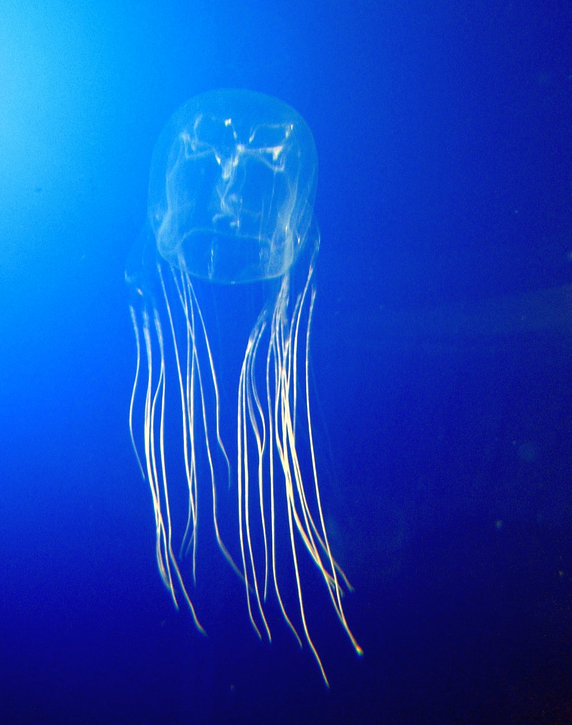
The species has four clusters of tentacles, with up to 15 tentacles extending from each corner of its bell. It also has four eye clusters containing a total of 24 eyes.[1][2]
The bell usually measures approximately 16 cm in diameter but can reach 35 cm. Tentacles can extend to approximately 3 m when the animal is hunting.[3][4]
Swimming tentacles contract to approximately 150 mm in length and 5 mm in diameter.[5]
Habitat
During heavy storms, the species moves into deeper waters to avoid damage from rough conditions.[6]
Diet
The species feeds on prawns and small fish. It also consumes crabs, shrimp and other pelagic invertebrates.[7][8]
Immature individuals primarily feed on shrimp, particularly Acetes australis.[9]
Behaviour
The species actively swims rather than relying entirely on ocean currents for movement. Its swimming speed can reach four knots, although it typically travels at one knot or less during the day.[10][11][12]
The species hunts during daylight hours and rests on the ocean floor at night.[13][14]
The species is attracted to white, red, orange, yellow, green and blue light. Blue light appears to stimulate feeding behaviour and tentacle extension.[15][16]
The species moves away from black objects. It uses venomous tentacles to capture and immobilise prey.[17][18]
Reproduction and life cycle
Males and females release sperm and eggs directly into the water for fertilisation. Fertilised eggs develop into planulae that eventually become polyps.[19][20]
Polyps reproduce asexually through budding and transform into juvenile medusae through metamorphosis.[21][22]
Mature individuals die shortly after spawning.[23]
Conservation
Green sea turtles and leatherback turtles are identified as known predators of the species.[24]
Uses
Research into the species' venom has contributed to the development of an antivenom agent.[25]
Classification of the Australian Box Jellyfish
| Kingdom | Animalia |
|---|---|
| Phylum | Cnidaria |
| Class | Cubozoa (Box Jellyfish) |
| Order | Chirodropida |
| Family | Chirodropidae |
| Genus | Chironex (Lethal Sea Wasps) |
| Species | Chironex fleckeri Southcott, 1956 |
Where the Australian Box Jellyfish is found
Checklists and occurrence records place Chironex fleckeri in 1 country. GBIF holds 199 georeferenced records of it.
Countries
Regions and cities with the most records
- Queensland, Australia 31
- Darwin, Australia 26
- Northern Territory, Australia 14
- Townsville, Australia 10
1 more country has a few records outside this range
These countries hold a few records of Chironex fleckeri but lie outside the range the checklists give for it. Such records are often zoo or garden specimens, museum material or vagrants, so the species is not counted as occurring there.
A number beside a place is its count of GBIF occurrence records. A place without a number comes from a checklist alone. Records show where a species has been observed or collected, which can include escapes and vagrants.
Common names
English
- Australian Box Jellyfish
- Australian Box Jelly
- Marine Stinger
- Sea Wasp
- Box Jelly
- Deadly Sea Wasp
Names in 15 other languages
- Asturian
- viéspora de mar
- Czech
- čtyřhranka Fleckerova
- Danish
- Havhveps
- Dutch
- Zeewesp
- French
- Cuboméduse, Cuboméduse d'Australie, Guêpe de mer, Main de la mort, Main qui tue, Piqueur marin
- German
- Australische Würfelqualle, Seewespe
- Hebrew
- קטלנית אוסטרלית
- Italian
- Vespa di mare
- Japanese
- オーストラリアウンバチクラゲ
- Lithuanian
- Jūrų širšė
- Polish
- Kostkomeduza, kostkomeduza śmiercionośna
- Portuguese
- Vespa-do-mar, Vespa-do-mar-australiana
- Russian
- Морская оса
- Slovenian
- morska osa
- Spanish
- Avispa marina, Cubomedusa
Related species
-
 Hub JellyChironex yamaguchii
- Chironex indrasaksajiae
- Chironex blakangmati
-
 Gorilla Box JellyChirodropus gorilla
- Chirodectes maculatus
Compare
Questions and answers
What is the scientific name of the Australian Box Jellyfish?
The scientific name of the Australian Box Jellyfish is Chironex fleckeri. Written with its author, the full name is Chironex fleckeri Southcott, 1956.
Which family does the Australian Box Jellyfish belong to?
Chironex fleckeri belongs to the family Chirodropidae, in the order Chirodropida and the class Cubozoa.
Where is the Australian Box Jellyfish found?
Checklists and occurrence records place Chironex fleckeri in 1 country: Australia.
What other names does the Australian Box Jellyfish have?
Chironex fleckeri is also known in English as Australian Box Jelly, Marine Stinger, Sea Wasp, Box Jelly and Deadly Sea Wasp.
What is the deadliest jellyfish sting?
The Australian box jellyfish is described as extremely venomous. Its venom can cause cardiovascular collapse through potassium leakage from cells.[26][27]
What is the diet of jellyfish?
The Australian box jellyfish feeds on prawns, small fish, crabs, shrimp and other pelagic invertebrates. Immature individuals primarily feed on shrimp, particularly Acetes australis.[7][8][9]
Which jellyfish has 24 eyes?
The Australian box jellyfish has four eye clusters containing a total of 24 eyes.[2]
Sources
Passages the profile rests on
- The species has four clusters of tentacles, with up to 15 tentacles extending from each corner of its bell. Source passage: “From each of the four corners of the bell trails a cluster of 15 tentacles.” — English Wikipedia
- The species has four eye clusters containing a total of 24 eyes. Source passage: “C. fleckeri has four eye-clusters with 24 eyes.” — English Wikipedia
- The bell usually measures approximately 16 cm in diameter but can reach 35 cm. Source passage: “Its bell usually reaches about 16 cm (6.3 in) in diameter but can grow up to 35 cm (14 in).” — English Wikipedia
- The tentacles can extend to approximately 3 m when the animal is hunting. Source passage: “when they are hunting, the tentacles are thinner and extend to about 3 m (9.8 ft) long.” — English Wikipedia
- Swimming tentacles contract to approximately 150 mm in length and 5 mm in diameter. Source passage: “the tentacles contract so they are about 150 mm (6 in) long and about 5 mm (0.20 in) in diameter” — English Wikipedia
- During heavy storms, the species moves into deeper waters to avoid damage from rough conditions. Source passage: “During heavy storms, they move into deeper waters where the water is calm to avoid damage.” — animaldiversity.org
- The species feeds on prawns and small fish. Source passage: “Chironex fleckeri lives on a diet of prawns and small fish” — English Wikipedia
- The species also consumes crabs, shrimp and other pelagic invertebrates. Source passage: “as well as crabs, shrimp (most commonly Acetes sibogae australis) and other pelagic invertebrates.” — English Wikipedia
- Immature individuals primarily feed on shrimp, particularly Acetes australis. Source passage: “Until they are fully grown, box jellyfish feed primarily on shrimp, most commonly Acetes australis .” — animaldiversity.org
- The species actively swims rather than relying entirely on ocean currents for movement. Source passage: “Most notably, box jellyfish can actively swim, whereas most species of jellyfish float wherever the current takes them with no control over their direction.” — animaldiversity.org
- Its swimming speed can reach four knots. Source passage: “Although box jelly have the ability to move up to 4 knots” — animaldiversity.org
- The species typically travels at one knot or less during the day. Source passage: “during the day they typically travel at 1 knot or less.” — animaldiversity.org
- The species rests on the ocean floor at night. Source passage: “at night they are seen resting on the ocean floor.” — English Wikipedia
- The species hunts during daylight hours. Source passage: “Box jellyfish are day hunters” — English Wikipedia
- The species is attracted to several light colours, including white, red, orange, yellow, green and blue. Source passage: “They are attracted to light of different colors (white, red, orange, yellow, green and blue)” — English Wikipedia
- Blue light appears to stimulate feeding behaviour and tentacle extension. Source passage: “blue light seems to elicit a feeding behavior, as it slows down their pulsation rate and makes them stream out their tentacles.” — English Wikipedia
- The species moves away from black objects. Source passage: “Black objects, on the other hand, cause them to move away.” — English Wikipedia
- The species uses venomous tentacles to capture and immobilise prey. Source passage: “Box jellyfish rely on their venomous tentacles to capture their prey.” — animaldiversity.org
- Males and females release sperm and eggs directly into the water for fertilisation. Source passage: “sperm and eggs are expelled into the water by the male and female respectively to result in fertilization.” — English Wikipedia
- Fertilised eggs develop into planulae that eventually become polyps. Source passage: “The gametes produced by the spawning process will go on to become planulae and eventually small sea wasp polyps.” — English Wikipedia
- Polyps reproduce asexually through budding. Source passage: “A polyp can reproduce asexually via budding.” — animaldiversity.org
- Polyps transform into juvenile medusae through metamorphosis. Source passage: “The original polyp along with the new ones will eventually become small medusa through metamorphosis” — English Wikipedia
- Mature individuals die shortly after spawning. Source passage: “Mature box jellyfish die soon after the release of sperm and eggs” — animaldiversity.org
- Green sea turtles and leatherback turtles are identified as known predators of the species. Source passage: “Their only known predators are green sea turtles and leatherback turtles” — English Wikipedia
- Research into the species' venom has contributed to the development of an antivenom agent. Source passage: “The study of box jellyfish venom has led to a successful anti-venom agent” — animaldiversity.org
- The species is described as extremely venomous. Source passage: “Chironex fleckeri, commonly known as the Australian box jelly and nicknamed the sea wasp, is a species of extremely venomous box jellyfish” — English Wikipedia
- Its venom can cause cardiovascular collapse through potassium leakage from cells. Source passage: “The venom causes cells to become porous enough to allow potassium leakage, causing hyperkalemia, which can lead to cardiovascular collapse” — English Wikipedia
Data
- Catalogue of Life, 2026-10-16 XR cc by
- Global Biodiversity Information Facility CC BY 4.0
- Wikidata CC0
- GeoNames CC BY 4.0
- Wikimedia Commons per image; credit shown with each image
- Within the Catalogue of Life, this name comes from World Register of Marine Species cc by
References
- Studies on Australian Cubomedusae, Including a New Genus and Species Apparently Harmful to Man. (1956). Australian Journal of Marine and Freshwater Research, 7(2), 254–280. https://doi.org/10.1071/mf9560254 Link where the name was published
This species in other databases
- Catalogue of Life 5XSVZ
- Wikidata Q310432
- iNaturalist 321669
- WoRMS urn:lsid:marinespecies.org:taxname:289593
- ITIS 51478
Page built on 24 November 2026. See how the catalog is made and all sources and licences.
Cite this page
ScientificNames.org. (2026). Chironex fleckeri (Australian Box Jellyfish). Retrieved November 24, 2026, from https://scientificnames.org/species/chironex-fleckeri
“Chironex fleckeri (Australian Box Jellyfish).” ScientificNames.org, 2026, scientificnames.org/species/chironex-fleckeri. Accessed 24 Nov. 2026.
ScientificNames.org. “Chironex fleckeri (Australian Box Jellyfish).” Accessed November 24, 2026. https://scientificnames.org/species/chironex-fleckeri.
@misc{scientificnames_chironex_fleckeri_australian_box_jellyfish,
  author = {{ScientificNames.org}},
  title = {Chironex fleckeri (Australian Box Jellyfish)},
  year = {2026},
  url = {https://scientificnames.org/species/chironex-fleckeri},
  note = {Accessed 2026-11-24}
}