Species · Insects
Broad Centurion Chloromyia formosa
The scientific name of the Broad Centurion is Chloromyia formosa. It is a species of insect in the family Stratiomyidae (soldier flies), order Diptera. The name dates from 1763.
- Scientific name
- Chloromyia formosa (Scopoli, 1763)
- Common name
- Broad Centurion
- Genus
- Chloromyia
- Family
- Stratiomyidae (Soldier Flies)
- Order
- Diptera
- Class
- Insecta
- Recorded in
- 39 countries
- Name status
- accepted in the Catalogue of Life

Overview
The Broad Centurion is an insect in the soldier fly family Stratiomyidae, order Diptera, class Insecta. It mainly inhabits wooded areas, hedgerows, moist forests, wet meadows, parks and gardens.
Written 26 November 2026 from the sources listed below. Each statement was checked against the passage it cites; statements that could not be supported were removed.
Appearance
The wings are yellowish-brown, and the legs are black except for the yellow knees. The antennae are short, with the first segment longer than the second.[1][2][3]
Female eyes are separated from each other, and the eyes are densely hairy.[4][5]
The larva resembles species of the genus Sargus but has seven to nine longitudinal stripes, including one central dark stripe.[6]
Adults measure 7.3–9 millimetres in body length, and their wings measure 6–7 millimetres in length.[7][8]
Habitat
The Broad Centurion mainly inhabits wooded areas, hedgerows, moist forests, wet meadows, parks and gardens. It occurs in damp habitats with fertile soil, including grassland and woodland.[9][10]
Larvae can occur in compost and grass tussocks.[11]
Diet
Adults feed on flower nectar, particularly from plants in the Apiaceae family, and on flowers such as umbellifers and hogweed. They also feed on pollen from Filipendula ulmaria.[12][13][14]
Larvae feed on dead leaves and other decaying plant material. They develop in rotting vegetation, compost or cow dung.[15][16]
Behaviour
Adults are generally observed between April and August. They are on the wing from early May until the end of August, occasionally into early October, with activity peaking in early July.[17][18][19]
Males have occasionally been observed hovering above the ground. The species exhibits swarming behaviour.[20][21]
Reproduction and life cycle
Adults mate several times between April and August.[22]
Larvae develop in humus-rich soil and overwinter after reaching their final developmental stage.[23][24]
Similar species
Chloromyia formosa is the only species of its genus occurring in Britain. Its larva resembles larvae of the genus Sargus.[25][26]
Classification of the Broad Centurion
| Kingdom | Animalia |
|---|---|
| Phylum | Arthropoda |
| Subphylum | Hexapoda |
| Class | Insecta (Insect) |
| Order | Diptera (Fly) |
| Family | Stratiomyidae (Soldier Flies) |
| Subfamily | Sarginae |
| Genus | Chloromyia |
| Species | Chloromyia formosa (Scopoli, 1763) |
Where the Broad Centurion is found
Checklists and occurrence records place Chloromyia formosa in 39 countries. GBIF holds 63,078 georeferenced records of it.
Countries
- Aland Islands 91
- Albania 14
- Austria 1,120
- Belarus 29
- Belgium 374
- Bosnia and Herzegovina 5
- Bulgaria 59
- Croatia 38
- Czechia 154
- Denmark 541
- Estonia 59
- Finland 8
- France 2,769
- Germany 4,169
- Greece 122
- Guernsey 13
- Hungary 256
- Ireland 184
- Isle of Man 72
- Italy 1,128
- Jersey 48
- Latvia 4
- Lithuania 36
- Luxembourg 114
- Moldova 3
- Norway 112
- Poland 1,094
- Portugal 345
- Romania 60
- Russia 397
- Serbia 311
- Slovakia 23
- Slovenia 22
- Spain 1,007
- Sweden 1,305
- Switzerland 124
- The Netherlands 22,957
- Ukraine 405
- United Kingdom 23,506
Regions and cities with the most records
- England, United Kingdom 19,644
- Gelderland, The Netherlands 3,447
- Wales, United Kingdom 2,342
- Bergschenhoek, The Netherlands 1,964
- Berkel en Rodenrijs, The Netherlands 1,960
- Pijnacker, The Netherlands 1,925
- Utrecht, The Netherlands 1,853
- Benthuizen, The Netherlands 1,841
- Rotterdam, The Netherlands 1,808
- Krimpen aan den IJssel, The Netherlands 1,777
- Zoetermeer, The Netherlands 1,777
- Capelle aan den IJssel, The Netherlands 1,752
- Nootdorp, The Netherlands 1,737
- Overijssel, The Netherlands 1,648
- Ridderkerk, The Netherlands 1,646
- Waddinxveen, The Netherlands 1,643
- Delft, The Netherlands 1,629
- Driebergen-Rijsenburg, The Netherlands 1,617
- Ypenburg, The Netherlands 1,584
- Zeist, The Netherlands 1,561
- Utrecht, The Netherlands 1,544
- Bilthoven, The Netherlands 1,534
- Woerden, The Netherlands 1,534
- Schiedam, The Netherlands 1,523
- Voorburg, The Netherlands 1,513
- Boskoop, The Netherlands 1,485
- Alphen aan den Rijn, The Netherlands 1,484
- Voorschoten, The Netherlands 1,483
- Vianen, The Netherlands 1,477
- Barendrecht, The Netherlands 1,470
- Alblasserdam, The Netherlands 1,464
- IJsselstein, The Netherlands 1,441
- Elst, The Netherlands 1,436
- Beuningen, The Netherlands 1,428
- Nieuwegein, The Netherlands 1,421
- Limburg, The Netherlands 1,415
7 more countries have a few records outside this range
These countries hold a few records of Chloromyia formosa but lie outside the range the checklists give for it. Such records are often zoo or garden specimens, museum material or vagrants, so the species is not counted as occurring there.
A number beside a place is its count of GBIF occurrence records. A place without a number comes from a checklist alone. Records show where a species has been observed or collected, which can include escapes and vagrants.
Common names
English
- Broad Centurion
- Broad Centurion Fly
Names in 12 other languages
- Czech
- bráněnka zlatá
- Danish
- Grøn våbenflue
- Dutch
- Gewone prachtwapenvlieg, Prachtwapenvlieg
- French
- Chloromyie agréable, Chloromyie magnifique
- German
- Gewöhnliche Waffenfliege
- Hungarian
- fémzöld katonalégy
- Italian
- Cloromia magnifica
- Norwegian Bokmål
- blågrønn våpenflue
- Norwegian Nynorsk
- blågrøn våpenfluge
- Polish
- Zielenucha kształtna
- Portuguese
- Mosca-soldado-verde
- Slovak
- bránivka zelenkastá
Synonyms
15 other scientific names have been used for this species and are now treated as synonyms of Chloromyia formosa.
- Chloromyia aurata (Fabricius, 1787)
- Chloromyia azureus (Loew, 1840)
- Chloromyia cicur (Harris, [1776])
- Chloromyia flavogeniculatus (De Geer, 1776)
- Chloromyia xanthopterus (Sargus, 1804)
- Chrysomyia formosa (Scopoli, 1763)
- Musca cicur Harris, 1778
- Nemotelus flavogeniculatus De Geer, 1776
- Nemotelus fllavogeniculatus Scopoli, 1763
- Sargus aeneus Walckenaer, 1802
- Sargus azureus Loew, 1840
- Sargus xanthopterus Sargus, 1804
- Sargus xanthopterus Meigen, 1804
- Musca aurata Fabricius, 1787 ambiguous synonym
- Musca formosa Scopoli, 1763 ambiguous synonym
Related species
- Chloromyia speciosa
- Chloromyia bella
- Chloromyia caeligera
- Chloromyia cingulata
- Chloromyia tuberculata
- Chloromyia coerulea
-
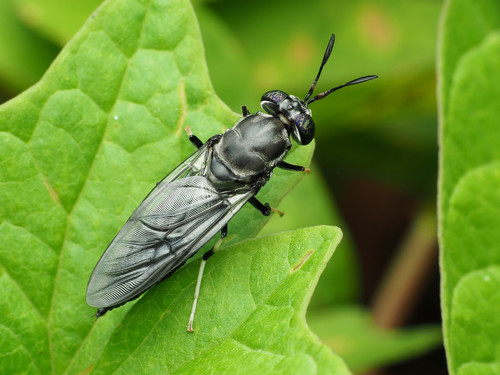 Black Soldier FlyHermetia illucens
-
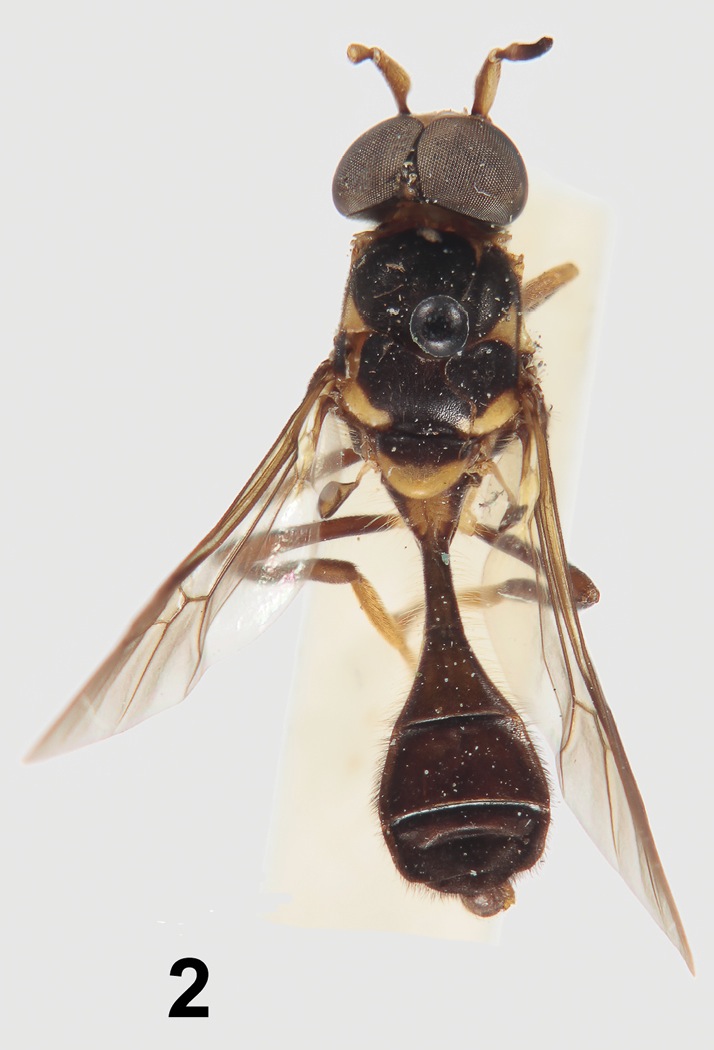 Parastratiosphecomyia stratiosphecomyioides
Compare
Questions and answers
What is the scientific name of the Broad Centurion?
The scientific name of the Broad Centurion is Chloromyia formosa. Written with its author, the full name is Chloromyia formosa (Scopoli, 1763).
Which family does the Broad Centurion belong to?
Chloromyia formosa belongs to the family Stratiomyidae, in the order Diptera and the class Insecta.
Where is the Broad Centurion found?
Checklists and occurrence records place Chloromyia formosa in 39 countries, including United Kingdom, The Netherlands, Germany, France, Sweden and Italy.
What other names does the Broad Centurion have?
Chloromyia formosa is also known in English as Broad Centurion Fly.
Sources
Passages the profile rests on
- The wings are yellowish-brown. Source passage: “The wings are yellowish-brown.” — English Wikipedia
- The legs are black except for the yellow knees. Source passage: “The legs are black, only the knees are yellow.” — English Wikipedia
- The antennae are short, and the first antennal segment is longer than the second. Source passage: “Antennae are short, the first antennal segment is longer than the second.” — English Wikipedia
- Female eyes are separated from each other. Source passage: “The female's eyes are separated from each other.” — English Wikipedia
- The eyes are densely hairy. Source passage: “It has densely hairy eyes” — pmc.ncbi.nlm.nih.gov
- The larva resembles species of the genus Sargus but has seven to nine longitudinal stripes, including one central dark stripe. Source passage: “The larva is similar in appearance to Sargus Fabricius, 1798, but with more numerous longitudinal stripes (7–9), and one central dark stripe” — pmc.ncbi.nlm.nih.gov
- Adults measure 7.3–9 millimetres in body length. Source passage: “Chloromyia formosa can reach a length of 7.3–9 millimetres” — English Wikipedia
- The wings measure 6–7 millimetres in length. Source passage: “and a wing length of 6–7 millimetres (0.24–0.28 in).” — English Wikipedia
- The species mainly inhabits wooded areas, hedgerows, moist forests, wet meadows, parks and gardens. Source passage: “These flies mainly inhabit wooded areas, hedge rows, moist forests, wet meadows, parks and gardens.” — English Wikipedia
- The species occurs in damp habitats with fertile soil, including grassland and woodland. Source passage: “Chloromyia formosa can be found in a range of habitats, usually damp and with fertile soil, grassland and woodland.” — pmc.ncbi.nlm.nih.gov
- Larvae can occur in compost and grass tussocks. Source passage: “The larvae can be found in their breeding substrate, e.g. compost, or in grass tussocks.” — pmc.ncbi.nlm.nih.gov
- Adults feed on flower nectar, particularly from plants in the Apiaceae family. Source passage: “feeding on nectar of flowers (mainly of Apiaceae species)” — English Wikipedia
- Adults feed on pollen from Filipendula ulmaria. Source passage: “and on pollen of Filipendula ulmaria (Rosaceae).” — English Wikipedia
- Adults feed on flowers, particularly umbellifers such as hogweed. Source passage: “Adults frequent flowers, particularly umbellifers such as hogweed, on which they feed.” — pmc.ncbi.nlm.nih.gov
- Larvae feed on dead leaves and other decaying plant material. Source passage: “feeding on dead leaves and other decaying vegetal substances.” — English Wikipedia
- Larvae develop in rotting vegetation, compost or cow dung. Source passage: “The larvae develop in rotting vegetation, compost or cow dung” — pmc.ncbi.nlm.nih.gov
- Adults are generally observed between April and August. Source passage: “Adults can mostly be encountered from April through August” — English Wikipedia
- Adults are on the wing from early May until the end of August, occasionally into early October. Source passage: “The adults are on the wing from early May to the end of August, occasionally to the beginning of October” — pmc.ncbi.nlm.nih.gov
- Adult activity peaks in early July. Source passage: “peaking in early July” — pmc.ncbi.nlm.nih.gov
- Males have occasionally been observed hovering above the ground. Source passage: “Males have been occasionally observed hovering above ground” — pmc.ncbi.nlm.nih.gov
- The species exhibits swarming behaviour. Source passage: “swarming behaviour has also been noted in this species” — pmc.ncbi.nlm.nih.gov
- Adults mate several times between April and August. Source passage: “Between April and August these insects mate several times.” — English Wikipedia
- Larvae develop in humus-rich soil. Source passage: “The larvae develop in humus-rich soil” — English Wikipedia
- Larvae overwinter after reaching their final developmental stage. Source passage: “After reaching the final stage larvae overwinter.” — English Wikipedia
- Chloromyia formosa is the only species of its genus occurring in Britain. Source passage: “It is the only species from the genus Chloromyia Duncan, 1837 occurring in Britain.” — pmc.ncbi.nlm.nih.gov
- The larva resembles larvae of the genus Sargus. Source passage: “The larva is similar in appearance to Sargus Fabricius, 1798” — pmc.ncbi.nlm.nih.gov
Data
- Catalogue of Life, 2026-10-16 XR cc by
- Global Biodiversity Information Facility CC BY 4.0
- Wikidata CC0
- GeoNames CC BY 4.0
- Wikimedia Commons per image; credit shown with each image
- Within the Catalogue of Life, this name comes from Systema Dipterorum cc by
References
- Scopoli, J.A. (1763) Entomologia carniolica ... I. T. Trattner, Vindobonae [=Vienna]. [36] + 420 + [1] pp. [before 1763.06.23]. where the name was published
This species in other databases
Page built on 27 November 2026. See how the catalog is made and all sources and licences.
Cite this page
ScientificNames.org. (2026). Chloromyia formosa (Broad Centurion). Retrieved November 27, 2026, from https://scientificnames.org/species/chloromyia-formosa
“Chloromyia formosa (Broad Centurion).” ScientificNames.org, 2026, scientificnames.org/species/chloromyia-formosa. Accessed 27 Nov. 2026.
ScientificNames.org. “Chloromyia formosa (Broad Centurion).” Accessed November 27, 2026. https://scientificnames.org/species/chloromyia-formosa.
@misc{scientificnames_chloromyia_formosa_broad_centurion,
  author = {{ScientificNames.org}},
  title = {Chloromyia formosa (Broad Centurion)},
  year = {2026},
  url = {https://scientificnames.org/species/chloromyia-formosa},
  note = {Accessed 2026-11-27}
}