Species · Birds
Greater Green Leafbird Chloropsis sonnerati
The scientific name of the Greater Green Leafbird is Chloropsis sonnerati. It is a species of bird in the family Chloropseidae (leafbird), order Passeriformes. The name dates from 1827.
- Scientific name
- Chloropsis sonnerati Jardine & Selby, 1827
- Common name
- Greater Green Leafbird
- Genus
- Chloropsis
- Family
- Chloropseidae (Leafbird)
- Order
- Passeriformes
- Class
- Aves
- Red List category
- EN Endangered
- Recorded in
- 4 countries
- Name status
- accepted in the Catalogue of Life

Overview
Chloropsis sonnerati occurs in Brunei, Indonesia, Malaysia, Myanmar, Singapore and Thailand, throughout the Sundaic lowlands. The male has a black mask and throat, while the female has a yellow throat and a yellow eye ring.
Written 26 November 2026 from the sources listed below. Each statement was checked against the passage it cites; statements that could not be supported were removed.
Appearance
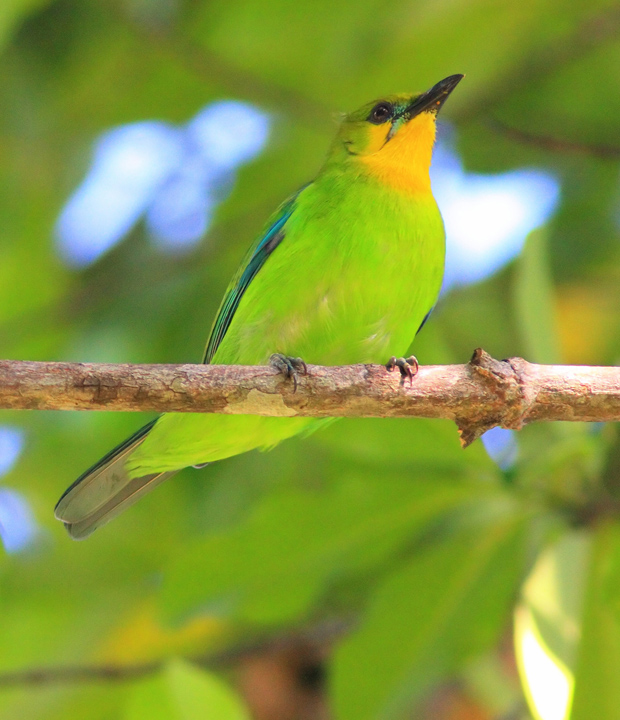
The male has a black mask and throat. It lacks the yellow border along the black throat patch that occurs in the lesser green leafbird.[1][2]
The female has a powerful beak, a yellow throat and a yellow eye ring.[3]
Habitat
The species inhabits subtropical or tropical moist lowland forests and mangrove forests. It primarily inhabits old-growth forest but also occurs in secondary forest and forest edges.[4][5]
It occurs in the canopy of lowland evergreen forest.[6]
Diet
The species frequently visits fruiting fig trees for food. It also eats insects and small invertebrates.[7][8]
Behaviour
The species moves conspicuously through the canopy by jumping between branches and flying from tree to tree. It joins mixed-species flocks in the forest canopy.[9][10]
It produces a loud ascending whistle.[11]
Conservation
The species is threatened by trapping for the cage bird trade. It has become rare or disappeared from large parts of its range.[12][13]
Similar species
The lesser green leafbird (Chloropsis cyanopogon) is distinguished by the yellow border along the male's black throat patch, which the Greater Green Leafbird lacks.[2][14]
Classification of the Greater Green Leafbird
| Kingdom | Animalia |
|---|---|
| Phylum | Chordata |
| Subphylum | Vertebrata |
| Infraphylum | Gnathostomata |
| Parvphylum | Osteichthyes |
| Megaclass | Tetrapoda |
| Class | Aves (Bird) |
| Order | Passeriformes (Passerine) |
| Family | Chloropseidae (Leafbird) |
| Genus | Chloropsis (Leafbird) |
| Species | Chloropsis sonnerati Jardine & Selby, 1827 |
Where the Greater Green Leafbird is found
Checklists and occurrence records place Chloropsis sonnerati in 4 countries. GBIF holds 991 georeferenced records of it.
Countries
Regions and cities with the most records
- Sabah, Malaysia 157
- Sarawak, Malaysia 135
- Jurong East, Singapore 74
- Jurong Town, Singapore 74
- Jurong West, Singapore 73
- Anak Bukit, Singapore 72
- Boon Lay, Singapore 72
- Queenstown Estate, Singapore 72
- Bukit Timah, Singapore 71
- Choa Chu Kang New Town, Singapore 69
- Teck Whye, Singapore 69
- Bukit Panjang New Town, Singapore 68
- Keat Hong Village, Singapore 68
- Yew Tee, Singapore 66
- Novena, Singapore 63
- Marsiling, Singapore 57
- Singapore, Singapore 57
- Ang Mo Kio New Town, Singapore 56
- Woodlands, Singapore 55
- Yio Chu Kang, Singapore 51
- Yishun New Town, Singapore 48
- Johor Bahru, Malaysia 47
- MacPherson, Singapore 47
- Sungai Simpang, Singapore 47
- Iskandar Puteri, Malaysia 46
- Eunos, Singapore 45
- Marine Parade, Singapore 45
- Sembawang Estate, Singapore 44
- Sengkang New Town, Singapore 44
- Ulu Bedok, Singapore 42
- Bedok New Town, Singapore 41
- Kampong Pasir Ris, Singapore 41
- Matilda Estate, Singapore 41
- Perling, Malaysia 40
- Phetchaburi, Thailand 40
- Punggol, Singapore 39
A number beside a place is its count of GBIF occurrence records. A place without a number comes from a checklist alone. Records show where a species has been observed or collected, which can include escapes and vagrants.
Common names
English
- Greater Green Leafbird
Names in 26 other languages
- Catalan
- verdet gros
- Chinese
- 大綠葉鵯, 大绿叶鹎
- Croatian
- velika zelenka
- Czech
- sýkavka větší
- Danish
- Smaragdbladfugl
- Dutch
- Diksnavelbladvogel
- Esperanto
- granda kloropseo
- Estonian
- suur-viherlüüdik
- Finnish
- viherlehvi
- French
- Verdin de Sonnerat
- German
- Dickschnabel-Blattvogel, Dickschnabelblattvogel
- Hungarian
- vastagcsőrű levélmadár
- Indonesian
- Cica-daun besar
- Italian
- Fogliarolo verde maggiore
- Japanese
- オオコノハドリ
- Lithuanian
- didysis žaliasis lapinukas
- Polish
- zielenik duży
- Portuguese
- Verdinho-de-Sonnerat, verdim-grande, verdinho-grande
- Russian
- Большая (зелёная) листовка, Большая зелёная листовка, Большая листовка
- Slovak
- zelenáčik veľkozobý
- Spanish
- Verdín de Sonnerat
- Swedish
- smaragdbladfågel
- Thai
- นกเขียวก้านตองใหญ่
- Turkish
- Sonnerat Yaprakkuşu
- Ukrainian
- зеленчик великий
- Welsh
- aderyn dail gwyrdd mawr
Subspecies and varieties
- Chloropsis sonnerati sonnerati subspecies
- Chloropsis sonnerati zosterops subspecies
Related species
-
 Golden-fronted LeafbirdChloropsis aurifrons
-
 Orange-bellied LeafbirdChloropsis hardwickii
-
 Jerdon's LeafbirdChloropsis jerdoni
-
 Javan LeafbirdChloropsis cochinchinensis
-
 Philippine LeafbirdChloropsis flavipennis
-
 Lesser Green LeafbirdChloropsis cyanopogon
-
 Yellow-throated LeafbirdChloropsis palawanensis
-
 Blue-masked LeafbirdChloropsis venusta
Compare
Questions and answers
What is the scientific name of the Greater Green Leafbird?
The scientific name of the Greater Green Leafbird is Chloropsis sonnerati. Written with its author, the full name is Chloropsis sonnerati Jardine & Selby, 1827.
Which family does the Greater Green Leafbird belong to?
Chloropsis sonnerati belongs to the family Chloropseidae, in the order Passeriformes and the class Aves.
Where is the Greater Green Leafbird found?
Checklists and occurrence records place Chloropsis sonnerati in 4 countries: Malaysia, Indonesia, Thailand and Singapore.
What is the conservation status of the Greater Green Leafbird?
The IUCN Red List category recorded for Chloropsis sonnerati is Endangered (EN).
Where does the Greater Green Leafbird occur?
It occurs in Brunei, Indonesia, Malaysia, Myanmar, Singapore and Thailand. Within Indonesia, it occurs in Sumatra, Borneo, the Natuna Islands, Java and Bali.[15][16]
What does the Greater Green Leafbird eat?
It frequently visits fruiting fig trees for food and also eats insects and small invertebrates.[7][8]
Sources
Passages the profile rests on
- The male has a black mask and throat. Source passage: “Male has a black mask and throat.” — ebird.org
- The male lacks the yellow border along the black throat patch that occurs in the lesser green leafbird. Source passage: “lack of a yellow border along the black throat patch found in the male C. cyanopogan.” — English Wikipedia
- The female has a powerful beak, a yellow throat and a yellow eye ring. Source passage: “It is distinguished from the lesser green leafbird (Chloropsis cyanopogon) by its powerful beak, yellow throat and eye ring of the female” — English Wikipedia
- The species inhabits subtropical or tropical moist lowland forests and mangrove forests. Source passage: “Its natural habitats are subtropical or tropical moist lowland forest and subtropical or tropical mangrove forest” — English Wikipedia
- The species primarily inhabits old-growth forest but also occurs in secondary forest and forest edges. Source passage: “mainly old-growth forest but also secondary forest and edges.” — English Wikipedia
- The species occurs in the canopy of lowland evergreen forest. Source passage: “Vivid green bird of lowland evergreen forest canopy” — ebird.org
- The species frequently visits fruiting fig trees for food. Source passage: “It often visits fruiting fig trees” — English Wikipedia
- The species also eats insects and small invertebrates. Source passage: “but also takes insects and small invertebrates.” — English Wikipedia
- The species moves conspicuously through the canopy by jumping between branches and flying from tree to tree. Source passage: “It moves quite conspicuously at the canopy level, jumping between branches and flying from tree to tree.” — English Wikipedia
- The species joins mixed-species flocks in the forest canopy. Source passage: “where it joins mixed flocks.” — ebird.org
- The species produces a loud ascending whistle. Source passage: “The greater green leafbird has a loud voice, consisting of an ascending whistle chee-zi-chee.” — English Wikipedia
- The species is threatened by trapping for the cage bird trade. Source passage: “The species is threatened by trapping for the cage bird trade” — English Wikipedia
- The species has become rare or disappeared from large parts of its range. Source passage: “has become rare or even disappeared in large parts of its range.” — English Wikipedia
- The lesser green leafbird (Chloropsis cyanopogon) is distinguished from this species by the yellow border along the male's black throat patch. Source passage: “lack of a yellow border along the black throat patch found in the male C. cyanopogan.” — English Wikipedia
- The species occurs in Brunei, Indonesia, Malaysia, Myanmar, Singapore and Thailand. Source passage: “It is found in Brunei, Indonesia, Malaysia, Myanmar, Singapore, and Thailand.” — English Wikipedia
- Within Indonesia, the species occurs in Sumatra, Borneo, the Natuna Islands, Java and Bali. Source passage: “In Indonesia, it is found in Sumatra, Borneo, Natuna Islands, Java and Bali.” — English Wikipedia
Data
- Catalogue of Life, 2026-10-16 XR cc by
- Global Biodiversity Information Facility CC BY 4.0
- Wikidata CC0
- GeoNames CC BY 4.0
- Wikimedia Commons per image; credit shown with each image
- Within the Catalogue of Life, this name comes from The Integrated Taxonomic Information System cc0
References
- Jardine, William & Prideaux J. Selby. 1827. Illustrations of Ornithology. W.H. Lizars, Edinburgh. Vol. 1: pt.1: A-F, pls.1-16. where the name was published
- Gill, Frank, & and Minturn Wright. (2006). Birds of the World: Recommended English Names.
This species in other databases
Page built on 26 November 2026. See how the catalog is made and all sources and licences.
Cite this page
ScientificNames.org. (2026). Chloropsis sonnerati (Greater Green Leafbird). Retrieved November 26, 2026, from https://scientificnames.org/species/chloropsis-sonnerati
“Chloropsis sonnerati (Greater Green Leafbird).” ScientificNames.org, 2026, scientificnames.org/species/chloropsis-sonnerati. Accessed 26 Nov. 2026.
ScientificNames.org. “Chloropsis sonnerati (Greater Green Leafbird).” Accessed November 26, 2026. https://scientificnames.org/species/chloropsis-sonnerati.
@misc{scientificnames_chloropsis_sonnerati_greater_green_leafbird,
  author = {{ScientificNames.org}},
  title = {Chloropsis sonnerati (Greater Green Leafbird)},
  year = {2026},
  url = {https://scientificnames.org/species/chloropsis-sonnerati},
  note = {Accessed 2026-11-26}
}