Species · Insects
Ash Cicada Cicada orni
The scientific name of the Ash Cicada is Cicada orni. It is a species of insect in the family Cicadidae (cicada), order Hemiptera. The name dates from 1758.
- Scientific name
- Cicada orni Linnaeus, 1758
- Common name
- Ash Cicada
- Genus
- Cicada
- Family
- Cicadidae (Cicada)
- Order
- Hemiptera
- Class
- Insecta
- Recorded in
- 43 countries
- Name status
- accepted in the Catalogue of Life
Overview
Cicada orni occurs in southern and central Europe and the Near East.
Written 26 November 2026 from the sources listed below. Each statement was checked against the passage it cites; statements that could not be supported were removed.
Appearance
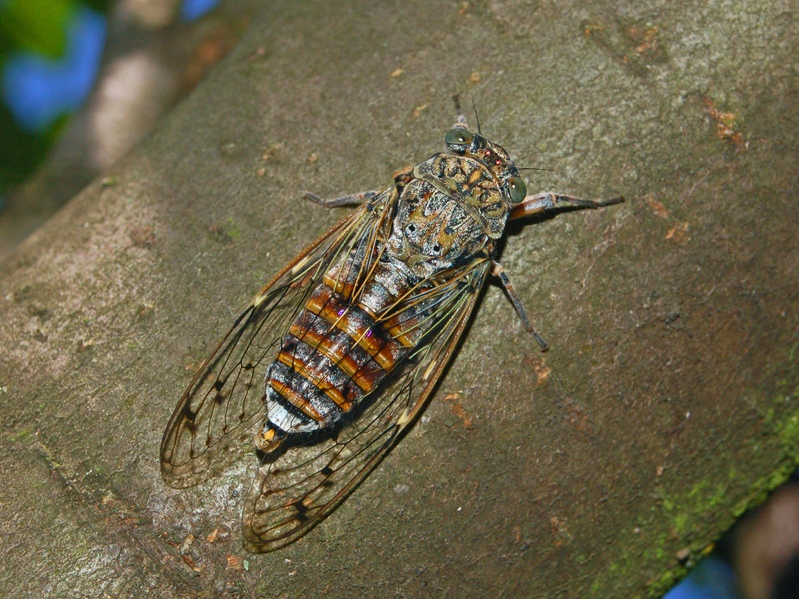
The adult body has cryptic coloration ranging from brown to gray. The abdomen has reddish segments covered with silky pubescence.[1][2]
The head has large, prominent eyes positioned far apart on its sides and bears three small ocelli on its upper surface. The species has short antennae and a long proboscis used for feeding on sap.[3][4][5]
The membranous forewings are transparent and bear several characteristic black spots. Adults reach approximately 25 millimetres in body length, with a wingspan of approximately 70 millimetres.[6][7][8]
Diet
Adults feed on sap extracted from trees and shrubs. Larvae feed on juices obtained from plant roots.[9][10]
Behaviour
Adult individuals are encountered feeding during summer. Only males produce the species' calling song, a clicking sound produced through the contraction and relaxation of abdominal membranes called tymbals.[11][12][13]
Male calling songs function to attract females for mating. Males commonly sing in aggregations on sunny tree branches.[14][15]
During courtship, individuals repeatedly embrace and touch one another with their legs. Mating takes place at the location where courtship occurs.[16][17]
Classification of the Ash Cicada
| Kingdom | Animalia |
|---|---|
| Phylum | Arthropoda |
| Subphylum | Hexapoda |
| Class | Insecta (Insect) |
| Order | Hemiptera |
| Suborder | Auchenorrhyncha (True Hoppers) |
| Infraorder | Cicadomorpha |
| Parvorder | Clypeata |
| Superfamily | Cicadoidea |
| Family | Cicadidae (Cicada) |
| Subfamily | Cicadinae |
| Tribe | Cicadini |
| Genus | Cicada |
| Species | Cicada orni Linnaeus, 1758 |
Where the Ash Cicada is found
Checklists and occurrence records place Cicada orni in 43 countries across Africa, Asia and Europe. GBIF holds 22,709 georeferenced records of it.
Countries
- Albania 40
- Algeria 2
- Armenia 6
- Austria 39
- Azerbaijan 4
- Belgium 70
- Bosnia and Herzegovina 16
- Bulgaria 23
- Croatia 915
- Cyprus 5
- Czechia 2
- Egypt 1
- France 12,413
- Georgia 136
- Germany 18
- Greece 1,269
- Hungary 51
- India 1
- Iran 15
- Israel 1
- Italy 2,483
- Jordan 1
- Lebanon 2
- Luxembourg 3
- Malta 4
- Montenegro 53
- North Macedonia 9
- Palestinian Territory 2
- Portugal 985
- Romania 7
- Russia 168
- Serbia 193
- Slovakia 1
- Slovenia 19
- Spain 1,213
- Sweden 7
- Switzerland 2,317
- The Netherlands 104
- Tunisia 2
- Turkey 22
- Turkmenistan 1
- Ukraine 84
- United Kingdom 2
Regions and cities with the most records
- Provence-Alpes-Côte d'Azur, France 5,952
- Occitanie, France 3,736
- Auvergne-Rhône-Alpes, France 1,402
- Valais, Switzerland 1,001
- Catalonia, Spain 808
- Orange, France 750
- Ticino, Switzerland 707
- Arles, France 679
- Bagnols-sur-Cèze, France 675
- Istres, France 673
- Le Pontet, France 667
- Sorgues, France 654
- Antibes, France 630
- Castelnau-le-Lez, France 629
- Mauguio, France 624
- Vence, France 620
- L'Isle-sur-la-Sorgue, France 618
- Avignon, France 615
- Cagnes-sur-Mer, France 613
- Juan-les-Pins, France 612
- Montpellier, France 593
- Saint-Laurent-du-Var, France 587
- Odivelas, Portugal 564
- Campo Grande, Portugal 563
- Carnide, Portugal 563
- Miramas, France 561
- Pontinha, Portugal 561
- Bellinzona, Switzerland 560
- Ramada, Portugal 560
- Alfornelos, Portugal 559
- Alvalade, Portugal 559
- Lumiar, Portugal 559
- Sete Rios, Portugal 559
- Areeiro, Portugal 558
- Damaia, Portugal 555
- Benfica, Portugal 554
Range as the checklists state it
Naxos and Mikres Kyklades
Islas Baleares
Transcarpathia
Peloponnisos
A number beside a place is its count of GBIF occurrence records. A place without a number comes from a checklist alone. Records show where a species has been observed or collected, which can include escapes and vagrants.
Common names
English
- Ash Cicada
Names in 16 other languages
- Catalan
- Cigala del pi
- Croatian
- Jasenov cvrčak, Manin cvrčak
- Czech
- cikáda jasanová
- Danish
- Sangcikade
- Dutch
- Kraakcicade
- French
- Cacan, Cigale de l'orne, Cigale grise, Cigale panachée
- German
- Eschensingzikade, Eschenzikade, Mannasingzikade
- Greek
- Τζίτζικας του φράξου
- Hungarian
- mannakabóca
- Italian
- Cicala del frassino
- Polish
- Piewik mannik
- Portuguese
- Cega-rega, Cegarrega, Cigarra‑comum
- Russian
- Цикада ясеневая
- Slovak
- cikáda jaseňová
- Spanish
- Cigarra Común
- Turkish
- Dişbudak Ağustos Böceği
Synonyms
11 other scientific names have been used for this species and are now treated as synonyms of Cicada orni.
- Cicada (Tettigia) orni Linnaeus, 1758
- Cicada (Tettigonia) orni Linnaeus, 1758
- Cicada ormi Linnaeus, 1758
- Cicada orni lesbosiensis Boulard, 2000
- Cicada ornia Linnaeus, 1758
- Macroprotopus oleae Costa, 1877
- Tettigia (Tettigia) orni (Linnaeus, 1758)
- Tettigia orni punctata (Fabricius, 1798)
- Tettigonia orni (Linnaeus, 1758)
- Tibicen orni (Linnaeus, 1758)
- Tettigonia punctata Fabricius, 1798 ambiguous synonym
Related species
-
 Cicada barbara
-
 Cretan CicadaCicada cretensis
- East Aegean CicadaCicada mordoganensis
- Cicada albicans
- Cicada albida
- Cicada asius
- Cicada casmatmema
- Cicada cerisyi
Compare
Questions and answers
What is the scientific name of the Ash Cicada?
The scientific name of the Ash Cicada is Cicada orni. Written with its author, the full name is Cicada orni Linnaeus, 1758.
Which family does the Ash Cicada belong to?
Cicada orni belongs to the family Cicadidae, in the order Hemiptera and the class Insecta.
Where is the Ash Cicada found?
Checklists and occurrence records place Cicada orni in 43 countries, including France, Italy, Switzerland, Greece, Spain and Portugal.
Sources
Passages the profile rests on
- The adult body has cryptic coloration ranging from brown to gray. Source passage: “The cryptic coloration of the body varies from brown to gray.” — English Wikipedia
- The abdomen has reddish segments covered with silky pubescence. Source passage: “The abdomen has reddish segments and a silky pubescence.” — English Wikipedia
- The head has large, prominent eyes positioned far apart on its sides. Source passage: “The head shows large and prominent eyes far apart on the sides” — English Wikipedia
- The head bears three small ocelli on its upper surface. Source passage: “three small eyes (ocelli) located on the top” — English Wikipedia
- The species has short antennae and a long proboscis used for feeding on sap. Source passage: “short antennae, and a long proboscis used for feeding on sap.” — English Wikipedia
- Its membranous forewings are transparent and bear several characteristic black spots. Source passage: “The membranous front wings are transparent with several characteristic black spots.” — English Wikipedia
- Adult individuals reach approximately 25 millimetres in body length. Source passage: “Adult Cicada orni reach approximately 25 millimetres (0.98 in) in length” — English Wikipedia
- The wingspan of adults is approximately 70 millimetres. Source passage: “with a wingspan of about 70 millimetres (2.8 in).” — English Wikipedia
- Adults feed on sap extracted from trees and shrubs. Source passage: “Adult cicadas can be encountered in summer feeding on sap from trees or shrubs” — English Wikipedia
- Larvae feed on juices obtained from plant roots. Source passage: “the larvae live for several years underground, feeding on the juices of plant roots.” — English Wikipedia
- Adult individuals are encountered feeding during summer. Source passage: “Adult cicadas can be encountered in summer feeding on sap from trees or shrubs” — English Wikipedia
- Only males produce the species' calling song. Source passage: “Only males produce their calling song” — English Wikipedia
- The male calling song is a clicking sound produced through the contraction and relaxation of abdominal membranes called tymbals. Source passage: “a clicking sound caused by the contraction and relaxation of abdominal membranes (tymbal).” — English Wikipedia
- Male calling songs function to attract females for mating. Source passage: “This song has the function of sexual attraction for females.” — English Wikipedia
- Males commonly sing in aggregations on sunny tree branches. Source passage: “Usually males sing in aggregations of many individuals on sunny tree branches.” — English Wikipedia
- During courtship, individuals repeatedly embrace and touch one another with their legs. Source passage: “cicadas repeatedly hug and touch each other with their legs.” — English Wikipedia
- Mating takes place at the location where courtship occurs. Source passage: “At the end of this process they mate in the same place.” — English Wikipedia
Data
- Catalogue of Life, 2026-10-16 XR cc by
- Global Biodiversity Information Facility CC BY 4.0
- Wikidata CC0
- GeoNames CC BY 4.0
- Wikimedia Commons per image; credit shown with each image
- Within the Catalogue of Life, this name comes from 3i World Auchenorrhyncha Database cc0
References
- Linnaeus, C. (1758a) II. Hemiptera. In Systema naturae per regna tria naturae, secundum classes, ordines, genera, species, cum characteribus, differentiis, synonymis, locis. Tomus I. Editio decima, reformata. Laurentius Salvius, Holmiae. pp. 434–439. [iv + 823 + 1 (Emendanda, Addenda) pp.] https://doi.org/10.5962/bhl.title.542 where the name was published
- Nast, J. (1972a) Palaearctic Auchenorrhyncha (Homoptera). An annotated check list. Polish Scientific Publishers, Warszawa, 550 pp.
- Nast, J. (1987a) The Auchenorrhyncha (Homoptera) of Europe. Annales Zoologici, Warszaw, 40(15), 535–661.
This species in other databases
Page built on 26 November 2026. See how the catalog is made and all sources and licences.
Cite this page
ScientificNames.org. (2026). Cicada orni (Ash Cicada). Retrieved November 26, 2026, from https://scientificnames.org/species/cicada-orni
“Cicada orni (Ash Cicada).” ScientificNames.org, 2026, scientificnames.org/species/cicada-orni. Accessed 26 Nov. 2026.
ScientificNames.org. “Cicada orni (Ash Cicada).” Accessed November 26, 2026. https://scientificnames.org/species/cicada-orni.
@misc{scientificnames_cicada_orni_ash_cicada,
  author = {{ScientificNames.org}},
  title = {Cicada orni (Ash Cicada)},
  year = {2026},
  url = {https://scientificnames.org/species/cicada-orni},
  note = {Accessed 2026-11-26}
}