Species · Other invertebrates
Social Tunicate Clavelina robusta
The scientific name of the Social Tunicate is Clavelina robusta. It is a species of animal in the family Clavelinidae, order Aplousobranchia. The name dates from 1990.
- Scientific name
- Clavelina robusta Kott, 1990
- Common name
- Social Tunicate
- Genus
- Clavelina
- Family
- Clavelinidae
- Order
- Aplousobranchia
- Class
- Ascidiacea
- Environment
- marine
- Recorded in
- 6 countries
- Name status
- accepted in the Catalogue of Life
Overview
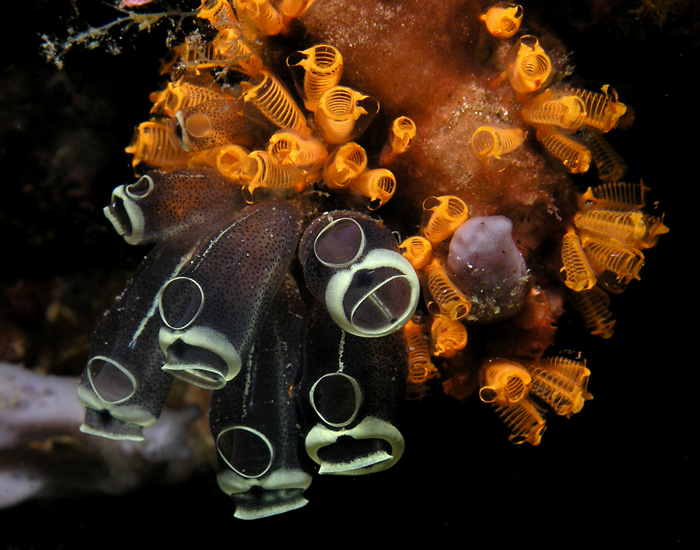
Social Tunicate occurs in the Western Pacific. It has cylindrical zooids with fluorescent green, yellow, or white rings surrounding both siphons.
Written 27 November 2026 from the sources listed below. Each statement was checked against the passage it cites; statements that could not be supported were removed.
Appearance
The zooids are cylindrical and measure between 2 and 4 cm in length. Their colour ranges from black and dark blue to gray.[1][2][3]
Individual zooids have fluorescent green, yellow, or white rings surrounding both siphons. The external covering consists of a firm basal matrix and is somewhat transparent and soft.[4][5][6]
Habitat
Social Tunicate commonly occurs in dense clusters.[7]
Diet
Social Tunicate obtains food through filter feeding.[8]
Behaviour
Social Tunicate is sessile and can form large colonies.[9][10]
Classification of the Social Tunicate
| Kingdom | Animalia |
|---|---|
| Phylum | Chordata |
| Subphylum | Tunicata |
| Class | Ascidiacea |
| Order | Aplousobranchia |
| Family | Clavelinidae |
| Genus | Clavelina (Blue Choirboys) |
| Species | Clavelina robusta Kott, 1990 |
Where the Social Tunicate is found
Checklists and occurrence records place Clavelina robusta in 6 countries. GBIF holds 233 georeferenced records of it.
Countries
Regions and cities with the most records
- Bitung, Indonesia 33
- Daanbantayan, Philippines 16
- Manado, Indonesia 13
- Romblon, Philippines 12
- Wongsorejo, Indonesia 11
- Bauan, Philippines 8
- Danao, Philippines 8
- San Pascual, Philippines 7
- Tagbilaran City, Philippines 7
- Sabah, Malaysia 5
- Batangas, Philippines 4
- Dili, Timor Leste 3
- Taal, Philippines 3
- Western Australia, Australia 3
A number beside a place is its count of GBIF occurrence records. A place without a number comes from a checklist alone. Records show where a species has been observed or collected, which can include escapes and vagrants.
Common names
English
- Social Tunicate
Names in 1 other language
- French
- Ascidie à bouche claire
Related species
-
 Skeleton Panda Sea SquirtClavelina ossipandae
-
 Bluebell TunicateClavelina moluccensis
-
 Light-bulb Sea SquirtClavelina lepadiformis
-
 Painted TunicateClavelina picta
-
 Clavelina australis
-
 Clavelina coerulea
-
 Clavelina sabbadini
-
 Lightbulb TunicateClavelina huntsmani
Compare
Questions and answers
What is the scientific name of the Social Tunicate?
The scientific name of the Social Tunicate is Clavelina robusta. Written with its author, the full name is Clavelina robusta Kott, 1990.
Which family does the Social Tunicate belong to?
Clavelina robusta belongs to the family Clavelinidae, in the order Aplousobranchia and the class Ascidiacea.
Where is the Social Tunicate found?
Checklists and occurrence records place Clavelina robusta in 6 countries: Indonesia, Philippines, Australia, Malaysia, Solomon Islands and Timor Leste.
Which are tunicate characteristics?
Social Tunicate has cylindrical zooids measuring between 2 and 4 cm in length. The zooids range in colour from black and dark blue to gray and have fluorescent green, yellow, or white rings surrounding both siphons. The species is sessile and obtains food through filter feeding.[1][2][3][4][9][8]
Sources
Passages the profile rests on
- The zooids of Clavelina robusta are cylindrical in shape. Source passage: “It has large 2–4 cm cylindrical zooids.” — English Wikipedia
- Individual zooids measure between 2 and 4 cm in length. Source passage: “It has large 2–4 cm cylindrical zooids.” — English Wikipedia
- The zooids range in colour from black and dark blue to gray. Source passage: “They generally range from black to dark blue to gray in colour” — English Wikipedia
- Individual zooids have fluorescent green, yellow, or white rings surrounding both siphons. Source passage: “individual zooids having fluorescent green, yellow, or white rings around both siphons.” — English Wikipedia
- The external covering consists of a firm basal matrix. Source passage: “The external cover has a firm basal matrix” — English Wikipedia
- The external covering is somewhat transparent and soft. Source passage: “and is somewhat transparent and soft.” — English Wikipedia
- Clavelina robusta commonly occurs in dense clusters. Source passage: “This species frequently occurs in dense clusters.” — English Wikipedia
- Clavelina robusta obtains food through filter feeding. Source passage: “Like all ascidians, these sessile animals are filter feeders.” — English Wikipedia
- Clavelina robusta is sessile. Source passage: “Like all ascidians, these sessile animals are filter feeders.” — English Wikipedia
- Clavelina robusta can form large colonies. Source passage: “Clavelina robusta is found, often in large colonies” — English Wikipedia
Data
- Catalogue of Life, 2026-10-16 XR cc by
- Global Biodiversity Information Facility CC BY 4.0
- Wikidata CC0
- GeoNames CC BY 4.0
- Wikimedia Commons per image; credit shown with each image
- Within the Catalogue of Life, this name comes from World Register of Marine Species cc by
References
- Kott, P. (1990). The Australian Ascidiacea, part 2, Aplousobranchia (1). Mem. Qd Mus., 29. where the name was published
This species in other databases
- Catalogue of Life VV8P
- Wikidata Q4919352
- iNaturalist 318922
- WoRMS urn:lsid:marinespecies.org:taxname:250326
Page built on 28 November 2026. See how the catalog is made and all sources and licences.
Cite this page
ScientificNames.org. (2026). Clavelina robusta (Social Tunicate). Retrieved November 28, 2026, from https://scientificnames.org/species/clavelina-robusta
“Clavelina robusta (Social Tunicate).” ScientificNames.org, 2026, scientificnames.org/species/clavelina-robusta. Accessed 28 Nov. 2026.
ScientificNames.org. “Clavelina robusta (Social Tunicate).” Accessed November 28, 2026. https://scientificnames.org/species/clavelina-robusta.
@misc{scientificnames_clavelina_robusta_social_tunicate,
  author = {{ScientificNames.org}},
  title = {Clavelina robusta (Social Tunicate)},
  year = {2026},
  url = {https://scientificnames.org/species/clavelina-robusta},
  note = {Accessed 2026-11-28}
}