Species · Fishes
Keyhole Cichlid Cleithracara maronii
The scientific name of the Keyhole Cichlid is Cleithracara maronii. It is a species of fish in the family Cichlidae (cichlid), order Cichliformes. The name dates from 1881.
- Scientific name
- Cleithracara maronii (Steindachner, 1881)
- Common name
- Keyhole Cichlid
- Genus
- Cleithracara
- Family
- Cichlidae (Cichlid)
- Order
- Cichliformes
- Class
- Teleostei
- Environment
- brackish, freshwater
- Recorded in
- 3 countries
- Name status
- accepted in the Catalogue of Life
Overview
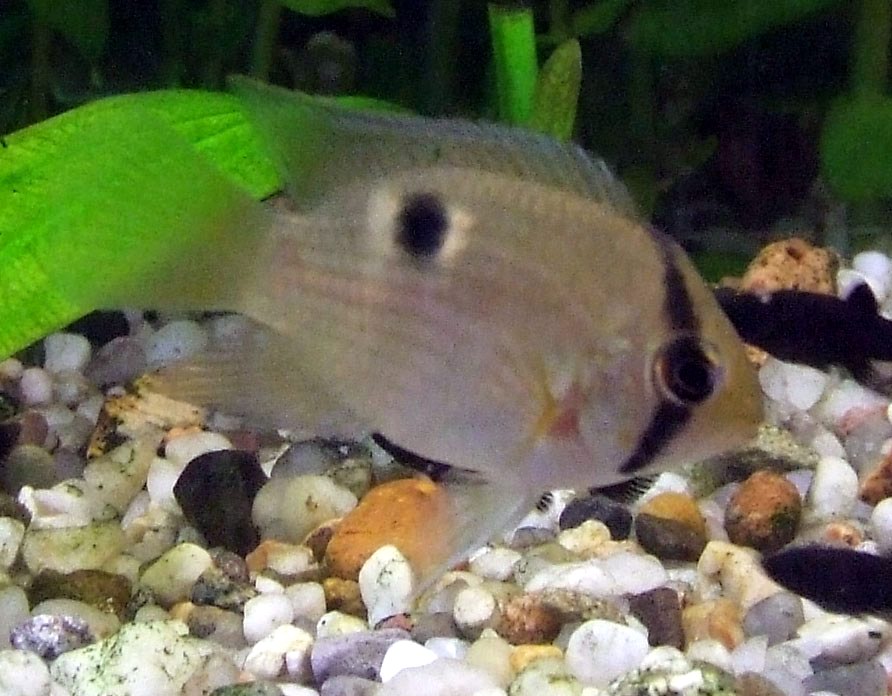
Keyhole Cichlid (Cleithracara maronii) is a fish in the family Cichlidae, order Cichliformes and class Teleostei. It occurs in the lower Orinoco Basin of Venezuela and river basins in The Guianas. It has a small, tan-coloured, oval body with a black spot on its upper flank that sometimes extends into a short stripe.
Written 26 November 2026 from the sources listed below. Each statement was checked against the passage it cites; statements that could not be supported were removed.
Appearance
The Keyhole Cichlid has a small, tan-coloured body with an oval shape. A black spot on its upper flank sometimes extends into a short stripe.[1][2]
When startled or nervous, the fish develops blotchy coloration and presses its body against rocks or logs for camouflage. The sexes are difficult to distinguish, although some males have longer and more pointed dorsal fins.[3][4]
Habitat
The species is endemic to tropical South America, occurring in the lower Orinoco Basin of Venezuela and river basins in The Guianas.[5]
Behaviour
The Keyhole Cichlid is generally shy and peaceful. It is unsuitable for keeping with aggressive fish.[6]
Reproduction and life cycle
The species is a monogamous breeder, and both parents provide care for the offspring. Eggs are deposited on flattened rocks, logs or leaves.[7][8]
The typical clutch size ranges from 300 to 400 eggs. Both male and female fish tend the eggs, and an individual spawning event involving 1,000 eggs has been observed.[9][10][11]
Diet
The species feeds on crustaceans, insects and other invertebrates. In captivity, it accepts a wide variety of prepared fish foods and also eats beetles introduced into its aquarium.[12][13][14]
Uses
The Keyhole Cichlid is popular among fishkeeping hobbyists and is frequently kept in aquariums. It is suitable for community aquariums.[15][16]
Similar species
The Keyhole Cichlid is the sole member of the genus Cleithracara.[17]
Conservation
The estimated minimum population doubling time for the species is less than 15 months. Its phylogenetic diversity index is 1.0000.[18][19]
The U.S. Fish and Wildlife Service lists the species under the common name keyhole cichlid.[20]
Classification of the Keyhole Cichlid
| Kingdom | Animalia |
|---|---|
| Phylum | Chordata |
| Subphylum | Vertebrata |
| Infraphylum | Gnathostomata |
| Parvphylum | Osteichthyes |
| Gigaclass | Actinopterygii |
| Superclass | Actinopteri |
| Class | Teleostei (Teleost) |
| Order | Cichliformes |
| Family | Cichlidae (Cichlid) |
| Subfamily | Cichlinae |
| Genus | Cleithracara (Keyhole Cichlids) |
| Species | Cleithracara maronii (Steindachner, 1881) |
Where the Keyhole Cichlid is found
Checklists and occurrence records place Cleithracara maronii in 3 countries. GBIF holds 376 georeferenced records of it.
Countries
Regions and cities with the most records
- Kourou, French Guiana 17
- Sipaliwini District, Suriname 14
- Demerara-Mahaica, Guyana 10
- Upper Demerara-Berbice, Guyana 7
- Para District, Suriname 6
- Barima-Waini, Guyana 3
1 more country has a few records outside this range
These countries hold a few records of Cleithracara maronii but lie outside the range the checklists give for it. Such records are often zoo or garden specimens, museum material or vagrants, so the species is not counted as occurring there.
A number beside a place is its count of GBIF occurrence records. A place without a number comes from a checklist alone. Records show where a species has been observed or collected, which can include escapes and vagrants.
Common names
English
- Keyhole Cichlid
Names in 6 other languages
- Afrikaans
- Sleutelgat-kurper
- Czech
- akara hnědá
- Danish
- Nøglehulcichlide
- Finnish
- avainkirjoahven
- French
- Acara du Maroni
- Polish
- Akara z Maronii
Synonyms
3 other scientific names have been used for this species and are now treated as synonyms of Cleithracara maronii.
- Acara maronii Steindachner, 1881
- Aequidens maronii (Steindachner, 1881)
- Cleithracara maroni (Steindachner, 1881)
Related species
-
 OscarAstronotus ocellatus
-
 Nile TilapiaOreochromis niloticus
-
 Green ChromideEtroplus suratensis
-
 Convict CichlidAmatitlania nigrofasciata
-
 Ram CichlidMikrogeophagus ramirezi
-
 Mozambique TilapiaOreochromis mossambicus
-
 Blue AcaraAndinoacara pulcher
- Jack DempseyRocio octofasciata
Compare
Questions and answers
What is the scientific name of the Keyhole Cichlid?
The scientific name of the Keyhole Cichlid is Cleithracara maronii. Written with its author, the full name is Cleithracara maronii (Steindachner, 1881).
Which family does the Keyhole Cichlid belong to?
Cleithracara maronii belongs to the family Cichlidae, in the order Cichliformes and the class Teleostei.
Where is the Keyhole Cichlid found?
Checklists and occurrence records place Cleithracara maronii in 3 countries: French Guiana, Suriname and Guyana.
Can keyhole cichlids be aggressive?
The species is generally shy and peaceful. It is unsuitable for keeping with aggressive fish.[6]
How to gender a keyhole cichlid?
The sexes are difficult to distinguish, although some males have longer and more pointed dorsal fins.[4]
Sources
Passages the profile rests on
- The species has a small, tan-coloured body with an oval shape. Source passage: “The species is a small tan coloured ovate-bodied fish.” — English Wikipedia
- The species has a black spot on its upper flank that sometimes extends into a short stripe. Source passage: “It has a black spot on its upper flank which sometimes extends into a short stripe.” — English Wikipedia
- When startled or nervous, the fish develops blotchy coloration and presses its body against rocks or logs for camouflage. Source passage: “When the species is startled or nervous it assumes a blotchy colouration and presses its body against rocks or logs in an attempt to camouflage itself.” — English Wikipedia
- The sexes are difficult to distinguish, although some males have longer and more pointed dorsal fins. Source passage: “The sexes are difficult to distinguish, though some males have a longer and more pointed dorsal fin.” — English Wikipedia
- The species is endemic to tropical South America, occurring in the lower Orinoco Basin of Venezuela and river basins in The Guianas. Source passage: “The keyhole cichlid (Cleithracara maronii) is a cichlid fish endemic to tropical South America, occurring in the lower Orinoco Basin in Venezuela and river basins in The Guianas.” — English Wikipedia
- The species is generally shy and peaceful and is unsuitable for keeping with aggressive fish. Source passage: “It is generally shy, peaceful and should not be kept with aggressive species.” — English Wikipedia
- The species is a monogamous breeder in which both parents provide care for the offspring. Source passage: “It is a monogamous, biparentally custodial breeder which spawns on flattened rocks, logs or leaves.” — English Wikipedia
- The species deposits its eggs on flattened rocks, logs or leaves. Source passage: “It is a monogamous, biparentally custodial breeder which spawns on flattened rocks, logs or leaves.” — English Wikipedia
- The typical clutch size ranges from 300 to 400 eggs. Source passage: “Clutch size ranges from 300-400 eggs that are tended by both the male and female.” — English Wikipedia
- Both male and female fish tend the eggs. Source passage: “Clutch size ranges from 300-400 eggs that are tended by both the male and female.” — English Wikipedia
- An individual spawning event involving 1,000 eggs has been observed. Source passage: “There has been a sighting of a keyhole cichlid laying 1000 eggs.” — English Wikipedia
- The species feeds on crustaceans, insects and other invertebrates. Source passage: “The species feeds on crustaceans, insects and other invertebrates.” — English Wikipedia
- In captivity, the species accepts a wide variety of prepared fish foods. Source passage: “The species is suitable for the community aquarium and will accept a wide variety of prepared fish food in captivity.” — English Wikipedia
- The species also eats beetles introduced into its aquarium. Source passage: “It will also eat beetles that have been dropped in the tank.” — English Wikipedia
- The species is popular among fishkeeping hobbyists and is frequently kept in aquariums. Source passage: “The species is popular with fishkeeping hobbyists and is frequently kept in aquariums.” — English Wikipedia
- The species is suitable for community aquariums. Source passage: “The species is suitable for the community aquarium and will accept a wide variety of prepared fish food in captivity.” — English Wikipedia
- The species is the sole member of the genus Cleithracara. Source passage: “It is the only species in the genus Cleithracara.” — English Wikipedia
- The species has a phylogenetic diversity index of 1.0000. Source passage: “PD50 = 1.0000 [Uniqueness, from 0.5 = low to 2.0 = high].” — fishbase.se
- The estimated minimum population doubling time for the species is less than 15 months. Source passage: “High, minimum population doubling time less than 15 months (Preliminary K or Fecundity.).” — fishbase.se
- The U.S. Fish and Wildlife Service lists the species under the common name keyhole cichlid. Source passage: “Scientific Name Cleithracara maronii Common Name keyhole cichlid Kingdom Animalia” — fws.gov
Data
- Catalogue of Life, 2026-10-16 XR cc by
- Global Biodiversity Information Facility CC BY 4.0
- Wikidata CC0
- GeoNames CC BY 4.0
- Wikimedia Commons per image; credit shown with each image
- Within the Catalogue of Life, this name comes from World Register of Marine Species cc by
This species in other databases
- Catalogue of Life VXNV
- Wikidata Q795072
- iNaturalist 611363
- WoRMS urn:lsid:marinespecies.org:taxname:405367
- ITIS 648188
Page built on 27 November 2026. See how the catalog is made and all sources and licences.
Cite this page
ScientificNames.org. (2026). Cleithracara maronii (Keyhole Cichlid). Retrieved November 27, 2026, from https://scientificnames.org/species/cleithracara-maronii
“Cleithracara maronii (Keyhole Cichlid).” ScientificNames.org, 2026, scientificnames.org/species/cleithracara-maronii. Accessed 27 Nov. 2026.
ScientificNames.org. “Cleithracara maronii (Keyhole Cichlid).” Accessed November 27, 2026. https://scientificnames.org/species/cleithracara-maronii.
@misc{scientificnames_cleithracara_maronii_keyhole_cichlid,
  author = {{ScientificNames.org}},
  title = {Cleithracara maronii (Keyhole Cichlid)},
  year = {2026},
  url = {https://scientificnames.org/species/cleithracara-maronii},
  note = {Accessed 2026-11-27}
}