Species · Reptiles
Spotted Turtle Clemmys guttata
The scientific name of the Spotted Turtle is Clemmys guttata. It is a species of reptile in the family Emydidae (terrapins), order Testudines. The name dates from 1792.
- Scientific name
- Clemmys guttata (Schneider, 1792)
- Common name
- Spotted Turtle
- Genus
- Clemmys
- Family
- Emydidae (Terrapins)
- Order
- Testudines
- Class
- Reptilia
- Red List category
- EN Endangered
- Environment
- freshwater
- Recorded in
- 2 countries
- Name status
- accepted in the Catalogue of Life

Overview
Clemmys guttata occurs from southern Maine, Quebec and Ontario south to Florida, and west to central Indiana and Ohio. It is distinguished by a black or bluish black upper shell marked with yellow spots and yellow spots on its head, neck and limbs.
Written 26 November 2026 from the sources listed below. Each statement was checked against the passage it cites; statements that could not be supported were removed.
Appearance
The Spotted Turtle has a smooth, low-profile upper shell that is black or bluish black and marked with yellow spots. The upper shell can have between zero and approximately one hundred yellow spots.[1][2]
Yellow spots also occur on the head, neck and limbs. The dorsal skin is black with sparse yellow spots, while the ventral skin can be orange, pink or red.[3][4]
The lower shell is yellow or orange-yellow with a black spot on each section, although it can become entirely black with age. The head is black, with a notched upper jaw and a large orange blotch on each side.[5][6]
Females have more shell spots on average than males and grow slightly larger on average. Southern populations tend to have smaller and less conspicuous shell spots than northern populations.[7][8][9]
Habitat
Suitable habitat requires soft substrate and at least some aquatic vegetation. Optimal habitat includes shallow, slow-moving water, muddy soil, sedge tussocks, water lilies, sphagnum moss and cattails.[10][11]
The species is also found near ponds, swamps and streamside habitats. It avoids artificial reservoirs and deep open-water environments.[12][13]
Diet
The Spotted Turtle is an omnivore that feeds exclusively in water. Its plant foods include aquatic vegetation, green algae and wild cranberries.[14][15]
Its animal foods include insect larvae, worms, slugs, millipedes, spiders, crustaceans, tadpoles, salamanders and small fish. The species begins feeding at water temperatures above 14.2 °C.[16][17]
Behaviour
The Spotted Turtle hunts aquatic prey by directing its head into aquatic plants. It is relatively diurnal.[18][19]
The species becomes active early in spring, even when water temperatures are relatively cold. Activity generally peaks during April and May in the northern part of its range.[20][21]
The species becomes inactive during winter freezing conditions and extreme summer heat. During summer dormancy, individuals may burrow into leaf litter or remain in muskrat burrows and other aquatic refuges.[22][23]
Individuals can spend substantial periods on land and bask on grass near water. When startled while basking, they have been observed diving into water and burying themselves in bottom mud.[24][25]
Individual home ranges generally cover approximately 0.5–3.5 hectares.[26]
Reproduction and life cycle
Sexual maturity is generally reached at approximately eight years of age. Courtship and nesting typically occur between March and June.[27][28]
During courtship, females may be chased by one or several males for approximately 15–30 minutes. Females construct nests in well-drained locations exposed to full sunlight.[29][30]
Clutches contain between one and eight eggs, averaging three to four. Egg incubation lasts approximately 70–83 days.[31][32]
The species exhibits temperature-dependent sex determination, with lower incubation temperatures producing males and higher temperatures producing females.[33]
Conservation
The Spotted Turtle is identified as an endangered species of the genus Clemmys. Thirty-six of the 104 recorded Spotted Turtle sites in Ontario are known to have lost their populations.[34][35]
Canadian Spotted Turtle populations are generally small, isolated and contain fewer than 200 individuals each.[36]
Similar species
The Spotted Turtle is the only living species in the genus Clemmys.[37]
Classification of the Spotted Turtle
| Kingdom | Animalia |
|---|---|
| Phylum | Chordata |
| Subphylum | Vertebrata |
| Infraphylum | Gnathostomata |
| Parvphylum | Osteichthyes |
| Megaclass | Tetrapoda |
| Class | Reptilia (Reptile) |
| Order | Testudines (Turtle) |
| Suborder | Cryptodira |
| Superfamily | Testudinoidea |
| Family | Emydidae (Terrapins) |
| Genus | Clemmys (Pond Turtles) |
| Species | Clemmys guttata (Schneider, 1792) |
Where the Spotted Turtle is found
Checklists and occurrence records place Clemmys guttata in 2 countries across North America. GBIF holds 7,991 georeferenced records of it.
Countries
Regions and cities with the most records
- Massachusetts, United States 907
- Virginia, United States 660
- New Jersey, United States 572
- North Carolina, United States 475
- Maryland, United States 358
- Woodlawn, United States 322
- Lorton, United States 317
- Hybla Valley, United States 299
- Franconia, United States 297
- West Springfield, United States 295
- Fort Hunt, United States 294
- Rose Hill, United States 290
- Fort Washington, United States 285
- Springfield, United States 281
- Connecticut, United States 260
- Lincolnia, United States 251
- Alexandria, United States 247
- Lake Ridge, United States 243
- Pennsylvania, United States 241
- Randolph, United States 240
- Brockton, United States 233
- Canton, United States 233
- Stoughton, United States 231
- Annandale, United States 219
- Abington, United States 216
- Braintree, United States 214
- Norwood, United States 211
- Oxon Hill, United States 208
- Burke, United States 206
- New York, United States 206
- Rockland, United States 205
- Baileys Crossroads, United States 203
- Oxon Hill-Glassmanor, United States 202
- Glassmanor, United States 201
- Dedham, United States 200
- Milton, United States 200
1 more country has a few records outside this range
These countries hold a few records of Clemmys guttata but lie outside the range the checklists give for it. Such records are often zoo or garden specimens, museum material or vagrants, so the species is not counted as occurring there.
Range as the checklists state it
Canada (S Ontario, Quebec),
A number beside a place is its count of GBIF occurrence records. A place without a number comes from a checklist alone. Records show where a species has been observed or collected, which can include escapes and vagrants.
Common names
English
- Spotted Turtle
Names in 11 other languages
- Arabic
- سلحفاة منقطة
- Chinese
- 星點龜
- Czech
- želva tečkovaná
- Dutch
- Druppelschildpad
- French
- tortue ponctuée, Émyde à gouttelettes (L')
- German
- Tropfenschildkröte
- Hungarian
- pettyes víziteknős
- Japanese
- キボシイシガメ
- Russian
- Пятнистая черепаха
- Spanish
- Tortuga Moteada de Norteamerica
- Turkish
- Benekli kaplumbağa
Synonyms
5 other scientific names have been used for this species and are now treated as synonyms of Clemmys guttata.
- Chelopus guttatus
- Geoclemmys sebae Gray, 1869
- Testudo anonyma Schneider, 1792
- Testudo guttata Schneider, 1792
- Testudo punctata Schoepff, 1792 ambiguous synonym
Related species
-
 Painted TurtleChrysemys picta
-
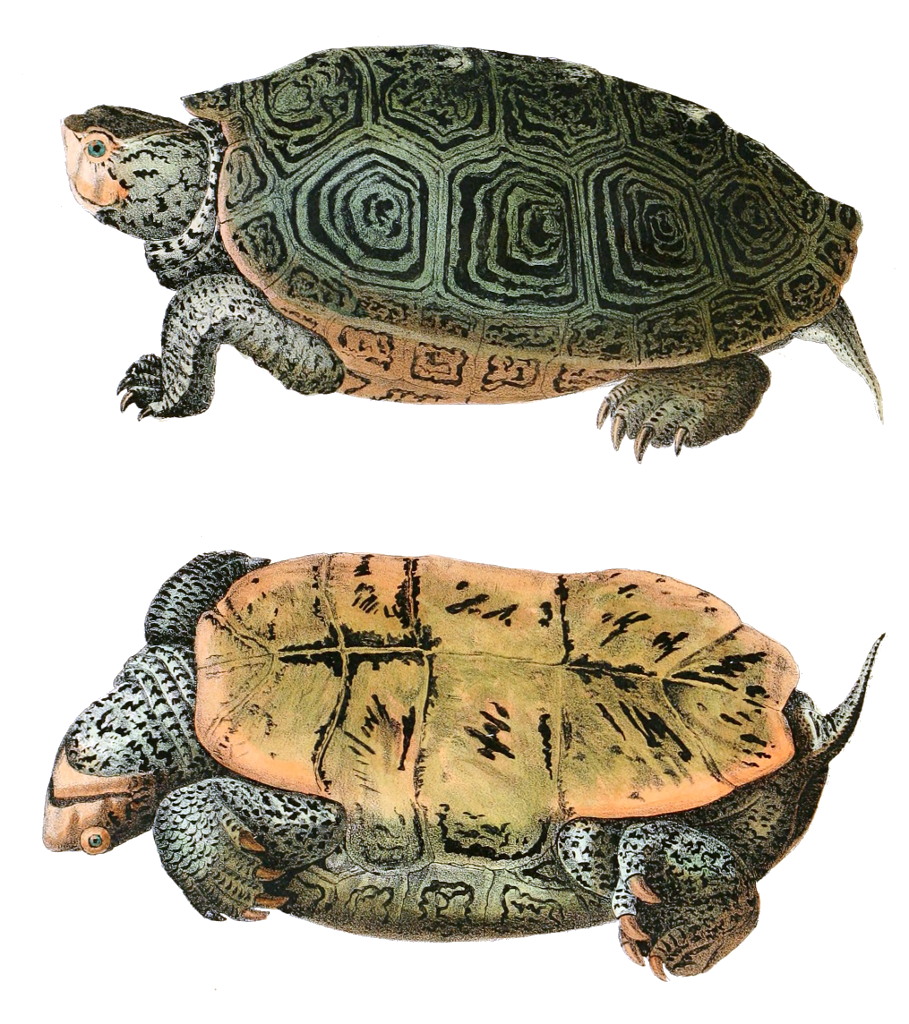 Diamondback TerrapinMalaclemys terrapin
-
 Pond SliderTrachemys scripta
-
 Blanding's TurtleEmydoidea blandingii
-
 Common Box TurtleTerrapene carolina
-
 Wood TurtleGlyptemys insculpta
-
 Bog TurtleGlyptemys muhlenbergii
-
 Maranhão SliderTrachemys adiutrix
Compare
Questions and answers
What is the scientific name of the Spotted Turtle?
The scientific name of the Spotted Turtle is Clemmys guttata. Written with its author, the full name is Clemmys guttata (Schneider, 1792).
Which family does the Spotted Turtle belong to?
Clemmys guttata belongs to the family Emydidae, in the order Testudines and the class Reptilia.
Where is the Spotted Turtle found?
Checklists and occurrence records place Clemmys guttata in 2 countries: United States and Canada.
What is the conservation status of the Spotted Turtle?
The IUCN Red List category recorded for Clemmys guttata is Endangered (EN).
How rare is a spotted turtle?
Canadian Spotted Turtle populations are generally small, isolated and contain fewer than 200 individuals each. Thirty-six of the 104 recorded Spotted Turtle sites in Ontario are known to have lost their populations. The species is identified as endangered.[34][35][36]
What is a spotted turtle's habitat?
The Spotted Turtle inhabits shallow freshwater environments, including flooded forests, marshes, wet meadows, bogs and woodland streams. Suitable habitat requires soft substrate and at least some aquatic vegetation.[38][10]
Sources
Passages the profile rests on
- The spotted turtle has a smooth, low-profile upper shell that is black or bluish black and marked with yellow spots. Source passage: “Their broad, smooth, low upper shell, or carapace, reaches 8–12 cm (3.1–4.7 in) upon adulthood, and ranges in its exact colour from black to a bluish black with a number of tiny yellow round spots.” — English Wikipedia
- The upper shell can have between zero and approximately one hundred yellow spots. Source passage: “It is also totally black and contains anywhere from zero to about one hundred yellow spots” — English Wikipedia
- Yellow spots occur on the turtle's head, neck and limbs. Source passage: “Spots can always be found on the head, neck, and limbs.” — English Wikipedia
- The dorsal skin is black with sparse yellow spots, while the ventral skin can be orange, pink or red. Source passage: “Skin on the dorsal side of the turtle is black with sparse yellow spots while skin on the ventral side may be brighter: orange, pink, or red.” — English Wikipedia
- The lower shell is yellow or orange-yellow with a black spot on each section, although it can become entirely black with age. Source passage: “The bottom shell (plastron) is yellow or orange-yellow and a black spot is present on each section (scute); however, with age, melanism of the plastron increases until the entire surface is black.” — English Wikipedia
- The turtle has a black head, a notched upper jaw and a large orange blotch on each side of its head. Source passage: “The head is black and the upper jaw is notched. On each side of the head is a large orange blotch.” — English Wikipedia
- Southern populations tend to have smaller and less conspicuous shell spots than northern populations. Source passage: “southern individuals tend to have smaller and less conspicuous spots than those of individuals from farther north.” — English Wikipedia
- Females have more shell spots on average than males. Source passage: “Also, females have more spots than males (on average).” — English Wikipedia
- Females grow slightly larger than males on average. Source passage: “On average, females grow to be slightly larger than males.” — English Wikipedia
- Suitable habitat requires soft substrate and at least some aquatic vegetation. Source passage: “For a habitat to be sufficient for spotted turtle survival it must have areas of soft substrate and at least some aquatic vegetation.” — English Wikipedia
- Optimal habitat includes shallow, slow-moving water, muddy soil, sedge tussocks, water lilies, sphagnum moss and cattails. Source passage: “An optimum habitat would include shallow and slow-moving waters with soft muddy soil, sedge tussocks, water lilies, sphagnum moss, and cattails.” — English Wikipedia
- The species avoids artificial reservoirs and deep open-water environments. Source passage: “The spotted turtle avoids artificial reservoirs and deep, open-water areas.” — English Wikipedia
- The species is also found near ponds, swamps and streamside habitats. Source passage: “The spotted turtle is a small species of turtle found near ponds, swamps and streamside habitats in the eastern United States and lower Canada.” — nationalzoo.si.edu
- The spotted turtle is an omnivore that feeds exclusively in water. Source passage: “It is omnivorous and eats exclusively in the water” — English Wikipedia
- Its plant foods include aquatic vegetation, green algae and wild cranberries. Source passage: “consuming plant material including aquatic vegetation, green algae, and in at least one instance, wild cranberries.” — English Wikipedia
- Its animal foods include insect larvae, worms, slugs, millipedes, spiders, crustaceans, tadpoles, salamanders and small fish. Source passage: “Animal food includes aquatic insect larvae, worms, slugs, millipedes, spiders, crustaceans, tadpoles, salamanders, and several genera of small fish.” — English Wikipedia
- The species begins feeding at water temperatures above 14.2 °C. Source passage: “It feeds at temperatures above 14.2 °C (57.6 °F)” — English Wikipedia
- The spotted turtle hunts aquatic prey by directing its head into aquatic plants. Source passage: “The spotted turtle is an active hunter: seeking out prey items in the water by pointing its head into aquatic plants.” — English Wikipedia
- Spotted turtles are relatively diurnal. Source passage: “Spotted turtles are a relatively diurnal species, being active” — mass.gov
- The species becomes active early in spring, even when water temperatures are relatively cold. Source passage: “Spotted turtles do become active very early in the spring, and are often active at relatively cold water temperatures during that season.” — English Wikipedia
- Activity generally peaks during April and May in the northern part of the species' range. Source passage: “Activity appears to peak during April and May in the northern part of the range.” — English Wikipedia
- The species becomes inactive during winter freezing conditions and extreme summer heat. Source passage: “During the freezing temperatures of winter and the extreme heat of summer, spotted turtles become inactive during environmentally unfavorable conditions.” — English Wikipedia
- During summer dormancy, individuals may burrow into leaf litter or remain in muskrat burrows and other aquatic refuges. Source passage: “During summer dormancy, the turtles may burrow into leaf litter in woodlands or marsh edges or open fields; others remain in muskrat burrows or other aquatic refuges.” — English Wikipedia
- The species can spend substantial periods on land and bask on grass near water. Source passage: “The spotted turtle can be decidedly terrestrial, spending a good amount of time on land and sometimes basking on patches of grass near its body of water.” — English Wikipedia
- When startled while basking, spotted turtles have been observed diving into water and burying themselves in bottom mud. Source passage: “Spotted turtles have been observed to dive into the water and bury themselves in the bottom mud when surprised while basking.” — English Wikipedia
- Individual home ranges generally cover approximately 0.5–3.5 hectares. Source passage: “Spotted turtles home ranges tend to occupy limited areas of about 0.5 to 3.5 hectares (1.2 to 8.6 acres).” — English Wikipedia
- Sexual maturity is generally reached at approximately eight years of age. Source passage: “Sexual maturity is not reached until age 8” — English Wikipedia
- Courtship and nesting typically occur between March and June. Source passage: “courtship and nesting periods typically ranged from March until June.” — English Wikipedia
- Female spotted turtles may be chased by one or several males for approximately 15–30 minutes during courtship. Source passage: “females being frantically chased by one to several males for approximately 15 to 30 minutes.” — English Wikipedia
- Females construct nests in well-drained locations exposed to full sunlight. Source passage: “Females later constructed their nest in well-drained areas that were exposed to full sunlight.” — English Wikipedia
- Clutches contain between one and eight eggs, averaging three to four. Source passage: “Clutches can range from 1–8 with an average of 3–4.” — English Wikipedia
- Egg incubation lasts approximately 70–83 days. Source passage: “Incubation periods were estimated to range between 70 and 83 days.” — English Wikipedia
- The species exhibits temperature-dependent sex determination, with lower incubation temperatures producing males and higher temperatures producing females. Source passage: “males resulting from the temperature being lower and females when it's higher.” — English Wikipedia
- The spotted turtle is identified as an endangered species of the genus Clemmys. Source passage: “the only endangered species of the genus Clemmys” — inaturalist.org
- Thirty-six of the 104 recorded spotted turtle sites in Ontario are known to have lost their populations. Source passage: “Of the original 104 sites noted, 36 are known to no longer have spotted turtles.” — English Wikipedia
- Canadian spotted turtle populations are generally small, isolated and contain fewer than 200 individuals each. Source passage: “the majority of the populations are small, they all have less than 200 individuals, and the areas are all isolated from one another.” — English Wikipedia
- The spotted turtle is the only living species in the genus Clemmys. Source passage: “The spotted turtle is the only species in the genus Clemmys” — English Wikipedia
- The species inhabits shallow freshwater environments, including flooded forests, marshes, wet meadows, bogs and woodland streams. Source passage: “shallow, fresh-water areas such as flooded forests, marshes, wet meadows, bogs and woodland streams” — English Wikipedia
Data
- Catalogue of Life, 2026-10-16 XR cc by
- Global Biodiversity Information Facility CC BY 4.0
- Wikidata CC0
- GeoNames CC BY 4.0
- Wikimedia Commons per image; credit shown with each image
- Within the Catalogue of Life, this name comes from The Reptile Database cc by
References
- Schneider, J. G. (1792). Beschreibung und Abbildung einer neuen Art von Wasserschildkröte nebst Bestimmungen einiger bisher wenig bekannten fremden Arten. Schriften Der Gesellschaft Naturforschender Freunde Zu Berlin 10: 259-283 [1791].
- Ritgen, F. A. (1828). Versuch einer natürlichen Eintheilung der Vögel. Nova Acta Physico-Medica Academiae Caesareae Leopoldino-Carolinae Naturae Curiosorum, 14: 245–284.
- Sowerby, & James de Carle and Edward Lear. (1872). Tortoises, terrapins, and turtles: drawn from life. London, Paris, and Frankfort :H. Sotheran, J. Baer & Co.
- Wright, A. H. (1918). Notes on Clemmys. Proc. Biol. Soc. Washington 31: 51-58.
- Walker, C. (1931). Notes on Reptiles in the Collection of the Ohio State Museum. Copeia 1931 (1): 9-13.
- Netting, M. (1936). Hibernation and Migration of the Spotted Turtle, Clemmys guttata (Schneider). Copeia, 1936(2), 112-112.
- Conant, & Roger. (1938). The Reptiles of Ohio. American Midland Naturalist 20 (1): 1-200.
- Netting, & Graham, M. (1940). The spotted turtle, Clemmys guttata (Schneider) (an addition to the herpetofauna of West Virginia). Proceedings, West Virginia Academy of Science 14: 146-147.
- Mehrtens, J. M. (1949). Copulation of Clemmys guttata and Pseudemys troostii elegans. Herpetologica 5 (6): 150.
- Moski, H. C. (1957). Algal occurrence on the turtle Clemmys guttata. Copeia 1957 (1): 50-51.
- Folkerts, G.W. & A.C. Skorepa. (1967). A Spotted Turtle, Clemmys guttata (Schneider), from Southeastern Georgia. Herpetologica 23 (1): 63.
- Ernst, C. H. (1967). A mating aggregation of the turtle Clemmys guttata. Copeia 1967 (2): 473-474.
- Ernst, C. H. (1968). Homing ability in the spotted turtle, Clemmys guttata (Schneider). Herpetologica 24 (1): 77-78.
- Manns, B. (1969). Notes on Clemmys guttata as a scavenger in a Parkville, Maryland pond. Bull. Maryland Herpetol. Soc., 5(2): 57.
- Ernst, C. H. (1970). Reproduction in Clemmys guttata. Herpetologica 26 (2): 228-232.
- Ernst, C. H. (1970). Home range of the spotted turtle, Clemmys guttata (Schneider). Copeia 1970 (2): 391-393.
- Graham, Terry E. (1970). Growth Rate of the Spotted Turtle, Clemmys guttata, in Southern Rhode Island. Journal of Herpetology 4 (1-2): 87-88.
- Ernst, Carl H. (1972). Clemmys guttata. Catalogue of American Amphibians and Reptiles (124): 1-2.
- Ernst, C. H. (1975). Growth of the Spotted Turtle, Clemmys guttata. Journal of Herpetology 9 (3): 313-318.
- Merkle, D. A. (1975). A taxonomic analysis of the Clemmys complex (Reptilia: Testudines) utilizing starch gel electrophoresis. Herpetologica 31 (2): 162-166.
- Froom, B. (1976). The turtles of Canada. McClelland & Stewart, Toronto 120 Pp.
- Ward, F. P., Hohmann, C. J., Ulrich, J. F., & Hill, S. E. (1976). Seasonal microhabitat selections of spotted turtles (Clemmys guttata) in Maryland elucidated by radioisotope tracking. Herpetologica 32 (1): 60-64.
- Ernst, C. H. (1976). Ecology of the Spotted Turtle, Clemmys guttata (Reptilia, Testudines, Testudinidae), in Southeastern Pennsylvania. Journal of Herpetology 10 (1): 25-33.
- Bury, R. Bruce; Ernst, Carl H. (1977). Clemmys. Catalogue of American Amphibians and Reptiles (203): 1-2.
- Steiner, H. M. (1977). Lebensraumwahl seniler Clemmys c. caspica in der Osttürkei (Reptilia, Testudines, Emydidae). Salamandra 13 (1): 53.
This species in other databases
- Catalogue of Life VYSQ
- Wikidata Q845189
- iNaturalist 50000
- WoRMS urn:lsid:marinespecies.org:taxname:1500054
- ITIS 173771
Page built on 26 November 2026. See how the catalog is made and all sources and licences.
Cite this page
ScientificNames.org. (2026). Clemmys guttata (Spotted Turtle). Retrieved November 26, 2026, from https://scientificnames.org/species/clemmys-guttata
“Clemmys guttata (Spotted Turtle).” ScientificNames.org, 2026, scientificnames.org/species/clemmys-guttata. Accessed 26 Nov. 2026.
ScientificNames.org. “Clemmys guttata (Spotted Turtle).” Accessed November 26, 2026. https://scientificnames.org/species/clemmys-guttata.
@misc{scientificnames_clemmys_guttata_spotted_turtle,
  author = {{ScientificNames.org}},
  title = {Clemmys guttata (Spotted Turtle)},
  year = {2026},
  url = {https://scientificnames.org/species/clemmys-guttata},
  note = {Accessed 2026-11-26}
}