Species · Flowering plants
Pear Clermontia Clermontia pyrularia
The scientific name of the Pear Clermontia is Clermontia pyrularia. It is a species of flowering plant in the family Campanulaceae (bellflowers), order Asterales.
- Scientific name
- Clermontia pyrularia Hillebr.
- Common name
- Pear Clermontia
- Genus
- Clermontia
- Family
- Campanulaceae (Bellflowers)
- Order
- Asterales
- Class
- Magnoliopsida
- Red List category
- CR Critically Endangered
- Recorded in
- 1 country
- Name status
- accepted in the Catalogue of Life
Overview
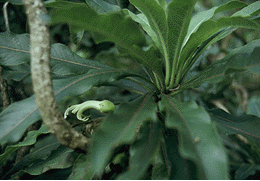
Clermontia pyrularia is endemic to the island of Hawaiʻi, where it grows in montane wet forests and subalpine dry forests on the slopes of Mauna Loa and Mauna Kea. It grows as a small tree and has greenish white two-lipped flowers and pear-shaped fruits.
Written 27 November 2026 from the sources listed below. Each statement was checked against the passage it cites; statements that could not be supported were removed.
Appearance
Pear Clermontia grows as a small tree. Its leaf blades have toothed edges, and its leaves are attached to winged petioles.[1][2][3]
Its flowers are greenish white and have two lips. The flower sepals have green tips.[4][5]
Its fruits are pear-shaped. Its berries have an inversely ovoid or inversely pear-shaped form.[6][7]
Habitat
Its forest habitat occurs on the slopes of Mauna Loa and Mauna Kea. The species occurs at elevations between 3,000 and 7,000 feet.[8][9]
Lythrum maritimum and Rubus hawaiensis are among the plants associated with Pear Clermontia.[10][11]
Reproduction and life cycle
Pear Clermontia flowers during November and December. Its pear-shaped fruits develop shortly after flowering.[12][13]
Native nectar-feeding birds formerly pollinated the species. Fruit-eating birds formerly dispersed its seeds.[14][15]
Conservation
Pear Clermontia is federally listed as an endangered species in the United States. One remaining wild population contains 15 individuals.[16][17]
Propagated individuals have been planted in protected habitat. Some populations have been established through planting at Hakalau National Wildlife Refuge.[18][19]
Feral pigs, black rats, introduced banana passionfruit, introduced weeping rice grass, and introduced kikuyu grass threaten the species.[20][21][22][23][24]
The loss of native nectar-feeding birds likely affects the species. The loss of native fruit-eating birds likely affects its seed dispersal.[25][26]
The species was included in the proposed Hawaii E critical habitat unit. It was assessed for the IUCN Red List in 2003.[27][28]
Classification of the Pear Clermontia
| Kingdom | Plantae |
|---|---|
| Subkingdom | Pteridobiotina |
| Phylum | Tracheophyta |
| Class | Magnoliopsida |
| Order | Asterales |
| Family | Campanulaceae (Bellflowers) |
| Subfamily | Lobelioideae |
| Genus | Clermontia ('ōhā) |
| Species | Clermontia pyrularia Hillebr. |
Where the Pear Clermontia is found
Checklists and occurrence records place Clermontia pyrularia in 1 country across North America. GBIF holds 60 georeferenced records of it.
Countries
Regions and cities with the most records
Range as the checklists state it
Hawaii (Hawaii Isl.)
A number beside a place is its count of GBIF occurrence records. A place without a number comes from a checklist alone. Records show where a species has been observed or collected, which can include escapes and vagrants.
Common names
English
- Pear Clermontia
Names in 1 other language
- Hawaiian
- 'oha wai
Synonyms
One other scientific name has been used for this species and is now treated as a synonym of Clermontia pyrularia.
- Delissea obtusa var. mollis A.Gray
Related species
- Hawaii ClermontiaClermontia hawaiiensis
- Pele ClermontiaClermontia peleana
-
 Hana ClermontiaClermontia samuelii
- Kohala Mountain ClermontiaClermontia drepanomorpha
- Oahu ClermontiaClermontia oblongifolia
-
 Smallflower ClermontiaClermontia parviflora
-
 Tree ClermontiaClermontia arborescens
-
 Hāhā 'ai A KamanuClermontia clermontioides
Compare
Questions and answers
What is the scientific name of the Pear Clermontia?
The scientific name of the Pear Clermontia is Clermontia pyrularia. Written with its author, the full name is Clermontia pyrularia Hillebr..
Which family does the Pear Clermontia belong to?
Clermontia pyrularia belongs to the family Campanulaceae, in the order Asterales and the class Magnoliopsida.
Where is the Pear Clermontia found?
Checklists and occurrence records place Clermontia pyrularia in 1 country: United States.
What is the conservation status of the Pear Clermontia?
The IUCN Red List category recorded for Clermontia pyrularia is Critically Endangered (CR).
Where is Pear Clermontia endemic?
Pear Clermontia is endemic to the island of Hawaiʻi.[29]
When does Pear Clermontia flower?
It flowers during November and December.[12]
How many individuals remain in the wild population?
One remaining wild population contains 15 individuals.[17]
What is the conservation status of Pear Clermontia?
It is federally listed as an endangered species in the United States.[16]
Sources
Passages the profile rests on
- The Pear Clermontia grows as a small tree. Source passage: “This is a small tree” — English Wikipedia
- Its leaf blades have toothed edges. Source passage: “It has toothed leaf blades borne on winged petioles.” — English Wikipedia
- Its leaves are attached to winged petioles. Source passage: “toothed leaf blades borne on winged petioles.” — English Wikipedia
- Its flowers are greenish white and have two lips. Source passage: “greenish white double-lipped flowers” — English Wikipedia
- Its flower sepals have green tips. Source passage: “with green-tipped sepals.” — English Wikipedia
- Its fruits are pear-shaped. Source passage: “Pear-shaped fruits occur soon after.” — English Wikipedia
- Its berries have an inversely ovoid or inversely pear-shaped form. Source passage: “The orange berry is inversely ovoid or inversely pear-shaped.” — ecos.fws.gov
- Its forest habitat occurs on the slopes of Mauna Loa and Mauna Kea. Source passage: “on the slopes of Mauna Loa and Mauna Kea” — English Wikipedia
- The species occurs at elevations between 3,000 and 7,000 feet. Source passage: “between 3,000 and 7,000 ft (910 and 2,130 m).” — English Wikipedia
- Lythrum maritimum occurs among the plants associated with this species. Source passage: “Associated plants include Lythrum maritimum and Rubus hawaiensis.” — English Wikipedia
- Rubus hawaiensis is another plant associated with the Pear Clermontia. Source passage: “Associated plants include Lythrum maritimum and Rubus hawaiensis.” — English Wikipedia
- The species flowers during November and December. Source passage: “The plant blooms in November and December” — English Wikipedia
- Its pear-shaped fruits develop shortly after flowering. Source passage: “Pear-shaped fruits occur soon after.” — English Wikipedia
- Native nectar-feeding birds formerly pollinated the species. Source passage: “native nectar-feeding birds which once pollinated it” — English Wikipedia
- Fruit-eating birds formerly dispersed the species' seeds. Source passage: “fruit-eating birds which dispersed its seeds.” — English Wikipedia
- The Pear Clermontia is federally listed as an endangered species in the United States. Source passage: “This is a federally listed endangered species of the United States.” — English Wikipedia
- One remaining wild population of the species contains 15 individuals. Source passage: “one remaining wild population containing 15 individuals” — English Wikipedia
- Propagated individuals have been planted in protected habitat. Source passage: “several propagated individuals that have been planted in protected habitat.” — English Wikipedia
- Some populations have been established through planting at Hakalau National Wildlife Refuge. Source passage: “A few populations have been planted in Hakalau National Wildlife Refuge.” — English Wikipedia
- Feral pigs threaten the species. Source passage: “Threats to this rare plant include feral pigs, black rats” — English Wikipedia
- Black rats are among the threats to the species. Source passage: “feral pigs, black rats, and introduced plant species” — English Wikipedia
- Introduced banana passionfruit threatens the species. Source passage: “banana passionfruit (Passiflora mollissima)” — English Wikipedia
- Introduced weeping rice grass is among the threats to the species. Source passage: “weeping rice grass (Ehrharta stipoides)” — English Wikipedia
- Introduced kikuyu grass threatens the species. Source passage: “kikuyu grass (Pennisetum clandestinum).” — English Wikipedia
- The loss of native nectar-feeding birds likely affects the species. Source passage: “The plant also likely suffers from the loss of several native nectar-feeding birds” — English Wikipedia
- The loss of native fruit-eating birds likely affects the species' seed dispersal. Source passage: “fruit-eating birds which dispersed its seeds.” — English Wikipedia
- The species was included in the proposed Hawaii E critical habitat unit. Source passage: “The proposed unit Hawaii E provides occupied habitat for three species: Clermontia lindseyana, Clermontia pyrularia, and Phyllostegia racemosa.” — federalregister.gov
- The species was assessed for the IUCN Red List in 2003. Source passage: “Pear Clermontia Clermontia pyrularia has most recently been assessed for The IUCN Red List of Threatened Species in 2003.” — iucnredlist.org
- The species is endemic to the island of Hawaiʻi. Source passage: “It is endemic to the island of Hawaiʻi” — English Wikipedia
Data
- Catalogue of Life, 2026-10-16 XR cc by
- Global Biodiversity Information Facility CC BY 4.0
- Wikidata CC0
- GeoNames CC BY 4.0
- Wikimedia Commons per image; credit shown with each image
- Within the Catalogue of Life, this name comes from Synonymic Checklists of the Vascular Plants of the World cc by
References
- Hillebr. Fl. Hawaiian Isl. [Hillebrand] 243 (1888). where the name was published
This species in other databases
- Catalogue of Life W3JH
- Wikidata Q5131938
- iNaturalist 160734
- World Flora Online wfo-0000830446
- GRIN 320409
Page built on 29 November 2026. See how the catalog is made and all sources and licences.
Cite this page
ScientificNames.org. (2026). Clermontia pyrularia (Pear Clermontia). Retrieved November 29, 2026, from https://scientificnames.org/species/clermontia-pyrularia
“Clermontia pyrularia (Pear Clermontia).” ScientificNames.org, 2026, scientificnames.org/species/clermontia-pyrularia. Accessed 29 Nov. 2026.
ScientificNames.org. “Clermontia pyrularia (Pear Clermontia).” Accessed November 29, 2026. https://scientificnames.org/species/clermontia-pyrularia.
@misc{scientificnames_clermontia_pyrularia_pear_clermontia,
  author = {{ScientificNames.org}},
  title = {Clermontia pyrularia (Pear Clermontia)},
  year = {2026},
  url = {https://scientificnames.org/species/clermontia-pyrularia},
  note = {Accessed 2026-11-29}
}