Species · Insects
New World Screw-worm Fly Cochliomyia hominivorax
The scientific name of the New World Screw-worm Fly is Cochliomyia hominivorax. It is a species of insect in the family Calliphoridae (blow-fly), order Diptera. The name dates from 1858.
- Scientific name
- Cochliomyia hominivorax (Coquerel, 1858)
- Common name
- New World Screw-worm Fly
- Genus
- Cochliomyia
- Family
- Calliphoridae (Blow-fly)
- Order
- Diptera
- Class
- Insecta
- Recorded in
- 18 countries
- Name status
- accepted in the Catalogue of Life
Overview
The species is native to the Western Hemisphere and is typically found in South America and parts of the Caribbean. Its larvae burrow into wounds and feed on healthy living tissue, causing tissue damage.
Written 24 November 2026 from the sources listed below. Each statement was checked against the passage it cites; statements that could not be supported were removed.
Appearance
Adult flies have a metallic blue or green body, orange eyes, and three dark stripes along the upper surface of the thorax. They are approximately the size of a common housefly or slightly larger.[1][2]
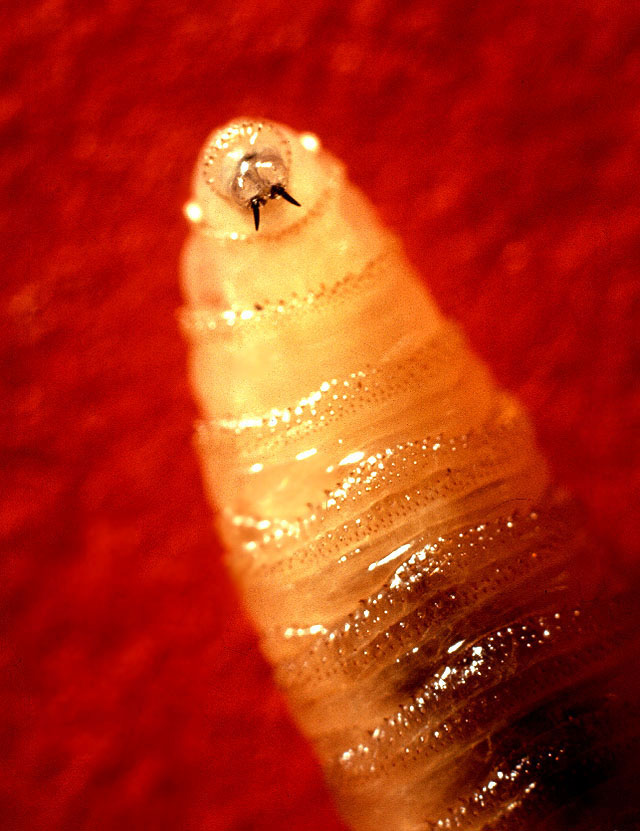
Mature larvae have protruding body spines arranged in a spiral pattern and can reach 17 millimeters in length.[3][4]
Diet
The larvae feed on living tissue and flesh from warm-blooded animals and humans. They consume healthy living tissue rather than relying primarily on dead or necrotic tissue.[5][6]
Behaviour
Adult flies are attracted to the smell of wounds and body openings. Female flies lay eggs in open wounds and body openings, including the eyes, ears, nose, and mouth.[7][8]
Larvae burrow into wounds and feed on the living flesh of their hosts. When a wound is disturbed, feeding larvae may burrow deeper into the host's flesh.[9][10]
The species can infest livestock, pets, wildlife, birds, and humans. It is an obligate parasite whose larvae require living tissue for nourishment.[11][12]
Reproduction and life cycle
Female flies mate approximately four to five days after hatching. They mate only once and retain the male's sperm throughout their lives, while males can mate as many as ten times.[13][14][15]
Mating takes place on vegetation. A female can lay between 250 and 500 eggs in exposed flesh and can produce as many as 3,000 eggs during her lifetime.[16][17][18]
Larvae leave their hosts after approximately three to seven days and pupate in the ground. Adult flies emerge approximately seven days after pupation begins.[19][20]
Conservation
The United States and Panama jointly manage and fund a sterile fly production facility through COPEG.[21]
Uses
The species has been used in research and control programs involving the sterile insect technique.[22]
Similar species
Cochliomyia macellaria resembles Cochliomyia hominivorax in having a metallic blue body and three stripes. In Cochliomyia macellaria, all three thoracic stripes begin at the same point behind the head.[23][24]
Unlike Cochliomyia hominivorax, adult Cochliomyia macellaria does not lay eggs on living animals and its larvae do not infest them.[25]
Habitat
The larvae inhabit wounds in living animals, where they feed and cause tissue damage.[26]
Classification of the New World Screw-worm Fly
| Kingdom | Animalia |
|---|---|
| Phylum | Arthropoda |
| Subphylum | Hexapoda |
| Class | Insecta (Insect) |
| Order | Diptera (Fly) |
| Family | Calliphoridae (Blow-fly) |
| Subfamily | Chrysomyinae |
| Genus | Cochliomyia |
| Species | Cochliomyia hominivorax (Coquerel, 1858) |
Where the New World Screw-worm Fly is found
Checklists and occurrence records place Cochliomyia hominivorax in 18 countries. GBIF holds 815 georeferenced records of it.
Countries
- Argentina 4
- Brazil 140
- Chile 6
- Colombia 54
- Costa Rica 35
- Cuba 53
- Dominican Republic 53
- Ecuador 14
- French Guiana 6
- Jamaica 8
- Mexico 164
- Panama 19
- Peru 8
- Puerto Rico 14
- Trinidad and Tobago 26
- United States 200
- Uruguay 4
- Venezuela 7
Regions and cities with the most records
- Texas, United States 108
- Campeche, Mexico 58
- Dallas, United States 45
- Grand Prairie, United States 45
- Irving, United States 45
- Mesquite, United States 45
- Richardson, United States 45
- Rio de Janeiro, Brazil 38
- Chiapas, Mexico 37
- Cordovil, Brazil 34
- Duque de Caxias, Brazil 34
- Barra da Tijuca, Brazil 32
- Caquetá, Colombia 32
- Nilópolis, Brazil 32
- São João de Meriti, Brazil 32
- Belford Roxo, Brazil 31
- Nova Iguaçu, Brazil 31
- Veracruz, Mexico 19
- Chaguanas, Trinidad and Tobago 18
- Port of Spain, Trinidad and Tobago 18
- Tunapuna/Piarco, Trinidad and Tobago 18
- Benito Juarez, Mexico 16
- Alexandria, United States 15
- Arlington, United States 15
- Chiapa de Corzo, Mexico 15
- District of Columbia, United States 15
- Downtown DC, United States 15
- McLean, United States 15
- Tuxtla, Mexico 15
- Washington, United States 15
- Wheaton, United States 15
- Coyoacán, Mexico 14
- Delegación Cuajimalpa de Morelos, Mexico 14
- Magdalena Contreras, Mexico 14
- Miguel Hidalgo, Mexico 14
- Naucalpan de Juárez, Mexico 14
1 more country has a few records outside this range
These countries hold a few records of Cochliomyia hominivorax but lie outside the range the checklists give for it. Such records are often zoo or garden specimens, museum material or vagrants, so the species is not counted as occurring there.
A number beside a place is its count of GBIF occurrence records. A place without a number comes from a checklist alone. Records show where a species has been observed or collected, which can include escapes and vagrants.
Common names
English
- New World Screw-worm Fly
- New World Screwworm Fly
Names in 6 other languages
- Arabic
- المتحلزة الشرهة للبشر, ذباب الدودة الحلزونية للعالم الجديد
- French
- Lucilie bouchère
- Japanese
- アメリカオビキンバエ, ラセンウジバエ
- Polish
- mucha śrubowa
- Spanish
- Gusano barrenador del ganado
- akz
- Oya
Synonyms
7 other scientific names have been used for this species and are now treated as synonyms of Cochliomyia hominivorax.
- Calliphora anthropophaga Conil, 1878
- Calliphora infesta Philippi, 1861
- Cochliomyia americana Cushing & Patton, 1933
- Compsomyia homicida (Coquerel, 1858)
- Compsomyia homicida Brauer, 1899
- Lucilia hominivorax Coquerel, 1858
- Somomyia fulvobarbata Bigot, 1888
Related species
- Secondary ScrewwormCochliomyia macellaria
- Cochliomyia aldrichi
- Cochliomyia fasciata
- Cochliomyia minima
-
 Common Green Bottle FlyLucilia sericata
-
 Orange-bearded BluebottleCalliphora vomitoria
- Mango FlyCordylobia anthropophaga
-
 Oriental Blue FlyChrysomya megacephala
Compare
Questions and answers
What is the scientific name of the New World Screw-worm Fly?
The scientific name of the New World Screw-worm Fly is Cochliomyia hominivorax. Written with its author, the full name is Cochliomyia hominivorax (Coquerel, 1858).
Which family does the New World Screw-worm Fly belong to?
Cochliomyia hominivorax belongs to the family Calliphoridae, in the order Diptera and the class Insecta.
Where is the New World Screw-worm Fly found?
Checklists and occurrence records place Cochliomyia hominivorax in 18 countries, including United States, Mexico, Brazil, Colombia, Cuba and Dominican Republic.
What other names does the New World Screw-worm Fly have?
Cochliomyia hominivorax is also known in English as New World Screwworm Fly.
How would a human get a screwworm?
Female flies lay eggs in open wounds and body openings, including the eyes, ears, nose, and mouth. The larvae hatch and burrow into wounds, where they feed on living flesh.[7][9]
Sources
Passages the profile rests on
- Adult flies have a metallic blue or green body, orange eyes, and three dark stripes along the upper surface of the thorax. Source passage: “Adult screwworm flies are about the size of a common housefly (or slightly larger). They have orange eyes, a metallic blue or green body, and three dark stripes along their backs.” — aphis.usda.gov
- Adult flies are approximately the size of a common housefly or slightly larger. Source passage: “Adult screwworm flies are about the size of a common housefly (or slightly larger).” — aphis.usda.gov
- Mature larvae have protruding body spines arranged in a spiral pattern. Source passage: “Mature larvae can reach 17 millimeters in length (or 2/3 of an inch) and have spines that protrude from the body and wrap around in a spiral, giving them the name screwworm.” — agrilifeextension.tamu.edu
- Mature larvae can reach 17 millimeters in length. Source passage: “Mature larvae can reach 17 millimeters in length (or 2/3 of an inch)” — agrilifeextension.tamu.edu
- The larvae feed on living tissue and flesh from warm-blooded animals and humans. Source passage: “New World screwworm (NWS), or Cochliomyia hominivorax, is species of parasitic fly that completes part of its lifecycle by feeding on the tissue or flesh of warm-blooded animals and people.” — cdc.gov
- The larvae consume healthy living tissue rather than relying primarily on dead or necrotic tissue. Source passage: “While the maggots of many fly species eat dead flesh, and may occasionally infest an old and putrid wound, screwworm maggots are unusual because they attack healthy tissue.” — English Wikipedia
- Female flies lay eggs in open wounds and body openings, including the eyes, ears, nose, and mouth. Source passage: “New World screwworm (NWS) is a fly that lays its eggs in open wounds and body openings such as the eyes, ears, nose, or mouth.” — cdc.gov
- Adult flies are attracted to the smell of wounds and body openings. Source passage: “The smell of a wound or body opening such as the nose, mouth, eyes, ears, or genitals can attract female flies.” — cdc.gov
- Larvae burrow into wounds and feed on the living flesh of their hosts. Source passage: “Eggs hatch into maggots that burrow into the wound to feed on the living flesh.” — cdc.gov
- When a wound is disturbed, feeding larvae may burrow deeper into the host's flesh. Source passage: “Should the wound be disturbed during this time, the larvae burrow or "screw" deeper into the flesh, hence the larva's common name.” — English Wikipedia
- The species can infest livestock, pets, wildlife, birds, and humans. Source passage: “NWS can infest livestock, pets, wildlife, occasionally birds, and in rare cases, people.” — aphis.usda.gov
- The species is an obligate parasite whose larvae require living tissue for nourishment. Source passage: “New World screwworm flies are obligate parasites, as their larvae require living tissue for food.” — English Wikipedia
- Female flies mate approximately four to five days after hatching. Source passage: “Female screwworm flies mate four to five days after hatching.” — English Wikipedia
- Female flies mate only once and retain the male's sperm throughout their lives. Source passage: “Females copulate only once and retain the male's sperm for life” — English Wikipedia
- Males can mate as many as ten times. Source passage: “Males mate up to ten times.” — English Wikipedia
- A female can lay between 250 and 500 eggs in exposed flesh. Source passage: “Screwworm females lay 250–500 eggs in the exposed flesh of warm-blooded animals.” — English Wikipedia
- A female can produce as many as 3,000 eggs during her lifetime. Source passage: “One female can lay 200 – 300 eggs at a time and may lay up to 3,000 eggs during her 10- to 30-day lifespan.” — cdc.gov
- Mating takes place on vegetation. Source passage: “Mating occurs on vegetation.” — English Wikipedia
- Larvae leave their hosts after approximately three to seven days and pupate in the ground. Source passage: “About three to seven days after hatching, the larvae fall to the ground to pupate” — English Wikipedia
- Adult flies emerge approximately seven days after pupation begins. Source passage: “emerging as adults about seven days later.” — English Wikipedia
- The United States and Panama jointly manage and fund a sterile fly production facility through COPEG. Source passage: “USDA and Panama’s Ministry of Agriculture Development (MIDA) jointly manage and fund the only NWS sterile fly production facility currently in operation in North America through the Commission for the Eradication and Prevention of Screwworm (COPEG).” — aphis.usda.gov
- The species has been used in research and control programs involving the sterile insect technique. Source passage: “The New World screwworm fly was the first species on which the sterile insect technique was tested and then applied in a natural environment” — English Wikipedia
- Cochliomyia macellaria resembles C. hominivorax in having a metallic blue body and three stripes. Source passage: “This fly resembles the closely related secondar screwworm, Cochliomyia macellaria, which is also a metallic blue blow fly with three distinct stripes” — agrilifeextension.tamu.edu
- Cochliomyia macellaria differs in having all three thoracic stripes begin at the same point behind the head. Source passage: “but the stripes all begin at the same point behind the head.” — agrilifeextension.tamu.edu
- Unlike C. hominivorax, adult C. macellaria does not lay eggs on living animals and its larvae do not infest them. Source passage: “Adult secondary screwworms do not deposit eggs on living animals, and their larvae do not infest them.” — agrilifeextension.tamu.edu
- Larvae inhabit wounds in living animals, where they feed and cause tissue damage. Source passage: “These larvae inhabit the wounds of living animals, where they cause extensive tissue damage.” — agrilifeextension.tamu.edu
- The species is native to the Western Hemisphere. Source passage: “The New World screwworm (NWS, Cochliomyia hominivorax) is a parasitic fly native to the Western Hemisphere.” — agrilifeextension.tamu.edu
- The species is endemic in Cuba, the Dominican Republic, and countries in South America. Source passage: “NWS is endemic in Cuba, the Dominican Republic, and countries in South America.” — aphis.usda.gov
- The species is typically found in South America and parts of the Caribbean. Source passage: “NWS is typically found in South America and parts of the Caribbean.” — cdc.gov
- Larval feeding can cause severe tissue damage and may result in the death of the host. Source passage: “When NWS fly larvae (maggots) burrow into the flesh of a living animal, they cause serious, often deadly damage.” — aphis.usda.gov
Data
- Catalogue of Life, 2026-10-16 XR cc by
- Global Biodiversity Information Facility CC BY 4.0
- Wikidata CC0
- GeoNames CC BY 4.0
- Wikimedia Commons per image; credit shown with each image
- Within the Catalogue of Life, this name comes from Systema Dipterorum cc by
References
- Coquerel, C. (1858) Note sur les larves appartenant a une espèce nouvelle de Diptère (Lucilia hominivorax) developpees dans les sinus frontaux de l'homme a Cayenne. Annales de la Société Entomologique de France (3) 6: 171-176, 1 pl. [1858.05.12]. Ann. Soc. Ent. Fr. where the name was published
This species in other databases
Page built on 24 November 2026. See how the catalog is made and all sources and licences.
Cite this page
ScientificNames.org. (2026). Cochliomyia hominivorax (New World Screw-worm Fly). Retrieved November 24, 2026, from https://scientificnames.org/species/cochliomyia-hominivorax
“Cochliomyia hominivorax (New World Screw-worm Fly).” ScientificNames.org, 2026, scientificnames.org/species/cochliomyia-hominivorax. Accessed 24 Nov. 2026.
ScientificNames.org. “Cochliomyia hominivorax (New World Screw-worm Fly).” Accessed November 24, 2026. https://scientificnames.org/species/cochliomyia-hominivorax.
@misc{scientificnames_cochliomyia_hominivorax_new_world_screw_worm_fly,
  author = {{ScientificNames.org}},
  title = {Cochliomyia hominivorax (New World Screw-worm Fly)},
  year = {2026},
  url = {https://scientificnames.org/species/cochliomyia-hominivorax},
  note = {Accessed 2026-11-24}
}