Species · Insects
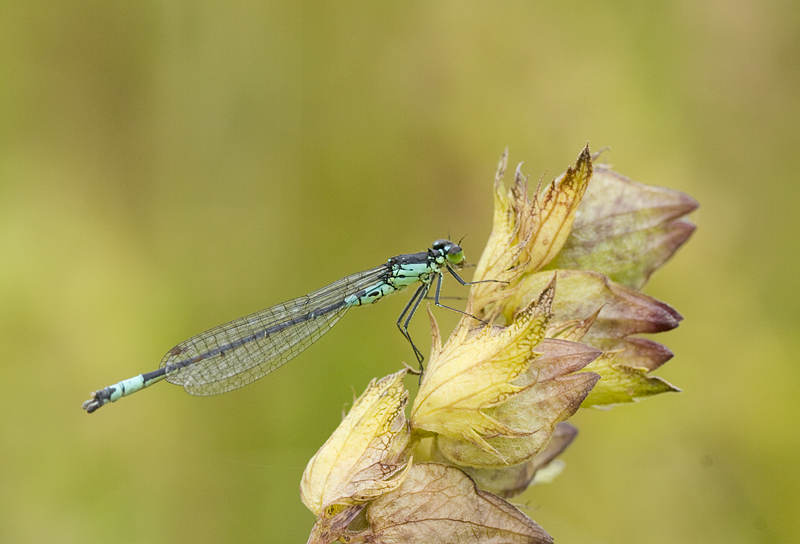
Variable Damselfly Coenagrion pulchellum
The scientific name of the Variable Damselfly is Coenagrion pulchellum. It is a species of insect in the family Coenagrionidae (narrow-winged damselflies), order Odonata. The name dates from 1825.
- Scientific name
- Coenagrion pulchellum (Vander Linden, 1825)
- Common name
- Variable Damselfly
- Genus
- Coenagrion
- Family
- Coenagrionidae (Narrow-winged Damselflies)
- Order
- Odonata
- Class
- Insecta
- Red List category
- LC Least Concern
- Recorded in
- 35 countries
- Name status
- accepted in the Catalogue of Life

Overview
Coenagrion pulchellum occurs throughout Europe and is scattered and uncommon in mainland Britain, while widespread and common in Ireland. The male has a distinctive wine-glass-shaped marking on the second abdominal segment, formed by a black U-shaped mark connected by a black line to the terminal black band.
Written 26 November 2026 from the sources listed below. Each statement was checked against the passage it cites; statements that could not be supported were removed.
Appearance
Male Variable Damselflies have a distinctive wine-glass-shaped marking on the second abdominal segment. The segment bears a black U-shaped mark connected by a black line to the terminal black band.[1][2]
Behaviour
Variable Damselflies usually remain close to vegetation.[3]
Habitat
Immature Variable Damselflies are often found in meadows adjacent to their usual habitat. They are also often found in uncut grassy areas.[4][5]
Similar species
The male's abdominal marking distinguishes the Variable Damselfly from the azure damselfly, which lacks the connecting line.[6]
Classification of the Variable Damselfly
| Kingdom | Animalia |
|---|---|
| Phylum | Arthropoda |
| Subphylum | Hexapoda |
| Class | Insecta (Insect) |
| Order | Odonata |
| Suborder | Zygoptera |
| Superfamily | Coenagrionoidea |
| Family | Coenagrionidae (Narrow-winged Damselflies) |
| Genus | Coenagrion (Eurasian Bluets) |
| Species | Coenagrion pulchellum (Vander Linden, 1825) |
Where the Variable Damselfly is found
Checklists and occurrence records place Coenagrion pulchellum in 35 countries. GBIF holds 152,003 georeferenced records of it.
Countries
- Aland Islands 90
- Albania 9
- Austria 685
- Belarus 170
- Belgium 976
- Bosnia and Herzegovina 8
- Bulgaria 182
- Croatia 46
- Czechia 10
- Denmark 2,139
- Estonia 1,213
- Finland 3,270
- France 10,311
- Germany 4,572
- Greece 107
- Hungary 398
- Ireland 968
- Italy 139
- Latvia 25
- Lithuania 1,710
- Luxembourg 5
- Montenegro 14
- North Macedonia 14
- Norway 1,638
- Poland 1,536
- Romania 176
- Russia 4,422
- Serbia 98
- Slovakia 7
- Slovenia 5
- Sweden 10,364
- Switzerland 10,639
- The Netherlands 80,717
- Ukraine 766
- United Kingdom 14,574
Regions and cities with the most records
- England, United Kingdom 12,400
- Krimpen aan den IJssel, The Netherlands 11,825
- Steenwijk, The Netherlands 11,758
- Friesland, The Netherlands 11,677
- Ridderkerk, The Netherlands 11,080
- Berkel en Rodenrijs, The Netherlands 10,729
- Overijssel, The Netherlands 10,721
- Bergschenhoek, The Netherlands 10,684
- Alblasserdam, The Netherlands 10,581
- Capelle aan den IJssel, The Netherlands 10,562
- Waddinxveen, The Netherlands 10,346
- Woerden, The Netherlands 10,342
- Meppel, The Netherlands 10,002
- Benthuizen, The Netherlands 9,964
- Zoetermeer, The Netherlands 9,528
- Boskoop, The Netherlands 9,416
- Gouda, The Netherlands 9,289
- Barendrecht, The Netherlands 9,145
- Rotterdam, The Netherlands 9,115
- Sliedrecht, The Netherlands 8,821
- Dordrecht, The Netherlands 8,675
- Hendrik-Ido-Ambacht, The Netherlands 8,589
- Maarssen, The Netherlands 8,479
- Papendrecht, The Netherlands 8,392
- Pijnacker, The Netherlands 8,287
- Zwijndrecht, The Netherlands 8,013
- Bodegraven, The Netherlands 7,914
- Alphen aan den Rijn, The Netherlands 7,730
- De Meern, The Netherlands 7,653
- Staphorst, The Netherlands 7,284
- Hilversum, The Netherlands 7,255
- Nootdorp, The Netherlands 7,081
- Heerenveen, The Netherlands 7,066
- Utrecht, The Netherlands 7,066
- IJsselstein, The Netherlands 6,849
- Bilthoven, The Netherlands 6,797
10 more countries have a few records outside this range
These countries hold a few records of Coenagrion pulchellum but lie outside the range the checklists give for it. Such records are often zoo or garden specimens, museum material or vagrants, so the species is not counted as occurring there.
A number beside a place is its count of GBIF occurrence records. A place without a number comes from a checklist alone. Records show where a species has been observed or collected, which can include escapes and vagrants.
Common names
English
- Variable Damselfly
- Variable Blue Damselfly
- Variable Bluet
- Variable Coenagrion
Names in 26 other languages
- Albanian
- Pilivesa e ndryshueshme
- Catalan
- Donzell de ratpenat
- Croatian
- Ljupka vodendjevojčica
- Czech
- šidélko širokoskvrnné, šidélko široskvrnné
- Danish
- Flagermus-vandnymfe
- Dutch
- Variabele waterjuffer
- Estonian
- Sarvikliidrik
- Finnish
- sirotytönkorento
- French
- Agrion exclamatif, Agrion exclamatif/Agrion joli, Agrion joli, agrion gracieux
- Galician
- Donceliña fermosa
- German
- Fledermaus-Azurjungfer, Fledermausazurjungfer
- Hungarian
- Gyakori légivadász
- Italian
- Azzurrina variabile
- Lithuanian
- Gražioji Strėliukė
- Norwegian Bokmål
- fagerblåvannymfe, variabel blåvannymfe
- Norwegian Nynorsk
- fagerblåvassnymfe
- Polish
- Łątka wczesna
- Russian
- Стрелка изящная, Стрелка красивенькая
- Scottish Gaelic
- cruinneag chaochlaideach, cruinneagan caochlaideach
- Serbian
- Peharasta plava devica, Пехараста плава девица
- Slovak
- šidielko veľkoškvrnné
- Slovenian
- Suhljati škratec
- Spanish
- Agrion variable, Azulado variable, Caballito del Diablo azul
- Swedish
- mörk lyrflickslända, mörk u-flickslända
- Ukrainian
- Стрілка чудова
- Welsh
- Coenagrion Amrywiol, Mursen Las Amrywiol, Mursennod Glas Amrywiol
Synonyms
10 other scientific names have been used for this species and are now treated as synonyms of Coenagrion pulchellum.
- Agrion bilineatum Schimer, 1913
- Agrion interruptum Charpentier, 1825
- Agrion nigrum Belyshev, 1964
- Agrion pulchella subsp. mediterraneum Schmidt, 1964
- Agrion pulchellum Vander Linden, 1825
- Agrion saisanicum Belyshev, 1964
- Agrion sibiricum Belyshev, 1964
- Coenagrion pulchellum interruptum (Vander Linden, 1823)
- Coenagrion pulchellum mediterraneum (Vander Linden, 1823)
- Coenagrion pulchellum saisanicum (Vander Linden, 1823)
Related species
-
 Azure DamselflyCoenagrion puella
-
 Southern DamselflyCoenagrion mercuriale
-
 Northern DamselflyCoenagrion hastulatum
- Dainty DamselflyCoenagrion scitulum
-
 Arctic BluetCoenagrion johanssoni
-
 Norfolk DamselflyCoenagrion armatum
-
 Irish DamselflyCoenagrion lunulatum
-
 Ornate BluetCoenagrion ornatum
Compare
Questions and answers
What is the scientific name of the Variable Damselfly?
The scientific name of the Variable Damselfly is Coenagrion pulchellum. Written with its author, the full name is Coenagrion pulchellum (Vander Linden, 1825).
Which family does the Variable Damselfly belong to?
Coenagrion pulchellum belongs to the family Coenagrionidae, in the order Odonata and the class Insecta.
Where is the Variable Damselfly found?
Checklists and occurrence records place Coenagrion pulchellum in 35 countries, including The Netherlands, United Kingdom, Switzerland, Sweden, France and Germany.
What is the conservation status of the Variable Damselfly?
The IUCN Red List category recorded for Coenagrion pulchellum is Least Concern (LC).
What other names does the Variable Damselfly have?
Coenagrion pulchellum is also known in English as Variable Blue Damselfly, Variable Bluet and Variable Coenagrion.
Sources
Passages the profile rests on
- Male variable damselflies have a distinctive wine-glass-shaped marking on the second abdominal segment. Source passage: “The male variable damselfly has a distinctive "wine glass" marking on the second segment of the abdomen.” — English Wikipedia
- The male's second abdominal segment bears a black U-shaped mark connected by a black line to the terminal black band. Source passage: “This is a black U-shaped mark with a black line joining the segment's narrow terminal black band.” — English Wikipedia
- Variable damselflies usually remain close to vegetation. Source passage: “Its behaviour is much like that of the azure damselfly; it usually stays close to vegetation.” — English Wikipedia
- Immature variable damselflies are often found in meadows adjacent to their usual habitat. Source passage: “Immatures are often found in adjacent meadows or uncut grassy areas.” — English Wikipedia
- Immature variable damselflies are often found in uncut grassy areas. Source passage: “Immatures are often found in adjacent meadows or uncut grassy areas.” — English Wikipedia
- The male's abdominal marking distinguishes the variable damselfly from the azure damselfly because the latter lacks the connecting line. Source passage: “This distinguishes it from the azure damselfly which has the U-shape but no line connecting it to the terminal band.” — English Wikipedia
Data
- Catalogue of Life, 2026-10-16 XR cc by
- Global Biodiversity Information Facility CC BY 4.0
- Wikidata CC0
- GeoNames CC BY 4.0
- Wikimedia Commons per image; credit shown with each image
- Within the Catalogue of Life, this name comes from The World Odonata List cc by
This species in other databases
Page built on 29 November 2026. See how the catalog is made and all sources and licences.
Cite this page
ScientificNames.org. (2026). Coenagrion pulchellum (Variable Damselfly). Retrieved November 29, 2026, from https://scientificnames.org/species/coenagrion-pulchellum
“Coenagrion pulchellum (Variable Damselfly).” ScientificNames.org, 2026, scientificnames.org/species/coenagrion-pulchellum. Accessed 29 Nov. 2026.
ScientificNames.org. “Coenagrion pulchellum (Variable Damselfly).” Accessed November 29, 2026. https://scientificnames.org/species/coenagrion-pulchellum.
@misc{scientificnames_coenagrion_pulchellum_variable_damselfly,
  author = {{ScientificNames.org}},
  title = {Coenagrion pulchellum (Variable Damselfly)},
  year = {2026},
  url = {https://scientificnames.org/species/coenagrion-pulchellum},
  note = {Accessed 2026-11-29}
}